On Record – Sarah Leonard, Xue Wei, BBCSO & BBCSSO / Martyn Brabbins – Naresh Sohal: Lila & Violin Concerto (Heritage Records)

Naresh Sohal
Lila (1996)
Violin Concerto (1986)

Sarah Leonard (soprano), BBC Symphony Orchestra / Martyn Brabbins (Lila)
Xue Wei (violin), BBC Scottish Symphony Orchestra / Martyn Brabbins (Violin Concerto)

Heritage HTGCD133 78’40”
Remastering Paul Arden-Taylor

Live performances at BBC Broadcasting House, Glasgow on 24th October 1992 (Violin Concerto); Royal Festival Hall, London on 13th October 1996 (Lila)

Reviewed by Richard Whitehouse

What’s the story?

Heritage follows up its earlier release of Naresh Sohal with this coupling of major orchestral works, both of them heard in their premiere performances.

What’s the music like?

By the 1990s, Sohal was a well-respected if not regularly played figure. Both these works demonstrate his compositional versatility while being wholly characteristic of his maturity. They were also written before and after his move from Edinburgh to London; having spent more than a decade in the Scottish capital, during which period he embarked on numerous multi-media pieces, he subsequently found himself drawn anew to the Punjabi and Bengali writers whose work frequently informed his compositions over the ensuing quarter-century.

Written a decade apart, these works could hardly be more different in their nominal concerns. At just under half an hour, the Violin Concerto may appear to be firmly within the lineage of such pieces from the Classical and early Romantic eras yet its three movements are hardly, if at all, beholden to precedent. That each is faster as to its underlying pulse than the one before, what one might loosely call an ‘Andante-Allegretto-Allegro’ progression, is less notable than the transformation of ideas and texture from one to the other; resulting in an overall sequence as convinces in its formal discipline and beguiles in its expressive immediacy. Its inhabiting a neo-Romantic world (with significant precursors by David Blake and H. K. Gruber) does not detract from the individuality and sheer attractiveness of Sohal’s contribution to this medium.

By contrast Lila, it title a Sanskrit term for the play of Nature, is the representation in music of the seven stages of development, in yogic philosophy, from the earthbound to the cosmic. That each of these can be linked to a specific colour, sound and elemental force might imply a multi-media presentation, and one as integrated music with dance and lighting was initially planned, but the work succeeds admirably on its own terms as it traverses seven continuous while increasingly shorter sections with its transformation of salient motifs never less than audible. There is no ultimate climax, yet the passing from ‘Consciousness’ to ‘Yoga’ could   be heard as a culmination; after which – this final section is graced with a soaring vocalise, here the late Sarah Leonard in what was a no doubt unintentional but appropriate memorial.

Does it all work?

Yes, once one has grasped the basis of Sohal’s compositional thinking via the essence of what   he was seeking to convey. It helps that both these performances are fully attuned to his idiom – Xue Wei evincing no indecision or uncertainty in the Violin Concerto, and Martyn Brabbins (who replaced an indisposed Andrew Davis for the first rendition of Lila) securing committed playing from the BBC Symphony and the BBC Scottish Symphony orchestras. Any future performances could hardly hope for more persuasive guides when approaching these pieces.

Is it recommended?

Very much so. Paul Arden-Taylor has once again done a fine job in remastering the original broadcasts while Suddhaseel Sen’s annotations, with a biographical note by Janet Swinney, provide all the relevant background. Further releases from this source will hopefully follow.

Listen / Buy

You can explore purchase options at the Heritage Records website

For more on the artists featured, click on the names to read more about Sarah Leonard, Xue Wei, the BBC Symphony Orchestra, BBC Scottish Symphony Orchestra and conductor Martyn Brabbins, and composer Naresh Sohal

Published post no.2,630 – Monday 18 August 2025
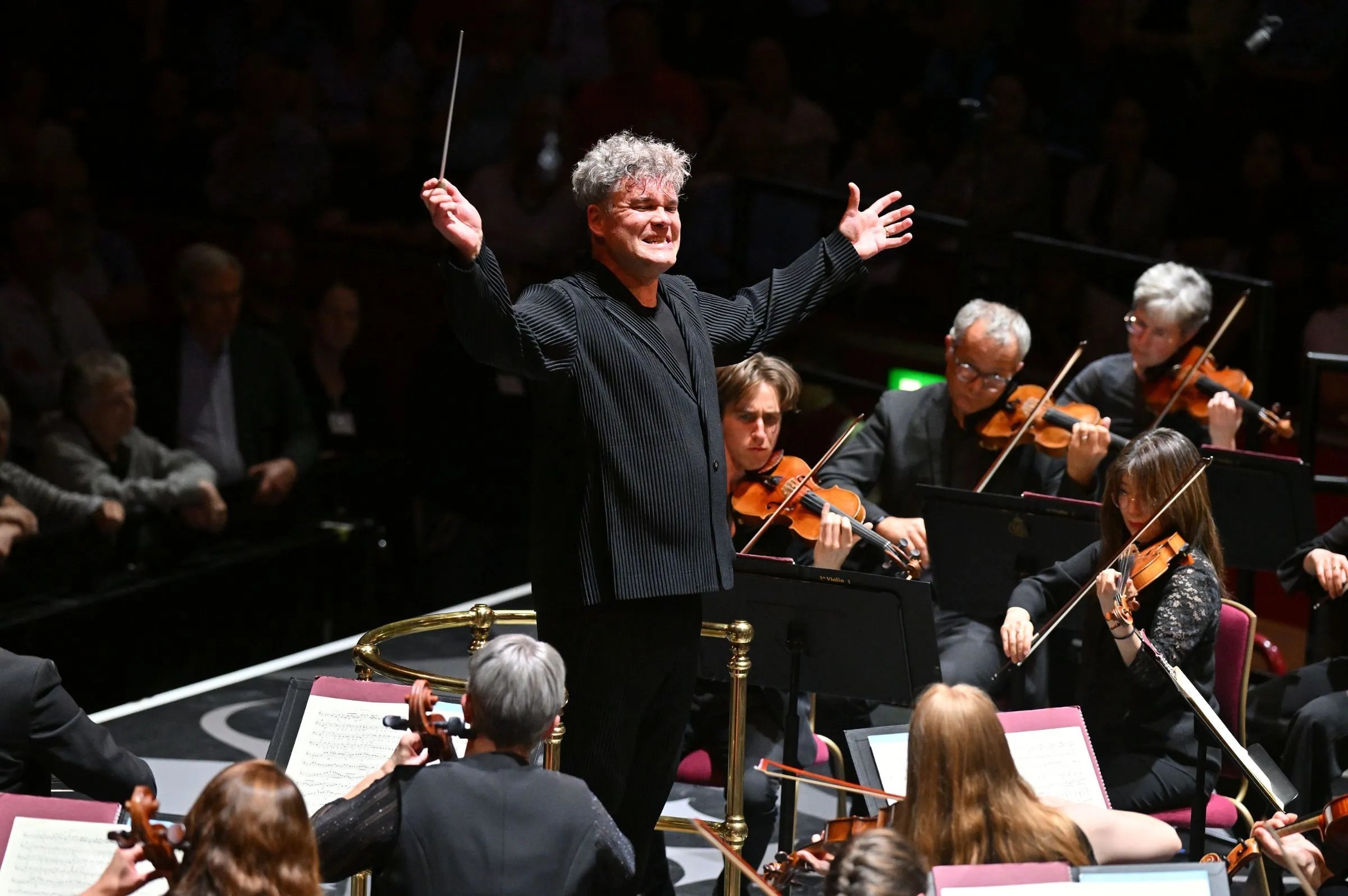
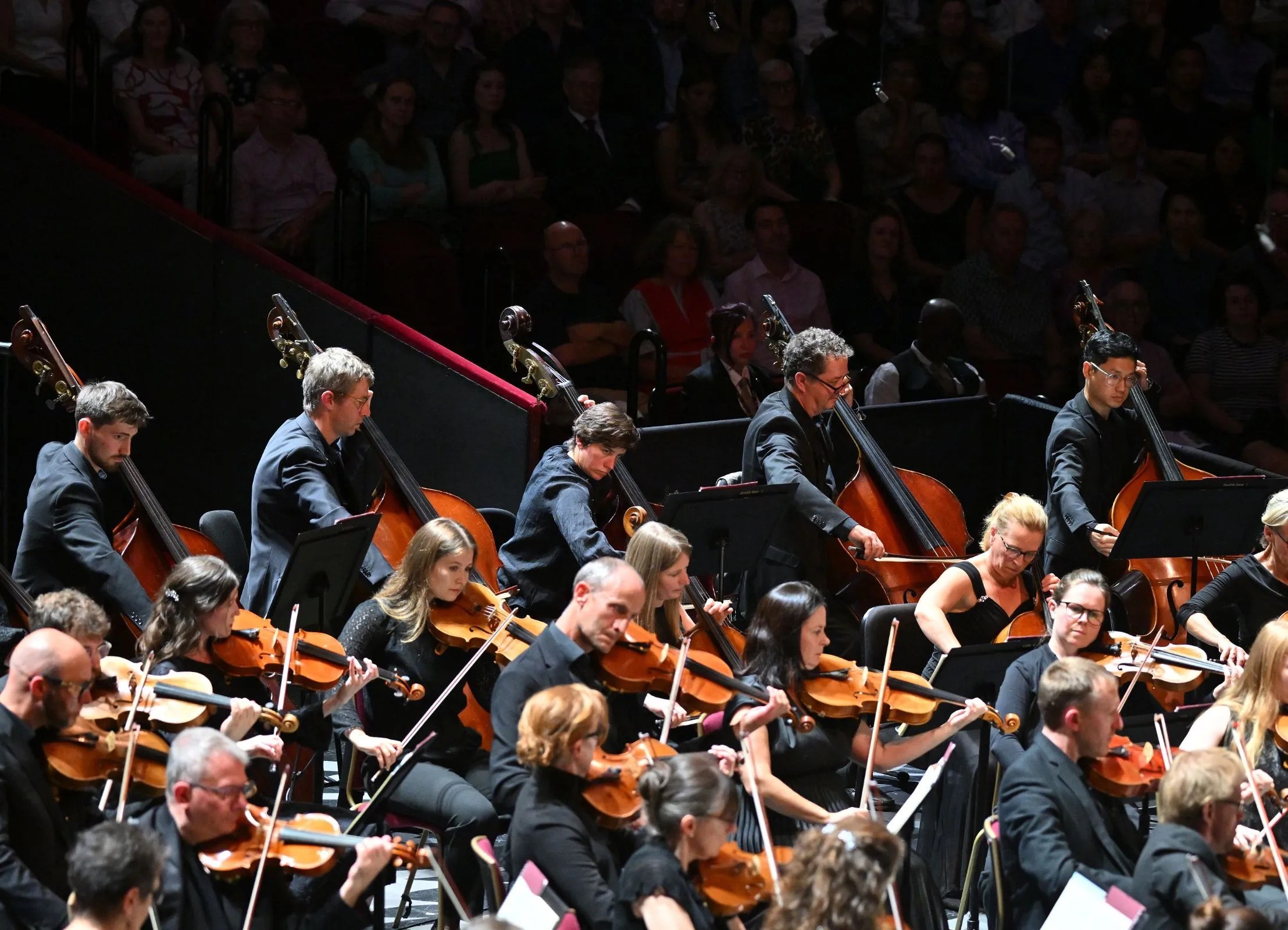
In concert – BBC Scottish SO / Ryan Wigglesworth @ BBC Proms: Birtwistle Earth Dances & Beethoven ‘Eroica’ Symphony

BBC Scottish Symphony Orchestra / Ryan Wigglesworth (above)

Birtwistle Earth Dances (1985-6)
Beethoven Symphony no.3 in E flat major Op.55 ‘Eroica’ (1802-4)

Royal Albert Hall, London
Monday 28 July 2025

Reviewed by Richard Whitehouse Photos (c) BBC / Mark Allan

The emphasis on Ryan Wigglesworth’s activities may have changed during recent years, but this is certainly no hardship when his conducting of so broad a repertoire is as convincing as in his brace of concerts from this year’s Proms with the BBC Scottish Symphony Orchestra.

Performed three times at the Proms during its first decade of existence, Sir Harrison Birtwistle’s Earth Dances tonight reappeared after 31 years. Much may have changed over that time (not least the passing of the composer), though this piece remains a sure highpoint of his output as of British music from the period. Premiered by the late Peter Eötvös before being taken up by Christoph von Dohnányi, Peter Boulez and Simon Rattle, it has now found an ideal advocate in Wigglesworth who surely gets to the heart of this particular matter like no-one before him.

Essentially this is about finding a balance between the facets of its title – those often densely arrayed yet always sharply differentiated strata of the orchestral texture, allied to a rhythmic fluidity which keeps the music moving forward even during its most intricate passages. Not an easy task such as previous exponents have conveyed with varying degrees of success, but Wigglesworth had the work’s measure from the beginning. Rather than a set of more or less complex episodes that follow on sequentially, what came across was a series of interrelated layers fused in an audible process of continual variation – one, moreover, in constant motion to a point at which it did not so much end as disperse into silence. Almost four decades after its premiere, Earth Dances has now emerged as that multi-faceted masterpiece it always was.

It likely took at least as long for the Eroica to be rendered, rather than merely recognized, as such – which could be a factor with their being juxtaposed in the same concert. Whatever the case, it made for judicious programming with Wigglesworth and the BBCSSO rising to their comparable challenges. First performed at these concerts 129 years ago then subsequently in almost every season, Beethoven’s Third Symphony is a testing assignment conceptually and interpretatively – as was not shirked by this involving though often understated performance.

An understatement evident in the opening Allegro, with its subtly modified exposition repeat, the more involving for rendering this movement as an unbroken while cumulative continuity through to an affirmative if not wantonly triumphal coda. Even finer was the Marcia funèbre, its steady undertow flexible enough to accommodate the lilting counter-theme as well as the intensifying fugato at its centre on route to a conclusion the more affecting for its emotional deftness. Nor was this latter quality absent from a Scherzo whose shimmering outer sections found ideal contrast in the trio, its incisive part-writing for three horns buoyantly articulated. The Finale was all of a piece with what went before, its variations on the ‘Prometheus’ theme enticingly characterized but with a keen underlying momentum toward the joyous apotheosis. While no single account of so trail-blazing a work could possibly convey all the answers, this was impressive in its formal focus and expressive balance as saw the symphony whole. Make no mistake, Ryan Wigglesworth now numbers among the finest conductors of his generation.

You can listen back to this Prom concert on BBC Sounds until Sunday 12 October – or listen to recommended recordings of the two works from the Cleveland Orchestra on Tidal here

Click on the artist names to read more about the BBC Scottish Symphony Orchestra and their chief conductor Ryan Wigglesworth. Click also for more on the BBC Proms

Published post no.2,613 – Friday 1 August 2025

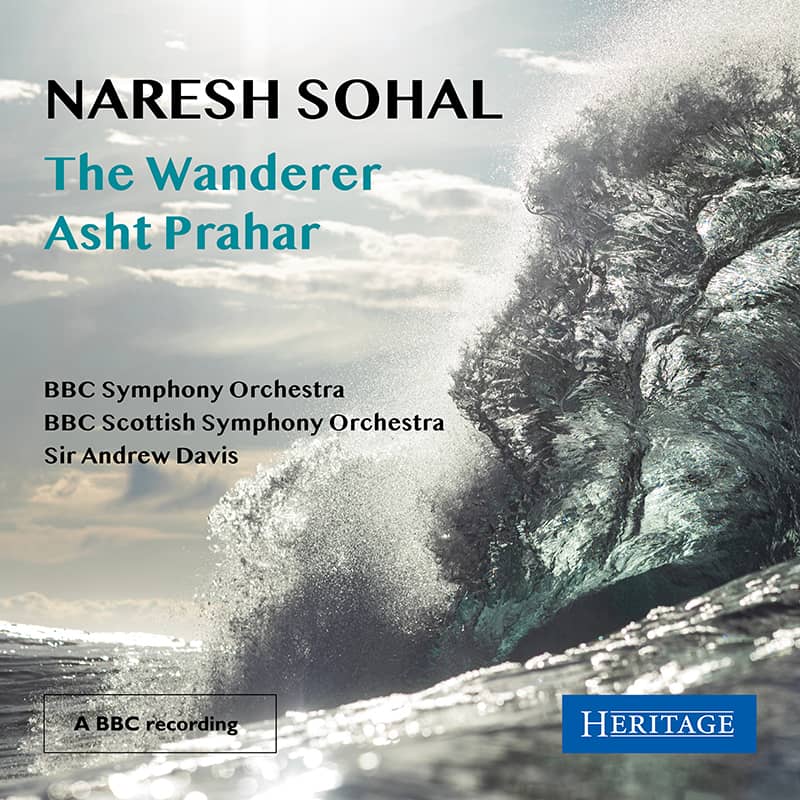
On Record – BBC SSO & BBC SO / Sir Andrew Davis – Naresh Sohal: The Wanderer & Asht Prahar (Heritage)

Naresh Sohal
Asht Pradar (1965)
The Wanderer (1982)

Jane Manning (soprano), BBC Scottish Symphony Orchestra (Asht Pradar), David Wilson-Johnson (baritone), BBC Symphony Chorus and Orchestra (The Wanderer) / Sir Andrew Davis

Heritage HTGCD135 [77’36”] English text included
Remastering Engineer Paul Arden-Taylor

Broadcast performance from BBC Studios, Glasgow on 6 January 1973 (Asht Pradar); live performance from Royal Albert Hall, London on 23 August 1982 (The Wanderer)

Reviewed by Richard Whitehouse

What’s the story?

Heritage issues what will evidently be an ongoing series of archival releases devoted to the music of Naresh Sohal, taken from BBC sources and featuring performers who championed his work over a career whose achievement is not reflected in the availability of recordings.

What’s the music like?

Although he came belatedly to the UK, Sohal (1939-2018) rapidly made up for any lost time when arriving in London in 1962 (further biographical detail can be found in the booklet note for this release and on the composer’s website). Within three years, he had produced his first major (and latterly his first acknowledged) work. Asht Prahar then had to wait until 1970 for its premiere (at the Royal Festival Hall conducted by Norman Del Mar), but it attracted much favourable attention and led to another hearing three years on – the performance featured here.

Taking its cue from the Indian sub-division of the day into eight temporal units (four each for day and night), Asht Prahar unfolds its eight sections as an unbroken continuity. The sizable forces are, for the most part, used sparingly yet resourcefully; as too the deployment of such devices as quarter-tones, along with influences of Ravel and Stravinsky, in music that makes a virtue of its pivoting between East and West. Cyclical if not necessarily cumulative, its final and longest ‘prahar’ brings wordless soprano and orchestra into tangible and haunting accord.

By the time that The Wanderer received its premiere, Sohal had a number of major works to his credit and rationalized his musical idiom accordingly. Setting an anonymous Anglo-Saxon poem in which the male protagonist speaks movingly and often despairingly of his isolation – both physical and spiritual – after the death of his lord, the work divides into two large parts that expand on the narrative’s emotional import. Such ‘‘existential bleakness’’ is intensified by omission of the poem’s last lines with their invoking a specifically Christian consolation. Despite its more than 50-minute duration, there is nothing discursive or unfocussed about The Wanderer’s content. Much of its text is understandably allotted to the baritone, whose austere character is complemented by darkly rhetorical choral passages while offset by an orchestral component with much soloistic writing (notably for flute) in a texture the more involving for its restraint and its strategic use of colour to define specific incidents or emotional responses. Nor is this an opera-manqué, the work succeeding admirably on its inherently abstract terms.

Does it all work?

It does, allowing for the fact that Sohal is not seeking any overt fusion between Occident and Orient, but rather attempting to forge a personal idiom influenced by both while beholden to neither. Both these performances bear out his convictions, Jane Manning adding her ethereal presence to Asht Prahar and David Wilson-Johnson bringing evident compassion to his more substantial role in The Wanderer. Both works benefit from the insightful presence of the late Sir Andrew Davis, whom one regrets never had an opportunity to record them commercially.

Is it recommended?

It is. The sound of these broadcasts has come up decently in remastering, lacking only the last degree of clarity or definition, and Suddhaseel Sen contributes informative annotations. Those looking for a way into Sohal’s distinctive and alluring sound-world need no further incentive.

Listen & Buy

For purchase options, you can visit the Heritage Records website

Published post no.2,451 – Thursday 20 February 2025

In appreciation – Laura Samuel

by Ben Hogwood

At the end of November we heard the incredibly sad news that violinist Laura Samuel had died at the age of 48. Laura was a prodigiously talented musician, and was co-founder of the highly regarded Belcea Quartet, a member of the Nash Ensemble and leader of the BBC Scottish Symphony Orchestra from 2012. There is a statement from the orchestra themselves, and an obituary on The Violin Channel website

I was fortunate to meet Laura on a couple of occasions and was struck by how friendly and approachable she was, even at the end of a gruelling three-hour rehearsal. Watching her with the orchestra you could see just how committed and passionate she was in her music making, the mutual respect she experienced with her fellow musicians, and above all the sheer enjoyment of making music.

By way of gratitude I have put this playlist together of recordings on which Laura appears, including her contributions as a session musician on albums by The Divine Comedy and Peter Gabriel:

Published post no.2,389 – Tuesday 10 December 2024

Arcana at the Proms – Prom 35: BBC Scottish Symphony Orchestra / Ilan Volkov – Ellington, Braxton and Mary Lou Williams

Ellington orch. Gould Solitude (1934), Mood Indigo (1930), Sophisticated Lady (1932), Caravan (1936)
Mary Lou Williams Zodiac Suite (1944-6) [UK premiere]
Braxton Composition no.27 (+ nos. 46, 59, 63, 146, 147, 151 & Language Music) (1972-91) [Proms premiere]

Mikaela Bennett (soprano), Aaron Diehl (piano), James Fei (saxophone/conductor), Gregory Hutchinson (drum kit), Ingrid Laubrock (saxophones), Brandon Lee (trumpet), Chris Lewis (clarinet/saxophone), David Wong (double bass), Katherine Young (bassoon/conductor), BBC Scottish Symphony Orchestra / Ilan Volkov

Royal Albert Hall, London
Thursday 15 August 2024

reviewed by Richard Whitehouse Photos (c) Sisi Burn

Never a conductor to take the path of least resistance, Ilan Volkov centred his latest Prom with the BBC Scottish Symphony Orchestra (whose Creative Partner he remains) around jazz – not that there was anything orthodox about the repertoire or the follow-through in what was heard.

The four Duke Ellington numbers heard tonight became standards in the Depression era, their pioneering spirit stylishly offset in orchestrations by Morton Gould (the first three on 1957’s Blues in the Night and the fourth on 1956’s Jungle Drums). Solitude ranks among Ellington’s most affecting tunes, while his sultry Mood Indigo proved an inspired co-write with Barney Bigard. The present arrangement fully enhanced the teasing elegance of Sophisticated Lady, before the expressive impetus of the Juan Tizol co-write Caravan left its evocative imprint.

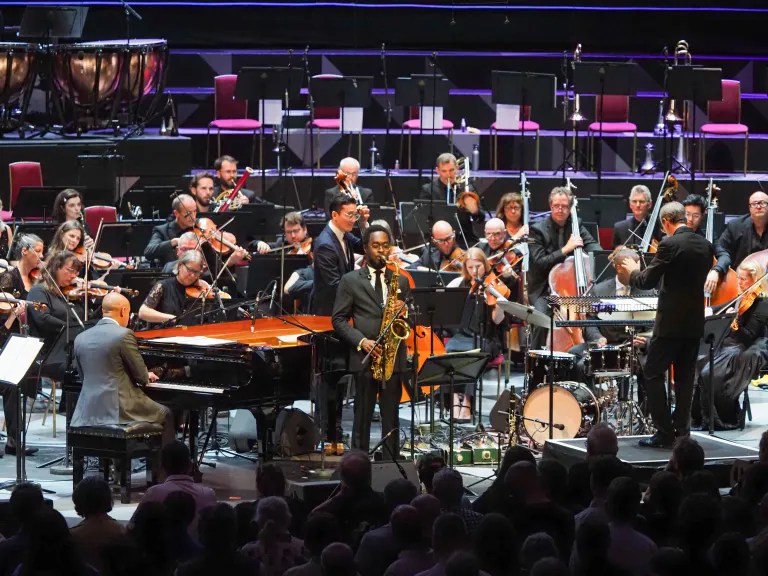
Pianist and arranger for artists from Ellington to Cecil Taylor, Mary Lou Williams’ music only posthumously came to the fore. She wrote nothing more ambitious than Zodiac Suite – a series of 12 tributes to musicians born under various star signs, as went through several incarnations at the end of the Second World War and remains a trailblazer for symphonic jazz. As realized here, each item left room for contributions by the assembled jazz or orchestral musicians: thus the incisiveness of Brandon Lee’s trumpet or mellifluousness of Chris Lewis’ clarinet and alto sax, besides stealthy interplay by the Aaron Diehn Trio (above) or a soulful violin solo by guest-leader Kate Suthers. The sequence concluded with Pisces and an agile vocal (lyrics not printed) by Mikaela Bennett – its manner (surprisingly?) redolent of mid-20th century American art-song.

From here to Anthony Braxton proved a fair conceptual leap, but a meaningful one within this context. One, moreover, for which Volkov has prepared painstakingly across almost a decade – working with several of Braxton’s longer-term collaborators (notably George Lewis), while performing several Braxton compositions duly rendered as the superimposed totality he openly encourages. What resulted was Composition No. 27 as a framework for this performance, into which elements from six later ‘Compositions’ were integrated – this whole entity underpinned by recourse to Language Music, collating 12 musical parameters in what is the codification of Braxton’s practice over six decades. The creative aspect arises at a point when the fullest extent of compositional systematization links with the furthest extent of improvisational spontaneity.

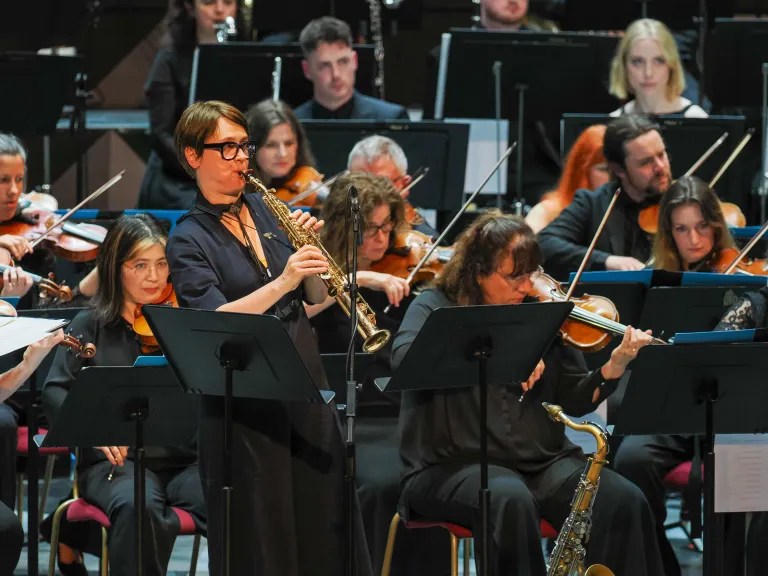
The interaction between jazz and orchestral musicians was intricate and unpredictable, so that saxophonist James Fel and bassoonist Katherine Young – but not the always inventive Ingrid Laubrock (above) – were often conductors next to Volkov in determining the overall trajectory. There were occasions when continuity felt tentative or uncertain, yet these were outweighed by the translucent allure in much of the ensemble playing as well as the resolve with which all those participating headed toward a culmination the more definite for its seeming inconclusiveness. Not that this performance commended itself to all those present, with several dozen exiting the auditorium as though insects under siege. Those who stayed were rewarded with music-making such as encouraged an active participation all too rare in present-day concertgoing.

For more on this year’s festival, visit the BBC Proms website. For further information, click on the artist names for more on Ilan Volkov and the BBC Scottish Symphony Orchestra, and on the composer names for information on Duke Ellington, Mary Lou Williams and Anthony Braxton.

Published post no.2,275 – Monday 16 August 2024