Arcana at the Proms – Prom 19: Jess Dandy, Senja Rummukainen, BBC SO & Sakari Oramo – Holst ‘Cloud Messenger’, Harvey & Elgar

Harvey Tranquil Abiding (1998) [Proms Premiere]
Elgar Cello Concerto in E minor, Op. 85 (1918-19)
Holst The Cloud Messenger, H111 (1909-10, rev. 1912) [Proms Premiere]

Jess Dandy (contralto), Senja Rummukainen (cello), BBC Symphony Chorus, BBC Symphony Orchestra / Sakari Oramo

Royal Albert Hall, London
Saturday 3 August 2024

reviewed by Richard Whitehouse Photos (c) Chris Christoudoulou

Now approaching his 12th season as chief conductor of the BBC Symphony Orchestra, Sakari Oramo tonight gave his first Prom of the season with this typically well-balanced programme of British music framing unfamiliar pieces past or (relative) present with a classic of its genre.

First came a welcome revival for Tranquil Abiding – doubtless one of Jonathan Harvey’s most immediately appealing works and one where the rhythm of ‘breathing’ central to so much of his later output is afforded lucid expression. The degree to which its melodic content emerges out of then returns into the surrounding texture was duly conveyed by Oramo, who ensured a real sense of expectation as this music took on an almost tangible impetus towards its climax. A pity that some restless and inattentive listeners robbed the final stage of its ‘ultimate calm’.

Long before it had the eminence it now enjoys, Elgar’s Cello Concerto was a regular Proms item through advocacy from Beatrice Harrison, Anthony Pini and, latterly, Jacqueline du Pré. Senja Rummukainen (above) thus joined a distinguished roster of soloists and, in the first movement at least, seemed a little inhibited in this context. Her arresting lead-in to the scherzo brought playing of greater involvement, both here and in an Adagio whose autumnal eloquence never risked sentimentality. The relatively lengthy finale was securely rendered, its themes incisive then genial, and if the development culminated a little portentously, the reprise was tellingly subdued before a moving apotheosis and curtly inevitable coda. Rummukainen can be heard again in London in the Dvořák concerto, with the BBC Concert Orchestra, this October 4th.

In the 150th anniversary of his birth, and the 90th anniversary of his death, a major revival by Gustav Holst was almost mandatory. Setting his translation from the Sanskrit of a poem by Kālidāsa, The Cloud Messenger never quite recovered from its evidently disastrous premiere such that revivals have been occasional. At almost 45 minutes, it is a demonstrable statement of intent whose expansive choral gestures are assured but almost anachronistic given Holst’s chamber opera Sāvitri redefined his conceptual approach and musical idiom barely a year before. Yet the present work amply foreshadows much of what was achieved over the next two decades, notably a freely evolving melisma mostly unimpeded by rhythmic precedent and a harmonic subtlety such as only needed greater refinement in its handling to realize its fullest potential.

That much of this latter aspect was already in place is clear from those intimate passages for semi-chorus to the fore during its later stages, while the third of its five continuous section brought a confiding soliloquy that Jess Dandy (above) – contralto in the truest sense – realized with distinction. A pity she was not heard again, but the BBC Symphony Chorus was not found wanting beforehand or in that ethereal leave-taking with which the work evanesces, ‘Venus’-like, to its close. Whatever the stylistic inconsistencies, the best of it is Holstian to its core.

Now it is available in an expert reduction for chamber orchestra by Joseph Fort, The Cloud Messenger should attract more frequent hearings, but the Royal Albert Hall proved a fitting venue for this expansive original while Oramo’s perceptive performance did not disappoint.

For more on this year’s festival, visit the BBC Proms website – and for more on the artists involved, click on the names to read more about Jess Dandy, Senja Rummukainen, the BBC Symphony Chorus, BBC Symphony Orchestra and chief conductor Sakari Oramo

Published post no.2,261 – Monday 5 August 2024

BBC Proms 2023 – Jon Hopkins with the BBC Symphony Orchestra and Jules Buckley

Prom 58

Hopkins
ATHOS (arr. Jules Buckley) (BBC Commission, world premiere)
Feel First Life (arr. Peter Riley & Leo Abrahams)
The Wider Sun (arr. Sam Gale)
Singularity (arr. Simon Dobson)
Music for Psychedelic Therapy – excerpt (arr. Peter Riley)
Form by Firelight (arr. Peter Riley)
Luna Moth (arr. Sam Gale)
Collider (arr. Simon Dobson)
Abandon Window (arr. Tom Trapp)
Recovery

Jon Hopkins (piano, programming), Leo Abrahams (guitar), BBC Singers, BBC Symphony Chorus (chorus master David Young), BBC Symphony Orchestra / Jules Buckley

Royal Albert Hall, London
Tuesday 29 August 2023

by Ben Hogwood photos by Mark Allan / BBC

Electronic and orchestral music are more closely related than you might think, with Jon Hopkins a classic case in point. For 15 years, the pianist and producer has been carefully sculpting his music either as a contributor for other artists (King Creosote, Coldplay and Brian Eno to name just three) or making his own, weather-beaten albums. Starting with Opalescent and Insides, these have developed into immersive meditations (Singularity and the most recent long player Music for Psychedelic Therapy) by way of more full-bodied rave music (2013’s Immunity). How, then, does this music hold up in a packed and expectant Royal Albert Hall?

Extremely well as it turns out. In order to achieve what he described beforehand as ‘a meditation for 5,000 people’, Hopkins has to temporarily turn his back on beat-driven, post-rave landmarks such as Collider or Form By Firelight. When such material appears, its percussive impact is modified so that the main job is done by the timeless, meditative chorale echoing around the hall.

Hopkins’ music is repetitive, but as with the best exponents of minimalism – Steve Reich, Philip Glass and John Adams, for instance – the material under repetition rewards the investment made. The mind is eased, enjoying the upfront melodies but also taking up the option of picking out new threads beneath the surface, like examining a tartan pattern under a magnifying glass.

The tartan analogy is purposeful, for Hopkins’ earlier music has a distinctive Celtic edge furthered by his work with King Creosote. The Wider Sun, from 2009 album Insides, has an authentic left of centre tuning, is slow but packs emotional heft, beautifully arranged by Sam Gale and masterfully weighted by Jules Buckley and the BBC Symphony Orchestra strings.

Before that we hear a new piece, the 25-minute ATHOS demonstrating Hopkins’ control of larger structures. This is a natural direction for his music to be taking after Music for Psychedelic Therapy, for it is effectively an album ‘A’ side of several interwoven tracks. The profile and material of ATHOS sits closely to composers such as Arvo Pärt, and in particular his Credo, but Hopkins has up his sleeve a number of heart-shifting modulations. Accentuated by the Royal Albert Hall organ, these are once heard, never forgotten moments.

So, too, are the choral passages, thanks to pinpoint interpretations from the BBC Singers and BBC Symphony Chorus, whose lines float effortlessly above the orchestral forces. Their vocal control is masterful and effortless, ensuring the sustained notes keep their emotional impact without wavering. Lesser singers would have tailed off long before these ones even think of blinking!

The sequence of music, running for approximately 75 minutes, is well chosen. Only on occasion does the source material become oversimplified, and as it turns out these moments serve as natural pauses for breath in the musical tapestry.

Guitarist Leo Abrahams, appearing for the last two numbers, makes a critical contribution (above). A good friend and established collaborator with Hopkins and Eno, he brings a sharper timbre to the shredded distortion of Recovery, which is – as throughout – complemented by imaginative and sympathetic lighting.

This was a multisensory Prom, containing a different sort of symphony to which the Royal Albert Hall is normally accustomed. Hopkins has proved his credentials in mastering larger structures, and his development in this field will be worth watching for sure. For now, the afterglow remains.

For more on the 2023 BBC Proms, visit the festival’s website at the BBC. For more on the artists, click here to read about Jon Hopkins, Leo Abrahams, Jules Buckley and the BBC Symphony Orchestra

BBC Proms #44 – Soloists, BBC Symphony Chorus & Orchestra / Sakari Oramo: Ethel Smyth ‘Mass’ & Debussy ‘Nocturnes’

Prom 44 – Nardus Williams (soprano), Bethan Langford (mezzo-soprano), Robert Murray (tenor), Božidar Smiljanić (bass), BBC Symphony Chorus, BBC Symphony Orchestra / Sakari Oramo

Debussy Nocturnes (1897-9)
Smyth Mass in D (1891, rev. 1924) [Proms premiere]

Royal Albert Hall, London

Saturday 20 August 2022

Reviewed by Richard Whitehouse Photos (c) Chris Christodoulou

His third Prom this season found Sakari Oramo conducting the BBC Symphony Orchestra in an unlikely yet, in the event, thought provoking double-bill of pieces composed at either end of the same decade and which duly played to the strengths of all those who were taking part.

The music of Ethel Smyth has been a prominent feature of this season and while her Mass in D comes too early in her career to be considered ‘mature’, it does evince many of those traits as defined the operas that followed. Written during a brief flush of adherence to Anglicanism, this is demonstrably a concert rather than liturgical setting (which makes its apparent status as the first Mass heard publicly in England for almost 300 years the more ironic) and, moreover, one of a ‘symphonic’ rather than ‘solemn’ conception despite the audible debt to Beethoven.

Smyth reinforces this aspect by placing the Gloria at the close – thereby making it the finale of a sequence in which the Kyrie, building gradually to a baleful climax before returning to its initial sombreness, becomes an extended introduction to the Credo whose numerous sub-sections facilitate a sonata-form design of no mean formal cohesion and expressive breadth. For their part, the Sanctus, Benedictus and Agnus Dei function as extended slow movement whose (for the most part) emotional restraint enables the soloists to come to the fore – after which, the Gloria takes its place as a finale not least in terms of drawing on previous themes and motifs through to the forceful though never merely bathetic culmination. That Smythe did not essay a symphony given her evident structural command seems the more surprising.

Tonight’s performance was no less assured than that which Oramo gave at the Barbican (and subsequently recorded, albeit with different soloists) three seasons ago. The soloists made the most of their contributions – Nardus Williams bringing a plaintiveness and elegance that was ideally complemented with Bethan Langford’s warmth and understated fervency, and though Robert Murray’s ardency showed signs of strain, he was no less ‘inside’ his part than Božidar Smiljanić, whose solo was more affecting for its burnished eloquence. The BBC Symphony Chorus responded as one to the full-on contrapuntal writing of those main movements, while Richard Pearce ensured the (too?) extensive organ part did not muddy the orchestral textures. Oramo directed with clear enjoyment a work that, for the most part, justified its 62 minutes.

In the first half, Oramo presided over a searching account of Debussy’s Nocturnes – its three movements still sometimes encountered separately but far more effective heard as a complete entity. Not its least impressive aspect was the ease with which these followed on from each other with a cumulative inevitability – the fugitive shading of Nuages (melting cor anglais playing by Helen Vigurs) leading to the half-lit activity of Fêtes, with its darting gestures and a central march-past of vivid understatement, then on to the sensuous allure of Sirènes.

As enticing as the women’s voices of the BBCSC sounded in this closing movement, it was the fervency with which Oramo infused its recalcitrant content such as made it the natural culmination of the sequence – the final bars dying away with a tangible sense of fulfillment.

Click on the artist names for more information on Nardus Williams, Bethan Langford, Robert Murray, Božidar Smiljanić and Sakari Oramo and for more information on the BBC Symphony Orchestra head to their website. For more on composer Dame Ethel Smyth, click here

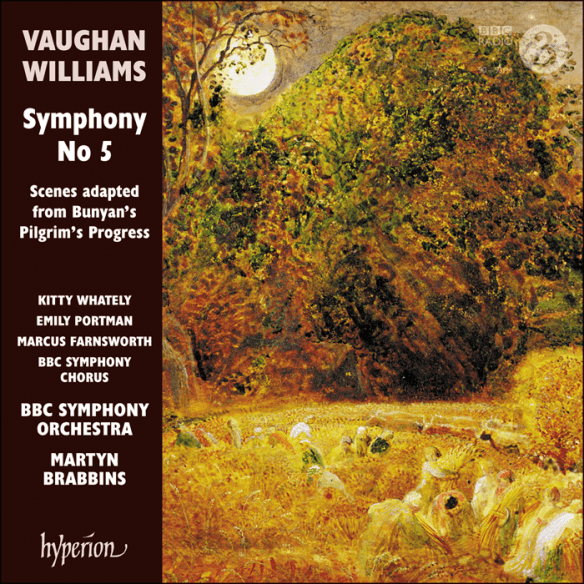
On record: BBC Symphony Orchestra / Martyn Brabbins – Vaughan Williams: Symphony no.5 & Scenes adapted from Bunyan’s Pilgrim’s Progress

*Emily Portman (singer); *Kitty Whatley (mezzo-soprano); *Marcus Farnsworth (baritone), *BBC Singers; *BBC Symphony Chorus, BBC Symphony Orchestra / Martyn Brabbins

Vaughan Williams
Symphony no.5 in D major (1938-43)
Scenes adapted from Bunyan’s Pilgrim’s Progress (1906)*

Hyperion CDA68325 [66’59”]
English text included
Producer Andrew Keener
Engineer Simon Eadon

Recorded 2 December 2018* & 4-5 November 2019 (Symphony 5), Watford Colosseum, UK

Reviewed by Richard Whitehouse

What’s the story?

Martyn Brabbins’s traversal of Vaughan Williams symphonies continues with the Fifth, long the most widely regarded of this cycle, alongside music written for a dramatized production which effectively launched the composer’s lifelong obsession with John Bunyan’s ‘allegory’.

What’s the music like?

Premiered in June 1943, the Fifth Symphony poses a challenge or even provocation through that inwardness all too easily regarded as escapism. A ‘less is more’ concept which Brabbins clearly appreciates – not least in a Preludio as builds incrementally, with little overt rapture going into the radiant second theme or a development understatedly accruing energy, toward a reprise whose climactic restatement of the second theme is (purposely?) less arresting than a coda in which any tonal ambiguity feels the more real for happening almost out of earshot. Easy to skate over, the Scherzo emerges with not a little malevolence in the deftness of its cross-rhythms – the chorale-like aspect of its trio questioning rather than affirming, then the return of the opening music exuding a sardonic quality left unresolved by the spectral close.

That the Romanza is the emotional heart of this work only increases a need for its contrast of moods to be (subtly) underlined. Brabbins achieves exactly so through an adroit interplay of the melodic and harmonic components whose cumulative yet unforced evolution accords the central phase of the movement an encroaching anxiety barely pacified at its culmination, before being more wholly transcended by a coda that is luminous in its simplicity and poise. Often thought unsatisfactory as a formal design, the final Passacaglia seems of a piece with what went before; its theme stated simply while purposefully before the variations build to a resolute central climax – after which, those conflicting elements of negation and affirmation are sublimated into a postlude which reaches out as though at once entreaty and benediction.

As a coupling, Scenes adapted from Bunyan’s Pilgrim’s Progress could not be more apposite. Written for a staging at Reigate Priory, the 13 short items unfold well as a continual sequence at the outset of an involvement with Bunyan’s novel that resulted in an evening-length drama 45 years on. Highlights are Emily Portman’s disarming take on the ‘Flower-girl’s song’, ‘The angel’s song’ eloquently rendered by Kitty Whately (her contribution an undoubted highpoint of ENO’s uneven 2012 production), Marcus Farnsworth’s fervour in a setting of Psalm 23 as constitutes the Shepherd’s Song, and lusty response from the BBC Symphony Chorus in The arming of Christian (best known as the hymn To be a Pilgrim) then a rapturous Final scene music which also serves as reminder that VW’s Tallis Fantasia was merely four years hence.

Does it all work?

It does. Brabbins’s Fifth may not be the most fervent or powerful but has the work’s measure as a cohesive and integrated entity. The Pilgrim’s Progress ‘Scenes’ makes for a fascinating comparison with subsequent versions in VW’s decades-long quest for a satisfying realization.

Is it recommended?

Indeed. The sound is on a par with previous instalments in its clarity and realism, and Robert Matthew-Walker’s booklet note expertly clears up any uncertainty over the genesis of VW’s Bunyan-related projects. Those remaining symphonies will hopefully not be long in coming.

For further information on this release, visit the Hyperion website, or the BBC Symphony Orchestra. You can also read Arcana’s interview with the conductor here

On record: Elizabeth Watts, BBC Symphony Orchestra / Martyn Brabbins – Vaughan Williams: A Pastoral Symphony & Symphony no.4

Elizabeth Watts (soprano)*, David Butt Philip (tenor)**, BBC Symphony Chorus & Orchestra / Martyn Brabbins

Vaughan Williams
A Pastoral Symphony (Symphony no.3)* (1921)
Symphony no.4 in F minor** (1931-4)
Saraband, ‘Helen’ (1913-4)

Hyperion CDA68280 [80’57”]
English text included
Producer Andrew Keener
Engineer Simon Eadon

Recorded 26 & 27 November (Symphonies), 2 December 2018 (Helen), Watford Colosseum, UK

Reviewed by Richard Whitehouse

What’s the story?

Martyn Brabbins and the BBC Symphony Orchestra continue their cycle of the symphonies by Vaughan Williams with the Third and Fourth, two ostensibly very different pieces whose equally equivocal reception at their premieres now seems testament to their expressive reach.

What’s the music like?

No longer the relative rarity it once was, A Pastoral Symphony remains the most elusive of this cycle – its arcadian rapture shot-through with imagery of war and transience.

Brabbins sets a well-nigh ideal tempo for the opening movement, its deceptively passive interplay of landscape and evocation informed by eddying agitation made more explicit in its successor – whose distanced solos for horn and (offstage) trumpet afford concrete recollections of VW’s wartime experience, made the more poignant by being sensed on the edge of consciousness. For all its greater physicality, the third movement is no conventional scherzo in its eliding between moods with an agility finely conveyed here through Brabbins’s judicious pacing – not least that eerily flitting coda which forms an unerring transition to the finale. Its remote outer sections enhanced by Elizabeth Watts‘s yearning vocalise, this unfolds as a necessary culmination; the composer bringing to the fore emotions earlier half-glimpsed on the way to a powerfully wrought climax, leaving in its wake a catharsis more potent for its intangibility.

From here to the seismic eruption of the Fourth Symphony is to set forth on a very different journey, one of absolute expression in combat with force of circumstance. Brabbins keeps a firm yet flexible grip on the initial Allegro, its violent opening balanced by the fugitive calm into which it withdraws. He then finds the right ‘walking’ tempo for the Andante, this sombre if never featureless landscape underpinned by angular harmonic progressions that twice break out in ominous outbursts prior to the flute’s lamenting soliloquy towards its close. Perhaps the Scherzo’s outer sections could have evinced greater sardonic humour, though the overbearing pomposity of its trio is as finely judged as is the pulsating transition into the finale. Brabbins duly brings out its martial swagger and if tension during the earlier stages could be even more acute, the ghostly throwback at its centre yields a wan rapture and how persuasively he draws the thematic elements together in the epilogo fugato for a stretto of mounting tension whose denouement is a return to the work’s fateful opening gesture and a four-letter clinching chord.

As makeweight, Saraband ‘Helen’ proves an enticing discovery. Left unfinished towards the outbreak of the First World War, this setting of lines from Marlowe’s Doctor Faustus may be off-balance in its utilizing tenor and chorus for what surely needed to become a larger entity, though both David Butt Philip and the BBC Symphony Chorus acquit themselves ably, while Brabbins secures playing of real elegance and finesse in orchestral writing that inadvertently yields what emerged as the main theme of Serenade to Music almost a quarter-century later.

Does it all work?

Almost entirely. Those who have acquired the earlier releases in this series (A Sea Symphony and A London Symphony) will be aware of the qualities which Brabbins brings to VW, and so it proves here with what is among the finest recent accounts of the Pastoral. Others have evinced a more visceral response in the Fourth, but there is no lack of impact – allied to a methodical sense of purpose that pays dividends in those densely contrapuntal passages over which the composer laboured before ultimately getting them right.

Is it recommended?

Indeed. Sound has the sense of perspective but also immediacy necessary in this music, with Robert Matthew-Walker once again contributing a detailed and informative note. Hopefully the next instalment, featuring the Fifth (and Sixth?) Symphony, will not be long in coming.

For further information on this release, visit the Hyperion website, or the BBC Symphony Orchestra. You can also read Arcana’s interview with the conductor here