The 2016 BBC Proms are go! Here’s what happened in Prom 1…

proms-2016

The national flag of Argentina waves in response to Sol Gabetta‘s account of the Elgar Cello Concerto

(c) Ben Hogwood

The BBC Proms are go!

The 2016 season is underway, and in a packed Royal Albert Hall this evening we were treated to the first of 75 Proms. As is traditional Sakari Oramo and the BBC Symphony Orchestra gave us a flavour of the season, but also a substantial second half in the form of Prokofiev‘s cantata and film score, Alexander Nevsky.

To begin, a sad reflection of the world’s troubles could be keenly felt in La Marseillaise, the Proms showing solidarity with France after the horrors in Nice. After such an event music can feel inconsequential but it can also bring people together and provide some sort of comfort – and in the big, swooning tunes of Tchaikovsky‘s Romeo and Juliet Oramo provided just that. The woodwind chorale on the approach to the end was particularly moving.

Sol Gabetta then stamped her own personality on Elgar‘s Cello Concerto, taking a few liberties with the tempo – but none of these were for personal gain, rather reflecting her own interpretation of the music. The pauses at the end of some of Elgar’s phrases were unexpected but profound, while the silvery accompaniment of the BBC SO spoke of Autumn rather than our supposed high summer. Gabetta’s encore, Dolcissimo by the Latvian composer Peteris Vasks, found her singing as well as playing cello, reducing the Royal Albert Hall to reverent silence.

Things got even colder for Prokofiev‘s film score Alexander Nevsky, though there were thrilling moments when the massed choir of the BBC National Chorus of Wales – just over 200 in all – let rip. The basses reached their lowest notes with commendable accuracy, while the Battle On The Ice, where Nevsky faces his German and Estonian foes, was thrilling and immediate.

Yet the show was stolen by Olga Borodina, the Russian mezzo-soprano ghosting onto the stage for a keenly felt account of The Field of the Dead near the end. Her emotion was first hand, and Oramo’s sensitive hand on the tiller encouraged a similarly heartfelt response from the orchestra.

It was a concert that bodes well for the season – and this year Arcana is planning two different approaches to its coverage of the BBC Proms. There will be a few straight ‘reviewed’ concerts, but the focus of our coverage will be on taking people to the Proms who have not been before. To that end our reviews of Proms will not be by experts, rather by first-time punters chosen from a pool of friends and contacts. Further to that, all reviews will be from the Arena, which is the ultimate Proms experience – and which to my knowledge is the best place for sound quality, let alone atmosphere.

No other source reviews from here as far as I am aware…so stick with Arcana in the weeks ahead, particularly through August. I can assure you we will be bringing classical music to new audiences on a weekly basis!

Ben Hogwood

In concert – Ryan Wigglesworth and the BBC Symphony Chorus and Orchestra at the Barbican

ryan-wigglesworth

Picture (c) Benjamin Ealovega

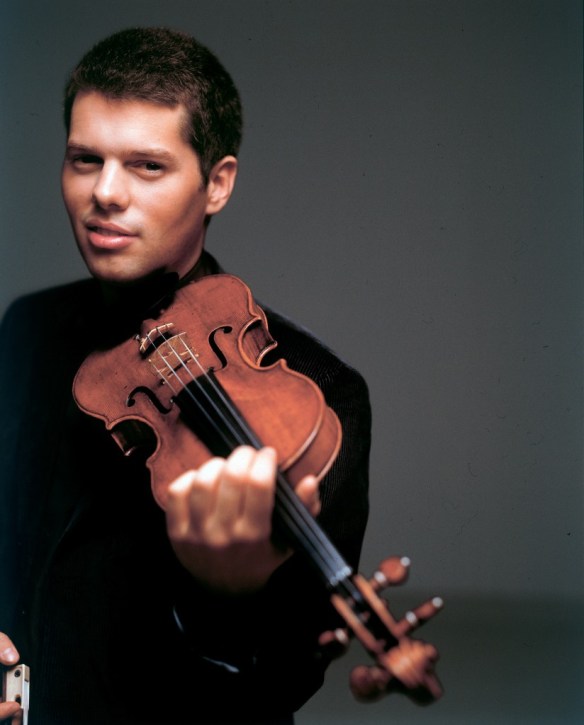
Barnabás Kelemen (violin), BBC Symphony Orchestra / Ryan Wigglesworth (above)

Barbican Hall, London / Wednesday 2 March

This typically well-planned BBC Symphony Orchestra concert had a surprise or two in store. Bookending the quartet of works on display were two pieces by Stravinsky – the Agon ballet from 1957 and the Symphony of Psalms.

They provided a good illustration of how Stravinsky changed styles as a composer, and how in spite of that he retained a fascination with older polyphonic styles. Some of the sound worlds in Agon, a set of twelve tableaux for twelve dancers, frequently alighted on melodic figures or chords that felt ‘old’, holding dissonances and deliberately leaving chords unresolved.

Agon is viewed as the work where Stravinsky starts to take his leave from a more obviously tonal approach to composition. In this performance it was lean yet colourful, with excellent solos from leader Stephanie Gonley, mandolin player Nigel Woodhouse, harpist Sioned Williams and Christian Geldsetzer and Richard Alsop, the two BBC SO lead double bass players, who nailed their otherworldly harmonics on each appearance.

The Symphony of Psalms was more obviously outgoing but saved its greatest emotional impact for the quieter music, the closing pages of ‘Omnis spiritus laudet Dominum’ (‘Let everything that hath breath praise the Lord’) from the BBC Symphony Chorus given out with softly oscillating orchestral figures.

Stravinsky uses the lower end of the orchestra in this piece, with no violins or violas, adding extra percussive punch from two pianos – all aspects that Wigglesworth brought forward in a taut performance. Great credit should however go to chorus master Hilary Campbell, who was unfortunately not mentioned in the concert programme. She is clearly popular with the singers, and helped secure that extra degree of accuracy and emotional involvement. One of Stravinsky’s most cinematic scores, it was in this performance a powerful statement of affirmation.

Wigglesworth positioned his own Violin Concerto modestly after the interval – I say modestly as in its five years of existence the piece has already ramped up an impressive number of performances. On this evidence its status is well-deserved, for it is a tightly structured unit of no little tension, the soloist searching for his ultimate melody while the reduced, ‘classical’ orchestra try and find their ultimate tonality.

barnabas-kelemen

Soloist Barnabás Kelemen (above) was a macho presence, with a little too much testosterone at times when the violin was surging forward, but he balanced that with some incredibly sensitive playing at the quietest moments of the piece, where the audience strained on his every note. Both melody and tonality were resolved in moments that confirmed Wigglesworth as a composer of impressive style and instinct.

The one dud in the program was Britten’s Four Sea Interludes and Passacaglia from the opera Peter Grimes, seen through the visual projections of Tal Rosner. This was a commission from four American orchestras in Britten’s centenary year 2013, with each interlude was set to the images of the city from which the commission came. For its UK premiere Rosner added a portrait of London to go with the other orchestral excerpt from the opera, the Passacaglia. This was centrally placed, keeping the order in which the scenes appear in the opera.

Although well played by the orchestra, the idea sadly fell flat on several levels. Although Britten spent time in America – and indeed began Peter Grimes there – the work’s roots are so entrenched in Suffolk that to suggest anything other than the Aldeburgh coastline through the music feels completely wrong. Rosner’s constructions were skilled, and had a few fine moments where close-up images of the Golden Gate Bridge rotated in technicolour.

Sunday Morning, with its bright building blocks of orchestral colour, was revealed to be a minimalist precursor of the music of John Adams through the clever constructions of its visuals. However despite Britten’s more universal appeal as a composer these days, Peter Grimes surely belongs wholeheartedly in Suffolk – and any suggestion to the contrary, however well intended, feels wrong.


Proms premiere – Luca Francesconi: Duende

luca-francesconi

Luca Francesconi

Leila Josefowicz (violin), BBC Symphony Orchestra / Susanna Mälkki (Prom 13)

Duration: 20 minutes

BBC iPlayer link

http://www.bbc.co.uk/iplayer/episode/p02wv00w/bbc-proms-2015-season-luca-francesconi-duende-the-dark-notes

What’s the story behind the piece?

leila-josefowicz
Leila Josefowicz playing Duende Photo (c) Chris Christodoulou

“Historically”,– says Luca Francesconi, “duende is the demon of flamenco. As Federico Garcìa Lorca explains, it is a subterranean force of unheard-of power that escapes rational control. To recover a primitive force in the instrument that perhaps most embodies the history of the West it is necessary to make a perilous descent into the underworld of dark notes, or a flight beyond the orbit of the earth. Which amounts to the same thing. Extremely difficult. But without duende we remain bolted to the ground.”

The work, for violin and orchestra, is a joint commission from the Swedish Radio Symphony Orchestra, the Orchestra Sinfonica Nazionale della RAI and the BBC Symphony Orchestra.

Leila Josefowicz, the violin soloist, has expanded on ‘duende’. “We acknowledged that we both have Duende, which cannot be learned…this is something we knew we could share with the world, he with his composition and me being the interpreter and musical messenger. I appreciate his incredible musical imagination, his scores bursting with colour and drama”.

Did you know?

Francesconi, born in 1956, has studied with both Karlheinz Stockhausen and Luciano Berio. His chamber opera Quartett, about the end of the world, was heard at the Royal Opera House in 2014.

Initial verdict

This is a striking piece, right from the start, where the violin begins with some feather light string crossing at a very high pitch, seemingly evoking night time insects or other sounds. There are some incredibly taxing passages for the instrument early on, which Josefowicz is completely equal to.

There is some frenetic activity both from violin and orchestra, but at around 7 minutes in the violin really soars, making a rather beautiful sound easily audible even above the glinting, treble-heavy accompaniment.

Around 13’10” there is a notable gear change, the violin digging in for some seriously virtuosic and demonic passages. Then at around 17” a slow, nocturnal atmosphere asserts itself, with various whistles and clicks from the violin to long-held notes from the orchestra.

I found it a little more difficult to hold attention with the piece in the closing stages, but it is doubtful that is the fault of the composer. A second hearing will confirm!

Second hearing

tbc!

Where can I hear more?

You can watch a performance of the Piano Concerto no.2, completed in 2013, below:

Proms premiere – Hugh Wood: Epithalamion

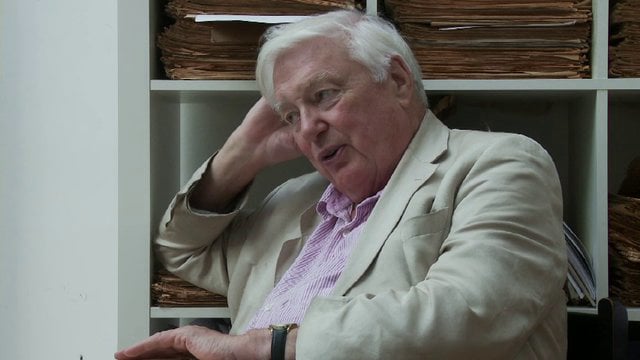
hugh-wood

Hugh Wood

Rebecca Bottone (soprano), BBC Symphony Chorus and Orchestra / Sir Andrew Davis (Prom 7)

Duration: 20 minutes

BBC iPlayer link

http://www.bbc.co.uk/programmes/p02xv5wc/player

This piece will shortly be broadcast on BBC4 on July 30, at which point I will provide a new link.

What’s the story behind the piece?

epithalamion
Procession for the wedding of Elizabeth to Frederick VAn engraving by Abraham Hogenberg, c. 1613, used courtesy of the History Today website

Epithalamion, though not one of Hugh Wood’s biggest works, was a mere sixty years in the writing. Wood first started work on it in 1955, only to abandon it, returning to the piece last year.

Epithalamion – an old word for ‘marriage song’ – celebrates the wedding of Princess Elizabeth Stuart, daughter of King James I, and Frederick, Count Palatine, on St Valentine’s Day 1613. The text was written specially for the occasion by John Donne, who used Valentine’s Day as his inspiration for the text.

Wood writes mainly for chorus and orchestra, with soprano and bass soloists (Rebecca Bottone and Nicholas Epton) listed in the Proms programme.

The story takes us through the wedding, as the couple strive to be alone together, to the bliss of the next morning.

Did you know?

Wood writes in largely traditional forms, so as well as a large-scale Symphony he has completed concertos for piano, violin and cello – as well as five celebrated string quartets.

Initial verdict

The celebrations begin with a great swell, the orchestra and choir making a joyful and expansive noise. Yet on first listen from the arena something about Wood’s music did not quite take off in this performance.

That is not a reflection on the quality of the choral writing, nor the brassy fanfares, both of which carry strong echoes of William Walton – who was of course still very active in 1955.

Yet the celebrations did not come through as consistently joyous – perhaps because of the couple striving to get away together – and it was disappointing the soloists were not used more, especially with the quality of Rebecca Bottone’s soprano well in evidence. She comes across fine on the radio but was awkwardly placed in the Hall itself, positioned top left by the percussion. Nicholas Epton, who I assumed to be taking Frederick’s part, had just one tiny cameo.

Wood’s musical language is appealing, with fulsome harmonies and appealing melodies with an upward curve, but although Sir Andrew Davis – to whom the piece is dedicated – gave it maximum input, Epithalamion fell a bit flat. Hopefully the radio broadcast will redress that!

Second hearing

tbc!

Where can I hear more?

You can read more about Hugh Wood at Music Sales, one of his two publishers, – where you can also listen to a short playlist of his compositions.

Meanwhile, here is a performance of his String Quartet no.4 from the Escher Quartet:

Encore: Hugh Wood – String Quartet No. 4 from Royal Philharmonic Society on Vimeo.

As part of the Royal Philharmonic Society's Encore Scheme, this short film opens up the music of British composer Hugh Wood.

Hugh Wood's Fourth String Quartet was selected as one of the works on the current scheme, which focuses on chamber music.

It was performed for Encore by the Escher String Quartet.

Encore is a scheme in partnership with BBC Radio 3. Encore is supported by the PRS for Music Foundation, The Mercers’ Company, The D’Oyly Carte Charitable Trust and the Idlewild Trust.

Under the Surface at the Proms – Delius and Nielsen

Prom 7, 22 July 2015 – BBC Symphony Orchestra / Sir Andrew Davis at the Royal Albert Hall

in-a-summer-garden

Delius’ garden in Grez-Sur-Loing, France Picture part of a collection at the website

Delius In a Summer Garden (1908)

http://www.bbc.co.uk/programmes/p02xv4kx/player

Is there a less fashionable British composer than Delius?

Not where the BBC Proms are concerned, it would seem – as right from the start the composer’s music has not done particularly well at the festival in the last 50 years. That poor form is exemplified by In a Summer Garden, written about Delius’ garden in Grez-Sur-Loing, France. The piece, receiving its first performance at the Proms since Sir Charles Groves brought it to the festival in 1977, was revived here under Delian specialist Sir Andrew Davis.

Delius’ mastery lies in his orchestration and harmony, with sultry added notes and hazy, impressionistic textures that evoke the laziness of a summer day. Woodwind add bird calls, and lazy melodies flit around the orchestra, before rising to an apex. This performance is as good as any you could wish for, and Davis conducted it with great affection.

Nielsen Clarinet Concerto (1928) with soloist Mark Simpson

http://www.bbc.co.uk/programmes/p02xv6cj/player

Not surprisingly, Nielsen’s Clarinet Concerto is a very different animal to the Delius. One of the composer’s last published works, it was the second in a sequence he was planning to write for members of the Copenhagen Wind Quintet – but sadly due to ill health he did not get as far as oboe, horn or bassoon.

Cast in three movements, the piece takes on a very private demeanour at times, the clarinet asked to play very quietly. This was where Mark Simpson came into his own, with exemplary control and poise that he held right up to the end, despite the necessities of breathing!

In the faster music Nielsen often brings to mind the music of Shostakovich, and the snare drum assumes a prominent role, frequently interrupting the soloist with its own thoughts. David Hockings, the resident BBC Symphony Orchestra percussionist, was on superb form here, and his rat-a-tat traded blows with the clarinet as the outer movements zipped along. On occasion, especially at the start, Simpson could have been louder still – but in his defence the Royal Albert Hall is not the easiest acoustic to work with for such a piece!

There will be more Under the Surface features as the Proms progress, exploring lesser known pieces and composers at the festival