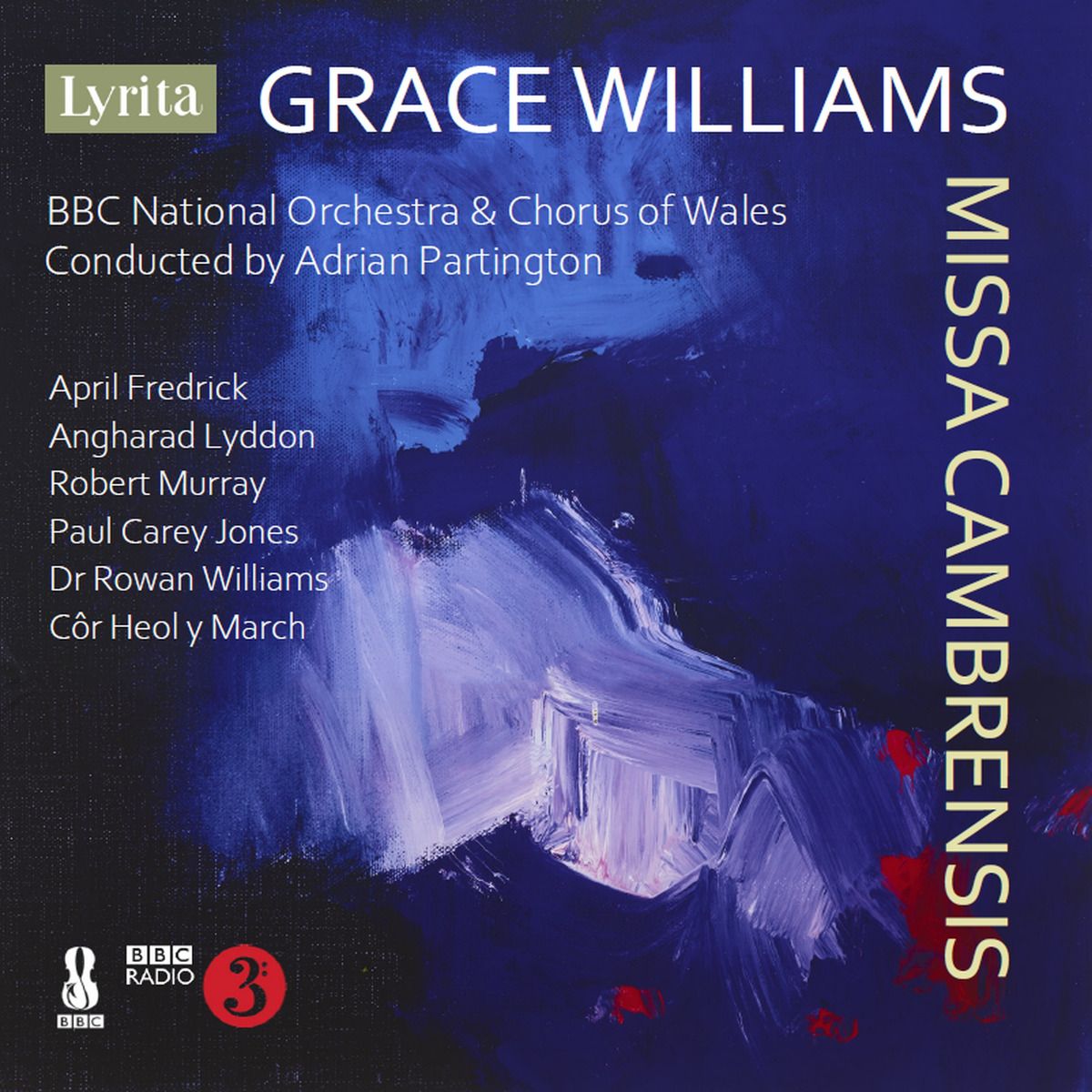
On Record – Soloists, BBC National Chorus and Orchestra of Wales / Adrian Partington – Grace Williams: Missa Cambrensis (Lyrita)

Grace Williams Missa Cambrensis (1968-71)

April Fredrick (soprano), Angharad Lyddon (mezzo-soprano), Robert Murray (tenor)
Paul Carey Jones (bass), Dr Rowan Williams (narrator); Côr Heol y March, BBC National Chorus and Orchestra of Wales / Adrian Partington

Lyrita SRCD442 [66’41’’] Latin / Welsh text and English translation included
Producer / Engineer Adrian Farmer, Engineer Simon Smith

Recorded 20-21 January 2024 at BBC Hoddinott Hall, Cardiff

Reviewed by Richard Whitehouse

What’s the story?

Lyrita continues its coverage of Grace Williams (1906-1977) with her largest concert work, Missa Cambrensis, in a recent studio recording which confirms it as the defining statement from a composer who, almost half a century since her death, is only now receiving her due.

What’s the music like?

As Paul Conway observes in his typically thorough booklet notes, Missa Cambrensis is one among a number of works by Williams that is Welsh only in a titular sense. Premiered at the Llandaff Festival in 1971, it was well received by fellow composers, critics and public alike but not heard again until 2016 in a performance one recalls as originally intended for release on Lyrita and which can be heard via the composer’s dedicated website. Not that the present account is other than successful in conveying the essence of this powerful yet elusive piece.

Many settings of the Mass since Haydn have unfolded a symphonic trajectory, but Williams goes further with the division into five clearly defined movements. The initial Kyrie Eleison not only introduces most of those salient motifs but also establishes that tone, mystical in its undulating equivocation, such as characterizes this work’s long-term expression: the contrast here between choral and soloistic textures duly accentuated by their hieratic and supplicatory quality. This duly sets up an emotional contrast intensified in the Gloria, outwardly the most straightforward part of the work but with a calmly ecstatic response at Laudamus te then an eloquent Dominus Deus that are nothing if not personal, together with an intensely wrought Cum Sancto Spiritu whose culminating Amen’s convey a distinctly ambivalent affirmation.

As most often, the Credo is the most substantial portion but Williams rings the changes by dividing this into halves, a pertinent division coming at Et homo factus est and Crucifíxus étiam pro nobis. In between are interpolated a setting of Saunders Lewis’s Carol Nadolig (A Christmas Carol) for children’s voices with viola, cello and harp of melting pathos, offset by a starkly narrative treatment of the ‘Beatitudes’ prior to a mostly ruminative resumption of the Credo. Pivoting between contemplation and elation, the Sanctus is rounded off by a joyful Hosánna in excélsis which is not to be heard again after the subdued eloquence of the Benedictus. An anguished response to the Agnus Dei feels the more acute, as also a searching Dona Nobis Pacem which brings the work full circle to its contemplative close.

Does it all work?

Yes, and with an understated while readily identifiable personality that surely makes this the most potent setting of the Mass from a Welsh composer. Subliminal influences might not be hard to discern, among them Britten’s War Requiem, but they never detract from Williams’s own idiom. The soloists cannot be faulted in terms of commitment, with Rowan Williams a notably incisive reciter, while Adrian Partington secures a lustrous response from his choral and orchestral forces. Overall, it is hard to imagine the work given with greater conviction.

Is it recommended?

It is indeed, not least in the hope that further live hearings of Missa Cambrensis may prove forthcoming. Good news, moreover, that Lyrita has now acquired the premiere performance of Williams’s only completed opera, The Parlour, which is scheduled for imminent release.

Listen & Buy

You can read more about this release at the Wyastone website

Published post no.2,516 – Monday 28 April 2025
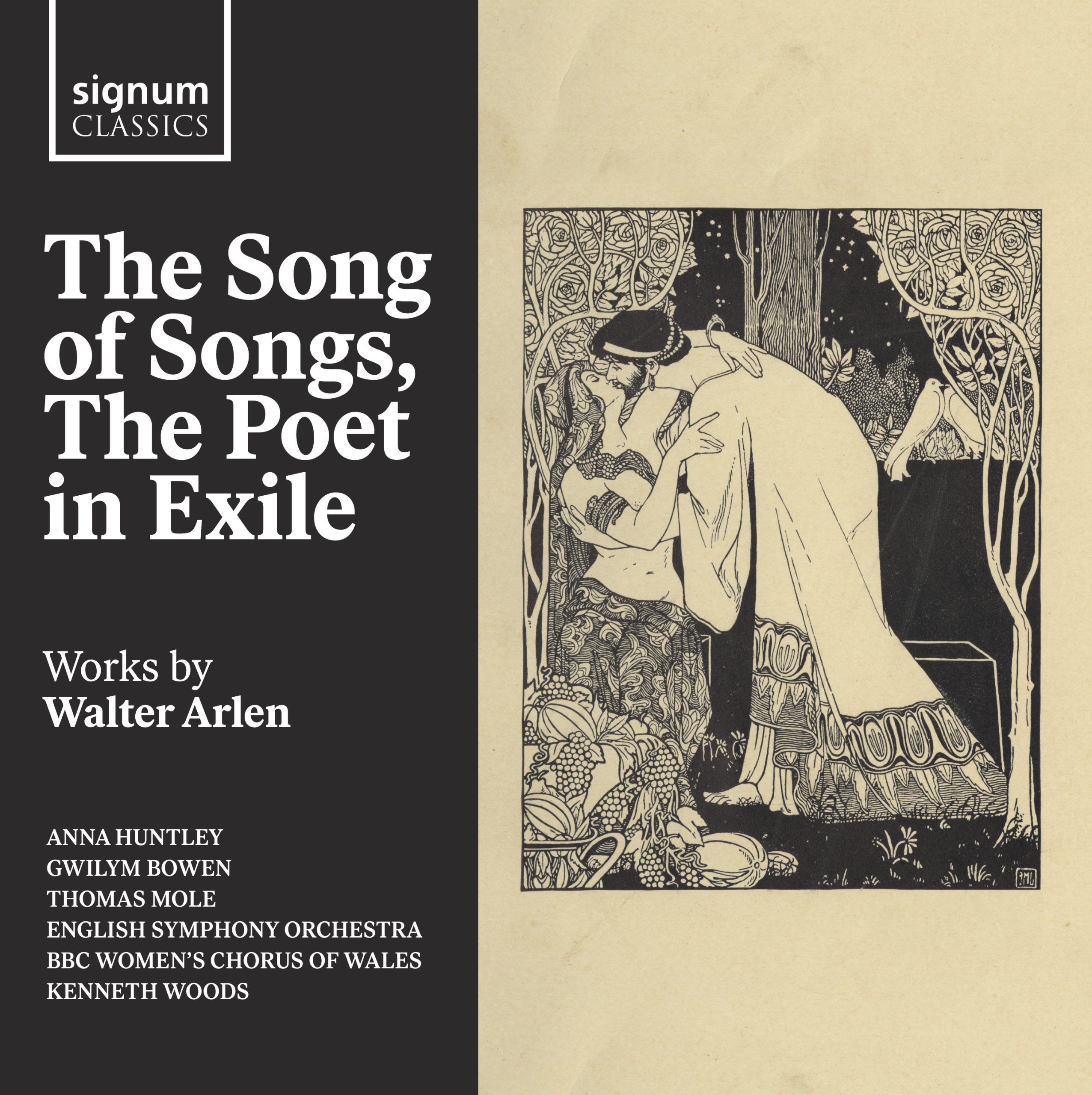
On Record – Anna Huntley, Gwilym Bowen, Thomas Mole, BBC Women’s Chorus of Wales, ESO / Kenneth Woods – Walter Arlen: The Song of Songs, The Poet In Exile (Signum Classics)

Arlen arr. Bekmambetov / ed. Woods The Song of Songs (1953)
Arlen ed. Woods The Poet in Exile (1988, rev. 1994)

Anna Huntley (mezzo-soprano), Gwilym Bowen (tenor), Thomas Mole (baritone), BBC Women’s Chorus of Wales, English Symphony Orchestra / Kenneth Woods

Signum Classics SIGCD879 [52’21’’]
Producer / Engineer Phil Rowlands, Engineer Andrew Smilie

Recorded 17-20 February 2022 at BBC Hoddinott Hall, Cardiff

Reviewed by Richard Whitehouse

What’s the story?

Kenneth Woods and the English Symphony Orchestra continue their exploration of music by composers murdered or forced into exile during the Third Reich with this release of Walter Arlen, whose recent death at 103 enabled him to experience a renewed interest in his music.

What’s the music like?

Although he remains best known through his trenchant music criticism for the Los Angeles Times, the Vienna-born Walter Arlen (Aptowitzer) also made a distinguished contribution to music administration and left a not inconsiderable output. Several albums featuring his songs and piano music can be heard on the Gramola label, while this latest ESO release provides a welcome introduction to two of his works that involve larger forces – the one drawing on an ancient Jewish source and the other upon poems by a seminal author from the post-war era.

Whether or not The Song of Songs is the harbinger of monogamy in the Judeo-Christian moral code, it contains some of the eloquent expression found in either Biblical testament. In just 30 minutes, Arlen’s ‘dramatic poem’ takes in the main narrative, its lively initial chorus featuring intricate polyphony for female voices and incisive orchestral textures. As the piece unfolds, its emotional emphasis is placed on the solo contributions – whether those of Solomon sung with burnished warmth by Thomas Mole, those of the Shepherdess with poise and insouciance by Anna Huntley, or those of the Shepherd given with virility and tenderness by Gwilym Bowen. Nor is the BBC Women’s Chorus of Wales wanting in intonational accuracy. If the resolution does not bring expected closure, this direct and unaffected setting certainly warrants revival.

The real discovery is The Poet in Exile, a song-cycle to texts by Polish-born American author Czesław Miłosz. These profound poems are not easily rendered in musical terms, and it is to Arlen’s credit that he goes a considerable way to achieving this. As the composer states, they ‘‘dealt with situations echoing my own remembrance of things past’’ – as holds good from the trenchant rhetoric of ‘Incantation’, via the sombre rumination of ‘Island’ then wistful elegance of ‘In Music’ or controlled fervour of ‘For J.L.’ (with its striking harpsichord obligato), to the confiding intimacy of ‘Recovery’. Some may have heard these songs with Christian Immler and Danny Driver (GRAM98946) but this orchestration by Woods, after the arrangement by Eskender Bekmambatov, offers a wider-ranging context for assured singing by Thomas Mole.

Does it all work?

Pretty much, and not least because the ESO is heard to advantage in the spacious acoustic of Hoddinott Hall while directed by Woods with unerring sense of where to place the emotional emphasis – especially important in conveying the meaning of the songs. A pity, however, that neither texts nor translations could be included here – not least as that by Leroy Waterman of The Song of Songs is appreciably different from those which have been previously set, while the Miłoz poems are worth savouring on their own terms and need to be approached as such.

Is it recommended?

It is. If not a major voice, Arlen’s music is always approachable and often thought-provoking. Initiates and newcomers alike will enjoy getting to know these works and hearing them given so persuasively – a worthy present, indeed, for this composer as he neared his 102nd birthday.

Listen & Buy

Click on the names to read more about performers Anna Huntley, Gwilym Bowen, Thomas Mole, the English Symphony Orchestra and conductor Kenneth Woods. Click on the name for more on Walter Arlen

Published post no.2,515 – Saturday 26 April 2025

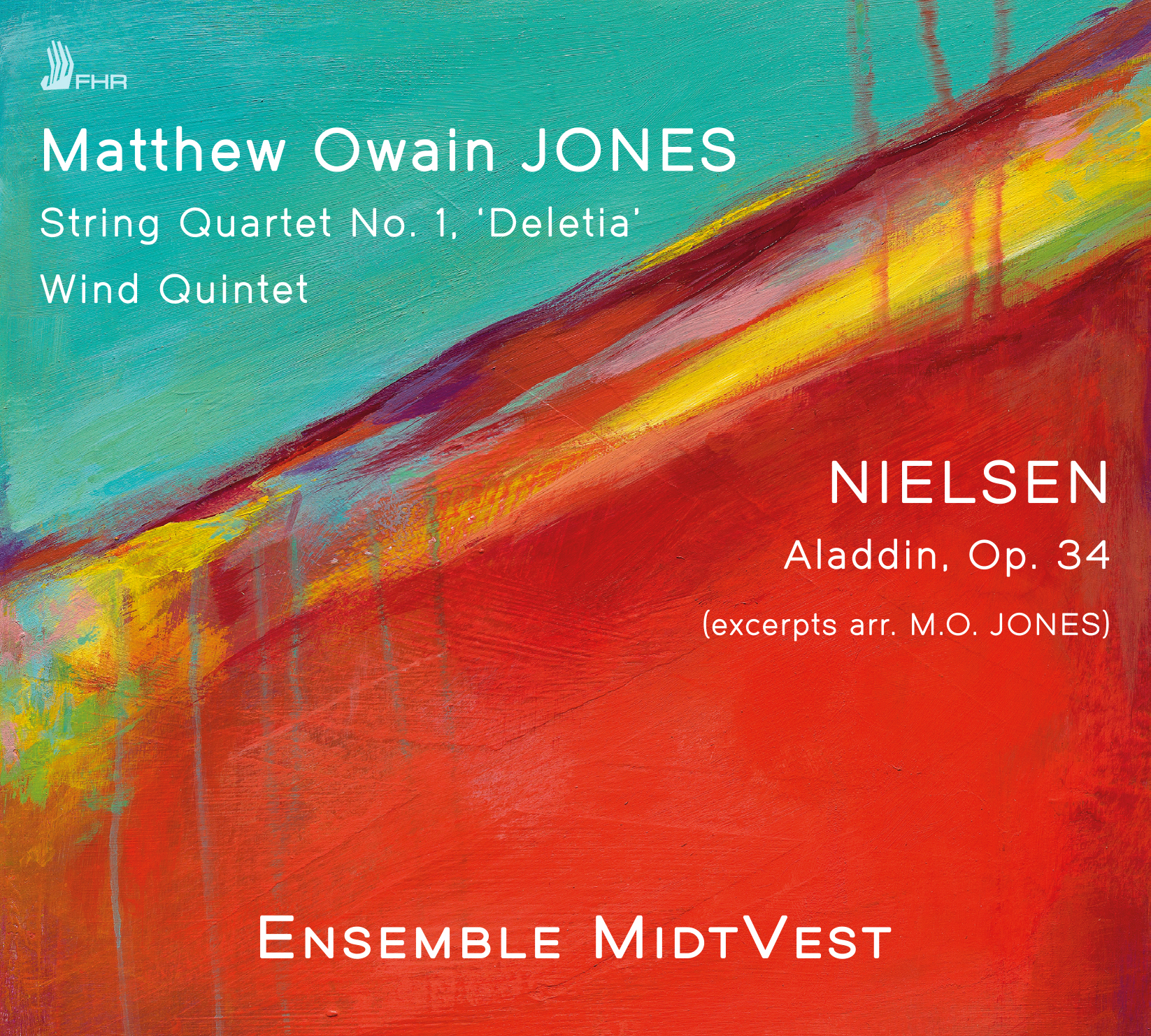
On Record – Ensemble MidtVest – Matthew Owain Jones: String Quartet no.1, Wind Quintet; Nielsen arr. Jones: Aladdin (First Hand Records)

Matthew Owain Jones
String Quartet no.1 ‘Deletia’ (1993, rev. 2012)
Wind Quintet (2016)
Nielsen arr. Jones
Aladdin, FS89: Nine Pieces for wind quintet, string quartet and piano (1917-19, arr. 2018)

Ensemble MidtVest [Charlotte Norholt (flute), Peter Kirstein (oboe), Tommaso Lonquich (clarinet), Yavor Petkov (bassoon), Neil Page (horn); Matthew Owain Jones, Karolina Weltrowska, Ana Feitosa (violins), Sanna Ripatti (viola), Jonathan Slaatto (cello), Martin Qvist Hansen (piano)]

First Hand Records FHR163 [63’53’’] All world premiere recordings
Producers / Engineers Michael Ponder (String Quartet, Wind Quintet), Morten Mogenson (Aladdin)

Recorded 6 December 2017 (String Quartet), 11 January 2018 (Wind Quintet), 29-31 August 2018 (Aladdin) at Den Jyske Sangskole, Herning, Denmark

Reviewed by Richard Whitehouse

What’s the story?

First Hand Records makes a welcome addition to its contemporary catalogue with this release of music or arrangements by Matthew Owain Jones, all performed by the extended outfit that is Ensemble MidtVest and among whose varied personal the composer himself can be found.

What’s the music like?

Fifty last year, Jones has had a diverse career as a musician as is recounted in his personable booklet notes. Composing has often taken a back seat in his activities, the works here written almost a quarter-century apart, yet there can be no doubting the idiomatic nature of his music.

Composed when barely out of his teens, the First String Quartet is evidently the product of a gifted if unfocussed musical talent. Jones admits as much by appending the subtitle ‘Deletia’ to its revision almost two decades on – the original four movements having been reduced to just two, albeit substantial entities. These duly complement each other in almost all respects – the initial Andante exuding a warmth and fervency that is questioned, without being denied outright, by the ensuing Allegro whose ‘minaccioso’ marking underlines its capricious while sometimes ominous nature. The result is uneven yet engaging – making it a pity that, after a musical co-written with his sister, Jones should have left composing somewhat in abeyance.

It was the positive reception accorded that revision of his quartet which encouraged Jones to return to composition in earnest, and among the first fruits of this resumption was his Wind Quintet. Its substantial single movement falls into four continuous sections such as outline a relatively Classical design (albeit with an intermezzo-like section placed second), and Jones cannily exploits those incremental changes in timbre or texture without recourse to extremes of tempo and mood. The outcome is music demonstrably within the lineage of a genre more extensive than often supposed and, though its content breaks little new ground, this is never less than expertly conceived for the medium and affords a pleasurable listen in its own right.

The locus classicus of wind quintets has to be that written just over a century ago by Nielsen, music by which composer ends this collection. Although its suite is periodically revived, the lavish incidental music (not a ballet, as is referenced several times in the notes, though there is a notable element of dance) for Adam Oehlenschlager’s play Aladdin proved too ambitious even at its Copenhagen premiere. Surprising, perhaps, that the nine numbers included here translate so well into the medium of a mixed decet – preserving the distinctive nature of music from Nielsen’s maturity (it comes mid-way between his Fourth and Fifth Symphonies) and thus making it freely available to practitioners for the very different context of the recital room.

Does it all work?

Pretty much. Much of the attraction of this collection lies in the respect which the members of Ensemble MidtVest have for Jones and his music, thereby making for performances that could scarcely be improved upon in terms of technical refinement or interpretative insight.

Is it recommended?

It is, not least as the sound conveys the immediacy but also delicacy of this music with ideal clarity and perspective. Jones must feel vindicated by the enterprise, as indeed he should, and one looks forward to more releases of both his compositions and arrangements in due course.

Listen & Buy

Click on the names to read more about composers Matthew Owain Jones and Carl Nielsen, and the performers Ensemble MidtVest

Published post no.2,515 – Saturday 26 April 2025

On Record – Matteo Generani: Martucci: Piano Works (Naxos)

Martucci
Romanza facile (1889)
Capriccio e Serenata Op.57 (1886)
Sei Pezzi Op.38 (1878)*
Notturno Op.25 ‘Souvenir de Milan’ (1875)*
Minuetto e Tempo di Gavotta Op.55 (1880/88)*
Sonata facile, Op.41 (1878)*
Scherzo in E major Op.53/2 (1880)
Nocturne in G flat major Op.70/1 (1891)
Tarantella Op. 44/5 (1880)
Prima barcarola, Op. 20 (1874)*

Matteo Generani (piano)

Naxos 8.574628 [71’51”] * World premiere recordings
Producer & Engineer Joseph Tesoro

Recorded 25-27 April 2023 at White Recital Hall, James C. Olsen Performing Center, Kansas City, USA

Reviewed by Richard Whitehouse

What’s the story?

Naxos continues its coverage of Giuseppe Martucci (1856-1909) with this selection of piano music, a medium for which the Italian composer wrote extensively but that has tended to be overshadowed by the upsurge of interest in his symphonies, concertos and chamber works.

What’s the music like?

As indicated by Tommaso Manera in his informative booklet notes, Martucci was established as a pianist when barely out of his teens and could have enjoyed an international career had it not been for his attraction to conducting and, most importantly, his determination to promote Austro-German symphonism when it was hardly established in the Italian-speaking territories. Even the piano pieces that enjoyed popularity in his lifetime often did so in transcriptions for orchestra, making the present anthology a viable overview of his achievement in this domain.

What is immediately noticeable about Martucci’s piano music is the relatively short time in which it was written – the 50 or so opus numbers over which it extends equating to 17 years of composing. Certainly, the Prima barcarola yields a melting limpidity redolent of Chopin, while the Notturno affords an evocation of Milan that wears any Lisztian antecedents lightly. More distinctive is the Sonata facile, a study in deftness and understatement which is by no means ‘easy’ and has an appealing humour. More substantial, however, the Six Pieces are not only contrasted within themselves but amount to a cohesive overall sequence (were they ever performed as such?). Highlights are its fourth and fifth pieces, an ebullient La Chasse then a beguiling Sérénade, but the whole sequence is demonstrably more than the sum of its parts.

Martucci’s piano output tended to fall away as the 1880s progressed, but what he did write is worth attention. Hence the capering Minuetto which was partnered almost a decade on by an even more engaging Tempo di Gavotta, or the Scherzo in E which is playful and resourceful by turns. A further set of six pieces is represented only by its final item, but this Tarantella is the most substantial piece here and testament to the increasing sophistication of its composer. Nor is Capriccio e Serenata other than a brace of genre-pieces unified in overall conception. Emerging either side of 1890, the Romanza facile is a compact study in unforced sentiment, whereas the Nocturne in G flat could hardly be further removed from that eponymous piece written some 16 years previously in terms of its harmonic subtlety and textural translucency.

Does it all work?

It does. As a composer for piano, Martucci may not have had the distinctive profile of Busoni (even at a comparable stage in their respective developments) or Sgambati, though the best of what he did write has no lack of character or personality. It is also music that cries out for the level of commitment evident throughout this selection, Matteo Generani audibly enjoying its technical challenges while always aware of that aspiring towards something more ambitious that was to find its outlet in the multi-movement works which crowned Martucci’s maturity.

Is it recommended?

It is. Although this does not survey the extent of Martucci’s piano music, Generani’s selection is an enticing one that will certainly appeal to those with any taste for the byways of musical Romanticism, along with those who have acquired earlier releases of this composer on Naxos.

Listen & Buy

Click on the artist names to read more on pianist Matteo Generani and composer Giuseppe Martucci

Published post no.2,513 – Wednesday 23 April 2025

In concert – Peter Donohoe, RPO / Brabbins: Elgar ‘Enigma’ Variations; Bliss Piano Concerto; Vaughan Williams @ Cadogan Hall

Peter Donohoe (piano, above), Royal Philharmonic Orchestra / Martyn Brabbins (below)

Vaughan Williams Five Variants of Dives and Lazarus (1939)
Bliss Piano Concerto in B flat major Op.58 (1938-9)
Elgar Variations on an Original Theme Op.36 ‘Enigma’ (1898-9)

Cadogan Hall, London
Wednesday 16 April 2025

Reviewed by Richard Whitehouse Pictures (c) Andy Paradise

June 1939 saw one of the more memorable occasions for British music with several premieres at the World’s Fair of New York, this multi-day festival with its theme of ‘Building the World of Tomorrow’ thrown into ironic relief given the outbreak of war in Europe three months later.

The first half of tonight’s concert by the Royal Philharmonic Orchestra duly replicated that on June 10th, beginning with Five Variants of Dives and Lazarus which Vaughan Williams wrote for the event. One of the few non-symphonic orchestral works from his later years, its scoring for divided strings and harp gives a warmly evocative context to this succession of paraphrases whose steadily unforced evolution is rounded off by one of its composer’s most radiant codas. Various solo passages provided the RPO’s section-leaders with their moment in the spotlight.

That concert 85 years ago continued with the Piano Concerto that Arthur Bliss had written for Solomon which enjoyed frequent revival over the next quarter-century. This 50th anniversary of its composer’s death provided an ideal opportunity to reassess a work conceived within the late-Romantic lineage, notably an opening movement whose thunderous initial gestures set in motion this large-scale sonata design whose overt rhetoric is tempered by an expressive poise and more ambivalent asides which make it anything but the epigone of an already bygone era.

Among a few present-day pianists to have this piece in his repertoire, Peter Donohoe tackled its many technical challenges head-on; the RPO and Martyn Brabbins (who had never before conducted it) overcoming some occasional moments of mis-coordination so as to present it to best advantage. He brought a lighter touch and no little emotional poise to bear on the central Adagietto, its inwardness carried over into a finale whose probing introduction was a perfect foil to the bravura that followed. Whatever qualms Bliss may have had regarding the ‘world situation’, there was little sense of doubt as the music surged to its emphatic and affirmative close – thereby setting the seal on this memorable performance and a work which, whatever it lacks in distinctive invention, vindicates Bliss’s overall ambition to an impressive degree.

A pity that logistics (and economics!) made revival of Bax’s Seventh Symphony, which had originally featured in those New York concerts, impracticable but hearing Brabbins direct so perceptive an account of Elgar’s Enigma Variations was no hardship. Perhaps because of the immediacy of the Cadogan Hall acoustic, it was also one in which the relatively brief livelier variations came into their own – hence the unbridled impetus of the fourth (W.M.B), seventh (Troyte) or 11th (G.R.S) variations, though there was no lack of eloquence in the first (C.A.E) and fifth (R.P.A) variations, or suffused fervour in the ninth (Nimrod). The 10th (Dorabella) variation was made into an intermezzo halting if whimsical, and the 13th became a romanza such as opened out this work’s expressive remit onto an altogether more metaphysical plane.

Those having heard Brabbins conduct this work in the Royal Albert Hall quite likely missed that organ-reinforced opulence afforded the 14th (E.D.U) variation yet, as this finale built to its triumphal conclusion, the unfailing conviction of this performance could hardly be denied.

For details on their 2024-25 season, head to the Royal Philharmonic Orchestra website. Click on the artist names to read more about pianist Peter Donohoe and conductor Martyn Brabbins, and also to discover more on The Arthur Bliss Society

Published post no.2,509 – Monday 21 April 2025