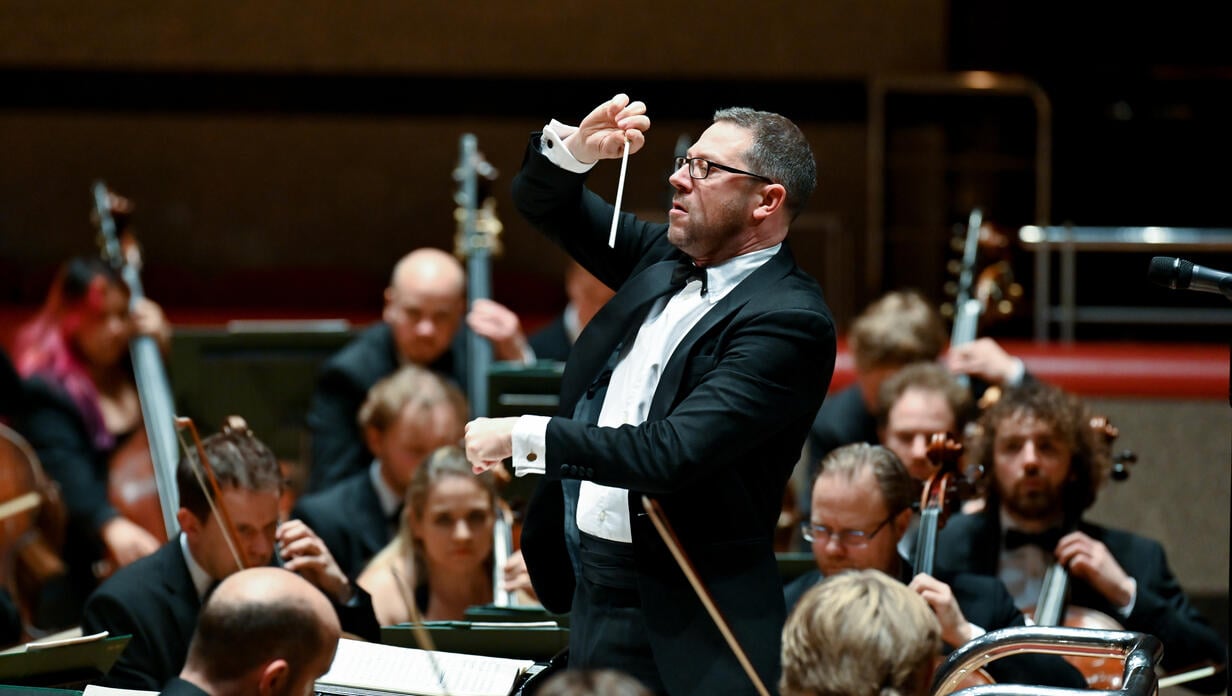
In concert – Jennifer France, London Philharmonic Orchestra / Edward Gardner @ Royal Festival Hall – Abrahamsen & Mahler

Jennifer France (soprano), London Philharmonic Orchestra / Edward Gardner

Abrahamsen let me tell you (2012-3)
Mahler Symphony no.4 in G major (1892, 1899-1900)

Royal Festival Hall, London
Friday 3 October 2025

Reviewed by Richard Whitehouse

Tonight’s London Philharmonic Orchestra concert featured the welcome revival of a 21st-century classic. Hans Abrahamsen’s recent output may be relatively sparing, but the works that have emerged represent a triumph of quality over quantity and not least let me tell you.

Set to fragmentary lines drawn by Paul Griffiths from his eponymous novel, this centres on the character of Ophelia – its seven songs falling into three larger parts whose outlining of a ‘before, now and after’ trajectory gives focus to the arching intensity of its 30-minute span. The first, fourth and sixth of these anticipate what comes to fruition during the second, fifth and seventh – the exception being the third whose speculative vocal line is underpinned by a stealthy progress in the lower registers evoking the motion, if not the form, of a passacaglia. Elsewhere the voice evinces an intricacy and translucency that effortlessly carries the word-setting as it pivots between thought of oblivion and transcendence, before eventually being subsumed into the orchestra for a conclusion among the most affecting in recent memory.

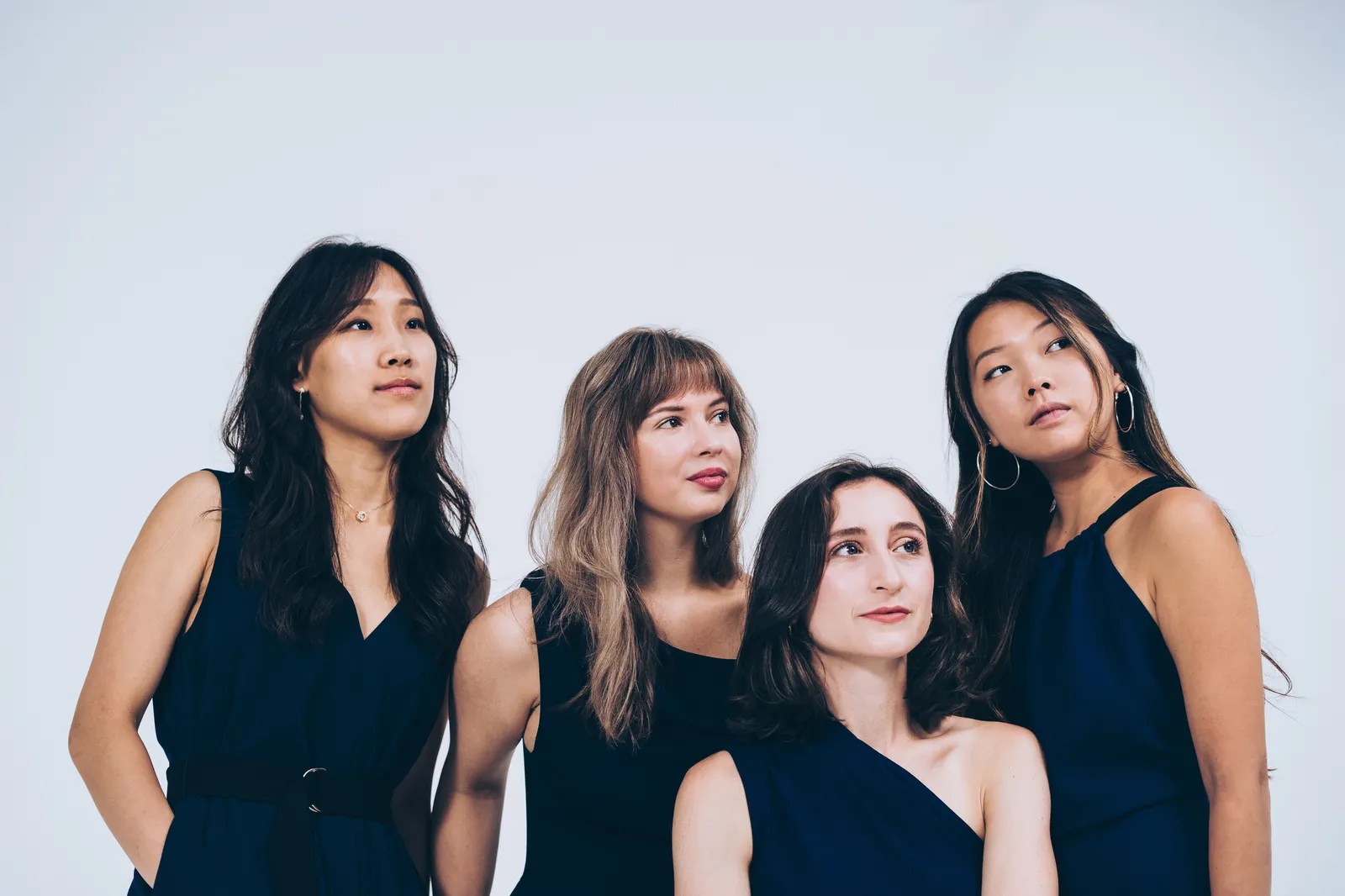
The LPO acquitted itself ably in music which is texturally complex for all its harmonic clarity, though it was Jennifer France (above) who (not unreasonably) most impressed with a rendering of the solo part as did ample justice to its high-lying melisma and airborne flights of fancy. Edward Gardner directed with an innate sense of where this music was headed, not least in those final bars with their tapering off into silence. Relatively few pieces are recognized as seminal from the outset, but let me tell you is one such and seems destined to remain so well into the future.

France then returned (or rather stole in) for the finale of Mahler’s Fourth Symphony after the interval. His setting of ‘Das himmlische Leben’ from the folk-inspired anthology Das Knaben Wunderhorn had actually been written almost a decade earlier and was once envisaged as the finale to the Third Symphony, but it makes a natural conclusion to a successor whose relative understatement is sustained right through to this movement’s intangible end: a ‘child’s vision of heaven’ whose intended innocence becomes informed with no little experience by the close.

Gardner had steered a convincing trajectory through the preceding movements – not least the opening one whose mingled whimsy and wistfulness took on a more ominous demeanour in its eventful development, before conveying unalloyed resolve in a warm-hearted reprise and beatific coda. What is among the most striking of Mahler’s scherzo’s proceeded with audible appreciation of its pivoting between the sardonic and sublime, Pieter Schoeman’s ‘mistuned’ violin being first among equals in music whose soloistic textures were thrown into relief by the homogenous stability of the Adagio. Its double variations unfolded with a fluid intensity capped by a coda whose ‘portal to heaven’ yielded thrilling resplendence as subsided into a transcendent raptness that, in other circumstances, could have made a satisfying conclusion.

That this lead so seamlessly into the vocal finale says a great deal for Mahler’s foresight, but also Gardner’s ability to fashion so cohesive a symphonic entity. As the music subsided into subterranean chords on harp, the audience was (necessarily) held spellbound a while longer.

Click on the links for more information on the London Philharmonic Orchestra, conductor Edward Gardner, soprano Jennifer France and composer Hans Abrahamsen

Published post no.2,679 – Monday 6 October 2025

In concert – The Gesualdo Six & Matilda Lloyd @ Wigmore Hall

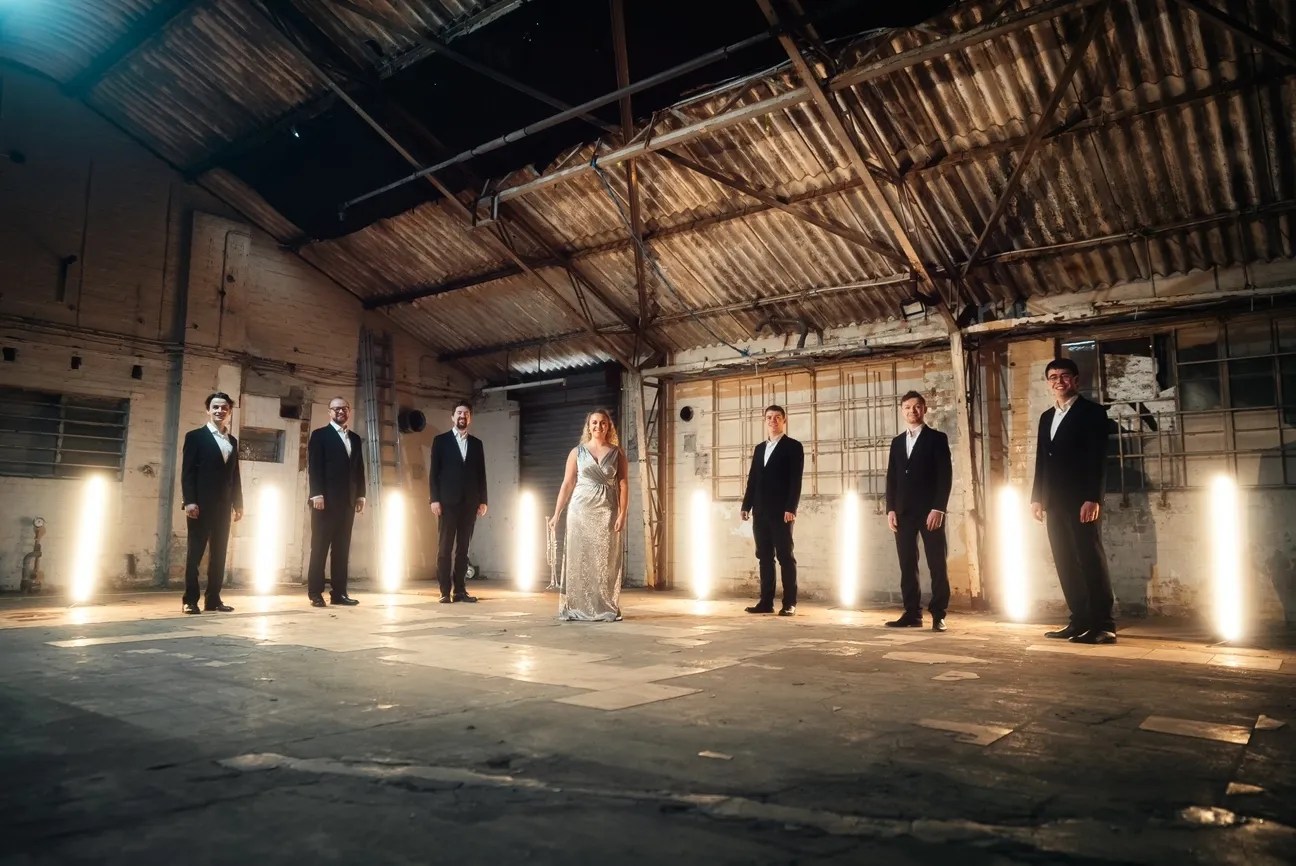
The Gesualdo Six [Guy James (countertenor), Alasdair Austin (countertenor), Joseph Wicks (tenor), Josh Cooter (tenor), Simon Grant (baritone) and director Owain Park (bass)]

Roth Night Prayer (2017)
Tallis O nata lux de lumine (pub. 1575)
Pritchard The Light Thereof (2020)
MacMillan O Radiant Dawn from The Strathclyde Motets (2005)
Tallis Dum transisset Sabbatum (1575)
Hildegard of Bingen O gloriosissimi (с.1163-1175)
Bingham Enter Ghost (2002)
Owain Park Sommernacht (2022)
Rheinberger Abendlied from 3 Geistliche Gesänge Op. 69 (pub.1873)
Barnard Aura (2020)
Roxanna Panufnik O Hearken (2015)
Burgon Nunc dimittis (1979)

Wigmore Hall, London, 2 October 2025

by John Earls. Photo credits unknown (above), John Earls (below)

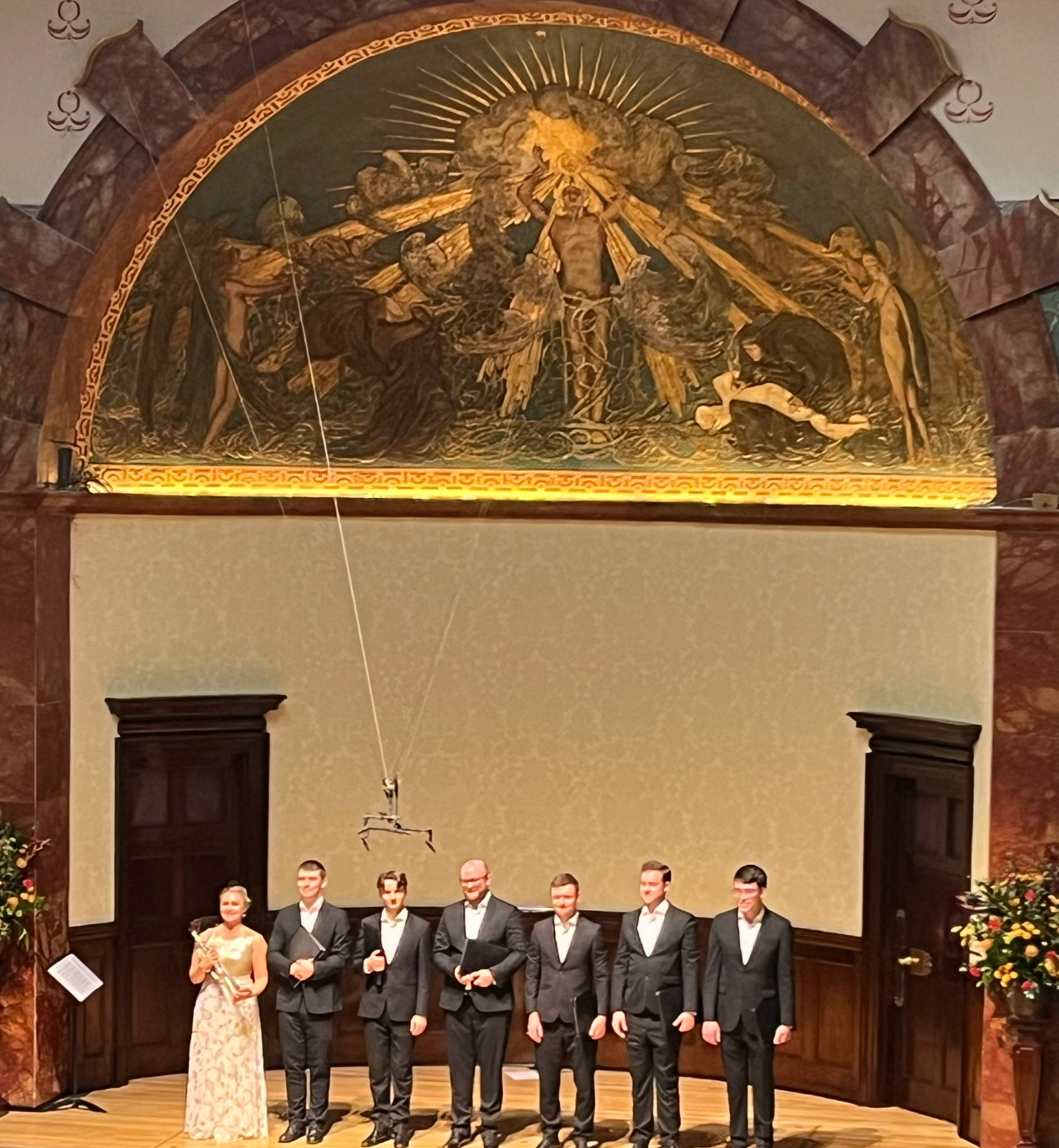
The Gesualdo Six have recently released their tenth album (for Hyperion) Radiant Dawn. It finds them combining consistently high standards of choral music with imaginative programming featuring classic and contemporary compositions spanning over 800 years of music. It also sees them introducing a new element to the mix, namely the inclusion of the trumpet for a number of pieces superbly played by Matilda Lloyd.

The new album was the focus for this hour-long lunchtime concert at a packed Wigmore Hall with all pieces performed coming from it (and a few omitted). The theme of the album, as explained by The Gesualdo Six’s director and bass (and recently named new chief conductor of the BBC Singers) Owain Park, is “musical responses to light” in a whole variety of contexts.

First up in the set (and on the album) was Alec Roth’s Night Prayer, an almost dreamy reflection of the Compline hymn Te lucis ante terminum that introduces Lloyd’s trumpet and the remarkable effect it has when married with these magnificent voices.

Next was Thomas Tallis’s O nata lux de lumine, one of two shorter pieces (both just over 2 minutes) along with Roxanna Panufnik’s O Hearken, but their duration made them no less impactful. Both featured just voices, and I loved finding out from the programme that O Hearken started life as a raffle ticket prize. Another Tallis piece Dum transisset Sabbatum saw Matilda Lloyd’s trumpet taking the soprano voice to powerful effect.

There are two of James MacMillan’s Strathclyde Motets on the album. Only one of them, O Radiant Dawn, from which the album gets its title, gets performed here. It’s harmonically inspired by Tallis’s O nata lux de lumine and has a yearning to it befitting of the Advent season it relates to.

Richard Barnard’s Aura (commissioned for the album) sets music to the text of Emily Barry’s poem about the loss of her mother. Credit to the programme editors for faithfully reproducing the poem’s arresting layout – two parallel columns reflecting the emotional fracture involved (Owain Park’s programme notes were also excellent). This fracturing dissipates musically as the piece progresses with the trumpet acting as a bridge between two groups of singers. It was one of the most affecting pieces of the concert with the composer in the audience to hear it.

Another composer in the audience was Deborah Pritchard whose The Light Thereof (also commissioned for the album) sets words from the Book of Revelation and demonstrated deftly the ability of the trumpet (muted at times) to evoke different shades of light.

Matilda Lloyd’s virtuosity on the trumpet was to the fore in Judith Bingham’s Enter Ghost, an interpretation of a passage from Shakespeare’s Hamlet mixing music with spoken word, the drama enhanced by her walking off stage (and returning) whilst playing.

Other pieces sung a cappella included Hildegard of Bingen’s O gloriosissimi (from the back of the hall) and beautiful performances of Owain Park’s own Sommernacht and Joseph Rheinberger’s Abendlied.

The programme ended (as does the album) with Geoffrey Burgon’s Nunc dimittis which some may remember as the closing music from the BBC’s television adaptation of John le Carré’s Tinker Tailor Soldier Spy. It was yet another example of how effective this glorious combination of voices and trumpet is and proved a fitting conclusion to a most illuminating concert.  

John Earls is Director of Research at Unite the Union and posts at @johnearls.bsky.social on Bluesky and @john_earls on X. You can subscribe (free) to his Hanging Out a Window Substack column here: https://johnearls.substack.com/

Published post no.2,677 – Saturday 4 October 2025

In concert – Heath Quartet @ London Chamber Music Society, St John’s Church Waterloo – Haydn, Bacewicz, Locke & Beethoven

Heath Quartet [Maja Horvat & Sara Wolstenholme (violins), Gary Pomeroy (viola), Christopher Murray (cello)]

Haydn String Quartet in G major Op.33/5 ‘How Do You Do?’ (1781)
Bacewicz String Quartet no.6 (1960)
Locke Suite III in F (c1660)
Beethoven String Quartet no.16 in F major Op.135 (1826)

St John’s Church, Waterloo, London
Sunday 28 September 2025, 6pm

Reviewed by Richard Whitehouse

This early evening concert marked not just the start of London Chamber Music Society’s new season but also that of its first at St John’s Waterloo, following some 17 seasons in residence at King’s Place. The actual programme, however, could not have been more typically LCMS.

What better than to start with a Haydn quartet? His Op. 33 abounds in ‘less is more’ writing, not least the fifth in this set whose buoyant opening Vivace features a cadential figure which provides the nickname, then a Largo whose keening melody for first violin and cadenza-like passage betrays likely operatic origin. The Heath Quartet was equally inside the Scherzo with its amiable impulsiveness, while the final Allegretto had a genial humour that carried through to its good-natured payoff. A piece deserving of greater prominence within the Haydn canon.

As does the Sixth Quartet in Grażyna Bacewicz’s output. Evidently a breakthrough in terms of her writing for strings, its stealthy yet never brazen Modernism is clear from the opening movement in its subtle overhaul of sonata design, then the Vivace with its intensive rhythmic interplay. A ‘song without words’ centred on cello, the slow movement is a soulful interlude prior to a final Allegro as makes inventive play with rondo design – the widening expressive gulf between its stable refrain and its unpredictable episodes deftly sidestepped at the close.

Purcell’s music for consort might be the most directly acknowledged precursor of the string quartet, but that by Matthew Locke is hardly less significant and preceded it by almost two decades. This third of his six four-part suites is no exception – the substantial and teasingly discursive Fantasia being followed with an elegant Courante and a soulful Ayre then a (surprisingly?) trenchant Saraband. Throughout, the Heath’s seamless interplay was such as to relativize any distinction between a consort of viols and the ensemble of strings it became.

An ensemble taken to a peak of perfection on the cusp of the Romantic era with Beethoven’s last string quartet. Here the Heath judged the equable poise of its opening Allegretto then the quixotic humour of its scherzo to perfection. Neither was there any lack of feeling in a slow movement whose pathos becomes the greater for its understatement; the ‘difficult decision’ that informs the finale duly rendered with a sure sense of this music’s venturing towards its playful conclusion. Beethoven was rarely so profound as when he was being this disarming. A persuasive start to a new season and a new chapter in the illustrious history of the LCMS. A wide range of recitals is scheduled between now and June, while those unfamiliar with St John’s need have no doubt as to the excellence of its acoustic or attractiveness of its setting.

Click on the links for more information on the Heath String Quartet, the London Chamber Music Society and events at St. John’s Church, Waterloo. You can also click for more on composer Grażyna Bacewicz

Published post no.2,676 – Friday 3 October 2025

In concert – BBC Singers / Martyn Brabbins @ St Paul’s Knightsbridge – Holst, Britten, Garrard, Elgar & Pickard

BBC Singers, Elizabeth Bass (harp), Richard Pearce (piano), Andrew Barclay (percussion) / Martyn Brabbins

Holst Choral Hymns from the Rig Veda – Group 3, H90 (1910)
Britten The Ballad of Little Musgrave and Lady Barnard (1943)
Garrard Missa Brevis (2017-18)
Elgar Five Part-Songs from the Greek Anthology Op.45 (1902)
Pickard Elemental (2024-25) (BBC commission: World premiere)

St Paul’s, Knightsbridge, London
Friday 19 September 2025

Reviewed by Richard Whitehouse

The upsurge of interest in and performances by the BBC Singers in the wake of its intended demise shows little sign of abating, and there could be few vocal ensembles able to put on a programme as stylistically inclusive or as technically demanding as that heard this afternoon.

Nowhere more so than Elemental by John Pickard, its first performance occupying the second half. Never absent from the composer’s output, choral music came into own with the powerful Mass in Troubles Times (premiered nearby at St Peter’s, Eaton Square in 2019) and the present work can be heard as a continuation in terms of its underlying concept. A further collaboration with author and theologian Gavin D’Costa, its form is of a journey through the elements such as Pickard had favoured earlier in his output but here with its emphasis firmly on the spiritual arising out of human concerns. Whether individually or collectively, the writing for 18 voices could hardly be more varied and imaginative, while the obbligato roles for harp plus a single percussionist playing across the spectrum of instruments enhances these settings accordingly.

After the evocative Prologue with its Paracelsian take on living matter, Earth draws on the recollections of those in the Tham Luang Cave Rescue – notably teenagers of the Wild Boars football team – in music whose initial bravado gradually assumes a near metaphysical import. Fire integrates its Shakespeare quotations into consideration of this most transformative and cathartic of elements. Air centres on Bessie Coleman with her ambition, racially rather than personally motivated, to become the first professional pilot from African-American ancestry – her combative and ultimately ill-fated career depicted with often graphic immediacy. Water then illustrates the Biblical flood narrative from an oblique and even ambivalent perspective, before Epilogue returns to evocation of the numinous as it builds with a frisson of emotion.

Not that the first half was any mere preparation. Most intimate and alluring of four such sets, the third group of Holst’s Choral Hymns from the Rig Veda traverses the ethereal, the limpid, the hieratic then the questing in the company of female voices and harp. The former were no less attuned to the greater astringency of Sara Garrard’s Missa Brevis – its bracing inclusion of traditional Estonian music offset by the greater introspection elsewhere; these contrasted aspects finding at least a degree of release with the emotional immediacy of the Agnus Dei.

Heard in alternation, the male voices duly came into their own with Britten’s The Ballad of Little Musgrave and Lady Barnard – its folk melody (Matty Groves) stretched through this plangent wartime setting with piano of illicit love, innocent betrayal, desperate revenge and stark lament. Facets that barely feature in Elgar’s Five Part-Songs from the Greek Anthology yet these brief if characterful treatments of translations by Alma Strettell, no less typical than his major choral and orchestral works from this period, were dispatched here with due relish.

Whatever else, this showcase with substance was conducted with unfailing insight by Martyn Brabbins, whose prowess in choral repertoire needs hardly more reiterating than his advocacy of Pickard, and is absolutely worth hearing when broadcast by BBC Radio 3 this Wednesday.

You can hear the BBC Radio 3 broadcast on Wednesday 24 September by clicking here

For more information on the artists, click on the names: BBC Singers, Martyn Brabbins, Elizabeth Bass, Richard Pearce and Andrew Barclay, and composers John Pickard and Sara Garrard

Published post no.2,664 – Sunday 21 September 2025

In concert – Vienna Philharmonic Orchestra / Franz Welser-Möst @ BBC Proms: Mozart & Tchaikovsky

Vienna Philharmonic Orchestra / Franz Welser-Möst (above)

Mozart Symphony no.38 in D major K504 ‘Prague’ (1786)
Tchaikovsky Symphony no.6 in B minor Op.74 ‘Pathétique’ (1893)

Royal Albert Hall, London
Tuesday 9 September 2025

Reviewed by Ben Hogwood Photos (c) BBC / Chris Christodoulou

The music of Mozart is the lifeblood of the Vienna Philharmonic Orchestra, so to describe their performance of the composer’s Prague symphony as routine is to say that everything was present and completely idiomatic.

Completed in Vienna, the Prague deserves to be mentioned with the last three symphonies as among Mozart’s greatest. In the hands of guest conductor Franz Welser-Möst, its phrases were stylishly turned, violins silky-smooth but keeping clear of full fat over-indulgence. This performance drew the audience in, with a chamber orchestra sound that acquired more beef when needed in the first movement, which had appropriate drama, or the boisterous passages of the finale. The woodwind were superb throughout.

Most intriguing was the Andante, a thoughtful repose whose chromatic melodies were lovingly shaped, while the central section was notable for its autumnal frissons whenever the music headed for a minor key. Meanwhile the faster music was imbued with the spirit of the dance, a performance carefully considered but let off the leash when appropriate.

Tchaikovsky’s Pathétique symphony took a while to get going, revealing the composer’s own Mozartian influence in the process. Initially the first movement felt underpowered, its sense of dread kept to a minimum and the second theme kept within itself – though that did mean a particularly beautiful clarinet solo from Matthias Schorn. This turned out to be an effective interpretative ploy on the part of Welser-Möst, for the impact of the stormy section was heightened, the orchestra suddenly playing hell for leather.

The 5/4 metre of the second movement was persuasively realised, the lilt of its dance compromised by unexpected syncopations, alternating between charming and disturbing. By this point the Proms audience notably rapt in their attention, and still between movements.

The scherzo felt Viennese yet acquired a manic need to please more in keeping with Mahler – not encouraged as much by Welser-Möst as previous Vienna Philharmonic incumbents (Herbert von Karajan, for example) but effective, nonetheless. It all set up the devastating pathos of the finale, taken relatively smooth and never lingering, but still uncommonly moving. Double basses were appropriately knotty, while the effect of the stopped horns, playing low and loud, was genuinely chilling. The fabled gong stroke, on the light side, was still a telling moment in the hall, as was the silence following the last note, Welser-Möst giving us over a minute to consider the masterpiece we had just heard. After that, there could be no encore.

Franz Welser-Möst is a subtle conductor who over the years has developed a close relationship with his charges in Cleveland and Vienna particularly. His poised approach brings optimum virtuosity and watertight ensemble, to which can be added artistic approaches with a great deal to commend them. In this case both Mozart and Tchaikovsky were the beneficiaries.

You can listen back to this Prom concert on BBC Sounds until Sunday 12 October.

Click to read more about the BBC Proms

Published post no.2,653 – Wednesday 10 September 2025