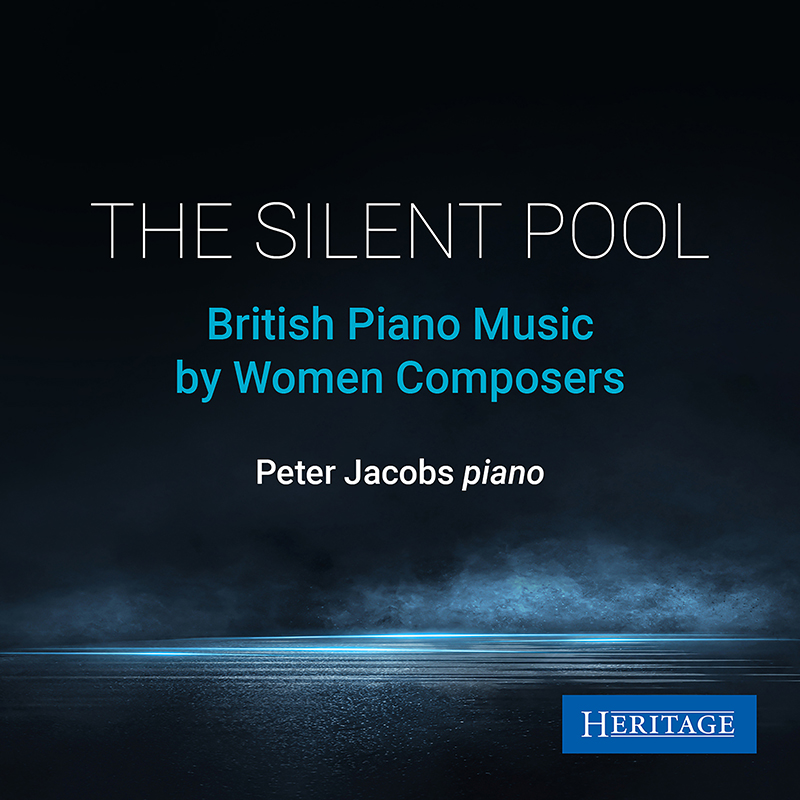
On Record – Peter Jacobs: The Silent Pool: British Piano Music by Women Composers (Heritage Records)

Peter Jacobs (piano)

Smyth Piano Sonata no.3 (1877); Piano Sonata no.2 (Andante) (1877)
Maconchy A Country Town (nos. 1, 3, 4, 5 & 7) (1945)
Williams The Silent Pool (1932)
Grime The Silver Moon (2025)
Dring Colour Suite (1963)
Bingham The Moon Over Westminster Cathedral (2003)
Woodforde-Finden Indian Love Lyrics (nos.2 & 1) (1903)
McDowall Vespers in Venice (2002)
Bingham Christmas Past, Christmas Present (1991)
Roe A Mystery of Cats (nos. 1, 4 & 5) (1994)
Beamish Lullaby for Owain (2016)
Da Costa Gigue; Moods (both 1930)
Lehmann Cobweb Castle (nos. 2 & 5) (1908)

Heritage Records HTGCD126 [75’40”]
Producer / Engineer Paul Arden-Taylor

Recorded 16 September 2024 & 26 January 2025 at Wyastone Concert Hall, Wyastone Leys, Monmouth

Reviewed by Richard Whitehouse

What’s the story?

Peter Jacobs continues his productive association with the Heritage label with this anthology that takes in a well-planned overview of piano music by female British composers, ranging across over more than 130 years of creativity in an impressive variety of idioms and genres.

What’s the music like?

Although female composers had been active in the UK from the outset of the English Musical Renaissance and before, relatively few came to prominence during their lifetime, with many others destined to be rediscovered only years and sometimes decades after their death. While hardly the first of its kind, the present collection is among the most representative in terms of its stylistic coverage which, in turn, underlines they should not be pigeon-holed any more than their male counterparts. Moreover, what was the loss to earlier generations is our gain today.

This recital opens with the redoubtable Ethel Smyth – her Third Piano Sonata contrasting the equable motion of its initial Allegro with the impetuous manner of its closing Allegro vivace. From its larger scale predecessor, the central Song Without Words affords ruminative space between the dynamism and tensions of those movements either side. Of the five (out of nine) pieces in Elizabeth Maconchy’s suite, the eloquent Lament and limpid Bells are especially appealing. Grace Williams is at her most haunting in the piece as gives this collection its title, and Helen Grime pens a miniature stark yet pellucid. Among the most versatile composers of her generation, Madeleine Dring is represented here by a five-movement themed suite which includes such delights as the quizzical Pink Mirror or the appropriately sensuous Blue Air. Judith Bingham may be best known for her choral and brass band music, but there is nothing unpianistic about so translucently textured a nocturne.

Two of Amy Woodforde-Finden’s four-piece suite include the elegant poise of Less than the Dust, while Cecilia McDowall sounds a note of spatial immensity in her Venetian evocation. The four pieces of her Christmas suite find Bingham pursuing an altogether more winsome vein of expression – duly complemented by three out of five whimsical feline homages by Betty Roe, happily still going strong in her 96th year. Sally Beamish contributes a (surprisingly?) capricious lullaby, with two pieces by the short-lived Raie da Costa typifying her witty and sassy manner. The wistful charm of Liza Lehmann, two of six pieces from her only piano suite, affords an elegant then touching envoi.

Does it all work?

As an overall sequence, absolutely. At around 75 minutes, this concert-length recital can be enjoyed as a continuous sequence or in any number of selections. It helps when Jacobs is so persuasive an exponent of this music, much of it remaining little known other than to pianists with his breadth of sympathies but which ought to find an audience given exposure in a live context. As he himself notes, this “random selection [is] united by being rewarding to play, beautifully written for the instrument, varied in style and intellectual depth”. Enough said.

Is it recommended?

It is. Piano sound is as full and spacious as expected given its Wyastone source, while Jacobs contributes laconically insightful notes on the recital overall. Most enjoyable, with hopefully enough material in this pianist’s “library of over 60 years collecting” to warrant a follow-up.

Listen / Buy

You can read more about this release and explore purchase options at the Heritage Records website

Published post no.2,682 – Thursday 9 October 2025

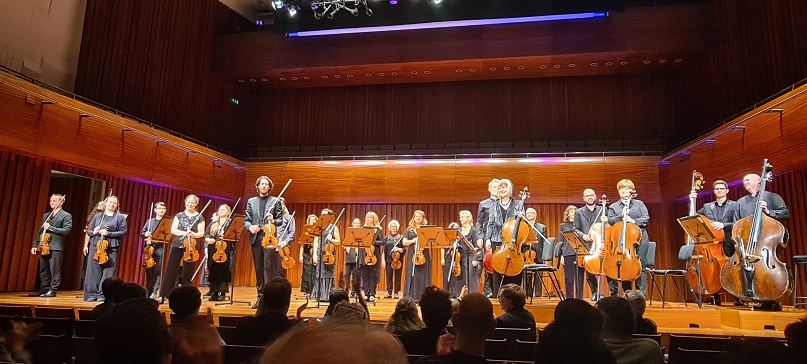
In concert – Britten Sinfonia / Thomas Gould & Agata Zając @ Milton Court: Musical Everests – The Year 1953

Thomas Gould (violin/director), Miranda Dale (violin), Caroline Dearnley (cello), Britten Sinfonia / Agata Zając (Maconchy)

Corelli Concerto Grosso in F major Op.6/2 (publ. 1714)
Tippett Fantasia Concertante on a theme of Corelli (1953)
Maconchy Symphony for Double String Orchestra (1953)
Phibbs Flame and Shadow (2023)
Walton Finale from Variations on an Elizabethan Theme (1953)

Milton Court, London
Wednesday 24 May 2023

Reviewed by Ben Hogwood Pictures (c) Ben Hogwood

This typically imaginative concert devised by the Britten Sinfonia took as its starting point the events of 1953, where the United Kingdom shifted on its axis. It was of course the year in which Britain witnessed a Coronation, and in which Everest was scaled, but other than Walton’s jubilant finale to the collaborative composer project Variations on an Elizabethan Theme, no explicit musical links were made.

Instead, the Britten Sinfonia concentrated on two major works written for string orchestra in that year – one now well-known and one barely performed. The underdog, Elizabeth Maconchy’s Symphony for Double String Orchestra, made a very strong impression in this performance, brilliantly played by string players using a handwritten manuscript from 1953. The difficulty of this task necessitated a conductor, with Agata Zając joining at short notice. Hers was a dynamic presence, helping emphasise the rhythmic flair and dramatic impetus of the piece.

Maconchy’s music has often been critically coveted but is rarely heard in the concert hall – sadly an all-too familiar plight for a female composer innovating in the 20th century. Where many British composers wrote to include the countryside around them she wrote in a continental style, her music powered by fertile melodic imagination and rhythmic vitality. At times there are elements of Stravinsky and Bartók in her music but the closest parallel is Frank Bridge, with whom she shared an ability to explore the outer reaches of tonality without selling listeners short on melody.

The first movement of the Symphony grips the listener immediately, its powerful forward momentum complemented by soaring violin solos, which Thomas Gould played to perfection here. The febrile main motif bore close resemblance to Stravinsky’s Symphony in Three Movements, and Maconchy’s treatment of it was economical and engaging. Emotionally, however, the heart of the piece lay in the second movement Lento, where an eerie figure crept slowly upwards from cellos and basses, refusing to give way to the sweeter intimate melodies above. A rustic Scherzo, laden with syncopation, was followed by an equally captivating finale, initially pensive but with gathering intensity and drive. Just before the end the music broke out into a joyous country dance before returning to its more angular outlines.

The Britten Sinfonia were at the top of their game, subtly and superbly drilled by leader Gould. Each player was fully engaged, with smiles and nods of encouragement frequently passing between the team. When these qualities are natural, as they were here, a performance is elevated for the audience – and that was certainly the case for Corelli’s Concerto Grosso in F major, second in his set of twelve published as Op.6 in 1714. This opened the concert, dovetailing neatly into the work of Sir Michael Tippett, which it inspired.

Elegance and style were to the fore in the Corelli, with clean melodic lines given just a hint of vibrato for expression, and the interplay and balance between the three soloists and orchestra ideally judged. The work’s sunny countenance spilled over into the Tippett, though here the sun’s rays took on a more ecstatic quality.

The Fantasia Concertante on a theme of Corelli, also dating from 1953, is a compelling study in time travel. Tippett presents the original 18th century material unadorned, but adds his own unique musical language incrementally, so the piece becomes awash with bright colour and reaches a feverish intensity. Gould led a performance to savour, with fulsome support from fellow soloists Miranda Dale (violin) and Caroline Dearnley (cello). Together with the enhanced Sinfonia they rendered the golden textures beautifully, enhancing the elegance of the original material.

With the Tippett and Maconchy works a formidable pair either side of the interval, it says much for the London premiere of Joseph Phibbs’ new work that it was not in any way overshadowed. Though Flame and Shadow looked beyond events of 1953 for its stimulus it nonetheless bore a resemblance to the new coronation, its fresh take on music for strings revealing a busy contemporary approach.

Phibbs has an original and imaginative way with writing for strings, using audience-friendly melodic figurations but allowing them to roam harmonically, changing their perspective. The punchy rhythms of the Dance section here were a thrill, as were the combination of rapid fire and sustained open string pizzicato heard throughout the Interlude. Flame and Shadow, taking its title from a collection of verse by Sara Teasdale, was an edge of the seat piece, even to its closing Vocalise section, where a melody closely related to that found at the opening of Sibelius Symphony no.4 had a sobering effect. The contrasts of darkness and light were vivid and left a lasting impression – as indeed did the whole concert.

In twenty years of covering Britten Sinfonia concerts, and marvelling at their programming and technical prowess, this Milton Court evening confirmed their musical health to be stronger than ever. If only the same could be said for their long-term financial prospects, thrown into doubt by the withdrawal of funding in the latest Arts Council England cuts. Without the immediate publicity of similar actions levelled at English National Opera and the BBC Singers, the Britten Sinfonia have just launched their Play On fundraising campaign. The initial response has been encouraging, but it needs to raise more to secure the organisation’s future. Please do consider giving – I certainly will. This is the only way their imaginative concerts and a wealth of community-based outreach across East Anglia – where they are the only full time orchestra – can continue.

You can read all about future concerts from the ensemble at the Britten Sinfonia website. Click on the composer names to read more about Joseph Phibbs, Elizabeth Maconchy and Sir Michael Tippett – and for more details on concerts at the venue, visit the Milton Court website

In appreciation – BBC Singers

by Ben Hogwood

Yesterday we learned of the almost incomprehensible decision by the BBC that they were planning to close the BBC Singers. The choir is one of the leading ensembles of its type in the UK – if not the leading example – and have been responsible for many important premieres and landmark concerts over their 99-year existence.

Only in 2020 they were on stage as the Proms concerts returned, with a memorable performance of Eric Whitacre‘s Sleep, while if you want proof of their versatility from this year, watch this video of an arrangement of ABBA‘s Little Things:

The Spotify playlist below celebrates just some of the recordings made by the BBC Singers, in the hope that they will somehow be able to continue their invaluable service to British music. Included are shorter works by John McCabe, Sir Michael Tippett, Elizabeth Maconchy and Diana Burrell, alongside excerpts from Mozart’s Requiem, under Jane Glover, Janáček’s The Excursions Of Mr. Brouček, in a Proms performance under Jiří Bělohlávek, and the same forces at work in Smetana’s large scale opera Dalibor.

Finally the Singers can be heard in the striking Moth Requiem by Sir Harrison Birtwistle, which they premiered at the Proms in 2013.

If you do listen, please also make sure you sign the petition calling for the BBC to reconsider their decision,