Lukas Sternath (piano), Elizabeth Watts (soprano), Laurence Kilsby (tenor), BBC Singers, BBC Symphony Chorus, BBC Symphony Orchestra / Sakari Oramo
Gipps Death on the Pale Horse Op.25 (1943) [Proms premiere] Grieg Piano Concerto in A minor Op.16 (1868 rev.1907) Bliss The Beatitudes F28 (1961)
Royal Albert Hall, London Sunday 7 September 2025
Reviewed by Richard Whitehouse Photos (c) BBC / Chris Christodoulou
This evening’s Prom – launching the final week of the present season – was billed as ‘Grieg’s Piano Concerto’, no doubt the reason why many in the audience were attending while hardly being the most interesting aspect of a typically adventurous programme from Sakari Oramo.
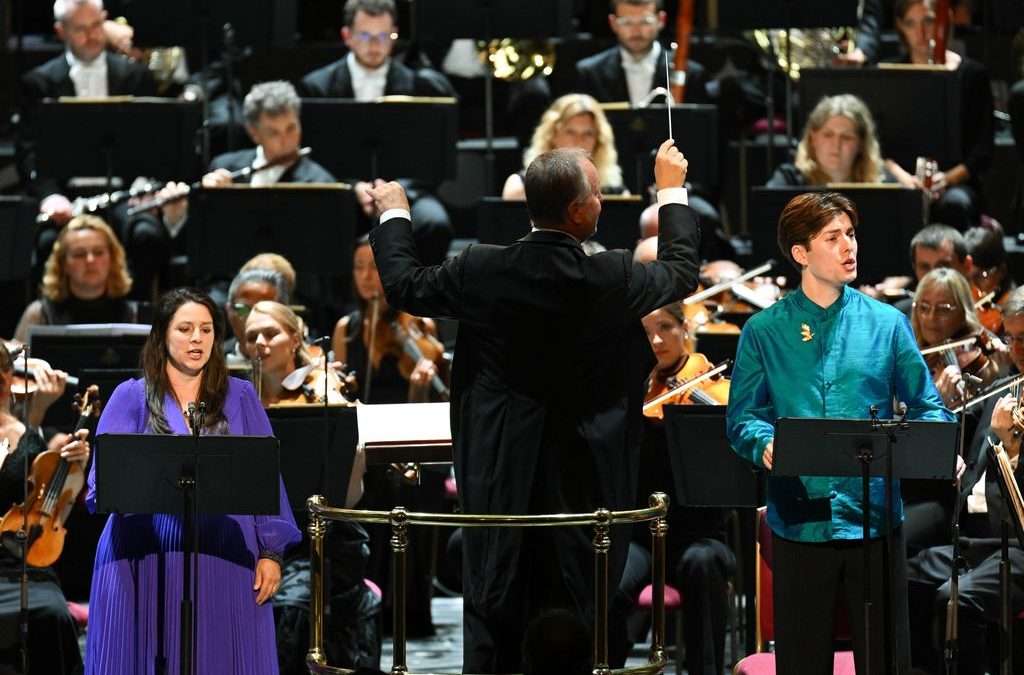
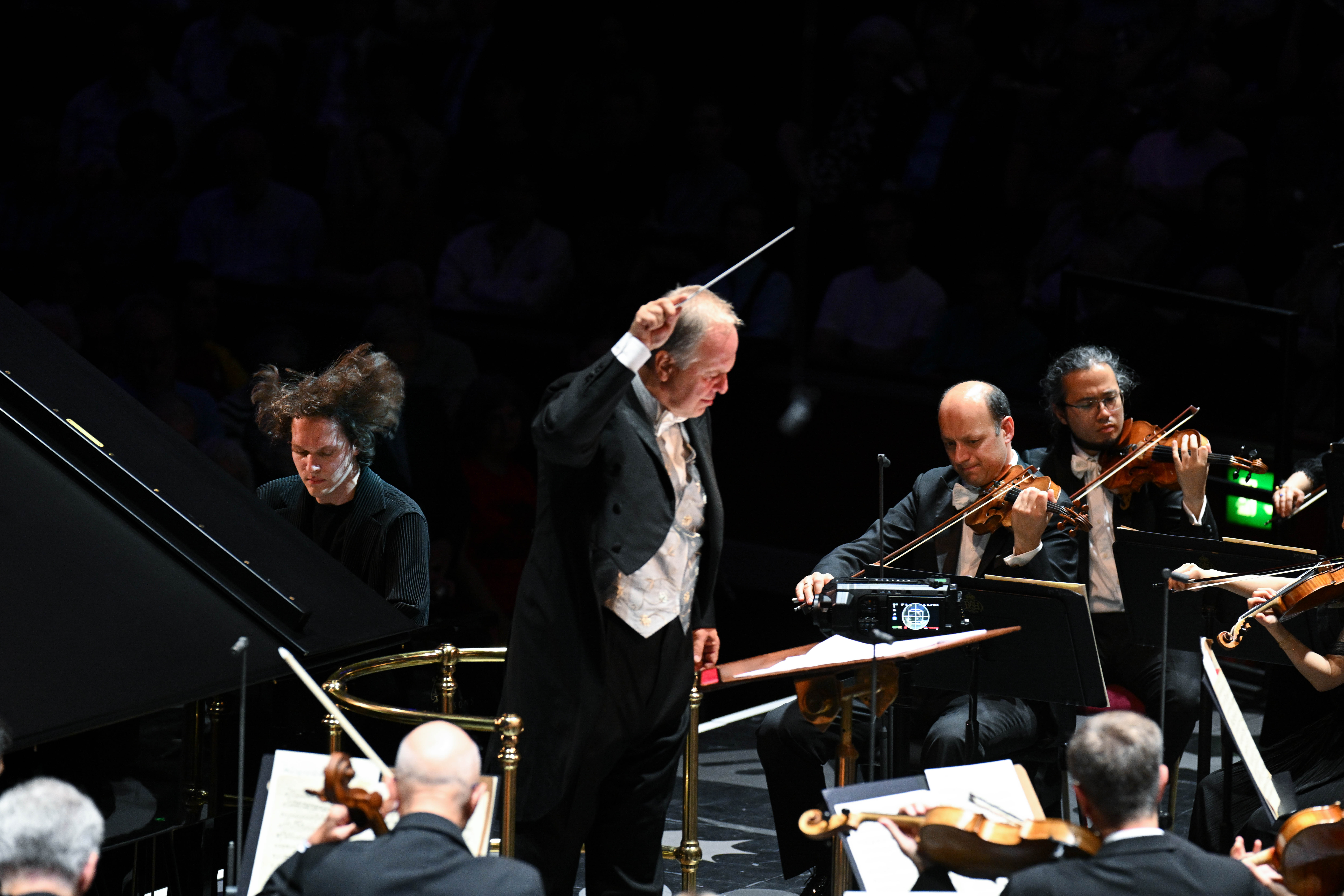
In the event the Grieg received a responsive reading from Lukas Sternath (below, with Oramo), the Viennese pianist who, still in his mid-20s, was most at home in more inward passages. The second theme of the initial Allegro was enticingly taken up after a heartfelt rendering by cellos, as was the Adagio’s eloquent melody and that first emerging in the finale on flute, where it was soulfully rendered by Daniel Pailthorpe. Nor were the more demonstrative aspects underplayed – Sternath having the measure of a cadenza whose mounting rhetoric was pointedly reined-in, while the finale’s outer sections were incisively inflected prior to an apotheosis which felt the more exhilarating through its absence of bathos. A melting take on Richard Strauss’ early song Morgen!, transcribed with enviable poise by Max Reger, served to reinforce Sternath’s formidable pianistic credentials.
The 50th anniversary year of Sir Arthur Bliss’s death has seen a gratifying number of revivals, few more significant than that of The Beatitudes. The misfortune of its premiere having been moved from Coventry’s new Cathedral to its Belgrade Theatre, thus freeing up rehearsal time for Britten’s War Requiem, rather condemned it as an also-ran from the outset. Yet Bliss had created a piece unerringly suited for the consecration in what, in itself, remains an impressive conception. Unfolding as 14 short sections which can be grouped into six larger movements, this is less a cantata than a choral symphony. Setting all nine Beatitudes, Bliss none the less merged several of these and interspersed them with settings from three 17th-century and one 20th-century ‘metaphysical’ poets to commemorate the past from the vantage of the present.
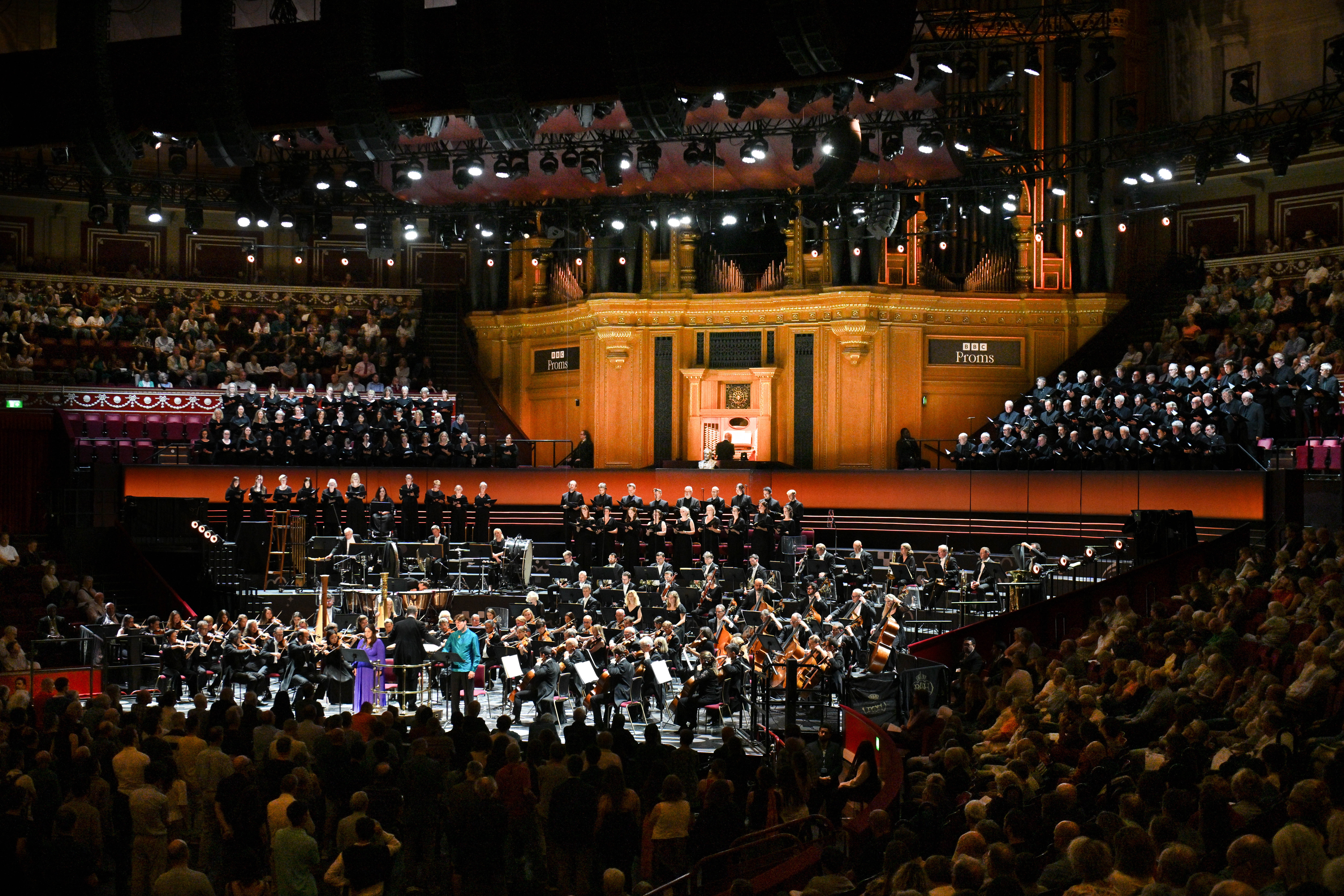
The texts, drawn from Henry Vaughan, George Herbert and Jeremy Taylor, anticipate a future redemption – as, more ambivalently, does Dylan Thomas in And death shall have dominion which builds implacably to the climactic Ninth Beatitude and Voices of the Mob prior to the hard-won serenity of the Epilogue. That The Beatitudes has enjoyed relatively few revivals is less to do with its intrinsic quality than the demands of its choral writing, to which the BBC Symphony Chorus and BBC Singers did notable justice. Elizabeth Watts responded with real sensitivity and perception to some radiant soprano writing and while Laurence Kilsby was a little effortful in the more demonstrative passages, he brought conviction to a tenor role both fervent and compassionate. Nor did Richard Pearce disappoint with his extensive organ part.
Oramo paced the 50-minute entity superbly as to make one hope he will tackle more works by Bliss – not least the masterly Meditations on a Theme by John Blow, which has inexplicably fallen through the net this year. He had started tonight’s concert with a most welcome revival for Death on the Pale Horse – the succinctly eventful tone poem by Ruth Gipps which, while it might not capture the visceral drama of Blake’s eponymous engraving, distils an evocative atmosphere from pithy initial ideas that audibly reflects the circumstances of its composition.
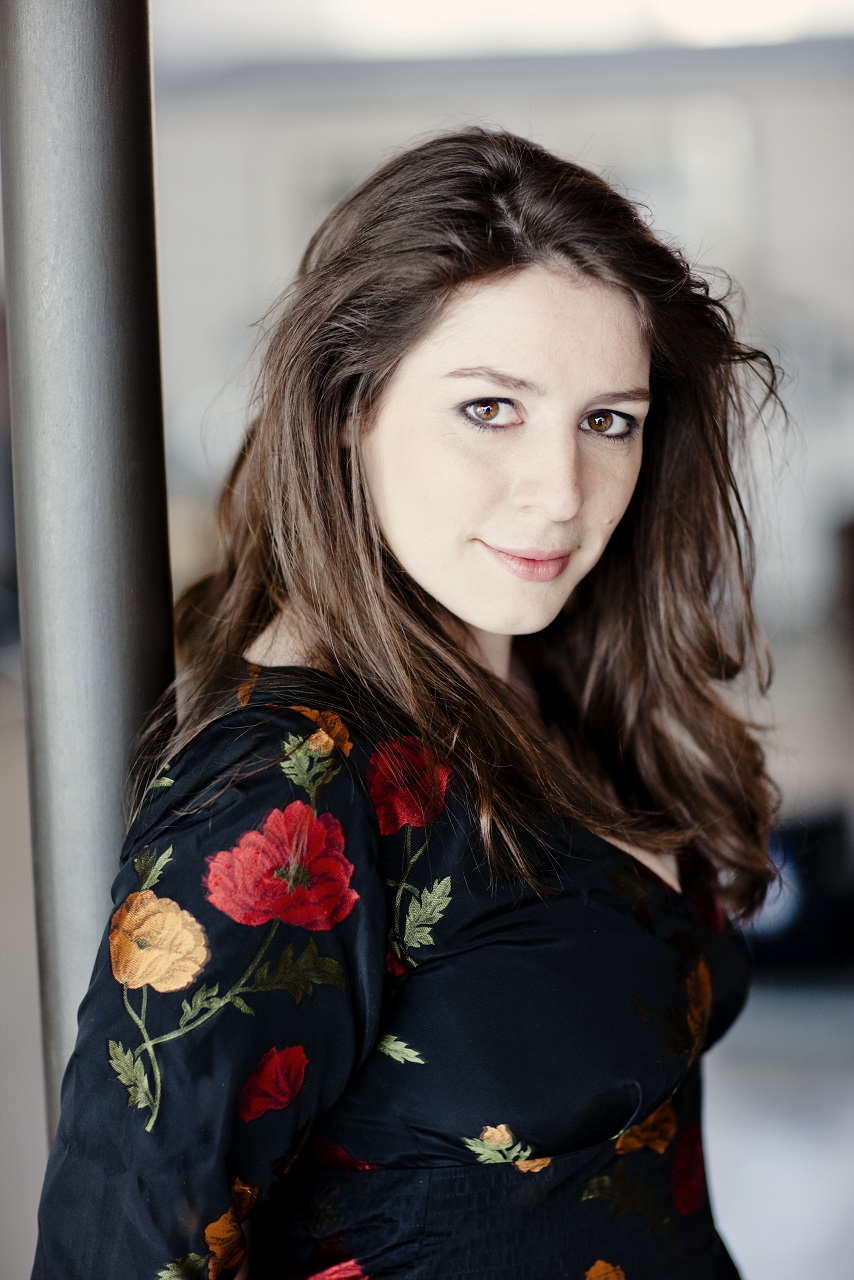
Elizabeth Watts (soprano, above), Julius Drake (piano, below)
Gustav Holst Calm is the morn Op. 16 No. 1 (1903-4), Persephone Op. 48 No. 1, Betelgeuse Op. 48 No. 12 (1929), The heart worships (1907), The Floral Bandit Op. 48 No. 6 (1929) Imogen Holst Weathers (1926), 4 Songs from Tottel’s Miscellany: Shall I thus ever long, As lawrell leaves (1944), 10 Appalachian Folk Songs: My dearest dear, The brisk young lover, I must and I will get married (1938, world première performances) Gustav Holst Hymns from the Rig Veda Op. 24 (1907-08)
Wigmore Hall, London, 3 January 2022
reviewed by Ben Hogwood from the online broadcast. Artist photos (c) Marco Borggreve
The songs of Gustav Holst have largely eluded British performers and concert audiences over the years, and a quick scan over retail sites reveals just the one recording in the last decade. The songs of Imogen Holst, meanwhile, are even more scarce, so it was doubly welcome that this imaginative recital from soprano Elizabeth Watts and pianist Julius Drake chose to pair works by father and daughter.
Holst senior was a composer capable of finding unusual stillness in music, as the Venus and Neptune movements from his orchestral suite The Planets testify. That talent extended to his songs, and we heard several examples where the composer took his time to set the scene, helped in extremely sympathetic performances from Watts and Drake.
Calm is the morn, a Tennyson setting, found a deep peace tinged with sorrow, though the high notes floated effortlessly by Watts were rather special. These contrasted vividly with the stately Betelgeuse, low in the range while contemplating the end of life – just as Neptune explored the boundaries of the living and the dead at the edge of the solar system. In theory Betelgeuse, with text by Holst’s good friend, the poet Humbert Wolfe, should be more effective with a male voice but Watts found the mysterious depths too. Drake’s tolling chords were the ideal foil, and indeed the pianist proved sensitive to every slight nuance in his scene setting, particularly the slow chorale figure of The heart worships. This was another setting that took its time but was all the more moving for it, with the soprano’s low range well controlled. The Floral Bandit, another Wolfe setting, flitted between quick piano figurations and a restless, high contour from the voice, deliberately uncertain in its direction. Meanwhile Watts’ fretful tones caught the urgency given to Persephone.
Holst was always a keen melodist, a quality that runs through Imogen’s music too. As her father did, she had a keen interest in folk melodies both from this country and further afield, and it was fascinating to compare Watts and Drake’s Anglo-American selection, sourced with help from the Benjamin Britten archive at the Red House, with the songs digitised for performance here.
Imogen’s writing celebrated the open air, its melodies often reaching for the sky. The first song Weathers revelled in its freedom, with a lovely pointed piano part to offset the folksy tune. Drake then enjoyed the trippy syncopations from the piano, combining with a bright soprano line for Shall I thus ever long, Watts keeping clarity in the quick moving words. The slightly elusive As lawrell leaves was next, before the three Appalachian folk settings, collected by Cecil Sharp, exhibited a powerful yearning quality. My Dearest dear kept the folk melody true but turned the melody beautifully. The brisk young lover could almost have been Gustav Holst himself, though Imogen’s piano parts felt more directly connected to the melody. There was an unexpectedly devastating beauty to the simple, sad, final verse, before I must and will get married took a lighter approach.
A rare performance of the complete set of Gustav Holst’s Hymns from the Rig Veda followed. It is remarkable to think these works were published in 1908, for they still sound forward looking today, written as they were after the composer made his own translations of the sacred texts.
Holst’s advanced harmonic thinking was distilled by Drake, while Watts took the longer and more complex melodic phrasing in her stride. The accumulating brightness of Ushas (Dawn) gave way to a stern Varuna I (Sky), where confession of sin was made and ultimately quashed. The sudden movements of Maruts (Stormclouds) came as something of a shock, with the flashing of sword blades, before Indra (God Of Storm and Battle) assumed a regal air with grand chords and a bold melody, strong as an ox under Watts’ delivery. Really impressive power from both in this song. Varuna II explored mysterious and ultimately deathly waters, the listener almost losing a harmonic centre, before Song of the Frogs charmed with its burbling activity. Vac (Speech) gave us another slow and concentrated song, while Creation was even more compelling with its haunting, mostly unaccompanied writing. Finally the wandering piano line for Faith found the soprano ‘rising in silent worship’.
This remarkable set of songs are not only harmonically adventurous but have words that are prescient for today’s climate and particularly the management of the Earth on which we live. Little did Holst know the way in which his work would be thought provoking nearly 115 years on. Watts recognised this, lending a lighter touch to her encore which was Imogen’s arrangement of Henry Carey‘s The Beau’s Lament, brightly sung.
This was a special concert, one of a kind – and a mention should be made for the quality of Wigmore Hall’s camera work, sensitive to both text and performers. Copyright restrictions may prevent them from doing so, but it would be wonderful to see Watts and Drake present this programme in recorded form, for they illuminated aspects of the Holst dynasty rarely glimpsed in the concert hall. Do watch it if you can.
Watch and listen
Sadly the Imogen Holst songs are not yet available in recorded form, but you can the selection from her father Gustav on the Spotify playlist below:
Various venues in Oxford, Saturday 9 October. Artists as listed below
Written by Ben Hogwood from online streams
The Oxford Lieder festival is into its 20th year, a cause for celebration indeed. It has become one of the UK’s finest classical music events, lovingly curated and produced but gathering increasing levels of enthusiasm every year.
The 2021 model is ideally weighted, with live music events streamed and recorded for posterity – an ideally weighted dual approach in these uncertain times. Titled Nature’s Songbook, it has set aside days for anniversary composers Saint-Saëns (100 years since his death) and the lesser-heard Swedish composer Wilhelm Stenhammar (150 years since his birth)
Saint-Saëns had his day on the Saturday, offering audiences a chance to appreciate his under-heard Mélodies in the context of better-known chamber and stage works, not to mention works by pupils and contemporaries. Baritone Victor Sicard & pianist Anna Cardona (above) were on first, the 2011 winners of the festival’s Young Artists Platform giving a recital from the ideal acoustic Saint John the Evangelist.
They began with a pupil and close friend of the featured composer. Gabriel Fauré was to become one of the very finest French composers of the 20th century, his output headed but not restricted to sublime contributions in the world of chamber music, piano and song. We heard his first published song cycle Poème d’un jour Op.21, a brief affair – which is ironic, since the subject of Charles Grandmougin’s verse was exactly that. Sicard found his feet in the slightly sorrowful first song, with an easily flowing piano part from Cardona. There was strength of character in the second, and wistfulness in the third as the day-long love affair fizzled out.
Saint-Saëns melodies followed and – as is often the case with this composer – hit the mark immediately. The attractive La Brise was secured by a rustic drone from Sicard’s left hand, which also gave its urgency to the next song. Emotionally the heart of this selection lay in La splendeur vide Op.26/2, which was followed by the Danse macabre, Saint-Saëns working with inner resolve. Perhaps it lacked a little edginess but a really strong connection between the two was clear.
Fauré’s pupil Ravel was next, and Sicard found the exquisite, timeless quality of Kaddisch, its melodic inflections beautifully expressed and contrasting with the questioning L’Énigme Éternelle. Following this was Histoires Naturelles, the ideal choice given the festival’s theme. Cardona had a strong descriptive role to play, with some lovely detail portraying Crickets, and The Swan too, which had strong characterisation. The Guinea Fowl’s ‘rowdy and shrill’ ending was perfectly judged by the pair – as was an exquisite encore of Chanson française.
Later we further examined the link between teacher and student in the Jacqueline du Pré Music Building, as violinist Fenella Humphreys and pianist Martin Roscoe played sonatas by Saint-Saens and Faure. In an aside to the audience, Humphreys revealed it was the first time the duo had performed the Saint-Saens Violin Sonata no.1 in D minor Op.75 (1885), realising a long-held dream of playing a work in public she had loved since childhood.
The closer acoustics of the hall took a little while to adjust to – certainly on the live stream – but it was easy to admire the duo as they met the challenges of the busy first movement head on, getting beneath the tumultuous phrases to the deeper emotion below. The softer-hearted second theme, a chorale, with rippling arpeggios from the piano, reminded us that the Organ Symphony was not far off – and it was beautifully rendered here. A keenly felt Adagio led to a balletic third movement, initiated by Roscoe’s nicely pointed piano part. There was however a strong sense of everything pointing towards the finale. Its tremendous technical demands were comfortably conquered, but again the music’s feeling won the day, Humphreys playing winsome long phrases. Both players enjoyed the return of the ‘chorale’ theme, but also the peal of bells evoked by Roscoe from the piano.
Fauré’s Violin Sonata no.1 in A major Op.13 is an early work, written nine years earlier, when it was given a glowing review by his teacher. Humphreys spoke affectingly of its significance during lockdown, and it was clearly a tonic for her to be playing it again. The two players dovetailed beautifully, Roscoe’s flowing introduction picked up seamlessly by Humphreys’ lyrical phrases. The slow movement took time for deep thought, its gently undulating piano a foil for the violin’s probing melodies, gradually building to a deeply felt apex. The scherzo was winsome, its syncopations tripping over each other happily. An ardent account of the fourth movement found the players deep in conversation, right up to the end of this richly rewarding piece. It is difficult to write about what makes Fauré such an attractive composer – his gifts are plentiful but elusive – yet this performance had all the qualities that so impressed his teacher.
A strong cast of thirteen musicians assembled for a pair of concerts in the Saint John the Evangelist church. They were led by soprano Elizabeth Watts, and baritone Felix Kemp, with pianists Jâms Coleman, Martin Sturfält joined by principal players of the Echor Chamber Orchestra (Anna Wolstenholme (flute / piccolo), Jernej Albreht (clarinet), Owen Gunnell (percussion), Jonathan Stone and Sara Wolstenholme (violins), William Bender (viola), Nathaniel Boyd (cello), Laurence Ungless (double bass)
It is funny to think Saint-Saëns prohibited performances of Le Carnaval des Animaux in his lifetime, for fear of being dismissed as a frivolous composer. In the event the suite was published a year after his death, and the piece has had an enduring appeal ever since. The Oxford Lieder edition recognised that appeal but interspersed his suite with an array of animal-based songs from contemporaries and countrymen, together with short readings from nonsense verse by Ogden Nash.
The programme was brilliantly conceived but was too big, including a total of 17 songs alongside the Carnival without a break, meaning the flow was difficult to pick up at times. That said, the imaginative set of works largely succeeded thanks to the artistry on stage. Watts’ versatility was evident in the oppressive heat of Chausson’s La Caravane, its powerful vocal line in thrall to Wagner, and also in the amusing tale of La Cigale et la fourmi as set by Offenbach, with some brilliant high notes at the end.
There was a striking duet between Watts and flautist Anna Wolstenholme, portraying Roussel’s Rossignol mon mignon, before the soprano found the nub of Hugo Wolf’s solemn Wie lange schon war immer mein Verlangen. Felix Kemp was an effective foil, capturing the micro portraits of animals as realised by Poulenc from Apollinaire’s poetry, as well as Britten’s elusive Fish in the unruffled lakes.
The Carnival itself was a huge amount of fun. From the boisterous Introduction and Royal March of the Lion onward, it was nice to see the performers enjoying themselves in this irrepressible music. Double bassist Laurence Ungless caught the character of The Elephant, lumbering into view, while The Swan was beautiful and effortless in the hands of Nathaniel Boyd. Pianists evinced some ready laughter, before we returned to Watts for the rather lovely final song, Grieg’s own portrayal of the swan, which found her using a third language of the evening. The Echor soloists wrapped up with a celebratory finale, putting the cap on a concert which may have been too long, but which was ultimately enjoyable.
A packed day ended with a late evening recital from Adèle Charvet & Anne Le Bozec. Subtitled Mélodies on Tour, their program began with three English-language songs – two about sleep from Gounod, by turns perky then lustrous, with a setting of Longfellow’s poem Sleep. Saint-Saëns himself was next, evoking a heady atmosphere with A Voice By The Cedar Tree but then agitated in La mort d’Ophélie, where Charvet held an impressively strong tone.
The recital alternated songs by our chosen composer with a well-chosen selection of eight songs from Pauline Viardot, to whom Saint-Saëns dedicated his opera Samson et Dalila. Her song Lamento was the most directly communicative song, and an indication of why she is finally starting to get the exposure she deserves in a male-dominated field. Noch’Yu, one of two Pushkin settings, was evocative in this setting, but the pick of the eight was Aimez Moi, which brought a rapt stillness to proceedings.
Saint-Saëns‘ two settings of Uhland featured a striking piece of writing in the low register during Antwort, very well handled by Charvet, then the composer exaggerating his feelings rather in Ruhetal. Later we heard Guitares et Mandolines, the composer relishing the chance to depict the instruments in Anne Le Bozec’s deft accompaniment. The agitated Tournoiement spun itself into an eternal whirlpool.
There was time for two songs from Massenet, another underrated songwriter – his Crépuscule and Nuit D’Espagne expertly crafted examples, the latter with a Habanera-like profile – to which we returned in Viardot’s Madrid. The context of these night-time songs helped put the seal on a fascinating and richly rewarding set of concerts, showing the strength of depth French composers have to offer.
For further information on this year’s Oxford Lieder festival, you can visit the event’s website here
Elizabeth Watts (soprano)*, David Butt Philip (tenor)**, BBC Symphony Chorus & Orchestra / Martyn Brabbins
Vaughan Williams
A Pastoral Symphony (Symphony no.3)* (1921)
Symphony no.4 in F minor** (1931-4)
Saraband, ‘Helen’ (1913-4)
Hyperion CDA68280 [80’57”]
English text included Producer Andrew Keener Engineer Simon Eadon
Recorded 26 & 27 November (Symphonies), 2 December 2018 (Helen), Watford Colosseum, UK
Reviewed by Richard Whitehouse
What’s the story?
Martyn Brabbins and the BBC Symphony Orchestra continue their cycle of the symphonies by Vaughan Williams with the Third and Fourth, two ostensibly very different pieces whose equally equivocal reception at their premieres now seems testament to their expressive reach.
What’s the music like?
No longer the relative rarity it once was, A Pastoral Symphony remains the most elusive of this cycle – its arcadian rapture shot-through with imagery of war and transience.
Brabbins sets a well-nigh ideal tempo for the opening movement, its deceptively passive interplay of landscape and evocation informed by eddying agitation made more explicit in its successor – whose distanced solos for horn and (offstage) trumpet afford concrete recollections of VW’s wartime experience, made the more poignant by being sensed on the edge of consciousness. For all its greater physicality, the third movement is no conventional scherzo in its eliding between moods with an agility finely conveyed here through Brabbins’s judicious pacing – not least that eerily flitting coda which forms an unerring transition to the finale. Its remote outer sections enhanced by Elizabeth Watts‘s yearning vocalise, this unfolds as a necessary culmination; the composer bringing to the fore emotions earlier half-glimpsed on the way to a powerfully wrought climax, leaving in its wake a catharsis more potent for its intangibility.
From here to the seismic eruption of the Fourth Symphony is to set forth on a very different journey, one of absolute expression in combat with force of circumstance. Brabbins keeps a firm yet flexible grip on the initial Allegro, its violent opening balanced by the fugitive calm into which it withdraws. He then finds the right ‘walking’ tempo for the Andante, this sombre if never featureless landscape underpinned by angular harmonic progressions that twice break out in ominous outbursts prior to the flute’s lamenting soliloquy towards its close. Perhaps the Scherzo’s outer sections could have evinced greater sardonic humour, though the overbearing pomposity of its trio is as finely judged as is the pulsating transition into the finale. Brabbins duly brings out its martial swagger and if tension during the earlier stages could be even more acute, the ghostly throwback at its centre yields a wan rapture and how persuasively he draws the thematic elements together in the epilogo fugato for a stretto of mounting tension whose denouement is a return to the work’s fateful opening gesture and a four-letter clinching chord.
As makeweight, Saraband ‘Helen’ proves an enticing discovery. Left unfinished towards the outbreak of the First World War, this setting of lines from Marlowe’s Doctor Faustus may be off-balance in its utilizing tenor and chorus for what surely needed to become a larger entity, though both David Butt Philip and the BBC Symphony Chorus acquit themselves ably, while Brabbins secures playing of real elegance and finesse in orchestral writing that inadvertently yields what emerged as the main theme of Serenade to Music almost a quarter-century later.
Does it all work?
Almost entirely. Those who have acquired the earlier releases in this series (A Sea Symphony and A London Symphony) will be aware of the qualities which Brabbins brings to VW, and so it proves here with what is among the finest recent accounts of the Pastoral. Others have evinced a more visceral response in the Fourth, but there is no lack of impact – allied to a methodical sense of purpose that pays dividends in those densely contrapuntal passages over which the composer laboured before ultimately getting them right.
Is it recommended?
Indeed. Sound has the sense of perspective but also immediacy necessary in this music, with Robert Matthew-Walker once again contributing a detailed and informative note. Hopefully the next instalment, featuring the Fifth (and Sixth?) Symphony, will not be long in coming.
For further information on this release, visit the Hyperionwebsite, or theBBC Symphony Orchestra. You can also read Arcana’s interview with the conductor here
Prom 14: Elizabeth Watts (soprano), Louis Lortie (piano), BBC Philharmonic Orchestra / John Storgårds
Wagner Die Meistersinger von Nürnberg – Prelude to Act One (c1861) Schubert (orch. Liszt) Four Songs (1825/1815/1826/1815, orch. 1860) Zimmermann Symphony in One Movement (1947-51, rev. 1953) Schubert (arr. Liszt) Fantasy in C, D760, ‘Wanderer’ (1822, arr. c1850) Sibelius Symphony No. 7 in C, Op. 105 (1924)
John Storgårds has given some enterprising concerts during his tenure as Chief Conductor of the BBC Philharmonic Orchestra, and this evening’s Prom was a further instance with its programme of mainly one-movement pieces and an underlying emphasis on symphonic cohesion, even unity.
The exception was the sequence of four songs by Schubert, arranged for orchestra by Liszt so that a tenuous cohesion is evident – without this being a song-cycle as such. Elizabeth Watts (below) duly had the measure of their predominantly sombre sentiments – ranging from the distanced recollection of Die junge Nonne, via remorseless passing of experiential time in Gretchen am Spinnrade and speculative radiance of Lied der Mignon, to visceral representation of fate in Erlkönig. Storgårds teased many subtleties from Liszt’s judiciously restrained orchestration.
Preceding this came a surprisingly dour account of the Prelude from The Mastersingers of Nuremburg. This grandest of Wagner music-dramas is also the most symphonic, not least its Prelude as it deftly outlines a four-movements-in-one format. While not being oblivious to this, Storgårds might have characterized these episodes more potently, though this may have been in line with his tendency to play down the music’s opulence and majesty. What resulted was a subdued and earnest performance that hardly marked him out as a budding Wagnerian.
Concluding the first half was the Symphony in One Movement by Bernd Alois Zimmermann; a timely hearing in this centenary year of the composer’s birth. Although the more discursive original version (complete with organ histrionics) has recently been revived, this revision is audibly more focussed in form and expression as it traverses a quirky yet combative sonata design – (modified!) exposition repeat included – before emerging full circle in a mood of unbridled ferocity. Storgårds was at his interpretative best here, maintaining a tensile course over an eventful score where influences of mid-century symphonism do not outface pointers to the intricacy or intensity of Zimmermann’s mature music. A notably enthusiastic reception suggested that tonight’s audience ‘got’ what the composer was about in this singular piece.
Time was when Liszt’s concertante realization of Schubert’s Wanderer Fantasy was a staple at these concerts, but this was only the second hearing in nearly six decades. 33 years ago, the soloist was Jorge Bolet at his unpredictable best, but Louis Lortie’s rendition (above) was altogether subtler as he brought out the pathos of the Andante then jocularity of the Presto. If the outer Allegro sections felt reined-in, this was not at the expense of that keen virtuosity informing Lortie’s playing in his solo passages or coruscating interplay with the orchestra at the close.
A century on, Sibelius not only ran movements together in his Seventh Symphony but fused them into a seamless and powerfully cumulative whole. Storgårds was certainly alive to this in what was a purposeful and often insightful reading; a little unsettled in those introductory pages, perhaps, but thereafter gauging the various transitions with a sure sense of where this music was headed while investing the vertiginous trombone entries with implacable majesty. One of this season’s most absorbing concerts thus far was brought to an impressive close.




 Prom 14: Elizabeth Watts (soprano), Louis Lortie (piano), BBC Philharmonic Orchestra / John Storgårds
 Preceding this came a surprisingly dour account of the Prelude from The Mastersingers of Nuremburg. This grandest of Wagner music-dramas is also the most symphonic, not least its Prelude as it deftly outlines a four-movements-in-one format. While not being oblivious to this, Storgårds might have characterized these episodes more potently, though this may have been in line with his tendency to play down the music’s opulence and majesty. What resulted was a subdued and earnest performance that hardly marked him out as a budding Wagnerian.
 Time was when Liszt’s concertante realization of Schubert’s Wanderer Fantasy was a staple at these concerts, but this was only the second hearing in nearly six decades. 33 years ago, the soloist was Jorge Bolet at his unpredictable best, but Louis Lortie’s rendition (above) was altogether subtler as he brought out the pathos of the Andante then jocularity of the Presto. If the outer Allegro sections felt reined-in, this was not at the expense of that keen virtuosity informing Lortie’s playing in his solo passages or coruscating interplay with the orchestra at the close.
 Arcana.fm