On Record – Parry Karp, BBC National Orchestra of Wales – Bloch: Schelomo & Suite (Signum Classics)

Ernest Bloch
Schelomo (1918)
Suite for Viola and Orchestra (1919; arr. Rejtő/Baller, 1969)

Parry Karp (cello), BBC National Orchestra of Wales / Kenneth Woods

Signum Classics SIGCD932 [60’58”]
Producer Phil Rowlands Engineer Andrew Smilie

Recorded 29-30 July 2024 at BBC Hoddinott Hall, Wales Millennium Centre, Cardiff

Reviewed by Richard Whitehouse

What’s the story?

Signum Classics issues its first release devoted to Ernest Bloch (1880-1959), comprising what is his best-known work alongside a piece that receives its first recording in a version for cello and orchestra – making for a representative introduction to this now under-appreciated figure.

What’s the music like?

Considered in his lifetime to be on a par with such contemporaries as Bartók and Stravinsky, Bloch duly suffered that almost inevitable falling off of reputation from which his music has never quite recovered, but almost all his major works have now been recorded and often on several occasions. Among his sizable output, those with a concertante element are especially notable for their redefining the relationship between soloist and orchestra as holds good for the present works, written as they were either side of the composer’s emigration to the USA.

Its title might translate as Solomon, but Schelomo is by no means a portrait of the Biblical monarch nor is the solo part merely a ‘translation’ of lines from Ecclesiastes such as Bloch had initially intended to set. This ‘Hebraic Rhapsody’ is the last and most representative, if not necessarily the finest, of his Jewish Cycle, its three contrasting sections amounting to a concerto (or maybe a Konzertstück) in terms of their encompassing a gradually cumulative ‘exposition’, then an impulsively tense ‘development’ whose impassioned climax subsides into a ‘reprise’ which takes in a musing accompanied cadenza prior to the starkly fatalistic close. Parry Karp is a perceptive interpreter – one who never over-emphasizes its eloquence or rhetorical overkill, while rendering the piece as a cohesive and an audibly unified whole.

Conceived for viola and piano, the Suite was orchestrated soon afterward then arranged for cello a half-century on by cellist Gábor Rejtő and pianist Adolph Baller. The layout, though not so integrated as to make it a concerto, is none the less striking. Its lengthy initial Lento (originally entitled ‘In the Jungle’) pits soloist against orchestra in a fantasia-like evolution that finds effective contrast in an alternately capricious and ruminative Allegro ironico, then the songfulness of an equally compact Lento; its searching inwardness pointedly dispelled by the lively and playful Molto vivo which brings about an affirmative conclusion. Karp is fully attuned to its understated charm and Kenneth Woods, who directed the likely premiere of this version in 2008, secures playing of sensitivity and imagination from the BBC NOW.

Does it all work?

Almost always. As his introductory note makes plain, Karp has been an enthusiastic advocate for this music throughout his career and there is no doubting the extent of his commitment in either piece. Schelomo remains Bloch’s most recorded work such that those who have any one of Gregor Piatigorsky (Testament), Pierre Fournier (DG), Mstislav Rostropovich (Warner) or, more recently, Sol Gabetta (Sony) can rest content; yet this newcomer is worth a place on any shortlist and a first recording of the Suite in this guise makes the release self-recommending.

Is it recommended?

It is. Balance between cello and orchestra could not be bettered in the spacious yet analytical ambience of Hoddinott Hall, while Woods contributes his customary insightful observations. Aficionados and newcomers alike will find much to delight and absorb them on this release.

Listen / Buy

You can read more about this release and explore purchase options at the Signum Records website. Click on the names to read more about cellist Perry Karp, the BBC National Orchestra of Wales and conductor Kenneth Woods, and for the Ernest Bloch Society

Published post no.2,585 – Friday 4 July 2025

In concert – Ruby Hughes, Natalie Clein & Julius Drake: Schubert and Other Folksongs @ Queen Elizabeth Hall

Ruby Hughes (soprano), Natalie Clein (cello), Julius Drake (piano)

Schubert arr. Jones Der Hirt auf dem Felsen (The Shepherd on the Rock) D965 (1828)
Kodály Sonatina for cello & piano (1922)
Tavener Akhmatova Songs: Dante, Boris Pasternak, Dvustishie (Couplet) (1993)
Brahms 2 Songs Op.91 (1884)
Trad arr. Britten I wonder as I wander (1940-41), At the mid hour of night (Molly, my dear), How sweet the answer (The Wren) (both 1957)
Deborah Pritchard Storm Song (2017)
Janáček Pohádka (Fairy tale) (1910, revised 1923)
Ravel Kaddisch from 2 Mélodies hébraïques (1914)
Bloch From Jewish Life (1924)
Schubert Auf dem Strom (On the river) D943 (1828)
(Encore) Berlioz La Captive

Queen Elizabeth Hall, London, 27 June 2025

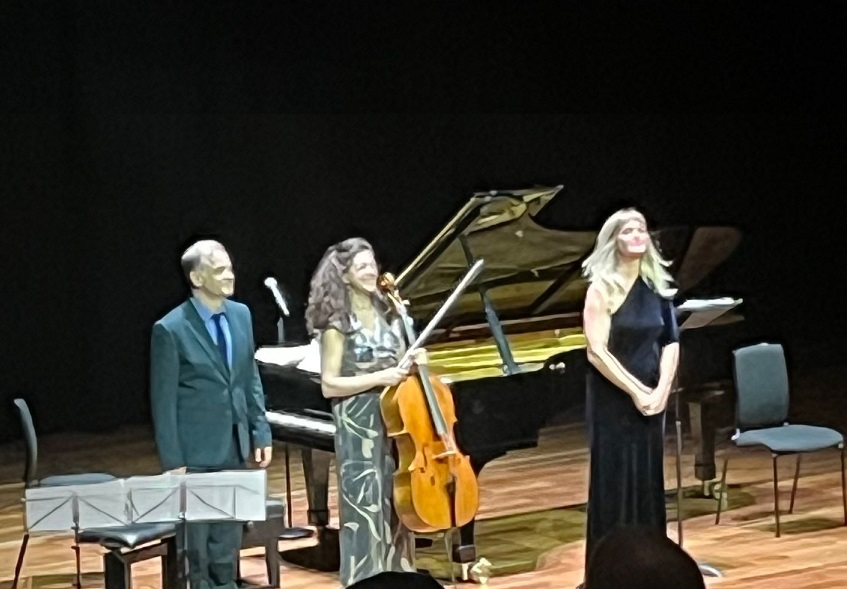
by John Earls. Photo credits (c) Philip Sharp (above), John Earls (below)

Two of the most affecting sections of Ruby Hughes’ excellent 2024 album with the Manchester Collective End of My Days are three of John Tavener’s Akhmatova Songs (Dante, Boris Pasternak and  Couplet) and Maurice Ravel’s Kaddish (from 2 Mélodies hébraïques).

These also featured to dramatic effect in this fascinating concert programme of Schubert and Other Folksongs spanning two centuries, where Hughes was joined by Natalie Clein (cello) and Julius Drake (piano).

In this performance the Tavener song miniatures were performed for voice and cello and were at turns powerful, beautiful and urgent across their nine-minute duration. The prolonged silence from the audience afterwards was noticeable. Ravel’s lament-like Kaddish, this time for voice and (sparse) piano, was similarly respectfully performed and observed.

There were non-vocal pieces for cello and piano where Clein and Drake displayed what a well matched duo they are. Zoltán Kodály’s Sonatina was luminescent, Leoš Janáček’s Pohádka absorbing (not least the cello bowing and pizzicato) and Ernest Bloch’s From Jewish Life was both lovely and mournful.

But this was a concert where Ruby Hughes’ amazing voice was to the fore but often in an understated, but no less impactful way. The captivating trio of Benjamin Britten folksong arrangements with their minimal piano trills were a case in point.

The trio performances were also impressive in their delivery and range. Brahms2 Songs (Op.91) were both gorgeous, while Deborah Pritchard’s Storm Song (from 2017, the most recently written piece) was powerfully unnerving between its haunting start and end (the composer was in the audience to take a well deserved bow).

The concert was bookended by two songs written by Franz Schubert shortly before his death in 1828 at the age of just 31. As David Kettle remarks in his excellent programme notes, to call them simply songs is to do them a disservice. Der Hirt auf dem Felsen (The Shepherd on the rock), arranged by Peter Jones for voice, cello (replacing the clarinet) and piano, traversed a journey of yearning and joy that was both delicate and impassioned. The closing Auf dem Strom (On the river) saw Hughes capturing the drama convincingly throughout.

An encore of Berlioz’s La Captive concluded this concert that combined fascinating and thoughtful programming with performances of beautifully judged expression.

John Earls is Director of Research at Unite the Union and posts at @johnearls.bsky.social on Bluesky and @john_earls on X. You can subscribe (free) to his Hanging Out a Window Substack column here: https://johnearls.substack.com/

Published post no.2,579 – Sunday 29 June 2025

On Record – Tim Posner, Berner Symphonieorchester / Katharina Müllner: Bloch, Bruch & Dohnányi (Claves)

Tim Posner (cello), Berner Symphonieorchester / Katharina Müllner

Bloch Schelomo (1917)
Bruch Kol Nidrei Op.47 (1880)
Dohnányi Konzertstück Op.12 (1904)

Claves CD3079 [56’21’’]
Producer & Engineer Johannes Kammann
Recorded September 2023 at Diaconis-Kirche, Bern, Switzerland

Reviewed by Ben Hogwood

What’s the story?

This is the debut concerto album from British cellist Tim Posner, currently principal cellist with the Amsterdam Sinfonietta. He has been awarded the Thierry Scherz prize at the Sommets musicaux de Gstaad, joining a list of illustrious cellists such as Nicolas Altstaedt, Pablo Ferrández and Anastasia Kobekina, as well as viola player Timothy Ridout, with whom he is a member of The Teyber Trio.

The winner of the Thierry Scherz prize gets a recording with Claves as part of their reward, and here Posner. together with conductor Katharina Müllner and the Berner Symphonieorchester have constructed an attractive program of concertante works for cello and orchestra, written in the style of a concerto but in single-movement form.

What’s the music like?

Bloch’s Schelomo is increasingly well-known, a powerful utterance for cello and orchestra in an extended single movement. Subtitling the piece Rhapsodie hébraïque, Bloch wrote the piece in six weeks, modelling it on chosen verses from the book of Ecclesiastes. In his words, the cello takes ‘the incarnation of King Solomon (the book’s author), while the orchestra ‘represents his internal world and his experience of life’. The themes are mostly original but are of Hebrew resonance, one a reproduction of a tune Bloch’s father would often sing.

The Konzertstück for cello and orchestra is not a well-known part of the output of Ernő Dohnányi, but it had personal significance for the composer when he completed it at the age of 26. The composer’s father was a fine amateur cellist, and he must have been at the front of Dohnányi’s mind when he wrote this single-movement work, set out as though it were a single movement concerto.

Bisecting the two larger works is Kol Nidrei, one of the most enduring of works for solo instrument and orchestra by Max Bruch. Completed in 1880, it was dedicated to Robert Hausmann, who premiered Brahms’s Double Concerto with Joseph Joachim seven years later. Kol Nidrei is based on two Hebrew melodies.

Does it all work?

Yes, it does. Posner brings a fresh approach to each of the three works and is extremely sensitive in his balancing with the orchestra and the melodic phrasing he applies.

Schelomo receives a commanding performance, but with room for the orchestra to make its telling contributions, ideally shaped under Katharina Müllner. Posner’s tone is beautiful throughout, and especially secure in the higher register sections, where he takes the part of Solomon with assurance and poise. There is some really nice detail in the smaller sections, where the Bern principal oboe really shines, and the whole mood is one of intense and passionate thought.

Kol Nidrei starts softly, lost in thought, but comes through to a chorale theme displaying emotional strength in depth, a real point of light in the darkness. Müllner’s pacing here is ideal.

The real discovery of the album is the Dohnányi, whose cheery, airy theme sets the tone for free flowing piece that proves contagious in its positivity. Cello and woodwind enjoy frequent dialogue, and the main theme is a joy when it reappears in orchestral guise half way through. The cello part is deceptively virtuosic, but it falls easily under Posner’s hands.

Is it recommended?

Enthusiastically. This is an imaginative album, performed with sensitivity and flair. The trio of pieces are extremely complementary, and Posner’s verve and enthusiasm are infectious. It is to be hoped more recordings will follow from this source, for this is a very fine package all round.

Listen

Buy

You can explore purchase options for this recording on the Presto website

Published post no.2,170 – Monday 6 May 2024

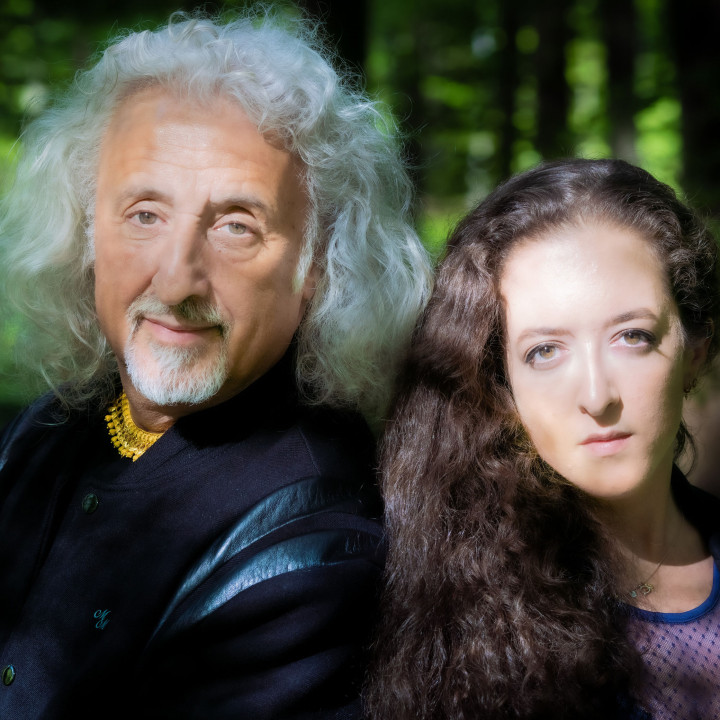
In concert – Mischa & Lily Maisky play Beethoven, Britten & Piazzolla @ Wigmore Hall

mischa-maisky-lily-maisky

Beethoven 7 Variations on ‘Bei Männern, welche Liebe fühlen’ from Mozart’s Die Zauberflöte WoO 46 (1796)
Britten Cello Sonata in C major Op.65 (1961)
Piazzolla Le grand tango (1982)

Mischa Maisky (cello), Lily Maisky (piano)

Wigmore Hall, London
Monday 1 November 2021

Written by Ben Hogwood

Father and daughter duo Mischa and Lily Maisky presented an imaginative program of works for cello and piano in this BBC Radio 3 Lunchtime Concert, where it was gratifying to note a full attendance at the Wigmore Hall.

They immediately found the light-hearted spirit of Beethoven’s 7 Variations on Bei Männern, welche Liebe fühlen, an aria from Mozart’s Die Zauberflöte. The piano takes the lead for much of this work, and Lily’s phrasing was subtle yet nicely shaped. The burnished tone of Mischa’s cello was a feature in the minor-key fourth variation, while Lily’s sensitive ornamentation at the start of the sixth was especially attractive.

A compelling performance of Britten’s Cello Sonata followed. As a former pupil of Mstislav Rostropovich, Mischa Maisky effectively has a direct line to a work that started the beginning of an extremely fruitful musical friendship between Britten and Rostropovich that lasted up to the composer’s death 15 years later. This performance inhabited the spirit of the work from first note to last, with the feeling in the first movement Dialogo that we were eavesdropping on a private conversation. Britten’s frequent but subtle references to Shostakovich were nicely highlighted here, with a few witty asides.

In the second movement Scherzo the Maiskys were dancing a balletic routine, Mischa’s pizzicato questions finished off by Lily’s featherweight answers. The tempo was slightly slower than is often used here, but in this way the pair effectively pointed out the work’s proximity in Britten’s output to the opera A Midsummer Night’s Dream. The sombre third movement Elegie had a silvery tone from the cello, while the following Marcia dealt in sardonic humour. The finale was a tour de force, featuring low notes from Mischa’s cello capable of rattling the windows, before powering through to an emphatic finish.

Piazzolla’s Le Grand Tango celebrates the dance form with which the Argentinian composer became obsessed, though as he stated the preoccupation was in his mind rather than the dancing feet. This was a passionate performance, the Maiskys in hold throughout as they maintained their close musical chemistry, right from the full bodied notes with which the cello began to a red-blooded dance for the closing pages. In between we had music of great tenderness and affection, not to mention rhythmic persuasion.

The duo gave us two encores, the first of which was a heartfelt tribute to the recent passing of Nelson Freire, clearly a dear friend. Bloch’s Prayer, from the short suite From Jewish Life, was an ideal choice, reverently played and with a searing tone quality to the highest register. It was a moving tribute that could hardly be bettered. There was also an ideal response in the form of Mischa’s own transcription of Brahms’s Lerchengesang Op.70/2, where Lily’s piano took the expressive lead.

You can hear the music played by Mischa and Lily on the Spotify playlist below, compiling Mischa’s recordings for Deutsche Grammophon of all the repertoire:

For more information on Mischa Maisky you can visit his artist page

Talking Heads: Sheku Kanneh-Mason

Interviewed by Ben Hogwood
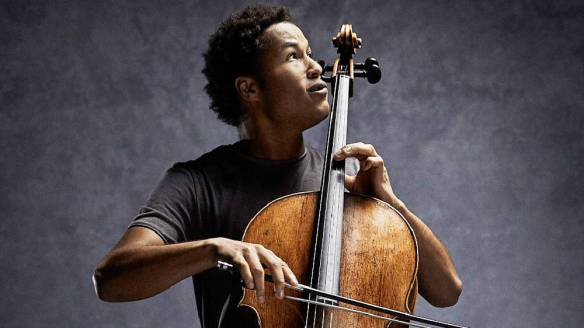
Picture courtesy of Decca Classics

Sheku Kanneh-Mason is a rare commodity. In the midst of dazzling publicity, he is helping open doors for classical music by his very approachable demeanour and an approach to album-making that brings it into closer contact with other forms. On the evidence of this interview he is refreshingly grounded and intently focussed on his first love, which of course is music.

While some have expressed concern that the cellist might be overworked early in his career, our discussions around second album Elgar confirm him to be relaxed and deeply satisfied with the newest addition to his discography.

His debut album Inspirations, released this time in 2019, presented the Shostakovich Cello Concerto no.1, the piece he played to win the final of the BBC Young Musician of the Year in 2016. Kanneh-Mason coupled it with diverse pieces from Pablo Casals, Offenbach, Leonard Cohen and Bob Marley. This time however his main focus is the work of a much older man, the Cello Concerto in E minor of Sir Edward Elgar.

The recording of this much-loved corner of the cello repertoire was made with conductor Sir Simon Rattle and the London Symphony Orchestra. It has an intensity which belies Kanneh-Mason’s tender years, offering new viewpoints into what will be familiar music to a lot of people. Again the context into which Sheku puts the Elgar on his album is intriguing, of which more later. But where did he first hear the music of Elgar – and was it the piece he has just recorded?

“It would have been the concerto, definitely”, he recalls. “I listened to it a lot when I was younger, and I grew up with the famous Jacqueline du Pré version. While we were working on it I listened to a lot of different recordings of the piece, it’s such a special work. Other recordings I really love are the most recent Steven Isserlis recording, Truls Mørk with Simon Rattle, and the famous one from Beatrice Harrison with Elgar himself conducting. There is a huge range of ways in which people approach the piece, and what strikes me about the piece is that everyone reacts in a different way.”

The second movement (a Scherzo) finds Kanneh-Mason and Rattle scooting along with a particularly quick choice of tempo, and the cellist clearly relishes the fast bow strokes required. “It’s a fun piece to play, and you get swept up in it but you have to work on getting a lightness of touch with the repeated notes.”

Elgar’s concerto may be the main piece on the album but there are a variety of shorter pieces imaginatively included by Kanneh-Mason. One composer in particular we may be hearing from again is the Swiss-born American Ernest Bloch, born to Jewish parents. Two of his shorter pieces are included here. “I love his music”, says Sheku. “For Grade 8 I did the Prayer for cello and piano, which is a piece I knew to play young. It’s music I really love, and there’s also the piece for cello and orchestra, Schelomo, which I hope to record in the future. You can feel some of the pain in the harmonies he uses.”

More obscure still is a piece for cello ensemble, Hymnus, by the German composer Julius Klengel. “It’s an amazing piece”, he says. “He was a cellist as well, so I think that’s how he ended up writing for 12 instruments. Every week at the Royal Academy of Music we had a cello ensemble, and that’s how we got to know it. There’s a nice link there, as there is for all the pieces on the album. It’s very inspiring being around really young hardworking musicians and all of us being based in one place.”

How does Kanneh-Mason balance his studies with days like today, where he has a whole day of promotional interviews to navigate? “I just have to be very organised with my time, which is a good thing for us anyway. I never feel that I have too much on.”
He is particularly gushing when talk turns to his work with Sir Simon Rattle, and the bond they share in the interpretation of the Elgar. “Definitely. I think what I love about working with someone is the freedom to do what I want but knowing that they can do everything as well. It’s the spirit of true collaboration I think”.

The theme of collaborating runs through both albums, and Kanneh-Mason identifies with this original approach. “It’s nice to have a link and a reason for putting them together, like creating a concert program. It’s great to record a masterpiece and a big piece, and put it with smaller pieces that have an equal range of colour and harmony, and perhaps more subtleties.”

For Elgar he was helped by Simon Parkin, with sensitive arrangements for cello and orchestra of Elgar’s Nimrod, from the Enigma Variations, and the Romance originally written for bassoon and orchestra. To that he adds Frank Bridge’s Spring Song, the folksongs Blow The Wind Southerly and Scarborough Fair, and Fauré’s profound Elégie.

“He’s an amazingly skilled arranger”, says Sheku of Parkin, “and he keeps the heart of the pieces while making the most of the instruments. I love mixing the arrangements that complement the pieces of music in their original form, and it’s great to record them in respect of friends and teachers, which makes it more personal. I’m always excited and open to lots of new things and working with new people. I’ve had some amazing experiences with these recordings, and you can hopefully hear the enjoyment from them.”

As you might expect given his album programming, Sheku’s ‘out of hours’ musical tastes are varied. “I listen to a mixture of classical, jazz, reggae, and different kinds of folk music”, he says. “Growing up with music all around me has been really inspiring, and it has kept me grounded and motivated. Now I live with students, and the people below me are also musicians.”

Thinking back to his BBC Young Musician of the Year triumph brings Kanneh-Mason onto a subject close to his heart, musical education. “I think we should have as many young people in music as possible. The Young Musician of the Year is great as it shows people playing to the highest standard. When I did it I found watching people three or four years older than me was really inspiring, and it ultimately gives people the opportunity to do many more things.”

He also notes the importance of after care. “Afterwards there was so much attention, but the BBC really looked after me. It was important to have the right people around me and to be working with the right people. A competition is only good if what comes after is good.”

With time running out, we conclude by discussing his favourite musicians of the moment. “I love Steven Isserlis”, he says. “He’s my favourite cellist to watch…and I also love listening to the violinist Daniel Lozakovich. Martha Argerich is also someone I find really inspiring, I love watching her play the piano.”

This blend of youth and maturity, established and new, is perhaps the most inspiring thing about Sheku Kanneh-Mason’s success. His approach is very inclusive, and his next ventures will be very interesting to chart and appraise. With Elgar reaching the heights of number eight in the album charts so far, the musical world is very open to him right now.

Sheku Kanneh-Mason’s Elgar album is out now on Decca Classics – it can be purchased here, via Apple Music, or streamed below via Spotify: