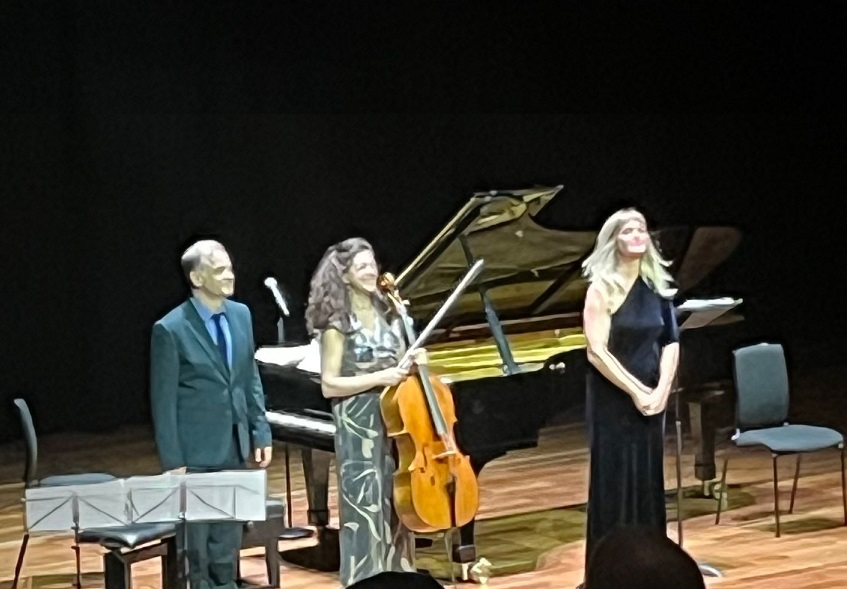
Ruby Hughes (soprano), Natalie Clein (cello), Julius Drake (piano)
Schubert arr. Jones Der Hirt auf dem Felsen (The Shepherd on the Rock) D965 (1828) Kodály Sonatina for cello & piano (1922) Tavener Akhmatova Songs: Dante, Boris Pasternak, Dvustishie (Couplet) (1993) Brahms 2 Songs Op.91 (1884) Trad arr. Britten I wonder as I wander (1940-41), At the mid hour of night (Molly, my dear), How sweet the answer (The Wren) (both 1957) Deborah Pritchard Storm Song (2017) Janáček Pohádka (Fairy tale) (1910, revised 1923) Ravel Kaddisch from 2 Mélodies hébraïques (1914) Bloch From Jewish Life (1924) Schubert Auf dem Strom (On the river) D943 (1828) (Encore) Berlioz La Captive
Queen Elizabeth Hall, London, 27 June 2025
by John Earls. Photo credits (c) Philip Sharp (above), John Earls (below)
Two of the most affecting sections of Ruby Hughes’ excellent 2024 album with the Manchester Collective End of My Days are three of John Tavener’s Akhmatova Songs (Dante, Boris Pasternak and Couplet) and Maurice Ravel’s Kaddish (from 2 Mélodies hébraïques).
These also featured to dramatic effect in this fascinating concert programme of Schubert and Other Folksongs spanning two centuries, where Hughes was joined by Natalie Clein (cello) and Julius Drake (piano).
In this performance the Tavener song miniatures were performed for voice and cello and were at turns powerful, beautiful and urgent across their nine-minute duration. The prolonged silence from the audience afterwards was noticeable. Ravel’s lament-like Kaddish, this time for voice and (sparse) piano, was similarly respectfully performed and observed.
There were non-vocal pieces for cello and piano where Clein and Drake displayed what a well matched duo they are. Zoltán Kodály’s Sonatina was luminescent, Leoš Janáček’s Pohádka absorbing (not least the cello bowing and pizzicato) and Ernest Bloch’s From Jewish Life was both lovely and mournful.
But this was a concert where Ruby Hughes’ amazing voice was to the fore but often in an understated, but no less impactful way. The captivating trio of Benjamin Britten folksong arrangements with their minimal piano trills were a case in point.
The trio performances were also impressive in their delivery and range. Brahms’ 2 Songs (Op.91) were both gorgeous, while Deborah Pritchard’s Storm Song (from 2017, the most recently written piece) was powerfully unnerving between its haunting start and end (the composer was in the audience to take a well deserved bow).
The concert was bookended by two songs written by Franz Schubert shortly before his death in 1828 at the age of just 31. As David Kettle remarks in his excellent programme notes, to call them simply songs is to do them a disservice. Der Hirt auf dem Felsen (The Shepherd on the rock), arranged by Peter Jones for voice, cello (replacing the clarinet) and piano, traversed a journey of yearning and joy that was both delicate and impassioned. The closing Auf dem Strom (On the river) saw Hughes capturing the drama convincingly throughout.
An encore of Berlioz’s La Captive concluded this concert that combined fascinating and thoughtful programming with performances of beautifully judged expression.
Beethoven Sonata for piano and violin no.6 in A major Op.30/1 (1802) Beethoven Sonata for piano and violin no.8 in G major Op.30/3 (1802) Schubert Rondo brillant in B minor D895 (1826)
Wigmore Hall, London Monday 7 April 2025 (1pm)
by Ben Hogwood
Violinist Viktoria Mullova and pianist Alasdair Beatson have been exploring Beethoven’s works for piano and violin for a while now, and this concert demonstrated the rapport they have built with the music – and the Wigmore Hall audience.
On a bright March day in London the Spring Sonata might have been the most appropriate choice – more of which later – but instead we enjoyed an unsung gem among Beethoven’s works for this combination. This was the Sonata for piano and violin no.6 in A major Op.30/1, the least heard of the trio published as Op.30 and a work brimming with good spirits in this performance.
As our BBC Radio 3 host Andrew McGregor informed us, Alasdair Beatson was playing a fortepiano copy of a Conrad Graf instrument, and it brought a wide range of tonal colour to the hall, with mottled treble and a wonderfully grainy lower register. Beatson and Mullova played as one, finishing each other’s sentences, or joining in unisons which could not be split. Op.30/1 warmed to this treatment, its bursts of energy complemented by tender, charming asides. Mullova’s intonation took a little while to settle, but once secured her phrasing was a delight. The soft centred, sweetly toned second movement was followed by an Allegretto con variazioni finale with terrific energy, driving up to and through a sparkling finish.
The Sonata for piano and violin no.8 in G major Op.30/3 followed – a charming work, especially in a performance such as this. Mullova and Beatson were on the edge, justifying a daringly fast tempo choice for the first movement with tight ensemble and drive, Mullova exaggerating the louder notes to put the listener in mind of the sort of sound Beethoven himself would surely have loved. The bubbly first movement was charming, its confidential asides well worth savouring, the togetherness between the two musicians truly admirable. The Tempo di minuetto explored darker moods, notably its brief passage in the minor key which cast a shadow over the return of the previously sunny first theme. The irrepressible finale enjoyed its humourous ‘wrong’ notes, recalling Haydn’s ‘Bird’ string quartet in their impudence.
It is hard to imagine a better performance of Schubert’s Rondo brillant, with which the concert ended. Here the two performers were like dancers in hold as they explored the composer’s unusual rhythmic terrain, bringing a sense of occasion to the introduction and an attractive sway to the dance rhythms as Schubert’s abundant melodies unfolded. A strong central section set up a series of virtuoso heroics towards the end, falling comfortably under Mullova’s fingers, while Beatson prompted with equal dexterity. The performance was a thrill from start to finish. As an ideal encore we did finally hear from Beethoven’s Spring Sonata – the beautiful second movement Adagio, given a charming lilt from Mullova’s phrasing and Beatson’s flowing accompaniment.
by Ben Hogwood. Photo credits (c) Uwe Arens (above), Filarmonia Hungaria (Kurtág), Jean-Regis Rouston/Getty (Dietrich Fischer-Dieskau)
Seven years on from his firstinterview with Arcana, Benjamin Appl is in town. In that time a great deal has happened in the career of the Regensburg-born baritone. He has received worldwide acclaim not just for his beautiful voice but for the invention and style with which he has been creating concert programs and recording projects.
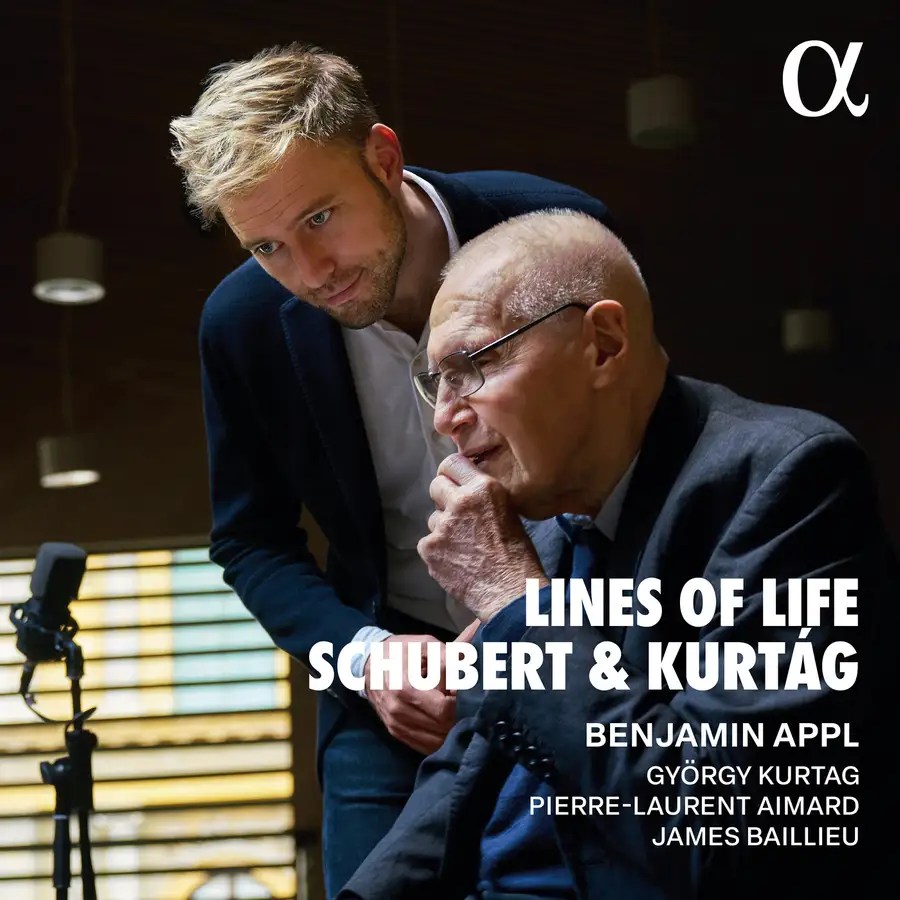
These projects form the core of our interview, principally Lines of Life – a newly released album complementing the music of Schubert and György Kurtág, with whom he has become firm friends. We will also discuss a carefully planned and fascinating tribute to Appl’s mentor, the great Dietrich Fischer-Dieskau.
Before that, however, we have the small matter of Handel’s Messiah to contemplate. Appl has just completed a performance with the Royal Liverpool Philharmonic Orchestra, not as a baritone soloist, but as a conductor. This bold step has made a lasting impact. “It was actually one of the greatest experiences of my life!” he says. “It’s interesting to be a singer, but also being able to communicate a lot with the audience through your eyes and facial expressions. You try to give a lot towards the singers in the choir, and then hope they mirror your intention back into the hall. It was very rewarding moment, musically and emotionally, and I was very happy and grateful that I got this chance, starting with a great orchestra. Let us see where this journey will lead!”
Had it always been an ambition, to conduct? “I always wanted to, from an early age”, he confirms. “I was conducting a lot of operas when I was six or seven, learning them off copy later on. I always conducted in the living room off recordings, with a baton my parents gave me for Christmas. It’s not just the beating time, it’s the psychology behind, leading people through a rehearsal and trying to get everyone in one direction – that I find the most interesting part. You have to make decisions in every second count. “With Messiah, you have 45 different numbers, and the hardest bit of conducting is starting and ending a piece, so after we agreed on Messiah I started to doubt if it was the right piece! But it was a wonderful experience, and everyone in Liverpool was incredibly supportive.”
Conducting the piece after Christmas made a refreshing change. “It was really uplifting, and as you know the story is much more than just Christmas. I also did Haydn’s Creation on January 1st in Budapest. I think that’s a wonderful piece for New Year’s Day, to be grateful about the creation of the world.”
He confesses to feeling odd with the audience behind instead of facing. “That felt very strange – and also even arriving in the concert hall. On both sides of my green room I could hear the soloists warming up, and I also started warming up! But somehow I wasn’t nervous at all. It felt very natural.” Will there be more as a conductor? “It’s something I’m interested in, particularly vocal music where I feel more familiar, and where I’m able to work with other singers and choirs.”
Appl’s mentor, Dietrich Fischer Dieskau, conducted near to the end of his life also, but he is keen to stress that is not the reason for taking up conducting at this point in his career. “It was something I wanted to do earlier on”, explains Appl, “whereas with Dietrich he started quite late.”
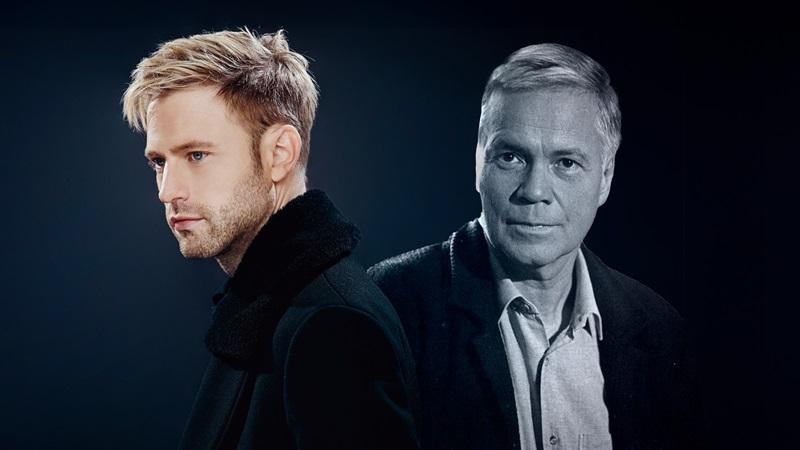
More of Fischer-Dieskau anon, as talk turns to 98-year old Hungarian composer György Kurtág (above), with whom Appl is now firm friends. They met in 2019. “The Konzerthaus in Dortmund decided to do a Kurtág festival”, he explains, “and the director of the hall went to Budapest to meet with Kurtág to discuss the repertoire for this festival. For Kurtág it was incredibly important to included a song cycle of six songs with poetry by Hölderlin, because that is a piece he sees as a significant one in his career. They looked into the option of who should sing it, and they selected ten baritones from around the world, who could send a recording to Kurtág. He is known for being very tricky and demanding, and the way he works with musicians, what he asks musicians to do, so he needed some months to really listen to the recordings and make up his mind.”
Gradually a shortlist emerged. “There were five left”, recounts Appl, “and then a few weeks later we were supposed to sing or record the low register of our voice. Then there were only three or four left, and then we had to record again, another page out of this song cycle. Finally I made it – and arrived in Budapest a few months later, to prepare the music for the cycle. I was incredibly nervous, because it is known that after a few minutes he might lose his interest, or that musicians really can’t cope with the intensity and the detailed work he asks to do. At the time his wife Marta was still alive, and after a few minutes she said something in Hungarian to him. He turned to me and said, “Marta says, “You are our person”.” From that moment on, we started a wonderful partnership, and I was in Budapest every few months, still working on these six songs. I understood that I would never be able to learn them at a level where he would be pleased or would respect these songs fully, and we often work just on one bar for three, four hours. My brain was absolutely exploding! In the afternoon, I came back and looked forward to focusing on bar two – but he said to me, “Let’s start from the beginning!” It’s a piece I’ve worked on for five, six years now on, and it will never be finished.”
This level of focus is truly unusual, and as Appl notes, “The wonderful thing is he is so far away from our music industry, with its budgets, timing, short rehearsals, and where it’s about finding the right piece for a small orchestra, where we can’t have 15 brass. That’s very refreshing.”
The recording process was highly unusual, with 1,300 takes required over 12 days for the finished article (above). Part of the reason for this was the sheer compression of Kurtág’s music, where he says so much in such a short space of time. “It’s a weird phenomenon, because you would think a very complicated, huge piece with thousands of interwoven lines, but when you look at the page, there is hardly anything written. It’s very bare. Nevertheless it has an ocean behind it, a very deep sea, where there’s so much to discover and to question. That’s what I find so fascinating, a paradox – but a most attractive one.”
Appl was witness to the remarkable chemistry between Kurtág and Marta when they played piano together, privately. “He has no awareness that he’s on stage. It is almost helpless, but in a way that is so real and honest, and touching.”
The new album explores more the connection Kurtág has with composers such as Schumann and, in this case, Schubert. “When I learn his music, it is like learning intervals, and you go along from one note to the next. When I worked with him for the first time, suddenly he put some harmonies underneath which completely made sense, and very often they were Schubertian harmonies. His music is close to Schubert’s, because Schubert also wrote reduced music in the score, there is not a lot. You feel very naked when you perform it. With the littlest impact he tried to have the biggest outcome. This is also music he played a lot with Marta, and she sang along, so this is a very personal connection between Kurtág and his music. He also selected the songs which we recorded, and it was wonderful to put an order together where some of these Schubert songs are like a meditation after his own short songs, while others are a break in mood and harmonics. It was a learning curve for me to work on the order.”
The learning process has been immense. “It is a question all the time. His favourite word is “Maybe?” He is someone who doubts all the time, with questions – there is such insecurity in him, and that’s the most confusing thing in the beginning. The composer should tell me how it has to be done, but actually he is always searching for the right performance, and that is something I find so fascinating, together with the composer. His understanding of the music of the world, bringing quotes from Russian literature or Chinese techniques in porcelain or Beckett, or whatever – his knowledge of the world is so incredible, and he brings parallels from different parts of the world and different art forms. It’s very, very inspiring.”
Does he use modern technology much? “No. He composes with paper, though he does use DVD and CD players. In rehearsals I brought my iPad, and it was interesting to see with a 97-year-old man, how immediately he understood how to tap and turn the pages. He’s a very open-minded person and has just started to learn Chinese. He has a super brain.”
The compositional process is very involved for Kurtág. “When he has to put a staccato dot on top of a note, you think he goes through hell – he starts shaking, and the pen goes closer to the page, and then he goes back and forward. His entire body is twisted, like Orpheus going through hell, and it’s nerve-wracking. It’s a real inner battle to compose. And that’s very inspirational.”
Appl regards him with affection, as a dear friend. “Mr Kurtág is someone you can’t have small talk with”, he observes. “To finish a sentence takes ages, because as he does in his music, he wants to use every word in the perfect way with perfect meaning. Expressing something is real work, but he shows affection, admiration, friendship in very little gestures. He leaves his house very rarely, but whenever I perform in Budapest the honour for him to come to my concerts is huge. When he appears in a concert hall all the people stand up because he’s a national hero. When you talk to a taxi driver from the airport and tell him you go to a composer called Kurtág, everyone knows him. It’s extraordinary how people appreciate him.”
Talk turns to another musical behemoth, Dietrich Fischer-Dieskau. Appl’s tribute album to him, To Dieter: The Past and Future, is due for release on 23 May. It prompts the question – how has it been possible to focus on two musical figures of such renown? “I feel incredibly grateful”, Appl says, “because those two encounters in my life are probably the most rewarding and special musical relationships, mentors I have had in my life. It’s just coincidence that their birthdays or where they stood in their life is close together.”
He talks about meeting the great German baritone. “It was really very special, as he was my absolute hero before meeting him. The first time was in a master class in Austria in 2009, where we were supposed to send suggestions of ten Schubert songs with our recording. I heard he could be quite tricky and demanding as well, so I sent a list of 30 Schubert songs. A few weeks later, back came a list of four Schubert songs, and all four were not part of my list. That was the first impression I got from him. After this masterclass, he offered me to work with him privately, and we worked regularly in his house in Berlin and Bavaria. It was an absolute gift to be together with him for six hours a day, just the two of us and a pianist.”
The repertoire choices for To Dieter are a true musical biography, with songs from Fischer-Dieskau’s father Albert and brother Klaus. “Honouring such a hero and such an incredible singer is a very tricky thing”, he explains, “because if you do his best-selling songs, he has already done them so well, so it’s hard for the next generation to do an album such as that. For me it was more important to give an insight more into who he was. I had the big pleasure of being able to go through most of his private correspondence, his love letters, contracts, diaries – all of that. While respecting privacy I wanted to give an insight into who he was, a person who had a lot of challenges in his life, a lot of things people are not so much aware of.”
He elaborates. “For me, the most important and interesting years are really his childhood in Berlin, growing up in a family where the father was a headmaster, and always wanted to become a composer. He did some singspiel, some small operas, while his brother wrote some music from an early age onwards. We also have a piece where Fischer-Dieskau appears as a poet, and some translations. There are the years in the beginning where he was as a soldier in Russia, then the years as a prisoner of war in Italy, where he was in an American prisoner of war camp, where he automatically learned most of his repertoire, and where he performed Winterreise a capella in front of 6,000 soldiers, then in 1945-46 where he was singing Russian, French and German songs all together in a recital for Germans in an American camp. These years shaped him so much, then coming to England and working with Gerald Moore, making a new export of German culture after a time of war. That, for me, is more interesting than the years we know him best, when he travelled around the world, and amazed people in the concert hall.”
There is his fascination with languages, too – which must have been hard to learn? “Absolutely. It was a good learning curve for him being in Italy for two and a half years as a prisoner of war, where he learned Italian, and where he had to communicate with the American soldiers. Generally he was just very good phonetically, singing different languages.”
Was it intimidating taking on such a program? “Absolutely! The album is not created to challenge him at all – but I know certain critics will compare the singing with him, which is always tricky. That is not my intention. There are many things that have changed – the attention of an audience, the tools and technology you have for live – so much around us has changed. Comparing musicians from different centuries is therefore a very tricky thing to do.”
It is tempting to consider how Fischer-Dieskau (above) would approach recording in today’s climate, with more bite-size musical consumption. Does Appl have to wrestle with that when performing, sticking to his principles? “I think you have to, because then you’re authentic. At the same time, I think artists have never been more challenged to be flexible, to adjust to new themes, forms of presenting, allowing cameras in hall, appearing on social media immediately. You can control certain things in our industry, but not as much as in the times of Karajan. Those times are gone and our influence and power is in other hands. You have to be flexible, but not at the price of losing authenticity.”
Is there a certain give and take, allowing projects for other people so that more personal aims can be achieved? “Absolutely, and more and more I realise – in politics or the world generally – that compromise has been, for many years, a negative. But I realise more in every field of who we are, that compromise is the only way of living together, of coexistence, of working together, of creating a career, of creating art. It’s always about compromise.”
We agree on the importance of music in these times, and our fortunate position in being able to work in and talk about it. “I hope that many people understand this and also come to this realization. If I may speak as a German during the times of the two big wars, that was a time where the concert halls were full, where people listened to music, and craved something beautiful, a world they can dive into where they are away from, from the misery they experience. People are searching for inner meaning, for peace, for being ‘careless’. Classical music is a wonderful solution for these things.”
Appl’s research and interest in the history of Germany runs deep. “I had a project with Éva Fahidi (above), a wonderful lady who unfortunately passed away one and a half years ago. She was a prisoner in Auschwitz, Jewish but also from Hungary. She wanted to become a pianist, but the Nazis broke her back in Auschwitz, so she never was able to become a musician. Nevertheless, we travelled around, and I performed while she talked about her life. It’s a topic for me as a German, particularly moving to the UK, being grateful. It’s about understanding differences, but also appreciating the things we have in common, in a time where half of the country decided to move out of the European Union. It is a time to really understand where you sit historically, how you fit into these societies, who you are and where you belong to. I think that is only possible if you think a lot about the past, and meet the older generation, to understand their point of view.”
In the time since we last met, Appl has graduated from the BBC New Generation scheme, and his career has blossomed. Has the voice changed in that time? “I think so, particularly in the last year. Normally, as a baritone, you have the big years between 40 and 50. As our physique and intellect changes, and the world around you, everything is connected, they are all influences. You want to improve your technique, but the way you see music and life influences your way of singing.”
Appl has complementary pianists, too, principally dfgd and dfgd. “I’m someone who likes working with different musical challenges. I understand other musicians who need the security and the bond working with one pianist for a long period or for the lifetime. But for me, it is like a master class, listening to what another pianist offers differently. I find there is a danger when you work always with the same people, that trust becomes comfort.”
That will never be a danger with Kurtág, presumably! “No. Artistically it is very, very difficult at times, with a level of exhaustion I’ve never experienced otherwise in my life. It’s a very unique experience.” A real balance to Messiah? “Yes. It is a wonderful thing being a musician, where every week you can focus on another wonderful experience. It’s hard to really say what music you love most, because everything has its face, and with this learning curve, with human encounters, they shape you as an artist and human being and that’s a wonderful thing. I’m very grateful.”
Lines of Life, the album of Schubert and György Kurtág, is out now on Alpha and is available on Presto Music Appl will celebrate his mentor Dietrich Fischer-Dieskau with a series of concerts with pianist James Baillieu, beginning at the Queen Elizabeth Hall on Sunday 2 March. For details of the tour, visit the Benjamin Appl website.
Ives Four Ragtime Dances (1902-04, rev. 1916) Fugue in Four Keys on ‘The Shining Shore’ (c1903) The Pond (c1906, rev, c1912-13) The Rainbow (first version, 1914) An Old Song Deranged (c1903) Skit for Danbury Fair (c1909, real. Sinclair) The Gong on the Hook and Ladder or Fireman’s Parade on Main Street (c1911, rev. 1934) Chromâtimelôdtune (c1923, real. Singleton) Tone Roads – no.1 (c1913-14); no.3 (c1911/13-14) Set of Incomplete Works and Fragments (ed. Singleton/Sinclair, 1974) March no.2, with ‘Son of a Gambolier’ (c1892) March no.3, with ‘My Old Kentucky Home’ (c1893) March ‘The Circus Band’ (c1898-99, rev. 1932-33) Arrangements (1896-97) – Schubert: Marche militaire in D, D733 No. 1 (1818). Schumann: Valse noble, Op. 9 No. 4 (1834-35). Schubert: Impromptu in C minor, D899 No. 1 (1827)
Orchestra New England, Orquesta Sinfónica de Navarra (arrangements) / James Sinclair
Naxos American Classics 8.559954 [75’43”] Editions John Kirkpatrick, Jacques-Louis Monod, James Sinclair, Kenneth Singleton and Richard Swift Producers Neely Bruce, Jan Swafford Engineers Benjamin Schwarz with Jonathan Galle and Gonzalo Noqué
Recorded 24/25 October 2023 at Auditorio Barañaín, Pamplona-Navarra, Spain (arrangements), 12-14 March 2024 at Colony Hall/Choate Rosemary Hall, Wallingford CT, USA
Reviewed by Richard Whitehouse
What’s the story?
Naxos continues its long-term series devoted to the orchestral music of Charles Ives with this volume of shorter pieces and arrangements, several of them recorded for the first time and conducted by James Sinclair, whose involvement with the composer now stretches back across 50 years.
What’s the music like?
Miniatures for a variety of forces are found right across the four decades of Ives’s composing and range from unformed experiments to perfectly realized exemplars of his idiom. Many of these were collated in the dozen or so Sets that Ives assembled at various stages in his career (recorded on Naxos 8.559917) while there are various others which resist any such compiling, and these can mostly be found here – often in critical editions prepared by a formidable team of Ives scholars, hence rounding out the picture of his creativity in the most immediate terms.
Written at the outset of the genre’s golden age, the Four Ragtime Dances neatly complement each other as regards form and content; elements from each finding their way into the second movement (The Rockstrewn Hills) from the Second Orchestral Set, which builds upon their anarchic humour accordingly. Following the shimmering polytonal ambivalence of the Fugue on ‘The Shining Shore’, the unworldly evocations The Pond and The Rainbow find Ives at his most intimate and confessional – as does the admittedly more genial An Old Song Deranged. Not so Skit for Danbury Fair, its inherent iconoclasm finding greater focus in the graphically descriptive The Gong on the Hook and Ladder or contrasting Tone Roads Nos. 1 and 3 which embody Ives’s thinking on indivisibility of life and music in the most uncompromising terms.
It was once thought Chromâtimelôdtune might be the missing Tone Road No. 2, yet this late and possibly incomplete piece is likely an acerbic response to the Modernism emerging from post-war Europe which seemingly preoccupied Ives in those twilight years of his composing. The three song-based Marches date from an earlier and ostensibly more carefree phase, their debunking couched in humorous terms, while the Set of Incomplete Works and Fragments is a judiciously conceived entity that should not have had to wait 50 years for its first recording. The orchestrations are from Ives’s study with Horatio Parker at Yale: that of Schubert’s First Marche Militaire and Schumann’s Valse noble (from Carnaval) are expert but anonymous, that of Schubert’s First Impromptu results in a ‘theme and variations’ of striking prescience.
Does it all work?
Yes, inasmuch that the effectiveness of these pieces largely depends on the conviction of their performers and, with Sinclair at the helm, this can be taken for granted. As can the excellence of Orchestra New England in repertoire it has often been playing for decades, and if Orquesta Sinfónica de Navarra might appear an unlikely choice for Ives’s undergraduate arrangements, it acquits itself admirably. The sound throughout is unexceptionally fine, and Sinclair’s own annotations are succinctly informative as to the genesis and context of some intriguing music.
Is it recommended?
Indeed, this is a necessary addition to a valuable series – hopefully to be continued before too long with recordings of the Fourth Symphony and Universe Symphony as partially realized by David Porter, of which Sinclair gave a memorable account at the Aldeburgh Festival in 2012.
Listen & Buy
For buying options, you can visit the Naxos website – or listen to the recording on Tidal below:
On this day, 174 years ago, the premiere of Schubert’s String Quintet in C major took place in Vienna, Austria.
The string quintet was brought to prominence by Mozart’s masterpieces in the form, using the standard string quartet line-up of two violins, viola and cello with the addition of a second viola. Beethoven wrote an underrated quintet for the same instrumental combination, but Schubert chose to use a second cello. His much-loved quintet, completed three weeks before his death, is a desert island choice for many people on account of its heavenly Adagio. Here it is, played by the Borodin String Quartet and cellist Alexander Buzlov: