
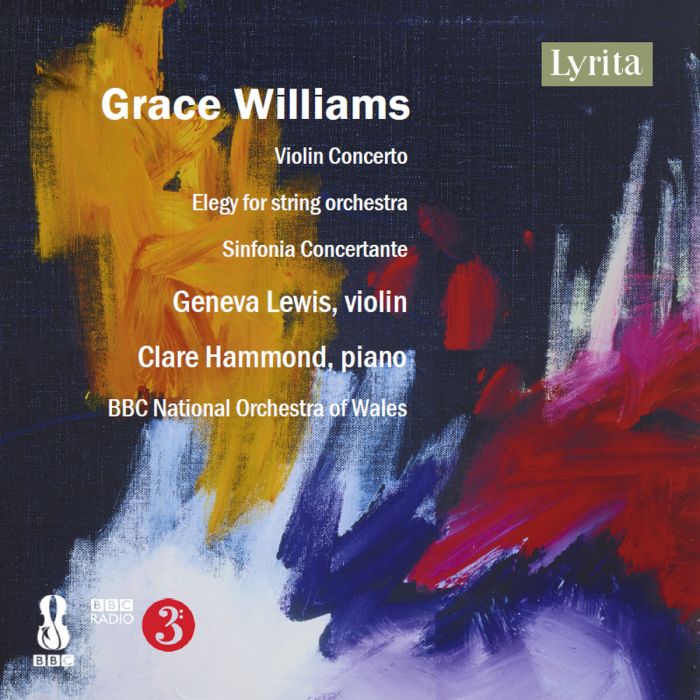
Geneva Lewis (violin, Violin Concerto), Clare Hammond (piano, Sinfonia Concertante), BBC National Orchestra of Wales / Jaime Martin (Violin Concerto), Ryan Bancroft (Elegy), Jac van Steen (Sinfonia Concertante)
Grace Williams
Violin Concerto (1949-50)
Elegy (1936, rev. 1940)
Sinfonia Concertante (1941)
Lyrita SRCD447 [59’09”]
Producer Mike Sims Engineers Andrew Smilie, Simon Smith (Violin Concerto)
Broadcast performances at Hoddinott Hall, Cardiff on 12 February 2022 (Elegy) and 22 September 2022 (Sinfonia Concertante); live performance from Royal Albert Hall, London on 8 August 2023 (Violin Concerto)
Reviewed by Richard Whitehouse
What’s the story?
Lyrita continues its exploration of Grace Williams with this enticing collection of orchestral works dating from before, during and after the Second World War. All the pieces feature the BBC National Orchestra of Wales, which has championed this composer over nine decades.
What’s the music like?
Earliest here is the Elegy for strings that, evidently overhauled and re-scored after several hearings, falls within an extensive lineage of such miniatures (in length but not expressive scope) by British composers. Scored for muted violins and violas, the initial idea evinces a ruminative austerity such as persists to the main climax; after which, a heartfelt passage for solo strings presages the more conciliatory mood setting in near its end. Ryan Bancroft has the measure of a piece whose emotional depth is out of all proportion to its modest duration.
Although conceived prior to the above, Williams did not commence work on what became her Sinfonia Concertante until the turn of the next decade. With its compact dimensions and intensive integration of piano and orchestra, its title (actually suggested by pianist Michael Mullinar) is well chosen. If the opening Allegro never quite finds the right balance between its impulsive and yielding main themes, the central slow movement is Williams at her most characteristic with its unfolding as terraces of mounting intensity toward a powerful climax which subsides into pensive resignation; the final Alla Marcia duly maintaining its impetus through to a forceful if never hectoring close. Clare Hammond is at her inquiring best in an account as finds Jac van Steen handling some passing issues of balance with real adeptness.
For its part, the BBC National Orchestra of Wales is no less attuned to the very different ethos of the Violin Concerto, which it premiered with soloist Granville Jones almost 75 years back. New Zealand-born Geneva Lewis proves to be a sympathetic advocate – even if the opening Liricamenta surely requires a more purposeful sense of direction for its enfolding inwardness not to risk inertia. Not that her unforced manner and tonal elegance are other than appropriate, as is even more evident in the central Andante with its impressionist eddying of phrases and fastidious timbral shading. Following on attacca, the final Allegro sees the work’s only swift music in which Lewis’s deftness gains from her assured co-ordination with Jaime Martin. Its cadenza is incisively despatched, and the coda more satisfying for its teasing unexpectedness.
Does it all work?
Almost always. The Violin Concerto is a work with which its composer never seems to have been wholly satisfied, but such reservations as there are centre less on its actual content than on the difficulty – at least in its opening movement – of controlling overall momentum such that the music coheres overall. Lewis is by no means unsuccessful, though comparison with earlier performances that are available online suggests other soloists may have gone further in this respect. A reminder, moreover, that Williams’s music does not necessarily ‘play itself’.
Is it recommended?
Indeed. The Cardiff broadcasts benefit from the superb acoustic of Hoddinott Hall, while the Proms account of the Violin Concerto has far more immediacy than ‘on the night’. Typically informed and informative notes by Paul Conway round out what is a mandatory acquisition.
Listen / Buy
You can hear excerpts from the album and explore purchase options at the Lyrita website and the Presto Music website, and click on the names for more information on violinist Geneva Lewis, pianist Clare Hammond, conductors Jaime Martin, Ryan Bancroft and Jac van Steen, the BBC National Orchestra of Wales and composer Grace Williams
Published post no.2,808 – Tuesday 24 February 2026


 Arcana.fm