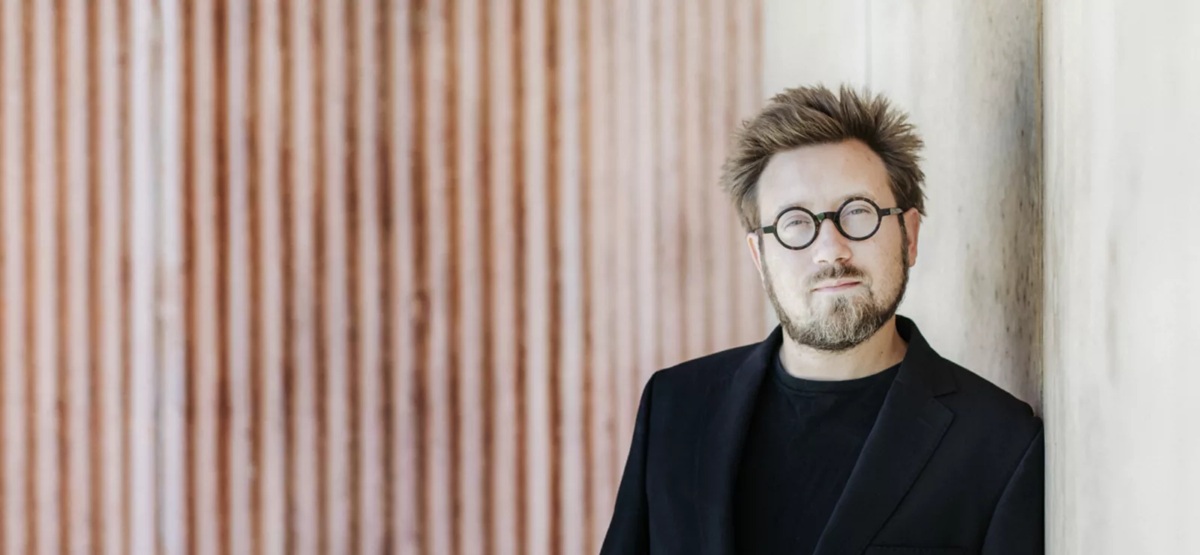
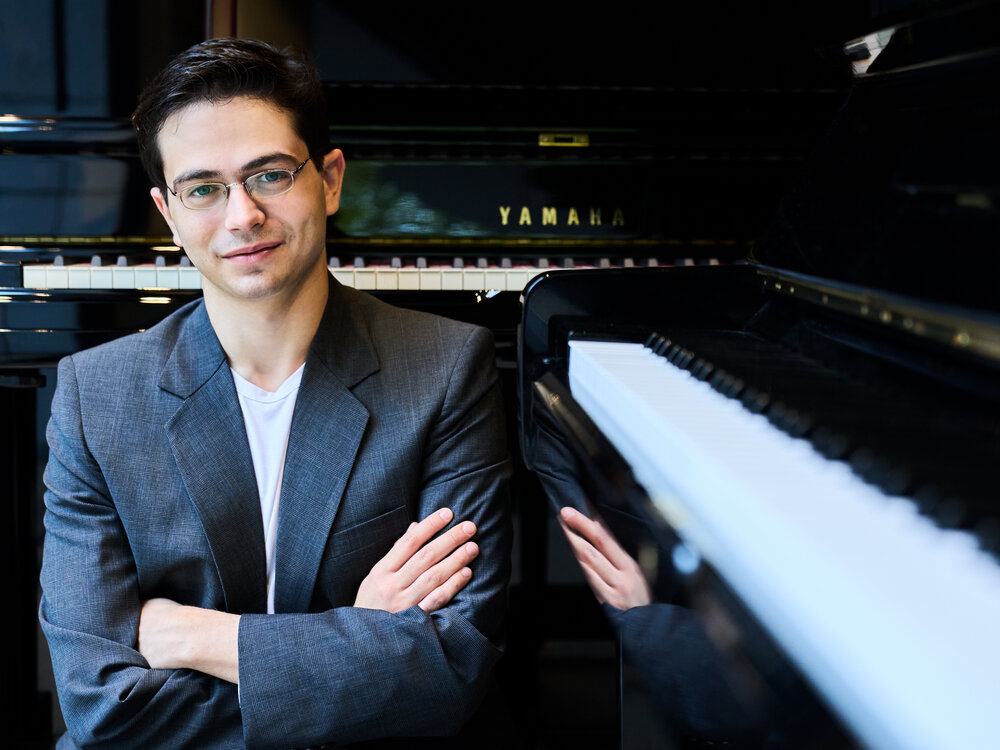
Ariel Lanyi (piano, below), London Firebird Orchestra / George Jackson (above)
Mendelssohn Overture: A Midsummer Night’s Dream Op.21 (1826) Beethoven Piano Concerto no.4 in G major Op.58 (1805-06) Puccini Crisantemi (1890) Haydn Symphony no.96 in D major ‘The Miracle’ (1791)
St John’s Church, Waterloo, London Sunday 8 March 2026 [6pm]
Reviewed by Richard Whitehouse Picture of George Jackson (c) Short Eared Dog Photography; Picture of Ariel Lanyi (c) Kaupo Kikkas
Having appeared at London Chamber Music Society on four previous occasions, the London Firebird Orchestra tonight made its debut at the organization’s new home, St John’s Waterloo, with a programme largely focussing on music from the late Classical and early Romantic eras.
Mendelssohn’s overture A Midsummer Night’s Dream seldom disappoints as a concert-opener, and conductor George Jackson duly ensured a characterful reading at its best in those passages when the composer allows his imaginative response to Shakespeare’s drama free rein – which is not to suggest a lack of animation or impetus elsewhere. Incidentally the prominent part for ophicleide was taken by bass trombone, though the programme listed both instruments while, with the piano lid already raised, it was by no means easy to tell which one was being played.
That piano came to the fore during Beethoven’s Fourth Concerto, and a work clearly playing to the strengths of Israeli pianist (currently residing in London) Ariel Lanyi. Speculative and often capricious in its solo writing, the opening movement had expressive breadth if without losing focus during its intricate development, and Lanyi made a persuasive case for the less often heard of the composer’s own cadenzas – the granitic power of its culmination making the orchestra’s re-entry more poetic. Soloist and orchestra drew the requisite contrasts from the Andante, before such opposition was resolved in a coda of melting pathos, then the final Rondo exuded boisterous good humour without neglecting those more graceful elements as increasingly come to the fore and hence make its hectic closing bars the more exhilarating.
Lanyi acknowledged the (rightly) enthusiastic reception with an unexpected yet appealing encore of a Notturno (fourth from a set of six pieces) that Respighi wrote around 1904. Its raptness made an admirable foil to the more conventional while affecting elegy Crisantemi that Puccini wrote in memory of Amadeo I, his brief tenure as Spanish king pre-dating his final years in Turin where he befriended the Italian composer. Conceived for string quartet, its never cloying sentiment felt even more in evidence heard with a larger group of strings.
The nicknames appended to many Haydn symphonies are often approximate and none more so than with No. 96, the ‘miracle’ of the falling chandelier which caused no injuries almost certainly taking place during the premiere of No. 102. The earlier work is not quite its equal, but Jackson made the most of its attractions with a winning take on a first movement whose imposing Adagio prepares for an agile Allegro in almost constant development. The Andante has a cadenza-like lead in to its coda – leader Calyssa Davidson and violinist Victoria Marsh relishing the spotlight as audibly as did oboist Polly Bartlett her winsome contribution in the Menuetto. The final Vivace finds Haydn at his most laconic, as he nimbly alternates its main themes on route to a coda which brings the whole symphony to a suitably effervescent close.
It also brought to an end a well-planned and thoroughly enjoyable concert that played to the strengths of both orchestra and conductor. LCMS continues on March 22nd with the Sacconi Quartet in what looks to be a no less enticing programme of Haydn, Boccherini and Dvořák.
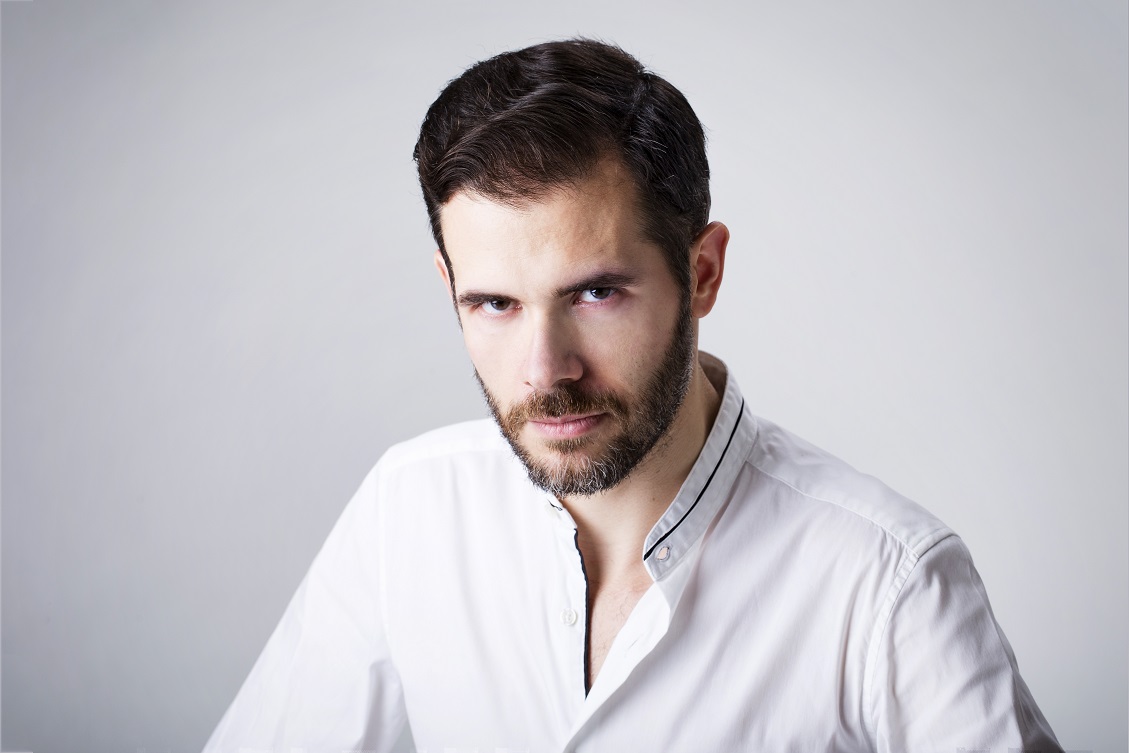
by Ben Hogwood pictures (c) Ribaltaluce Studio (Francesco Cilluffo); Pádraig Grant (rehearsals)
Arcana has the pleasure of an audience with conductor Francesco Cilluffo, in his third year as Principal Guest Conductor at Wexford Festival Opera. Previous outings have led to encounters with Alfredo Catalani’s Edmea (2021) and Fromental Halévy’s La tempesta (2022), both Italian operas with Shakespearean connections. This year, however, the action shifts to the coast of Florida, for a production of Frederick Delius‘s rarely heard opera The Magic Fountain.
As we talk, it is clear Cilluffo is excited and deeply passionate about communicating this little-known work to a wider audience, from his own unique position. “I’m a very unusual Italian conductor!” he says. “Alongside the staple repertoire one expects from an Italian conductor, I’ve always had a great curiosity about less performed repertoire. My musical upbringing was a mixture, because I grew up in Italy, but lived and studied in London for many years, and worked a fair amount of time in English speaking countries. I remember the first time I was exposed to Delius was when I heard The Walk to the Paradise Garden, in a Barbirolli recording. I thought there something very soothing about the music, but at the same time I could feel there were more layers. It made me very interested to know more and I learned it was from his opera A Village Romeo & Juliet, and gradually about Delius.
As I said I have an unusual profile, and to prove that I can say that The Magic Fountain is already better known than the only Delius opera I have already performed, which is Margot la Rouge, which I did in Opera Holland Park as part of a double bill (with Puccini’s Le Villi) two years ago. That is completely unknown but is his fourth opera, so not an early attempt. It’s a weird piece, because it is in French, and there are no other versions in any other language because it was written for a competition, for the famous Verismo opera competition that was in Italy, and was won by Leoncavallo’s Cavalleria Rusticana. Delius forced himself to enter it, because if you think of Delius, you don’t necessarily think about life and blood, or drama. Because I’ve conducted it now I can say it is probably the least interesting of his operas, because apart from his craft in writing for the orchestra, it sounds like something he felt he had to do, and it was not successful. So I arrived at The Magic Fountain knowing a lot about Delius. In the years coming up to this performance, I have always felt a particular connection with the music. It is gorgeous music, very personal, and clearly the music of someone with a very interesting and difficult life. All of that gets into the notes!”
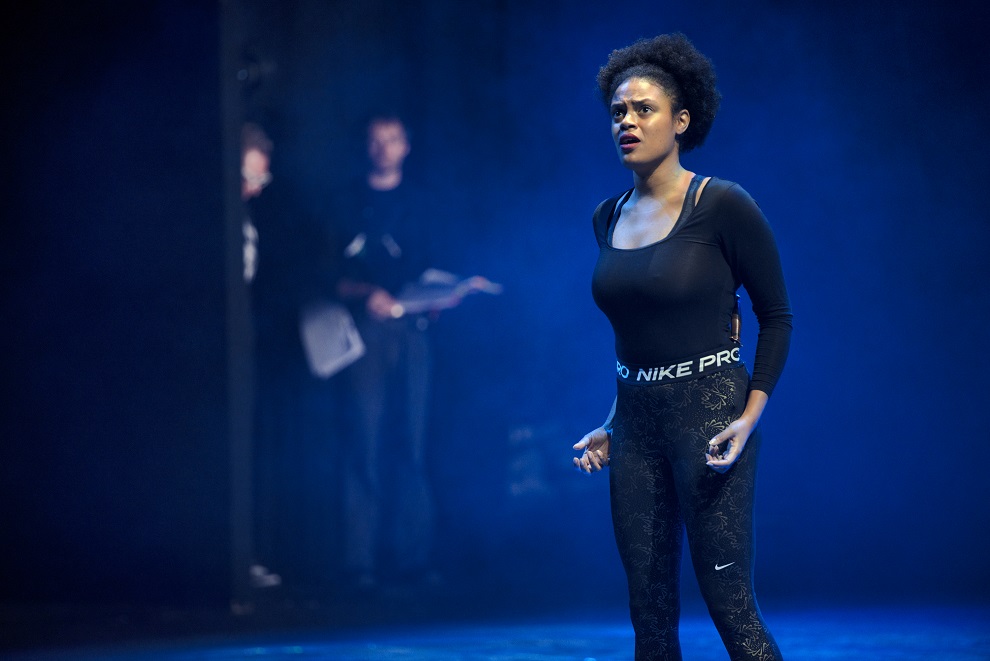
During a rehearsal for the Magic Fountain, Axelle Saint-Cirel sings the role of Watawa
The plot has strong autobiographical elements that Cilluffo recognises. “It’s not just an isolated case, because all the Delius operas deal with a similar situation”, he says. “You could say the same thing about Benjamin Britten’s operas. Delius has different worlds, backgrounds, countries and social backgrounds, different worlds that collide through love. We can read a lot of autobiographical meaning here, starting with the name of the main lead, Solano. We know that one of the many crazy things that Delius did was manage the orange plantation in Florida, called Solana Grove, and while there is no proof, we know when he was there he probably had a love child with one of the locals. There is also a letter from Delius planning an operatic trilogy about outcasts. In a way he did, because if you think of his three main operas, The Magic Fountain has the native Americans and the clashes between their culture and the conquistadors. Then his opera Koanga is a clash between slaves and the owner of a plantation, and in a way A Village Romeo & Juliet is about, again, innocence versus society, but again there is the strong character of the Traveller, who is central to the plot.”
Like Britten, the connection runs deep. “Delius probably felt some connection with the outcast, for the main reason that he was a man without a motherland. In my experience a lot of British people don’t really see Delius as a British composer. His DNA starts in North Europe, then most of his early life was in Bradford, but then he moved everywhere! Apparently he didn’t master British language as flawlessly as one would expect, because he was writing this weird German with a hint of Norwegian, because of his relationship with Grieg. I am aware of a bit of a Delius renaissance, because I’ve seen a lot of programming of his stuff. I’m very glad, because I think he stands in a category of his own.”
Meilir Jones
Cilluffo remembers fellow countryman, the critic Paolo Isotta, sharing this view. “He was a very old school music critic, who was very controversial in his taste, but I remember he kept saying he thought Delius was one of the most interesting orchestral composers of the 20th century. That’s quite a statement, and it clicked in my thinking – I thought there must be a grain of truth there. So I was very glad to spend a lot of time learning and studying his music.”
One of Delius’ strongest characteristics is an ability to create vivid pictures in the mind of his listener, which carries through to The Magic Fountain. Yet Cilluffo goes further. “I think so, but descriptive music is just the surface. There’s a veneer of that, but what really stands out is an incredibly physical and sexual drive in the music, a sensuality needs to be embraced in a very unapologetic way.”
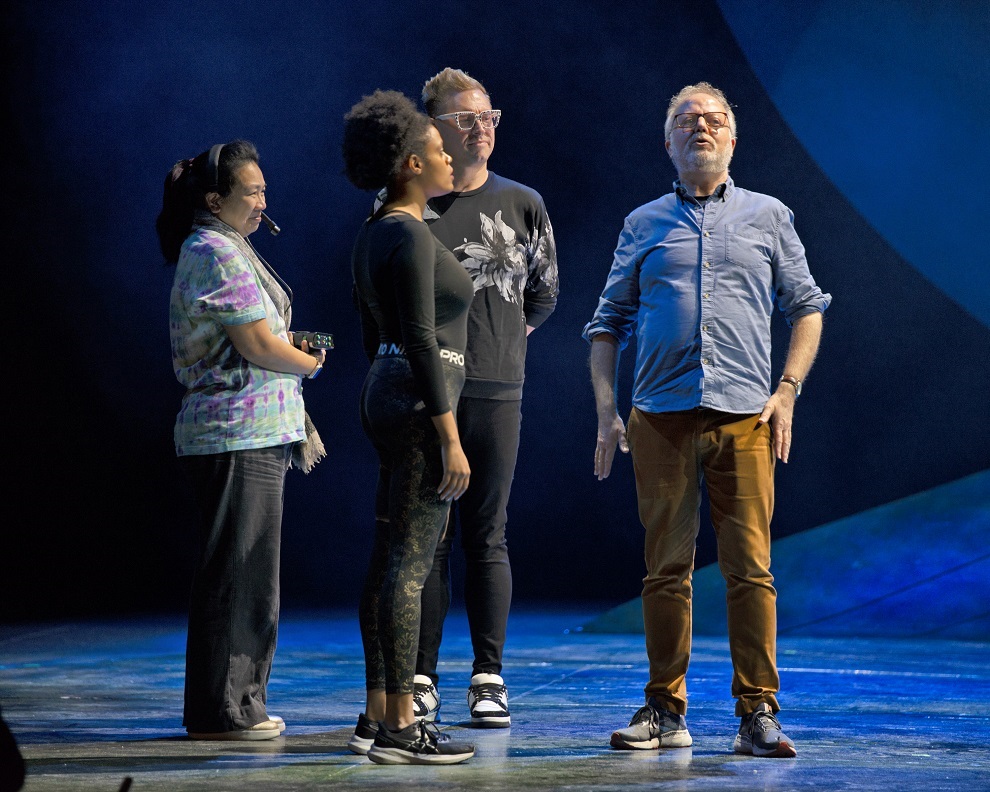
L-R Theresa Tsang, stage manager with Dominick Chenes, Axelle Saint-Cirel and director Christopher Luscombe
He also considers how the quality of the performance is particularly important in Delius’s music. “I think Beethoven and Puccini can survive, but for some composers a bad performance can harm them. I don’t mean technical, of course, but I mean when the music is not done in a way that does it justice or bring through the many layers of the music. Some composers can be doomed by that, and I think that’s the case with Delius. As much as Sir Thomas Beecham was an incredible champion of his music, and was an amazing conductor, I still feel to this day he gave the idea that this is lovely countryside, beautiful English music. As gorgeous as that can be, people can say after five minutes, “I’m done with your beautiful English idyll, there’s nothing else. Only by starting with the Delius biography, and reading his letters, which I’ve done, and knowing about the culture of Paris and Northern Europe at the start of the 20th century, then you start to see more. You see that why this person connected much more with expressionist painters and writers than any other – because there’s an incredibly violent and sensual layer in the music there. You just need to bring it up!”
There are interpretative dangers for conductors taking on Delius’s music. “The way it’s written – and we know that Delius was a self-taught musician – can lend itself to misinterpretation. If we talk about historical performers, I think Sir John Barbirolli understood him better, despite the fact that Beecham was the great champion of his music. We also have to remember that Delius never heard most of his music in his lifetime. He never sat through a performance or even the read through of The Magic Fountain. I don’t say to suggest that he would have changed anything, but I think there is an element of frustration and anger inside, of knowing he was writing this amazing music, but nobody wanted to put it on. That somehow creeps into the writing, especially towards the end.”
His health – and sexual health – also played a part. “We know that his syphilis was such a constant in his life. His relationship with an illness that was inevitably linked with sexual freedom was against his very strict upbringing, with a Protestant father. If we put on one side his friendships with Munch and Gauguin, and writers like Strindberg, there is very little room left for beautiful, idyllic, ‘make you feel good’ music.”
For this production of The Magic Fountain, Cilluffo is drawing on previous creative relationships. “We are very much on the same level with the director, Christopher Luscombe, as we already worked together at Grange Opera on Tosca together. We have one recording of The Magic Fountain to refer to, which is already one more than we would normally have for Wexford style operas. As good a reference as that recording is, we feel we are going in completely the opposite direction. The recording sounds too beautiful, too even, and this is an opera with bursts of passion and conflict. There is also something very courageous about this opera, where someone who is so clearly middle class wanted to put on stage people who are victims of the very same system of which Delius is part. Maybe that’s also one of the reasons why people didn’t go out of their way to put on operas like Koanga or The Magic Fountain, because it was uncomfortable. With Koanga, we are talking about decades before Porgy and Bess could be considered as an opera to put on the stage. All this is part of what we have in mind in bringing this work back to life.”
When conducting Delius, what does Cilluffo consider to be the principal challenges? “There are two sides to this answer”, he says. “One is that as an opera composer, Delius always thought of the orchestra first. The orchestra is the colour that brings out the drama, contrary to a lot of opera where the drama is always from the voice, and enhanced by the orchestral palette. You also have to keep in mind that he never heard it, and – I’m going to use a very bad word here – he never ‘workshopped’ it. Nobody told him that if you want to have three horns blasting out when a soprano is singing in the middle register, you might want to consider lowering the dynamics here and there. But that’s the work we do, and where my background as a composer comes in very useful. The technical challenge is to adjust the work so that the orchestra doesn’t become the only character.”
Francesco Cilluffo, conductor
As to the other side, Cilluffo says, “The one composer that keeps coming up as a reference when we speak with Chris about the opera is Puccini, which you would imagine is as far as possible from this world. However he isn’t far, because Puccini is another one who suffered, especially in the past decades, as being labelled as just one thing, an Italian composer of desperate love. Puccini was a very troubled and dark soul and was in contact with the same world at the same time – Paris and Northern Europe, of the beginning of 20th century. You know, Delius used to go and attend autopsies in the morgue in Paris. Part of that goes into Margot La Rouge, which is set on the outskirts of Paris and is a fight between prostitutes and dealers. I’m bringing this up because that’s something we read about in the novels of Émile Zola, like Thérèse Raquin, and that’s the same world Puccini was fascinated by, as in one of the operas of Il Trittico – Il Tabarro. I think both composers, as different as they were, were triggered by the incredible war in Paris for artists at the beginning of 20th century.”
Coincidentally, Francesco’s diary for 2025 has been dominated by two composers – Puccini and Delius, heightening the levels of interest in linking them. “What really stood out – and finally made Puccini be considered a proper great composer – was the orchestra, and how the orchestra conveys, in a post-Wagnerian but personal way, what’s going on, the psychology, or what we’re really talking about. It’s always with the lesser known operas where it is easier to see, and I think a great underrated opera of Puccini in La Rondine. You could say it is a lighter version of La Traviata, but if you listen to the music, and the duet at the end of the opera, it’s about the end of a world of certainties, of the Austo-Hungarian Empire. It’s interesting because you read his letters, and Puccini writes, “I want La Rondine to be my Der Rosenkavalier”. That’s why I always insist with younger colleagues that you have to study what’s in between the notes as well studying the notes, because by reading these things, words open up to you about how to actually make it work apart from the technical side. Of course Delius was a very different experience, because Puccini was one of the most famous and richest composers of his time, while Delius had to sell his Gauguin painting towards the end of his life because he just couldn’t make money – and of course he was becoming blind as well.”
Axelle Saint-Cirel
Yet the similarity of what they experienced persists. “I feel they were both in touch with this incredible age, where we cannot even start to feel what it was like to be in the Paris at the beginning of 20 century, with all the contradictions, the violence, and their approach towards love, sexuality and wars – and, up to a certain point, the approach to different and far away cultures. Puccini treated it in a very normal way of his time, with Madama Butterfly and Turandot using different cultures as a background for a story that was totally Western European. In the case of Delius, he actually went to the places, and dealt with rather less comfortable situations. As part of my background research I have been reading a book by Claude Levi Strauss, the French anthropologist. One of his books, Tristes Tropiques, talks about his work in South America, and how that changed the perception of different culture and how we actually go from an anthropological point of view, at that time, to interpret things according to our own system of beliefs. He talks of how not to do that.”
Turning to Wexford, the 2025 incarnation of the festival looks set to be a colourful one. “I started going to Wexford in 2015”, recalls Cilluffo, “and my first experience was a Mascagni opera, Guglielmo Ratcliff. Funnily enough, one of the three operas that year was Koanga by Delius! It’s funny after ten years I’m now the one conducting the Delius, but that is one of many reasons why I keep coming back and I was very happy to be nominated principal conductor in 2022. It’s the one moment of the year where I know I’m going back to a place where music and studying matter. As a guest conductor I travel all over the world, and most of the time it is with operas that are well known. It is very much a traveller’s life, but sometimes you do feel you are just one wheel of a big machine. I always think that in Wexford, the real core of Wexford is an act of love, because you take some less fortunate operas, that for some reason have been forgotten. Some of them, when they were premiered, were huge success and were for a long time but then suddenly disappeared. I think Wexford reconnects you with the very reason you want to do this, which is to make a difference, to really live a month in a work of art that has been rarely heard, and to make a case for it. I cannot lie – not all the operas are going to be blockbusters – but I’m not sure that’s the point. It’s a great moment to reflect and to connect with this repertoire. I always look forward to this every year, it is a privilege to think I am going to spend a month with Delius, and with this work. I’m already fascinated, and I haven’t done the first rehearsal yet!”
The location is also a draw. “Wexford is a very Delius-like festival, the coming together of different countries and cultures in one space, and the nature there is so outstanding. Most of us go from one city to another, but suddenly here you are, with the Irish Sea in front of you, and you are far away from the closest big city, Dublin, which is two hours north. It is a very Delius-esque festival, and in fact this is the third Delius opera they have done in under 20 years – with A Village Romeo & Juliet, Koanga and now this. I do have to say personally, however, that I think Delius’ operatic masterpiece is Fennimore and Gerda. I hope one day to that, it’s a one-act opera so has to be part of a double. It deals with so much material of his life, art and life in Northern Europe, Scandinavia. It’s the closest he got, I think, to writing Pelléas et Mélisande.”
We may hear more of that in time, of course – but for now it is clear anyone attending The Magic Fountain will be treated to a fascinating work by a composer whose creative wealth and originality is finally being transmitted to the stage.
The Magic Fountain runs at the O’Reilly Theatre, National Opera House, Wexford, on 19, 23, 25 and 31 October. For more information and tickets, visit the Wexford Festival Opera website
Published post no.2,684 – Saturday 11 October 2025
Cio-Cio San – Maki Mori (soprano), Pinkerton – Pene Pati (tenor), Suzuki – Hiroka Yamashita (mezzo-soprano), Sharpless – Christopher Purves (baritone), Goro – Christopher Lemmings (tenor), Kate – Carolyn Holt (mezzo-soprano), Yamadori/Bonze – Sanuel Pantcheff (baritone), Imperial Commissionaire – Jonathan Gunthorpe (bass), Yakuside – Matthew Pandya (bass), Cousin – Abigail Baylis (soprano), Mother – Hannah Morley (mezzo-soprano), Aunt – Abigail Kelly (soprano), Ufficiale – Oliver Barker (bass)
Thomas Henderson (director), Laura Jane Stanfield (costumes), Charlotte Corderoy (assistant conductor), Charlotte Forrest (repetiteur), Daniel Aguirre Evans (surtitles)
CBSO Chorus, City of Birmingham Symphony Orchestra / Kazuki Yamada
Symphony Hall, Birmingham Saturday 29 June 2024
reviewed by Richard Whitehouse Photo (c) Yuji Hori
The current season by the City of Birmingham Symphony Orchestra ended on an undoubted high with this performance of Madama Butterfly – if not Puccini’s greatest opera, then likely his most affecting and one with which Kazuki Yamada demonstrably feels an acute empathy.
Semi-stagings can be a mixed blessing, but Thomas Henderson fulfilled this task admirably through several strategically placed screens at either end and across the rear of the stage that enabled the singers to enter or exit without detriment to musical continuity. The costumes by Laura Jane Stanfield brought authenticity without risk of caricature, while whoever handled the lighting should be commended for so discreetly intensifying those emotional highpoints – notably when the ‘heroine’ meets her end in what felt as powerful visually as it did aurally.
The cast was a fine one and dominated (as it needed to be) by the Cio-Cio San of Maki Mori – her unforced eloquence and innate goodness evident throughout, while her only occasionally being overwhelmed by the orchestra underlined her technical assurance. A pity that Pene Pati was not on this level as, apart from his rather cramped tessitura in its higher register, his was a Pinkerton neither suave not alluring but precious and self-regarding – with barely a hint of remorse when forced to recognize the consequences of his actions. Hiroka Yamashita had all the necessary empathy as Suzuki, while Christopher Purves gave a memorable rendering of Sharpless – unsympathetic as to profession yet emerging as a hapless participant conveying real humanity, if unable to prevent what could hardly be other than a tragedy in the making.
Smaller roles were well taken, not least Carolyn Holt as a well-intentioned Kate and Samuel Pantcheff as a yearning if not over-wrought Yamadori. The CBSO Chorus gave its collective all in a contribution that goes a long way to defining the culture and atmosphere in a turn-of-century Nagasaki riven between its Oriental tradition and Occidental intervention. Otherwise, the CBSO was the star of this show in responding to Yamada’s direction, as disciplined as it was impulsive, with a precision and finesse maintained over even the most opulently scored passages. It is often overlooked just how wide-ranging Puccini’s idiom had by then become, with its impressionist and even modal elements duly subsumed into music whose Italianate essence is consistently enhanced while without sacrificing any of its immediacy or fervour.
Some 120 years on and attitudes to what this opera represents have inevitably changed, but it is a measure of Puccini’s theatrical acumen that anti-imperialist sentiment abounds in the narrative without drawing attention to itself conceptually or musically. Conducting with an audible belief in every bar, Yamada ably maintained underlying momentum – not least those potential longueurs in the initial two acts, while his handling of the third act made an already compact entity the more devastating in its visceral drama and ultimately unresolved anguish.
Overall, a gripping account of an opera too easy to take for granted as well as an impressive demonstration of the CBSO’s musicianship after just a year with Yamada at the helm. And, if ‘joy’ was in relatively short supply this evening, next season should more than make amends.
For information on the new CBSO season for 2024-25, click here
Margot la Rouge (1902) Lyric Drama in One Act – music by Frederick Delius; Libretto by Rosenval Sung in French with English surtitles
Margot – Anne Sophie Duprels (soprano), Sergeant Thibaud – Samuel Sakker (tenor), L’Artiste – Paul Carey Jones (bass-baritone), Lili Béguin – Sarah Minns (soprano), Nini – Laura Lolita Perešivana (soprano), La Patronne – Laura Woods (mezzo-soprano), Totor – David Woloszko (bass)
Le Villi (1883) Opera-Ballet in Two Acts – music by Giacomo Puccini, Libretto by Ferdinando Fontana Sung in Italian with English surtitles
Anna – Anne Sophie Duprels (soprano), Roberto – Peter Auty (tenor), Guglielmo – Stephen Gadd (baritone)
Martin Lloyd-Evans (director), takis (designer), Jake Wiltshire (lighting), Jami Read-Quarrel (movement) Opera Holland Park Chorus, City of London Sinfonia / Francesco Cilluffo
Opera Holland Park, London Thursday 21st July 2022 [7.30pm]
review by Richard Whitehouse Photos (c) Ali Wright
Delius and Puccini are unlikely operatic bedfellows (as anyone who recalls a near-disastrous ENO staging of Fennimore and Gerda with Gianni Schicchi three decades back will surely concur), but this double-bill by Opera Holland Park has an undeniable logic given both works started out as entries in the competition for one-act operas held on four occasions by Edoardo Sonzogno to encourage young talent (so gaining the upper hand against his established rival Ricordi). That neither proved successful at the time need not detract from the merits of either and if the concept of the one is, with hindsight, as uncharacteristic as that of the other appears immature, both contain more than enough worthwhile music along with arresting stagecraft to vindicate their revival in an imaginative production such as they receive on this occasion.
At the time he finished Margot la Rouge, Delius already had four operas behind him so was hardly unequipped for the task at hand. The challenge lay rather in adapting his increasingly personal, even metaphysical approach to the hard-hitting realism – not abetted by a libretto (written pseudonymously by Berthe Gaston-Danville) which reduces its characterization to stereotypes throughout. Yet the best of Delius’s music rises well above any one-dimensional sordidness – the plaintiveness of its prelude and mounting eloquence of its love scene (both refashioned as the Prelude and Idyll which was the composer’s final collaboration with Eric Fenby) equal to anything from his maturity. Had one or another of those earlier operas been acclaimed, the chances for Margot to reach the stage would have been appreciably greater.
The simple but effective revolving set favoured by Martin Lloyd-Evans presents this drama the more effectively for its unfussiness, enhanced by takis’s set designs and Jake Wiltshire’s resourceful lighting. Casting-wise the stage is dominated, as it needs to be, by Anne Sophie Duprels’s assumption of the title-role – emotionally guarded in its earlier sullenness, before ascending to heights of rapture once her identity becomes known. Samuel Sakker evinces the necessary ardency as Thibault and though Paul Carey Jones is a little too suave to convey the viciousness of The Artist, his commanding presence is never in doubt. Sarah Minns has just the right coquettishness as Lili, while there are telling cameos from Laura Lolita Perešvana, Laura Woods and, especially, David Woloszko among those (too?) numerous smaller roles.
Whereas Delius’s opera had to wait 82 years for its premiere, Puccini’s Le Villi hit the stage within a year of completion then was revived twice before the end of the decade – by which time, this ‘opera-ballet’ had expanded to two acts. Therein lies the problem, as Ferdinando Fontana’s modish libretto seems stretched beyond its effectiveness as drama, the threadbare nature in much of the latter scenario requiring a narrative element merely to hold it together. That said, there are various opportunities for characterizing the three protagonists of which Puccini made the most, with the central symphonic intermezzo L’abbandono e La tregenda (the latter still heard as an encore) confirming a new orchestral sophistication in Italian opera. Theatrically flawed as it may be, Le Villi is an auspicious and undeniable statement of intent.
Here, too, the Lloyd-Evans-takis-Wiltshire staging works to the advantage of this drama, yet without over-egging the supernatural shenanigans; credit, also, to Jami Reid-Quarrell for his utilizing the relatively restricted stage-space such that the dance element seems both alluring and more than compensates for the flailing narrative. Vocally, Anne Sophie Duprels has the measure of Anna as she traverses the gamut of emotions from diffidence, through heartbreak to revenge, with a continuity of expression not to be taken for granted. Peter Auty has made a speciality of high tenor roles, but his Roberto needs greater fervency and warmth to offset its shrillness. Not so Stephen Gadd, whose Guglielmo has a burnished humanity that commands attention on his (too few?) appearances and a clarity ideally suited to delivering the narrative.
The latter opera also gains from a typically lusty contribution by Opera Holland Park Chorus – and, in both works, the City of London Sinfonia responds with commitment to the dynamic direction of Francesco Cilluffo, who teases out the many dramatic nuances with alacrity. The orchestral reductions by Andreas Luca Beraldo have been judiciously gauged in both cases -that for Margot ironically closer to the orchestration undertaken by Eric Fenby in the absence of Delius’s score and which was soon mothballed once the original had been relocated. The relative unfamiliarity of these operas is a coup such as OHP has regularly delivered over the years, and one which is well worth the attention of more than just those drawn to rare opera.
Further performances take place on 29 July, 31 July [2pm], 2, 4 and 6 August. For more information visit the Opera Holland Park website
G. Gabrieli Canzoni – primi toni a 8; duodecimi toni a 8 (c1597) Vivaldi Concerto for Four Violins in B minor RV580 / Op.3/10 Petrassi Concerto for Orchestra No. 5 (1954-5) Puccini Capriccio sinfonico (1883) De Sabata Juventus (1919)
Benjamin Gilmore, Julia Ungureanu, Julián Gil Rodríguez, Thomas Norris (violins), London Symphony Orchestra / SirAntonio Pappano
Barbican Hall, London
Thursday 2 June 2022
Written by Richard Whitehouse
What better way to mark Queen Elizabeth II’s Platinum Jubilee than with two concerts providing a decent overview of Italian orchestral music with the London Symphony Orchestra and its chief conductor designate Sir Antonio Pappano. That relatively little of this music has managed to enter the standard repertoire only makes revivals such as these the more worthwhile.
Tonight’s programme began off-stage with two Canzoni by Giovanni Gabrieli played by LSO brass from the centre of the lower circle – Pappano facing the audience to conduct. Although a more spacious and terraced acoustic would have presented these to better advantage, their hieratic grandeur as well as intricately contrapuntal texture was an admirable foil to Vivaldi‘s Concerto for Four Violins which followed onstage. Published in his ground-breaking collection L’estro armonico, its bracing outer Allegros frame a brief while unpredictable Largo whose disjunctive contrasts of tempo and technique brought the best out of a quartet drawn from the LSO front desks and notably well-matched in temperament.
From the early 18th to mid-20th century was less of an aesthetic wrench than might be thought, the Fifth Concerto for Orchestra by Goffredo Petrassi embodying various of those facets as set out by his musical antecedents. Written for the Boston Symphony and long-serving director Charles Munch, this is arguably the most representative of its composer’s eight such works in its amalgam of technical virtuosity with that personal adaptation of serial thinking which Petrassi pursued during the post-war era. Moreover, its outwardly simple format of two movements each following a slow-fast trajectory belies a subtler and more organic evolution – such that an atmospheric prelude intensifies into a capricious scherzo whose provisional close makes possible what follows. Here, an increasingly restive intermezzo elides into a Dionysian toccata with brass and percussion to the fore – then a pensive epilogue returns the music to the inwardness from which it had emerged. A superb performance from the LSO, and a timely revival of this not so minor masterpiece.
His operas brought the orchestral component of Italian opera to a new level of sophistication, but Puccini wrote little for orchestra alone. Essentially his graduation exercise, Capriccio sinfonico is equally a ‘statement of intent’ with its unfolding from a sombre opening (later to be redeployed in Edgar), through an energetic central phase (its main idea familiar as the opening of La bohème), to a modified reprise of that first section which brings about a gently fatalistic close. Pappano duly guided the LSO through an assured reading of music known ‘by default’, making one regret that Puccini’s later focus on opera to the virtual exclusion of all else left no comparable orchestral work from his maturity.
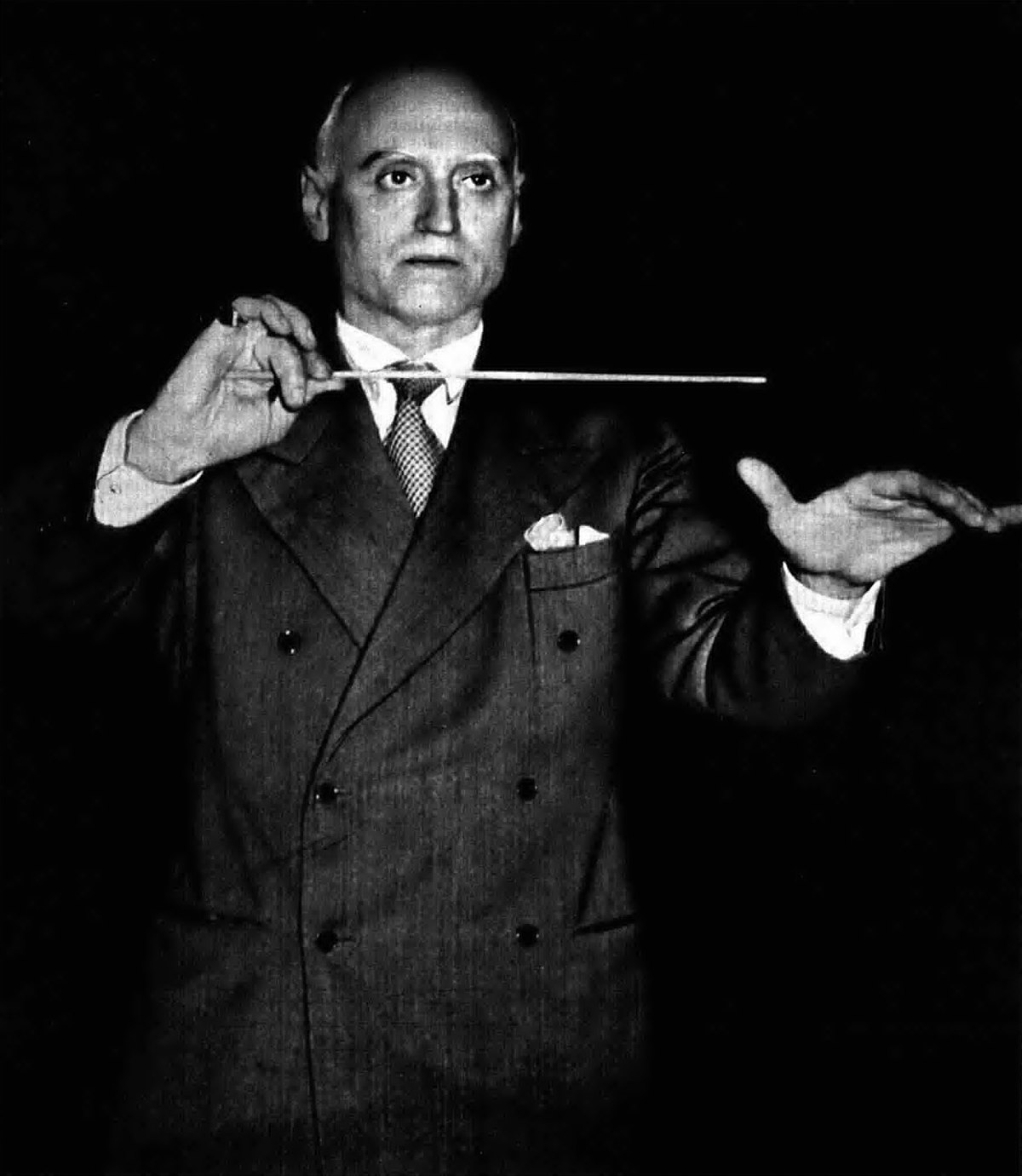
Much the same might be said of Victor de Sabata (above), whose international career as a conductor from his late thirties left him with little time or inclination to compose. A sequence of symphonic poems from around the early 1920s confirms sure mastery of the orchestra, and if Juventus is hardly the deepest of these, its dramatic flair and gestural immediacy are not to be gainsaid. Here, too, there is a three-part structure – the vaunting aspiration of youth becoming subsumed into the trials and setbacks which come with experience, before a revival of those earlier convictions ensures a close of blazing affirmation. Other composers might have invested such a sequence with a dialectical sense of change and attainment, but de Sabata is content to take these implications at face value – while investing his music with a greater subtlety and resourcefulness than it has often been credited for (not least by the writer of this evening’s programme note). This was certainly evident in Pappano’s take on a piece which could yet attract plaudits for other than its name.
As if mindful of the context in which this concert was heard, Pappano opened the second half with a rendering of the National Anthem – somewhat to the surprise of an audibly bemused audience, and presumably not to be repeated for Sunday’s follow-up programme that features Respighi and Dallapiccola at their (very different) communicative best.
To read more on the London Symphony Orchestra’s current season, visit their website



 Arcana.fm