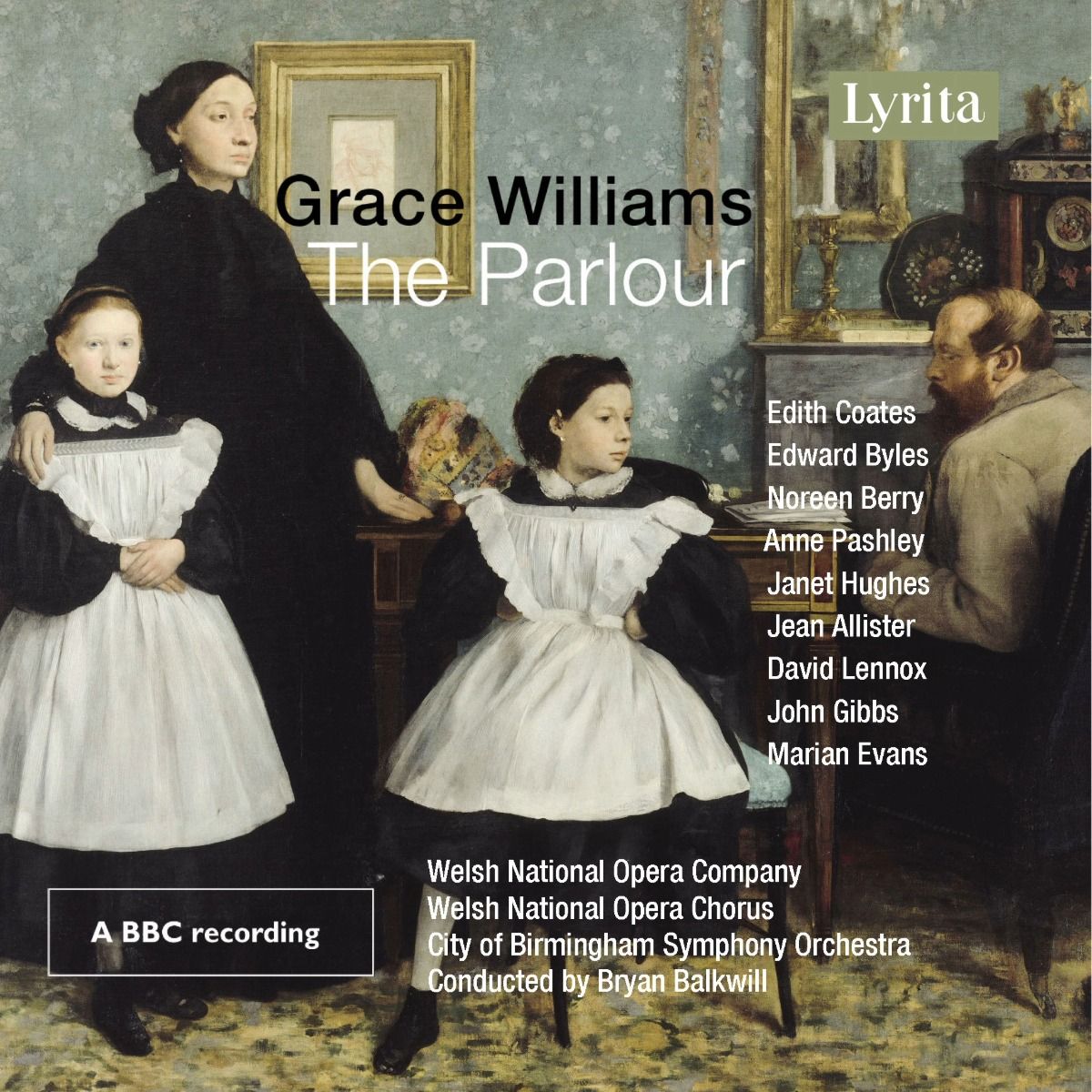
On Record – Grace Williams: The Parlour (Lyrita)

The Parlour (1960-61)

Comic Opera in One Act (two scenes)
Libretto and music by Grace Williams, after En Famille by Guy de Maupassant

Grandmama – Edith Coates (contralto)
Papa – Edward Byles (tenor)
Mama – Noreen Berry (mezzo-soprano)
Louisa – Anne Pashley (soprano)
Augusta – Janet Hughes (soprano)
Aunt Genevieve – Jean Allister (mezzo-soprano)
Uncle Steve – David Lennox (tenor)
Doctor Charlton – John Gibbs (baritone)
Rosalie – Marian Evans (soprano)
Welsh National Opera Company, Welsh National Opera Chorus, City of Birmingham Symphony Orchestra / Bryan Balkwill

Lyrita REAM.1147 [79’32”, Mono/ADD] Producer John Moody
Broadcast performance from Odeon Theatre, Llandudno on 18 August 1966

Reviewed by Richard Whitehouse

What’s the story?

Lyrita continues its coverage of Grace Williams with this first commercial release of her only opera, taken from its first run by Welsh National Opera and so adding another major work to the discography of one who, almost half a century after her death, is finally receiving her due.

What’s the music like?

Although she was, by her own admission, brought up in a ‘singing tradition’ and experienced opera from an early age, it was only in 1959 that Williams was approached with a commission for one. Written to her own libretto, after the short story by Guy de Maupassant, The Parlour was completed two years later but not premiered until May 1966 – a subsequent performance being broadcast and heard here. There have since been semi-professional stagings in London (1974) and Cardiff (1993), but no further production from one of the main British companies.

Relocating this story away from Paris to an unspecified Victorian seaside town, Williams was mindful to maintain the petit-bourgeois conservatism and mendacity from that original setting. As a narrative it makes for pretty dispiriting reading, but the liveliness and wit of her libretto is rarely less than engaging, while her music hardly falters in bringing out the essence of the situation at hand. Eight out of nine singing roles get a turn in the spotlight, and though their profiles might not be sharply drawn, the interplay of characters as of voice-types is astutely managed. Orchestrally the score may lack the intensity of Williams’ other large-scale works, but its dextrousness and intricacy seem ideally suited to a domestic drama; with that pathos which frequently surfaces in her music being no less evident during the opera’s final stages.

Vocally there are strong contributions by Edith Coates as the implacable grandmother, from Edward Byles as her always put-upon son and from Noreen Berry as her perennially hapless (and luckless!) daughter-in-law. Anne Pashley and Janet Hughes become one as her witless grand-daughters, with Jean Allister and David Lennox ideally cast as her favoured daughter and her wheedling son-in-law. John Gibbs makes the most of her doctor in all his contrived bluffness or feigned disinterest, and Marian Evans chips in as the dim-witted family servant. The Welsh National Opera Company and Chorus betray occasional tentativeness, but swift-moving passages for the neighbours lack little of focus or discipline – from a time when this organization was in the process of making its transition from amateur to professional status.

Does it all work?

It does, not least owing to the excellence of this performance. WNO did not then have its own orchestra, but the City of Birmingham Symphony Orchestra is more than equal to the task of projecting Williams’s eventful score with the necessary clarity and verve, while it responds with alacrity to the direction of the company’s then music director Bryan Balkwill. The mono broadcast has come up more than adequately in its remastering, and this set comes with the full libretto and insightful annotations from Paul Conway in what is a typically excellent Lyrita presentation.

Is it recommended?

It is. The Parlour is unlikely to have a professional staging any time soon, making this release of more than archival interest. Could Lyrita acquire the 1963 broadcast of Daniel Jones’s The Knife, intended to be staged with the Williams in what would have been a weighty double-bill.

Listen / Buy

Published post no.2,626 – Thursday 14 August 2025

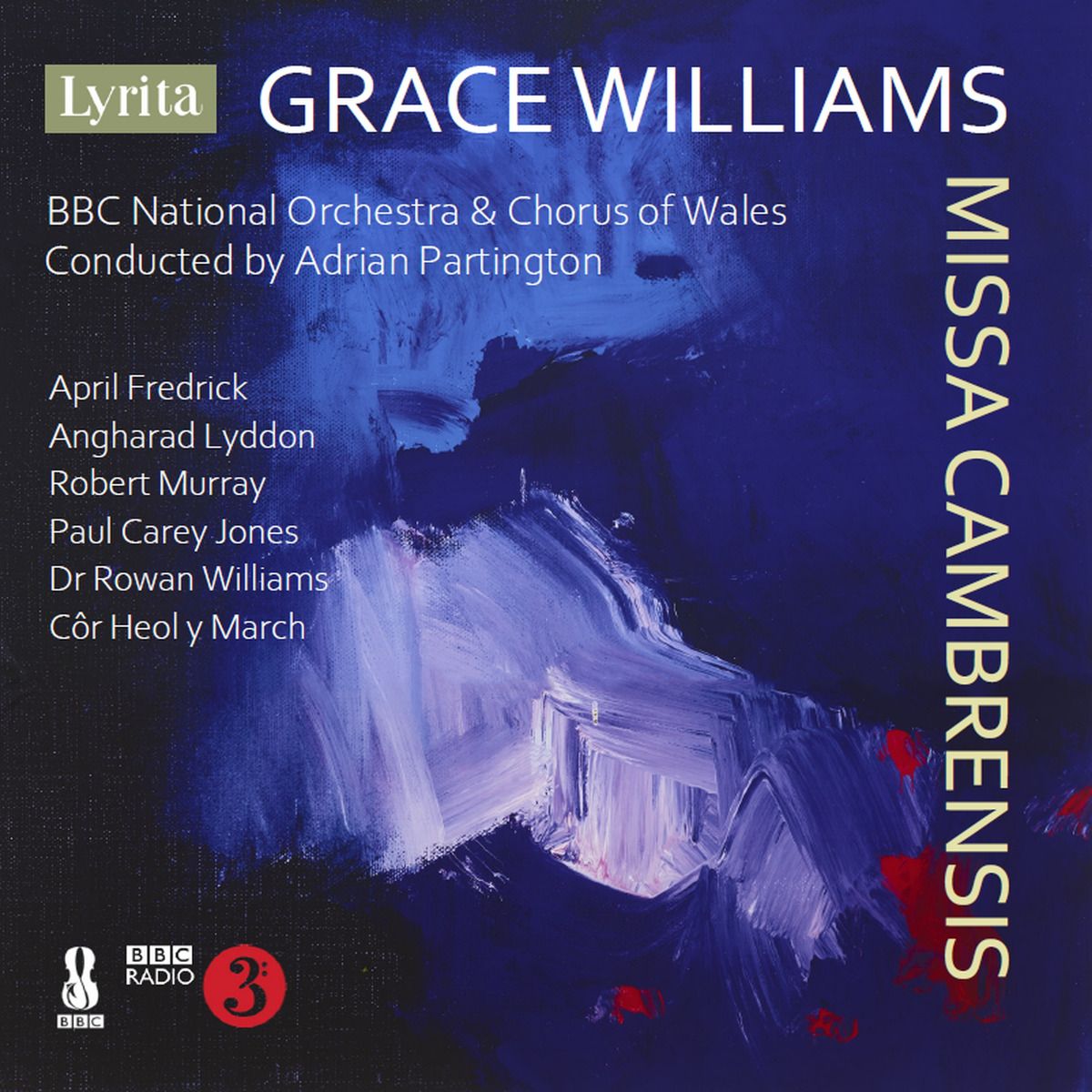
On Record – Soloists, BBC National Chorus and Orchestra of Wales / Adrian Partington – Grace Williams: Missa Cambrensis (Lyrita)

Grace Williams Missa Cambrensis (1968-71)

April Fredrick (soprano), Angharad Lyddon (mezzo-soprano), Robert Murray (tenor)
Paul Carey Jones (bass), Dr Rowan Williams (narrator); Côr Heol y March, BBC National Chorus and Orchestra of Wales / Adrian Partington

Lyrita SRCD442 [66’41’’] Latin / Welsh text and English translation included
Producer / Engineer Adrian Farmer, Engineer Simon Smith

Recorded 20-21 January 2024 at BBC Hoddinott Hall, Cardiff

Reviewed by Richard Whitehouse

What’s the story?

Lyrita continues its coverage of Grace Williams (1906-1977) with her largest concert work, Missa Cambrensis, in a recent studio recording which confirms it as the defining statement from a composer who, almost half a century since her death, is only now receiving her due.

What’s the music like?

As Paul Conway observes in his typically thorough booklet notes, Missa Cambrensis is one among a number of works by Williams that is Welsh only in a titular sense. Premiered at the Llandaff Festival in 1971, it was well received by fellow composers, critics and public alike but not heard again until 2016 in a performance one recalls as originally intended for release on Lyrita and which can be heard via the composer’s dedicated website. Not that the present account is other than successful in conveying the essence of this powerful yet elusive piece.

Many settings of the Mass since Haydn have unfolded a symphonic trajectory, but Williams goes further with the division into five clearly defined movements. The initial Kyrie Eleison not only introduces most of those salient motifs but also establishes that tone, mystical in its undulating equivocation, such as characterizes this work’s long-term expression: the contrast here between choral and soloistic textures duly accentuated by their hieratic and supplicatory quality. This duly sets up an emotional contrast intensified in the Gloria, outwardly the most straightforward part of the work but with a calmly ecstatic response at Laudamus te then an eloquent Dominus Deus that are nothing if not personal, together with an intensely wrought Cum Sancto Spiritu whose culminating Amen’s convey a distinctly ambivalent affirmation.

As most often, the Credo is the most substantial portion but Williams rings the changes by dividing this into halves, a pertinent division coming at Et homo factus est and Crucifíxus étiam pro nobis. In between are interpolated a setting of Saunders Lewis’s Carol Nadolig (A Christmas Carol) for children’s voices with viola, cello and harp of melting pathos, offset by a starkly narrative treatment of the ‘Beatitudes’ prior to a mostly ruminative resumption of the Credo. Pivoting between contemplation and elation, the Sanctus is rounded off by a joyful Hosánna in excélsis which is not to be heard again after the subdued eloquence of the Benedictus. An anguished response to the Agnus Dei feels the more acute, as also a searching Dona Nobis Pacem which brings the work full circle to its contemplative close.

Does it all work?

Yes, and with an understated while readily identifiable personality that surely makes this the most potent setting of the Mass from a Welsh composer. Subliminal influences might not be hard to discern, among them Britten’s War Requiem, but they never detract from Williams’s own idiom. The soloists cannot be faulted in terms of commitment, with Rowan Williams a notably incisive reciter, while Adrian Partington secures a lustrous response from his choral and orchestral forces. Overall, it is hard to imagine the work given with greater conviction.

Is it recommended?

It is indeed, not least in the hope that further live hearings of Missa Cambrensis may prove forthcoming. Good news, moreover, that Lyrita has now acquired the premiere performance of Williams’s only completed opera, The Parlour, which is scheduled for imminent release.

Listen & Buy

You can read more about this release at the Wyastone website

Published post no.2,516 – Monday 28 April 2025

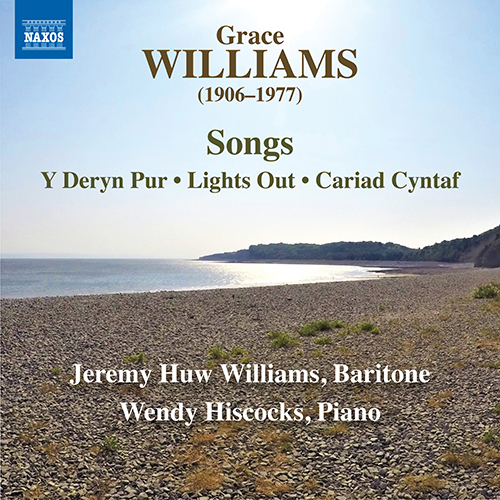
On Record – Jeremy Huw Williams & Wendy Hiscocks: Grace Williams: Songs (Naxos)

Grace Williams
Slow, slow, fresh fount (c1925); I had a little nut tree (c1930); Green Rain (1933); Stand forth, Seithenin (1935, rev; 1951); Ffarwel i langyfelach (?1920s); Llangynwyd (?1920s); The Song of Mary (1939, rev; 1945); Shepherds watched their flocks by night (1948); Fairground (1949); Flight (1949, rev; 1954); À Lauterbach (c1950); Le Chevalier du guet (1949); Four Folk Songs (1950-51); When thou dost dance (1951); Three Yugoslav Folk Songs (1952); Y Deryn Pur (1958); Y Fwyalchen (1958); Cariad Cyntaf (c1960); Ow, Ow, Tlysau (1964); Dwfn yw’r Môr (c1940); Lights Out (1965); Fear no more the heat o’ the sun (1967)

Jeremy Huw Williams (baritone), Wendy Hiscocks (piano)

Naxos 8.571384 [77’47”]
Producer Wendy Hiscocks Engineer Alastair Goolden

Recorded 28-30 September 2022 at Cooper Hall, Selwood Manner, Frome

Reviewed by Richard Whitehouse

What’s the story?

Naxos continues its long-running series of releases sponsored by the British Music Society with an album of songs by Grace Williams (1906-77), all of which are recorded here for the first time and, between them, extend chronologically over the greater part of her composing.

What’s the music like?

Even more than others of her generation, Williams has benefitted from the upsurge of interest in women composers this past decade with recordings of major works on Lyrita and Resonus. Songs may not have the primary place in her output, but they afford a viable overview of her stylistic evolution with individual instances among her most characteristic statements. Most are in English or Welsh though there also settings of French texts, while her own translations of several from the former Yugoslavia further underline the breadth of her literary concerns.

Early settings of Ben Johnson along with traditional English and Welsh poems find Williams, barely out of her teens, tackling verse with audible appreciation of this genre’s lineage within the Victorian and Edwardian eras. That of Mary Webb’s Green Rain is audibly more personal for its wistful ambivalence, while The Song of Mary brings due sensitivity to bear upon some familiar lines from St Luke. The most extended item, Fairground is a setting of Sam Harrison that captures the sights and sounds of said environment with an immediacy never descending into kitsch, while that of Flight matches the sentiments in Laurence Whistler’s poem and has a piano part testing in its intricacy. Her setting of the Jacobean-era When thou dost dance is, by comparison, slighter though no less attuned to the limpid elegance of its anonymous text.

Arrangements of traditional verse had early featured in this composer’s output, and this is not the customary text for her attractive treatment of a traditional Czech carol Shepherds watched their flocks by night. The period around 1950 saw a number of such arrangements and mainly of French texts, but with her take on the Northumbrian Bonny at Morn appreciably different from the more familiar one by Tippett. The end of that decade brought forth a trio of eloquent Welsh settings, while that of the Medieval text Oh, Oh, Treasures may be pastiche yet it has a fervency which feels not a little unsettling. The final two songs see a return to more familiar verse: that of Edward Thomas’s Lights Out evinces a subdued and even fatalistic acceptance, while that of Shakespeare’s Fear no more the heat o’ the sun captures its aura of resignation.

Does it all work?

Yes, allowing for inevitable unevenness in what is a conspectus over four decades. At least a half-dozen of these songs ranks with the best of those by British composers from this period and well warrant investigation by more inquiring singers. Jeremy Huw Williams clearly has no doubts as to their quality and, though his tone as recorded here is not always flattering, it captures his intensity of response. Nor could he have had a more committed or a perceptive accompanist than Wendy Hiscocks, who teases out myriad subtleties from the piano writing.

Is it recommended?

Indeed, and there ought to be enough remaining vocal items for a follow-up release at some stage. Graeme Cotterill pens informative notes, and while it is a pity that several texts could not be printed for copyright reasons, the clarity of Williams’s diction seems fair recompense.

Listen & Buy

Click on the artist names to read more on Jeremy Huw Williams, Wendy Hiscocks, composer Grace Williams and the British Music Society

Published post no.2,506 – Wednesday 16 April 2025

BBC Proms 2023 – Geneva Lewis, BBC National Orchestra of Wales / Jaime Martín – Pejačević, Grace Williams & Holst

Prom 32 – Geneva Lewis (violin), BBC National Orchestra of Wales / Jaime Martín

Pejačević Overture in D minor Op.49 (1919) [Proms premiere]
Williams Violin Concerto (1950) [Proms premiere]
Holst The Planets Op.32 (1914-17)

Royal Albert Hall, London
Tuesday 8 August 2023

by Richard Whitehouse photos by Chris Christodoulou / BBC

Although this evening’s Prom did not quite conform to that ‘overture – concerto – symphony’ format it came quite close, with its first half bringing to the attention of a near-capacity house two representative pieces by women composers who most definitely warrant greater exposure.

The centenary of Dora Pejačević’s death has duly consolidated what was already a burgeoning reputation curtailed by her untimely demise at only 37. Written two years after her impressive Symphony, which Sakari Oramo has performed and recorded (and will revive at these concerts on August 14th) to great acclaim, the Overture is a curtain-raiser as succinct as it is eventful – ably contrasting its respectively impetuous and equable main ideas in a tensile development, then on to a coda which rounds off this immensely appealing piece with decisive affirmation.

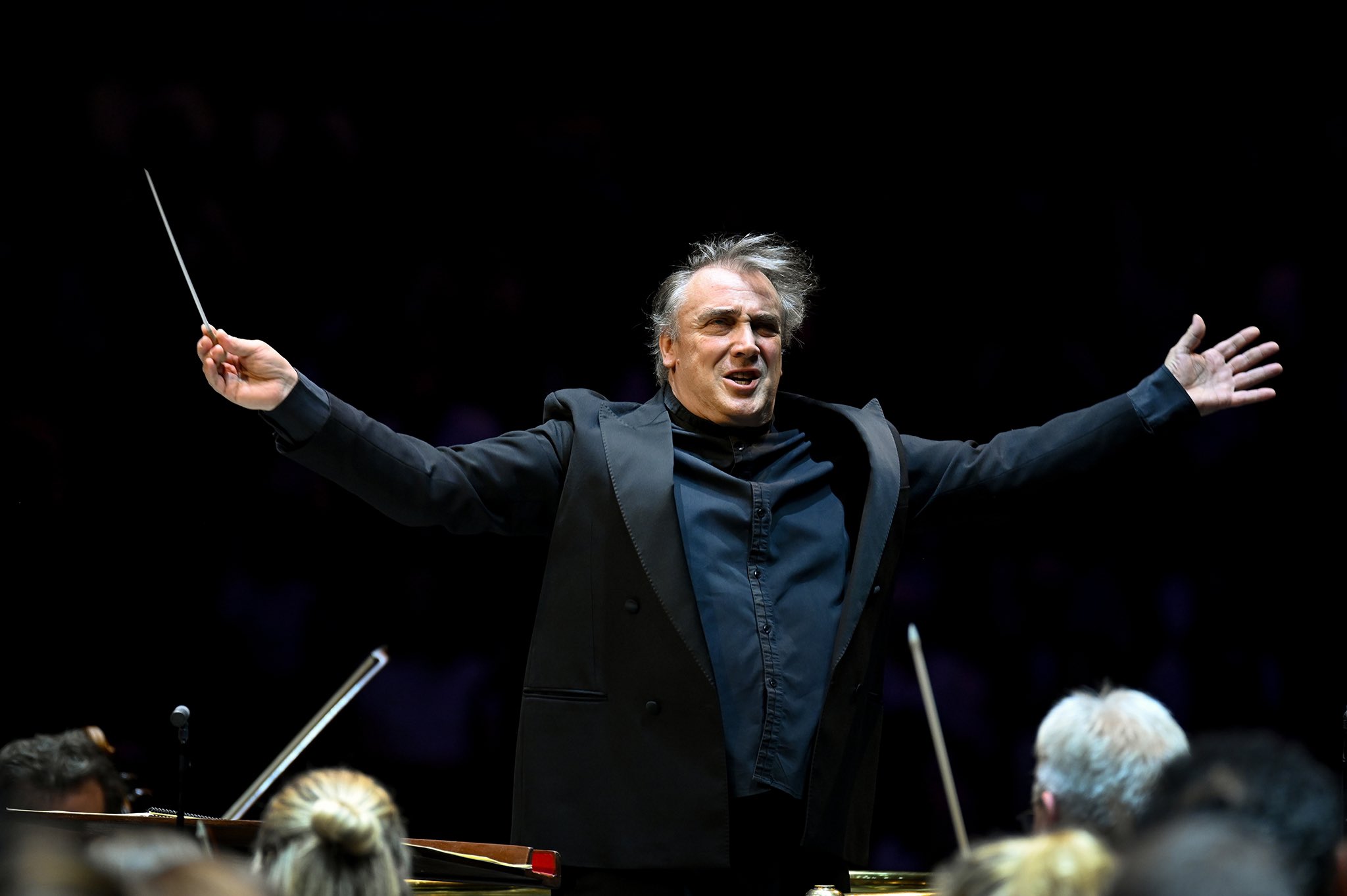
With Jaime Martín an animated podium presence, the BBC National Orchestra of Wales gave it a rousing rendition then was no less finely attuned to the very different ethos of the Violin Concerto by Grace Williams, which it premiered (as the BBC Welsh Orchestra) 73 years ago. There have been few performances since but, on the basis of that tonight, New Zealand-born Geneva Lewis is an eloquent advocate – even if the initial Liricamente arguably needed more purposeful sense of direction for its pensive and often searching inwardness not to risk inertia.

Not that Lewis’ unforced manner or tonal elegance were other than appropriate in this music, as was demonstrated even more directly in the central Andante with its impressionist eddying of melodic phrases and fastidious timbral shading. Following without pause, the final Allegro brought the work’s only fast music in which Lewis’s deftness and articulation gained through her assured coordination with BBCNOW. The cadenza was incisively despatched, while the ensuing coda brought the work to a close the more satisfying for its teasing unexpectedness.

There cannot have been many Proms season this past half-century when Holst’s The Planets has not been played, and it would be good to have welcomed this account more consistently. As it was, the performance took time to recover from a Mars whose stolid tread and lack of textural clarity made for a less than gripping traversal. Venus was better, for all that Martín’s fluctuations of pulse undercut its essential raptness, and though Mercury started off with the requisite humour, some effortful playing in its latter stages left the music feeling earthbound.

This was less of an issue in Jupiter, whose outer sections had all the right verve and energy, even if the trio’s indelible tune verged on the blousy. Pacing its stark opening bars effectively, Martín rather rushed the baleful climax of Saturn, though the radiance of what followed was nothing if not eloquent and bought the best out of BBCNOW. Uranus was almost as fine in this respect, and if the central processional sounded affable rather than sardonic, the sudden emptiness of its closing stages prepared well enough for the otherworldliness of Neptune.

If Martín might have obtained even more hushed and inward playing in this final movement, a sensuous contribution from the London Symphony Chorus enhanced the music-making. An enjoyable reading, albeit one where the whole was less than the sum of its individual planets.

For more on the 2023 BBC Proms, visit the festival’s website at the BBC. You can also click on the link to listen to Dora Pejačević’s Cello Sonata, performed by Laura van der Heijden and Jâms Coleman as part of their Proms at Dewsbury concert on 6 August.

Meanwhile click on the names for more information on artists Geneva Lewis, Jaime Martín and the BBC National Orchestra of Wales – and for information on the composers Dora Pejačević, Grace Williams and Holst

In concert – Jayson Gillham, Royal Philharmonic Orchestra / Owain Arwel Hughes: Grace Williams, Grieg & Sibelius

Williams Penillion (1955)
Grieg
Piano Concerto in A minor Op. 16 (1868)
Sibelius
Symphony no. 5 in E flat major Op. 82 (1919)

Jayson Gillham (piano), Royal Philharmonic Orchestra / Owain Arwel Hughes

Cadogan Hall, London
Tuesday 12 April 2022

Written by Richard Whitehouse. Photos (c) Benjamin Ealovega (Jayson Gillham)

Its high-profile concerts may currently be elsewhere in London, but the Royal Philharmonic Orchestra continues its schedule of regular performances at Cadogan Hall, and this evening was heard under the direction of former principal associate conductor Owain Arwel Hughes.

Hughes has rightly featured Welsh music whenever possible, and this programme began with Penillion that Grace Williams wrote for National Youth Orchestra of Wales. Two symphonies aside, several other of Williams’s pieces are inherently symphonic – not least her ‘symphonic poem in four movements’ whose title infers the Welsh tradition of singing against an existing melody. This is heard at its most evocative in the initial Moderato with solo trumpet intoning its (original) theme in the context of ethereal contributions from woodwind, harp, and strings. There follows a tensile Allegro then haunting Andante as ‘scherzo’ and ‘slow movement’ of a piece where the trenchant final Allegro proceeds toward a gently fatalistic close. Certainly, this is music such as warrants frequent hearings – irrespective of the present cultural climate.

Hard to imagine Grieg’s Piano Concerto undergoing a period of neglect, yet familiarity need not breed contempt at the hands of a skilled and sensitive exponent which Australian-British pianist Jayson Gillham assuredly is. After a commanding start the first movement felt unduly sectional in its unfolding, its orchestral tuttis a little overwrought, but the second main theme was limpidly rendered then Gillham came into his own with a cadenza whose developmental aspect was as audible as its virtuosity. With its poetic contributions from solo horn and cello, the Adagio was no less affecting, then the finale’s lyrical middle section threw into relief the combative dialogue either side. Its flute melody returns in a peroration whose grandiloquence found effective contrast with the Notturno in C (Op.54 No 4) that Gillham gave as an encore.

Even if Sibelius’s Second Symphony had been replaced by his Fifth during the run-up to this concert, the latter’s inclusion played no less to the RPO’s collective strengths. Building those earlier stages of the first movement’s intricate evolution patiently and methodically, Hughes amply brought out this music’s epic as well as ruminative qualities on the way to a powerful central climax – from where its scherzo-like continuation headed stealthily and purposefully to a coda that, if it lacked the last degree of visceral impact, generated undeniable dynamism.

The highlight was an Andante enticingly poised between intermezzo and slow movement – its plaintive repartee of not without its more ominous moments, yet whose winsome essence was itself a telling foil to the finale. Here the coursing interplay of strings and enfolding eloquence of its ‘swan theme’, horns magnetically to the fore, set in motion the eventful progress toward an apotheosis whose affirmation was never in doubt. If some of those concluding chords were not quite unanimous, this hardly detracted from the majesty of Sibelius’s overall conception.

A memorable ending, then, to an appealing programme that found the RPO on fine form and confirmed Hughes’s insights. The orchestra returns here next week in a concert of Schumann, Brahms and Dvořák with the violinist Fumiaki Miura and the conductor Domingo Hindoyan.

The inclusion of Penillion was made possible with funding from the ABO Trust’s Sirens programme, a ten-year initiative to support performance and promotion of music by historical women composers. Further information can be found by clicking here For further information on the Royal Philharmonic Orchestra’s 2021/22 season, click here Click on the performer names to read more about Jayson Gillham and Owain Arwel Hughes, and for more on Grace Williams click here