
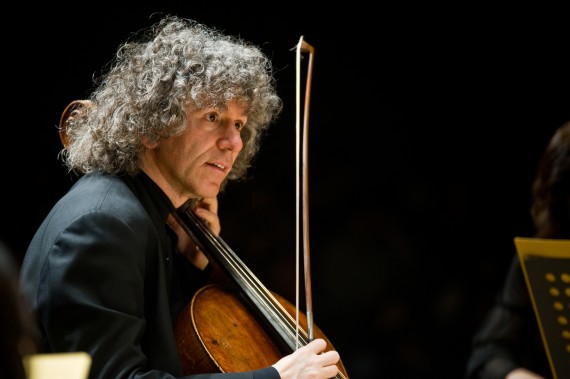
 Cellist Steven Isserlis is one of Britain’s best-loved classical artists – loved for his highly respected interpretations of the cello repertoire, but also for his open, honest and enthusiastic approach to classical music.
Isserlis, an author of books introducing children to the likes of Beethoven, Handel and Schumann, generously donated time to talk to Arcana about the roots of his love of the cello, his new disc of Cello Concertos by Elgar and Walton and his new work as an author.
Can you remember your first encounters with classical music?
I can’t remember a time without music! From the time I remember anything, my sisters were already learning instruments, and I used to go to sleep at night to the sound of my father practising the violin and my mother the piano.
How did you develop a love of the cello?
My sister Rachel played the violin, and my elder sister Annette was always going to play the viola. So a cellist was needed – that would be me. So my parents took me to a local teacher, and – after a false start at the age of four or five – I began lessons from the age of six. I think my love for the cello developed as I came to realise that if I played OK I could be the centre of attention!
What was it like returning to record Elgar’s Cello Concerto? Was it invigorating in the company of someone (the conductor Paavo Järvi) who may not have encountered the composer’s music so much?
Well, I’ve played the Elgar so many times over the 25+ years since I first recorded it that it seemed a good idea to record it again. It’s true that Paavo needed a bit more persuading than he did for our Prokofiev / Shostakovich disc, but not much more; he’s always up for a challenge.
Was it your aim to bring out a little more of the humour in the last movement of the Elgar, given the relative darkness around it? It also feels a little quicker than your first recording of the concerto.
It was not a conscious aim – I really didn’t think about (or listen to) the earlier recording. But yes, there is humour in parts of the last movement – which for me throw the tragedy into even sharper relief.
This is the first time you have recorded the Walton (I think!) I’m assuming you knew it very well before, but what effect did it have on you in the recording process?
I’m not sure it had any particular effect on me ‘in the recording process’, but I’d been wanting to record it for some years, since I feel passionately about it. I always name the Schumann, Dvorak, Elgar and Walton concertos as the four very greatest cello concertos (though I’d be bereft without those of Haydn, C.P.E. Bach, Boccherini, Saint-Saëns, Prokofiev, Shostakovich, Dutilleux etc).
It feels like a very romantic piece, with sighing melodies and deeply felt thoughts. Given your booklet note for the release, is that how you would view it?
Definitely – romantic, poetic, impassioned, magical.
The Gustav and Imogen Holst pieces make fascinating complements. Do you think people are in neglect of just how adventurous Gustav’s music could be?
Perhaps. To my shame, I know very little of it. But I love Invocation, maybe especially so since I had something of a part in its rediscovery.
What do you remember of Imogen Holst as a person, and of the piece here? Her ‘Presto’ seems to me (a bit of wishful thinking I’m sure!) to depict birds chasing each other in the reeds at Aldeburgh.
I remember Imogen as a wonderfully quaint personality who was also sharp as a stainless steel razor! Wonderful. I’ve always thought of the Presto as depicting leaves flying around in a storm. Recently I was sent a note by the work’s dedicatee, Pamela Hind O’Malley, apparently written with Imogen’s approval, which describes it as ‘the scuttering of leaves in a high wind’. I like that word ‘scuttering’!
I understand you have just completed a book – are you able to tell us more about it at this stage?
It’s advice for young musicians – incorporating and updating Schumann’s book of the same name. I suppose that means that I’m now an old musician – groan…
Is it important for you to communicate to people, young and old, in a language that brings classical music to everybody?
Absolutely! And I enjoy playing for children, as well as writing for them – it can be tremendous fun.
Do you think classical music should do more to get the music beyond its ‘inner circle’, so to speak?
Well, yes – but not if that means distorting it, or promoting sugary crossover stuff. Classical music doesn’t need that!
You can hear extracts from the new Steven Isserlis disc of cello concertos by Elgar and Walton, released by Hyperion Records, here – including shorter pieces by Gustav Holst – his Invocation – and his daughter Imogen, a short suite for solo cello The Fall of the Leaf.
Meanwhile forthcoming concerts from the cellist are listed on his website

 Arcana.fm