
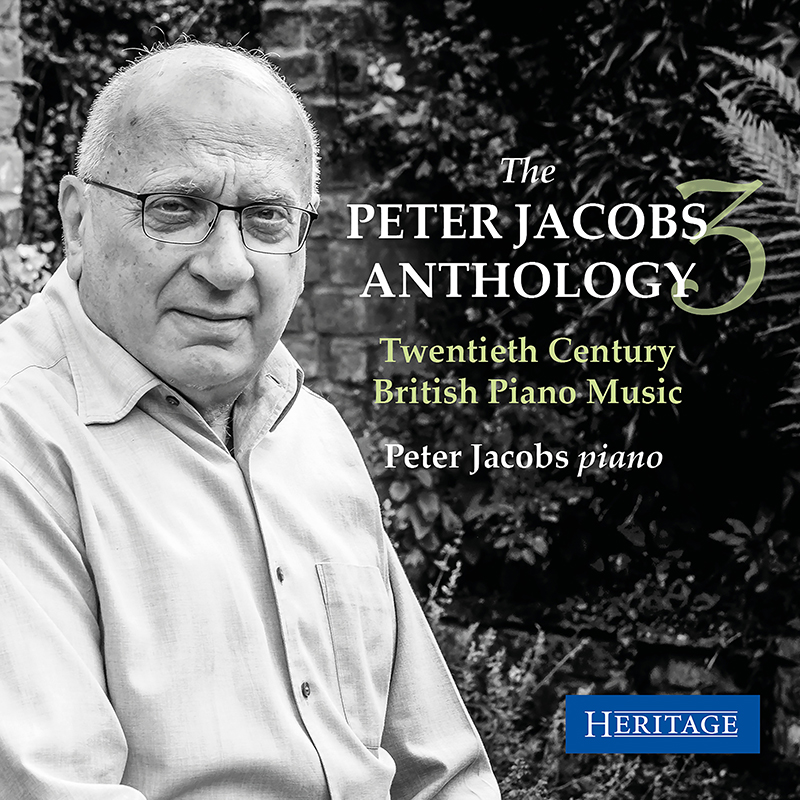
On Record – The Peter Jacobs Anthology Volume 3 (Heritage Records)

Peter Jacobs (piano)

Allum Nocturne in C sharp minor; Prelude No. 24 in D minor (both c.1950)
Bantock (arr. composer) Omar Khayam (1906-09) – Prelude and March
Fenney Au Printemps (pub. 1915)
MacDonald Waste of Seas (1976)
Purcell arr. Stevenson The Queen’s Dollour (pub. 1710, arr. 1958)
Simpson Variations and Finale on a Theme of Haydn (1948)
Truscott Prelude and Fugue in E flat minor; Prelude and Fugue in C major (1957)

Heritage Records HTGCD127 (67’25”)
Recorded live at London College of Music, April 1979

Reviewed by Richard Whitehouse

What’s the story?

Heritage continues adds to its extensive Peter Jacobs discography with this recital focussing on music by British composers mainly of the early and mid-twentieth century, each rendered with that combination of fluency and insight which this pianist brings to all his performances.

What’s the music like?

According to his booklet note, Jacobs gave this recital at an Annual General Meeting for the Havergal Brian Society in 1979, though the present writer remembers a pretty much identical programme being given at this event in 1982. The seeming unavailability of works by Brian (Four Miniatures then Prelude and Fugue in C minor) played on this occasion is regrettable, but these are easily available elsewhere while the recital’s purpose in drawing together music by various of Brian’s contemporaries, colleagues or advocates remains essentially unchanged.

Granville Bantock’s choral epic Omar Khayam has numerous excerpts worthy of autonomous status – not least its evocative Prelude and quizzical March. Apparently written in a weekend, Harold Truscott’s brace of Preludes and Fugues – that in E flat minor as methodical as that in C is impetuous – makes one regret he did not attempt a complete cycle. An amateur composer in the most professional sense, Walter Allum’s piano music wears its indebtedness to Chopin but deftly – witness his intricately designed Nocturne or Prelude in D minor which brings to a vividly decisive end a cycle likely worth hearing in its entirety. William J. Fenney enjoyed a modest reputation just after the First World War with Au Printemps (also known as ‘In Early Spring’) a trilogy the more affecting in its emotional restraint – ‘light’ music but never facile.

Forward to what was then the present, Malcolm MacDonald’s Waste of Seas (also known as Hebridean Prelude) sustaining a plangent atmosphere and of a pianistic resourcefulness to suggest his modest output as worth further investigation. A relatively early work, Variations and Finale on a Theme of Haydn has Robert Simpson drawing a wide but integrated range of moods from the innocuous Minuet of Haydn’s 47th Symphony (its palindromic aspect more intensively mined in Simpson’s Ninth Quartet), prior to an extended final section more akin to the iconoclastic fugal writing in late Beethoven. Such exhilaration needs a brief touchdown such as Jacobs supplies in Ronald Stevenson’s lucid take on one of Purcell’s most poignant inspirations; a reminder the former is often at his most creative in the realm of transcription.

Does it all work?

Indeed so, not least when those pieces by Bantock, Allum, Fenney and MacDonald have yet to receive commercial recordings. Jacobs himself has recorded the Truscott (Heritage) while there are studio accounts of the Simpson by Raymond Clarke (Hyperion) and of the Purcell/ Stevenson transcription from Murray McLachlan (Divine Art) or Christopher Guild (Toccata Classics). To hear these works in close proximity and so perceptively realized is, of course, its own justification and no one interested in this music need hesitate to acquire this release.

Is it recommended? Very much so. Whatever its provenance, the recording sounds entirely satisfactory thanks to Heritage’s expert remastering and one only hopes further such releases from Peter Jacobs’s doubtless extensive archive will be possible. This latest anthology is warmly recommended.

Listen / Buy

You can hear excerpts from the anthology at the Presto Music website, and explore purchase options at the Heritage Records website. Click on the composer names to read more about Robert Simpson, Ronald Stevenson and Harold Truscott

Published post no.2,761 – Thursday 8 January 2026

In Concert – Martin Fröst, Roland Pöntinen & Sébastien Dubé @ Wigmore Hall: Night Passages – A Musical Mosaic

Martin Fröst (clarinet), Roland Pöntinen (piano), Sébastien Dubé (double bass)

Debussy Première rhapsodie (1909-10)
Chausson Andante and Allegro (1881)
Poulenc Sonata for clarinet and piano (1962)
Night Passages – A musical mosaic (with arrangements by the performers)
Domenico Scarlatti Sonata in D minor Kk32
Chick Corea Children’s Song no.15 (1978)
Rameau Les Indes galantes: Air pour les Sauvages (1735-6)
Purcell Incidental music for Oedipus, King of Thebes Z583: Music for a while (1692)
J.S. Bach Sinfonia no15 in B minor BWV801 (c1720)
Chick Corea Armando’s Rumba (1976)
Purcell Hornpipe in E minor Z685
Handel Menuet in G minor (1733)
Traditional Polska från Dorotea
Göran Fröst Klezmer Dance no.2 (2011)

Wigmore Hall, London
Wednesday 21 December 2022

Reviewed by Ben Hogwood

In 2019, Arcana was at the Wigmore Hall to see Martin Fröst and Roland Pöntinen give a concert of largely French music for clarinet and piano. Their encore hinted at an intriguing sequence of arrangements exploring connections between classical music and jazz. Three years on, that sequence has grown in stature, realised in recorded form as the Sony Classical album Night Passages, and given meaningful content by personal and world events.

Through lockdown, Fröst experienced intense bouts of Ménière’s disease, whose symptoms include unexpectedly severe bouts of vertigo and tinnitus. The clarinettist experienced one such bout while driving his car, which he thankfully negotiated without injury, but which bred a number of accompanying fever dreams. Expressed in the program notes, they lent a vivid written complement to the music.

Since 2019 the double bass of Sébastien Dubé has been added to the instrumental thinking, an essential musical component taking the arrangement style towards Jacques Loussier without ever resorting to parody. Unexpectedly, the group’s colourful arrangements did not always include the piano, allowing Fröst and Dubé the chance to explore the rewarding combination of clarinet and double bass through imaginative techniques and compelling improvisation.

The course of Night Passages led from a solemn sonata by Domenico Scarlatti to a Klezmer dance from Fröst’s brother Göran, by way of arrangements exploring the versatility of Baroque music. These were matched by jazz-inflected work from Chick Corea, with Armando’s Rumba presenting some vibrant syncopations, along with a celebration of the Swedish polska.

Frost’s artistry was almost beyond criticism, the clarinettist able to make even the most demanding technical passages appear nothing more than a walk in the park, airily improvising or running through sharply edged cadenzas. Dubé was no less impressive, and a remarkably wide range of colours issued from the double bass, whether bowed or plucked. His chemistry with Fröst was compelling, and the occasional use of vocals added to the mix. Roland Pöntinen also made the most of his chances to shine, providing the rhythmic verve to the dances but also a welcome, cleansing clarity which ran through the Baroque arrangements, tastefully and affectionately realised.

Prior to the interval we heard three short pieces by French composers for clarinet and piano. Debussy’s Première rhapsodie tells its story through a set of contrasting thoughts, initially set out in a humid atmosphere but becoming more outward facing as it gains in confidence. Fröst and Pöntinen had its many twists and turns instinctively under their fingers, finishing each other’s sentences as they did in the romantic, lyrical writing of Chausson’s Andante and Allegro, played with evident affection.

Yet it was Poulenc’s Sonata for clarinet and piano, completed in the year before his death, that made the most lasting impression. What a profound work this is, paying tribute to his friend and fellow composer Arthur Honegger. The slow movement holds the emotional centre of the work, with melancholy on occasion spilling over into outright sadness. Fröst’s quieter asides encouraged the audience to lean closer to the music, but these intimate thoughts were swept away by the exuberant finale, throwing caution to the winds. Fröst and Pöntinen played with great feeling throughout, typifying the approach of a concert that may not have been generous in length but which amply compensated through musical quality.

BBC Proms #7 – Soloists, La Nuova Musica / David Bates: Purcell Dido and Aeneas

Purcell Dido and Aeneas (c1689)

Dido – Alice Coote (mezzo-soprano)
Aeneas – James Newby (baritone)
Belinda – Gemma Summerfield (soprano)
Sorceress – Madeleine Shaw (mezzo-soprano)
Second Woman – Nardus Williams (soprano)
Sailor – Nicky Spence (tenor)
Spirit – Tim Mead (countertenor)
First Witch – Helen Charleston (mezzo-soprano)
Second Witch – Martha McLorinan (mezzo-soprano)

La Nuova Musica / David Bates (harpsichord)

Royal Albert Hall, London
Tuesday 19 July 2022 (late night)

Reviewed by Richard Whitehouse Photo (c) Chris Christodoulou

After the existential confrontations of Vaughan Williams and Tippett earlier this evening, the more restrained yet no less acute expression of Dido and Aeneas came as a necessary tonic – with Purcell’s only through-composed work for the stage leaving a memorable impression.

The nature of its conception might remain as conjectural as the circumstances of its premiere, but there can be no doubt that this opera’s blazed a trail over the centuries that followed. Not the least of its attributes is a formal economy and a tensile dramatic trajectory whose ‘less is more’ aspect could scarcely be more evident. Neither is there any lack of expressive diversity in a score where elements of levity, even slapstick are aligned with a dramatic acuity which draws the three short but judiciously balanced acts into a cohesive and inevitable continuity.

Tonight’s concert performance manifestly played to these strengths. For the title-roles, Alice Coote brought gravitas and nobility of spirit to that of Dido, with James Newby an impulsive while knowingly fickle Aeneas. It was, however, Gemma Summerfield who stole the show as Belinda in rendering this most dramatically fluid of the opera’s parts with an emotional force, latterly foreboding, that was never less than captivating. Madeleine Shaw was larger than life if never overly parodic as the Sorceress, with Tim Mead a plangent Spirit whose intervention (from the organ console) seals the fate of the main protagonists. Credit, too, to Nicky Spence for an uproarious yet winning cameo as the Sailor in a scene whose Village People campery seemed entirely apposite in context and hence made this opera’s outcome the more affecting.

Directing La Nova Musica from the harpsichord, David Bates never lost sight of the dramatic continuity while ensuring an exemplary balance between chorus and ensemble. The former responded with a judicious combination of eloquence and discipline, whereas the emphasis on a continuo section of theorbos, harps and even guitar opened out but never obliterated the bracing string sonorities. Tempos were almost invariably well chosen, and though the final chorus was undeniably drawn out, this reinforced its postludial function to the work overall.

The past 58 seasons have since Dido and Aeneas given complete on four previous occasions, each time reflecting on how the opera was perceived at the time. Tonight’s performance was such a statement, and one as reaffirmed its greatness some 333 years after the first staging.

For more information on the 2022 BBC Proms season, you can visit the festival website. For more on the artists, click on the names for La Nuova Musica and David Bates.

In concert – City of London Sinfonia @ Southwark Cathedral: Origin: This is CLS

cls

Monteverdi arr. Wick Toccata from ‘L’Orfeo’ (1607)
Vaughan Williams
Fantasia on a theme by Thomas Tallis (1910)
Tabakova
Frozen River Flows (2005)
Finnis
The Centre is Everywhere (2019)
Vasks
Music for the fleeting birds (1977)
Tabakova
Origin (2022) (world premiere)
Carter
A Fantasy about Purcell’s ‘Fantasia on one note’ (1975)
Tavener
The Hidden Face (1996)

Hugh Cutting (countertenor), Dan Bates (oboe), City of London Sinfonia / Alexandra Wood (violin)

Southwark Cathedral, London
Thursday 3 March 2022

Written by Ben Hogwood

When the young Richard Hickox assembled a performing group in 1971, his vision was an extended family of talented musicians coming together to project the enjoyment of their art onto their audience.

Just over 50 years on, Hickox may sadly no longer be with us but his vision, realised by the City of London Sinfonia, burns with an ever brighter flame. This celebration in Southwark Cathedral may have been a year late, due to the consequences of the pandemic, but it brought everything together in a programme blending the old with the new.

Great credit should go to the orchestra’s creative director and leader, Alexandra Wood, for choosing music that looked simultaneously forwards and backwards, while utilising the vast spaces offered by the cathedral in inspiring and imaginative ways.

The audience were free to roam around during the concert, which was a considerable plus, for acoustic hotspots could be found and exploited, while it was also possible to stand to one side in contemplation. The mood was relaxed but focused, with audience members chosing a mixture of both options. The only danger of this was unexpectedly finding yourself in front of a group of instrumentalists when they were about to play, meaning the focus would suddenly shift in your direction! This was a risk well worth taking, for the rewards were many.

Before the concert, the Dean of Southwark Cathedral, Andrew Nunn, spoke warmly of the power of music to soothe the fevered mind, giving the pertinent Biblical example of David’s harp curing Saul’s war-torn temper, illustrated vividly by a stained-glass window depiction at the back of the church. The parallels with Russia and Ukraine were unmistakeable, and before the programme started everyone stood for the Ukraine national anthem.

The programme itself began under that very window, with Stephen Wick’s excellent arrangement of the Toccata from Monteverdi’s L’Orfeo, the brass filling the cathedral from back to front with sonorous colours.

The baton then passed to the strings for an unforgettable account of Vaughan WilliamsFantasia on a Theme of Thomas Tallis. This work was written for performance in Gloucester Cathedral in 1910, utilising the space in imaginative ways – and the City of London Sinfonia responded in kind, with the work’s solo group in the round in the nave, and the main body of the strings in the centre of the church. This was a deeply emotive performance, finding the intersection between the old of Tallis and Vaughan Williams’ own sweeping melodies and added-note harmonies. In doing so a composition that is often overplayed gained fresh insight, and, for your reviewer standing at the back of the church, a magical experience.

British-Bulgarian composer Dobrinka Tabakova has a close association with the Sinfonia. Frozen River Flows, an earlier work from 2005, appeared here in an arrangement for clarinet and percussion which was played in the south transept. This brightly coloured piece found Katherine Spencer’s clarinet evoking graceful lines not dissimilar to Poulenc, complemented by the richness of the vibraphone and crotales (antique cymbals), expertly managed by Chris Blundell.

We also heard Tabakova’s music in the world premiere of Origin, written for this concert. It was a brief but meaningful celebration placing violin soloist Alexandra Wood in the nave, with the accompanying musicians under the tower. Wood’s role was that of virtuoso, but she managed it carefully so that slower contributions from the strings and vibraphone were ideally balanced. Tabakova has a talent for the immediate creation of an atmosphere, and this may have been a relatively minimal piece but it left a lasting impression.

Complementing this was another work in the round of the nave, as 12 string players assembled for Edmund Finnis’s The Centre is Everywhere. This was a wholly appropriate choice, the soloists creating unusual and original sounds. On occasion the music swelled like the bellows of an accordion, then subsided to a barely audible whisper, then appeared to be reaching beyond the cathedral for the skies above. Finnis has an unusual and remarkable habit of writing music that becomes an out of body experience, and The Centre is Everywhere shows there is still so much more to achieve when writing for stringed instruments.

The programme turned to wind instruments for a timely reference to the troubles in Ukraine. Latvian composer Pēteris Vasks wrote Fleeting Birds in 1977 as an expression of his need for freedom. Restricted from travelling by the Soviet authorities, he made his feelings known through music. The City of London Sinfonia winds walked the length of the cathedral as they played, turning from joyous expressions of freedom and release to statements soured by compression, reflecting the composer’s earthbound plight.

Freedom lay in Elliott Carter’s Purcell Fantasy, richly expressed by the brass around a persistent middle C, before cutting without a break to John Tavener’s Hidden Face for a final contemplation. The stillness of this work is deceptive, achieved through great virtuosity from solo oboe and a countertenor, singing text written by Mother Maria. Oboist Dan Bates and singer Hugh Cutting were superb throughout, the latter floating his words effortlessly above the prayerful strings, whose sonorous tones were the ideal match for Bates’s keening oboe, which also scaled unfathomable heights with impressive ease.

It was a fitting way to finish a deeply felt concert and celebration, that of a performing group who continue to do their founder proud. Like their musical choices, the City of London Sinfonia look to the future, embracing new advances as well as nurturing past achievements while they do so. They deserve to continue as a treasured feature of the capital’s music making.

To read more about the City of London Sinfonia, visit their website – and for more on composers Dobrinka Tabakova and Edmund Finnis, click on their names

On record – Ronald Stevenson: Piano Music Volume Five: Transcriptions of Purcell, Delius and Van Dieren (Christopher Guild) (Toccata Classics)

stevenson-5

Delius The Young Pianist’s Delius (1962, rev. 2005)
Purcell Toccata (1955); The Queen’s Dolour – A Farewell (1959); Hornpipe (1995); Three Grounds (1995)
Stevenson Little Jazz Variations on Purcell’s ‘New Scotch Tune’ (1964, rev ’75)
Van Dieren String Quartet No. 5 (c1925, rev. 1931; transcr. c1948-1987); Weep You No More, Sad Fountains (1925, transcr, 1951); Spring Song of the Birds (1925, transcr. 1987)

Christopher Guild (piano)

Toccata Classics TOCC0605 [80’57”]

Producer / Engineer Adaq Khan

Recorded 5 – 6 September 2020, 5 January 2021 at the Old Granary Studio, Toft Monks, Norfolk

Written by Richard Whitehouse

What’s the story?

Christopher Guild continues his survey of Ronald Stevenson’s piano music with this volume comprising transcriptions of Purcell, Delius and Van Dieren – the latter’s Fifth Quartet fairly exemplifying Stevenson’s dedication to the spirit as much as the letter of the music at hand.

What’s the music like?

The essence of Stevenson’s re-creative approach is evident in his Purcell transcriptions, not least the Toccata with its deft changes of register and tensile rhetoric where Busoni’s benign presence can be felt. A lighter and more playful manner is evident in the Hornpipe, whereas the Three Grounds point up conceptual as well as musical links with Bach and, through their forming a ‘sonatina’ of unlikely cohesion, Beethoven. Greater license is demonstrated in the Little Jazz Variations, surely among Stevenson’s most delightful pieces in its blurring of the ‘boundary’ between transcription and composition and enhanced by its discreet take on pre-bop jazz idioms. The Queen’s Dolour looks to the poignant final aria from Dido and Aeneas for what is one of the most characteristic and, moreover, affecting Stevenson transcriptions.

All these pieces have been previously recorded, but not the remainder of this programme. A pity that The Young Pianist’s Delius is not more widely known, as this cycle of 10 miniatures drawn from across the composer’s output is a gift to pianists who have little original Delius to work with, whereas listeners who are unfamiliar with or deterred from investigating this easily misunderstood figure could hardly hope for a more representative or appealing breviary of his music. It helps that Stevenson’s transcriptions are straightforward but not in the least didactic.

Two songs by Bernard van Dieren – gravely eloquent as regards Weep You No More or deftly effervescent in Spring Song of the Birds – have secured a measure of familiarity when heard as encores. Not so the Fifth Quartet, never recorded in its original guise, whose transcription occupied Stevenson over almost four decades. Premiered in its revision in 1931, this work is among the most substantial from its composer’s later years as it unfolds from a discursive (if never rhapsodic) sonata design, via circumspect and headlong intermezzi, to a lively scherzo then soulful Adagio – before a resolute finale offers closure. Tonal ambivalence and textural intricacy are borne out in this recasting in terms of piano which lasts five minutes longer than the Allegri Quartet’s 1988 broadcast; not that Guild’s reading seems to lose focus in any way.

Does it all work?

Yes, given Stevenson’s command of keyboard technique and, moreover, his placing of this at the service of the piece in question. To paraphrase his comments on Liszt – were the classical repertoire suddenly to disappear, much it could still be accessed through those transcriptions that he made over the greater part of his career. Nor is the technique required of a consistently advanced degree, with the Delius and several of the Purcell pieces accessible to most capable pianists, though the Van Diren quartet necessitates an ability not far short of the transcriber!

Is it recommended?

Indeed. Christopher Guild is a resourceful and probing guide to Stevenson’s art; his Steinway D heard to advantage and his booklet notes readably informative. One final thought – the Van Dieren Quartets positively cry out for an integral recording: how about it, Toccata Classics?

Listen

https://open.spotify.com/album/6EDUvp6G1WYgOY3yIHegtF

Buy

You can discover more about this release at the Toccata Classics website, where you can also purchase the recording. To find out more about the composer, visit the Ronald Stevenson Society, while for more on Christopher Guild, click here