

Talking Heads: Benjamin Appl

by Ben Hogwood. Photo credits (c) Uwe Arens (above), Filarmonia Hungaria (Kurtág), Jean-Regis Rouston/Getty (Dietrich Fischer-Dieskau)

Seven years on from his first interview with Arcana, Benjamin Appl is in town. In that time a great deal has happened in the career of the Regensburg-born baritone. He has received worldwide acclaim not just for his beautiful voice but for the invention and style with which he has been creating concert programs and recording projects.

These projects form the core of our interview, principally Lines of Life – a newly released album complementing the music of Schubert and György Kurtág, with whom he has become firm friends. We will also discuss a carefully planned and fascinating tribute to Appl’s mentor, the great Dietrich Fischer-Dieskau.

Before that, however, we have the small matter of Handel’s Messiah to contemplate. Appl has just completed a performance with the Royal Liverpool Philharmonic Orchestra, not as a baritone soloist, but as a conductor. This bold step has made a lasting impact. “It was actually one of the greatest experiences of my life!” he says. “It’s interesting to be a singer, but also being able to communicate a lot with the audience through your eyes and facial expressions. You try to give a lot towards the singers in the choir, and then hope they mirror your intention back into the hall. It was very rewarding moment, musically and emotionally, and I was very happy and grateful that I got this chance, starting with a great orchestra. Let us see where this journey will lead!”

Had it always been an ambition, to conduct? “I always wanted to, from an early age”, he confirms. “I was conducting a lot of operas when I was six or seven, learning them off copy later on. I always conducted in the living room off recordings, with a baton my parents gave me for Christmas. It’s not just the beating time, it’s the psychology behind, leading people through a rehearsal and trying to get everyone in one direction – that I find the most interesting part. You have to make decisions in every second count. “With Messiah, you have 45 different numbers, and the hardest bit of conducting  is starting and ending a piece, so after we agreed on Messiah I started to doubt if it was the right piece! But it was a wonderful experience, and everyone in Liverpool was incredibly supportive.”

Conducting the piece after Christmas made a refreshing change. “It was really uplifting, and as you know the story is much more than just Christmas. I also did Haydn’s Creation on January 1st in Budapest. I think that’s a wonderful piece for New Year’s Day, to be grateful about the creation of the world.”

He confesses to feeling odd with the audience behind instead of facing. “That felt very strange – and also even arriving in the concert hall. On both sides of my green room I could hear the soloists warming up, and I also started warming up! But somehow I wasn’t nervous at all. It felt very natural.” Will there be more as a conductor? “It’s something I’m interested in, particularly vocal music where I feel more familiar, and where I’m able to work with other singers and choirs.”

Appl’s mentor, Dietrich Fischer Dieskau, conducted near to the end of his life also, but he is keen to stress that is not the reason for taking up conducting at this point in his career. “It was something I wanted to do earlier on”, explains Appl, “whereas with Dietrich he started quite late.”

More of Fischer-Dieskau anon, as talk turns to 98-year old Hungarian composer György Kurtág (above), with whom Appl is now firm friends. They met in 2019. “The Konzerthaus in Dortmund decided to do a Kurtág festival”, he explains, “and the director of the hall went to Budapest to meet with Kurtág to discuss the repertoire for this festival. For Kurtág it was incredibly important to included a song cycle of six songs with poetry by Hölderlin, because that is a piece he sees as a significant one in his career. They looked into the option of who should sing it, and they selected ten baritones from around the world, who could send a recording to Kurtág. He is known for being very tricky and demanding, and the way he works with musicians, what he asks musicians to do, so he needed some months to really listen to the recordings and make up his mind.”

Gradually a shortlist emerged. “There were five left”, recounts Appl, “and then a few weeks later we were supposed to sing or record the low register of our voice. Then there were only three or four left, and then we had to record again, another page out of this song cycle. Finally I made it – and arrived in Budapest a few months later, to prepare the music for the cycle. I was incredibly nervous, because it is known that after a few minutes he might lose his interest, or that musicians really can’t cope with the intensity and the detailed work he asks to do. At the time his wife Marta was still alive, and after a few minutes she said something in Hungarian to him. He turned to me and said, “Marta says, “You are our person”.” From that moment on, we started a wonderful partnership, and I was in Budapest every few months, still working on these six songs. I understood that I would never be able to learn them at a level where he would be pleased or would respect these songs fully, and we often work just on one bar for three, four hours. My brain was absolutely exploding! In the afternoon, I came back and looked forward to focusing on bar two – but he said to me, “Let’s start from the beginning!” It’s a piece I’ve worked on for five, six years now on, and it will never be finished.”

This level of focus is truly unusual, and as Appl notes, “The wonderful thing is he is so far away from our music industry, with its budgets, timing, short rehearsals, and where it’s about finding the right piece for a small orchestra, where we can’t have 15 brass. That’s very refreshing.”
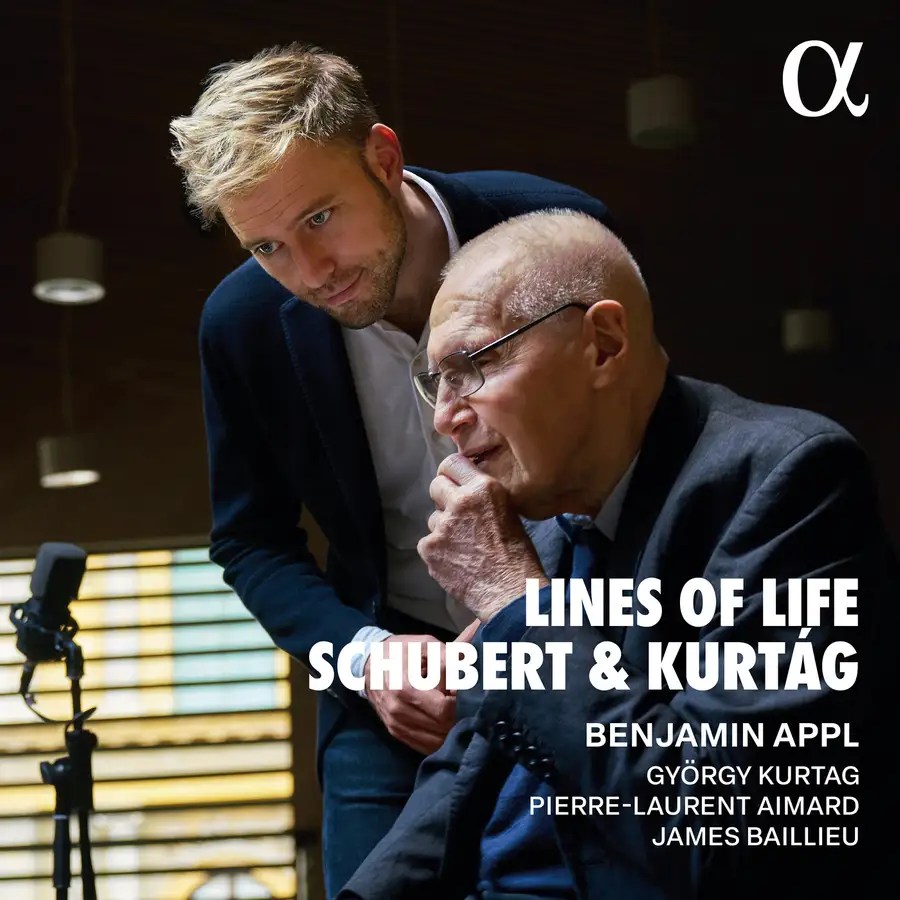
The recording process was highly unusual, with 1,300 takes required over 12 days for the finished article (above). Part of the reason for this was the sheer compression of Kurtág’s music, where he says so much in such a short space of time. “It’s a weird phenomenon, because you would think a very complicated, huge piece with thousands of interwoven lines, but when you look at the page, there is hardly anything written. It’s very bare. Nevertheless it has an ocean behind it, a very deep sea, where there’s so much to discover and to question. That’s what I find so fascinating, a paradox – but a most attractive one.”

Appl was witness to the remarkable chemistry between Kurtág and Marta when they played piano together, privately. “He has no awareness that he’s on stage. It is almost helpless, but in a way that is so real and honest, and touching.”

The new album explores more the connection Kurtág has with composers such as Schumann and, in this case, Schubert. “When I learn his music, it is like learning intervals, and you go along from one note to the next. When I worked with him for the first time, suddenly he put some harmonies underneath which completely made sense, and very often they were Schubertian harmonies. His music is close to Schubert’s, because Schubert also wrote reduced music in the score, there is not a lot. You feel very naked when you perform it. With the littlest impact he tried to have the biggest outcome. This is also music he played a lot with Marta, and she sang along, so this is a very personal connection between Kurtág and his music. He also selected the songs which we recorded, and it was wonderful to put an order together where some of these Schubert songs are like a meditation after his own short songs, while others are a break in mood and harmonics. It was a learning curve for me to work on the order.”

The learning process has been immense. “It is a question all the time. His favourite word is “Maybe?” He is someone who doubts all the time, with questions – there is such insecurity in him, and that’s the most confusing thing in the beginning. The composer should tell me how it has to be done, but actually he is always searching for the right performance, and that is something I find so fascinating, together with the composer. His understanding of the music of the world, bringing quotes from Russian literature or Chinese techniques in porcelain or Beckett, or whatever – his knowledge of the world is so incredible, and he brings parallels from different parts of the world and different art forms. It’s very, very inspiring.”

Does he use modern technology much? “No. He composes with paper, though he does use DVD and CD players. In rehearsals I brought my iPad, and it was interesting to see with a 97-year-old man, how immediately he understood how to tap and turn the pages. He’s a very open-minded person and has just started to learn Chinese. He has a super brain.”

The compositional process is very involved for Kurtág. “When he has to put a staccato dot on top of a note, you think he goes through hell – he starts shaking, and the pen goes closer to the page, and then he goes back and forward. His entire body is twisted, like Orpheus going through hell, and it’s nerve-wracking. It’s a real inner battle to compose. And that’s very inspirational.”

Appl regards him with affection, as a dear friend. “Mr Kurtág is someone you can’t have small talk with”, he observes. “To finish a sentence takes ages, because as he does in his music, he wants to use every word in the perfect way with perfect meaning. Expressing something is real work, but he shows affection, admiration, friendship in very little gestures. He leaves his house very rarely, but whenever I perform in Budapest the honour for him to come to my concerts is huge. When he appears in a concert hall all the people stand up because he’s a national hero. When you talk to a taxi driver from the airport and tell him you go to a composer called Kurtág, everyone knows him. It’s extraordinary how people appreciate him.”
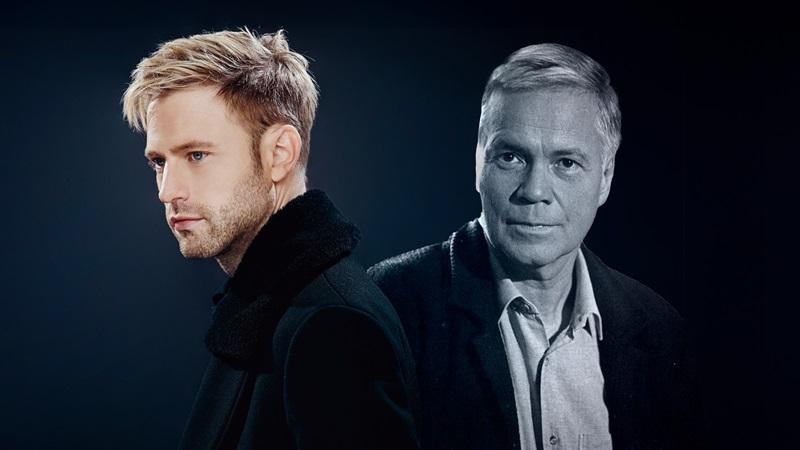
Talk turns to another musical behemoth, Dietrich Fischer-Dieskau. Appl’s tribute album to him, To Dieter: The Past and Future, is due for release on 23 May. It prompts the question – how has it been possible to focus on two musical figures of such renown? “I feel incredibly grateful”, Appl says, “because those two encounters in my life are probably the most rewarding and special musical relationships, mentors I have had in my life. It’s just coincidence that their birthdays or where they stood in their life is close together.”

He talks about meeting the great German baritone. “It was really very special, as he was my absolute hero before meeting him. The first time was in a master class in Austria in 2009, where we were supposed to send suggestions of ten Schubert songs with our recording. I heard he could be quite tricky and demanding as well, so I sent a list of 30 Schubert songs. A few weeks later, back came a list of four Schubert songs, and all four were not part of my list. That was the first impression I got from him. After this masterclass, he offered me to work with him privately, and we worked regularly in his house in Berlin and Bavaria. It was an absolute gift to be together with him for six hours a day, just the two of us and a pianist.”

The repertoire choices for To Dieter are a true musical biography, with songs from Fischer-Dieskau’s father Albert and brother Klaus. “Honouring such a hero and such an incredible singer is a very tricky thing”, he explains, “because if you do his best-selling songs, he has already done them so well, so it’s hard for the next generation to do an album such as that. For me it was more important to give an insight more into who he was. I had the big pleasure of being able to go through most of his private correspondence, his love letters, contracts, diaries – all of that. While respecting privacy I wanted to give an insight into who he was, a person who had a lot of challenges in his life, a lot of things people are not so much aware of.”

He elaborates. “For me, the most important and interesting years are really his childhood in Berlin, growing up in a family where the father was a headmaster, and always wanted to become a composer. He did some singspiel, some small operas, while his brother wrote some music from an early age onwards. We also have a piece where Fischer-Dieskau appears as a poet, and some translations. There are the years in the beginning where he was as a soldier in Russia, then the years as a prisoner of war in Italy, where he was in an American prisoner of war camp, where he automatically learned most of his repertoire, and where he performed Winterreise a capella in front of 6,000 soldiers, then in 1945-46 where he was singing Russian, French and German songs all together in a recital for Germans in an American camp. These years shaped him so much, then coming to England and working with Gerald Moore, making a new export of German culture after a time of war. That, for me, is more interesting than the years we know him best, when he travelled around the world, and amazed people in the concert hall.”

There is his fascination with languages, too – which must have been hard to learn? “Absolutely. It was a good learning curve for him being in Italy for two and a half years as a prisoner of war, where he learned Italian, and where he had to communicate with the American soldiers. Generally he was just very good phonetically, singing different languages.”

Was it intimidating taking on such a program? “Absolutely! The album is not created to challenge him at all – but I know certain critics will compare the singing with him, which is always tricky. That is not my intention. There are many things that have changed – the attention of an audience, the tools and technology you have for live – so much around us has changed. Comparing musicians from different centuries is therefore a very tricky thing to do.”

It is tempting to consider how Fischer-Dieskau (above) would approach recording in today’s climate, with more bite-size musical consumption. Does Appl have to wrestle with that when performing, sticking to his principles?  “I think you have to, because then you’re authentic. At the same time, I think artists have never been more challenged to be flexible, to adjust to new themes, forms of presenting, allowing cameras in hall, appearing on social media immediately. You can control certain things in our industry, but not as much as in the times of Karajan. Those times are gone and our influence and power is in other hands. You have to be flexible, but not at the price of losing authenticity.”

Is there a certain give and take, allowing projects for other people so that more personal aims can be achieved? “Absolutely, and more and more I realise – in politics or the world generally – that compromise has been, for many years, a negative. But I realise more in every field of who we are, that compromise is the only way of living together, of coexistence, of working together, of creating a career, of creating art. It’s always about compromise.”

We agree on the importance of music in these times, and our fortunate position in being able to work in and talk about it. “I hope that many people understand this and also come to this realization. If I may speak as a German during the times of the two big wars, that was a time where the concert halls were full, where people listened to music, and craved something beautiful, a world they can dive into where they are away from, from the misery they experience. People are searching for inner meaning, for peace, for being ‘careless’. Classical music is a wonderful solution for these things.”

Appl’s research and interest in the history of Germany runs deep. “I had a project with Éva Fahidi (above), a wonderful lady who unfortunately passed away one and a half years ago. She was a prisoner in Auschwitz, Jewish but also from Hungary. She wanted to become a pianist, but the Nazis broke her back in Auschwitz, so she never was able to become a musician. Nevertheless, we travelled around, and I performed while she talked about her life. It’s a topic for me as a German, particularly moving to the UK, being grateful. It’s about understanding differences, but also appreciating the things we have in common, in a time where half of the country decided to move out of the European Union. It is a time to really understand where you sit historically, how you fit into these societies, who you are and where you belong to. I think that is only possible if you think a lot about the past, and meet the older generation, to understand their point of view.”

In the time since we last met, Appl has graduated from the BBC New Generation scheme, and his career has blossomed. Has the voice changed in that time? “I think so, particularly in the last year. Normally, as a baritone, you have the big years between 40 and 50. As our physique and intellect changes, and the world around you, everything is connected, they are all influences. You want to improve your technique, but the way you see music and life influences your way of singing.”

Appl has complementary pianists, too, principally dfgd and dfgd. “I’m someone who likes working with different musical challenges. I understand other musicians who need the security and the bond working with one pianist for a long period or for the lifetime. But for me, it is like a master class, listening to what another pianist offers differently. I find there is a danger when you work always with the same people, that trust becomes comfort.”

That will never be a danger with Kurtág, presumably! “No. Artistically it is very, very difficult at times, with a level of exhaustion I’ve never experienced otherwise in my life. It’s a very unique experience.” A real balance to Messiah? “Yes. It is a wonderful thing being a musician, where every week you can focus on another wonderful experience. It’s hard to really say what music you love most, because everything has its face, and with this learning curve, with human encounters, they shape you as an artist and human being and that’s a wonderful thing. I’m very grateful.”

Lines of Life, the album of Schubert and György Kurtág, is out now on Alpha and is available on Presto Music Appl will celebrate his mentor Dietrich Fischer-Dieskau with a series of concerts with pianist James Baillieu, beginning at the Queen Elizabeth Hall on Sunday 2 March. For details of the tour, visit the Benjamin Appl website.

Published post no.2,445 – Friday 14 February 2025

Interview: Benjamin Appl

Of the many fine young singers coming through in classical music currently, few have a voice quite as memorable as Benjamin Appl (above). The German baritone, a BBC New Generation Artists performer, has been making quite an impact on audiences worldwide, and more recently wowed the Gramophone awards with a rendition of Carl Millöcker’s aria Dunkelrote Rosen from Gasparone. In this chat with Arcana, which took place a few months back, he talked about his first album for Sony Classical, Heimat, and the influence of legendary singer Dietrich Fischer-Dieskau on his work. But first…
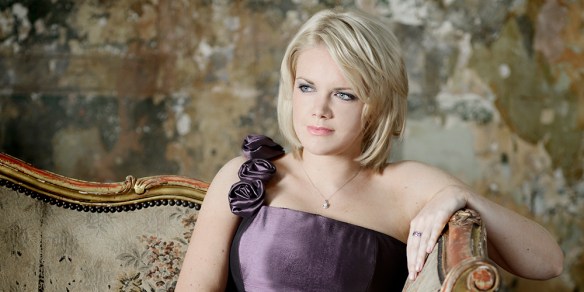
Can you remember your first encounters with classical music?

I grew up in Regensburg in Bavaria. I don’t remember my very first encounters but my mum is musical, and played guitar. I grew up with folk music, lullabies, classical music and the church. My older brother, six years older than me, was banned from attending the boys’ choir in our home town (the Regensburger Domspatzen). My parents were against it completely but he won the battle after six or seven years. My second brother followed, then as a natural process it was me. I sang a lot of church music and choral music – some of it in German but a lot of Latin.

When did you start to take singing lessons, and realise that singing was going to be a career?

The system is a bit different to that in England. When your voice breaks, you continue as part of a boys’ choir, and start as a young male voice. At the age of 15-16 I started as a young baritone, and had a very supportive teacher who introduced me to a lot of new repertoire. I worked in a bank for two years, then in business administration, and while I was doing that I started studying singing for fun. More and more I changed my direction, and around the beginning of 2009 I did my business administration diploma. Then I moved to London to study at the Guildhall. It was not an overnight decision but was a shift in my thinking.

What have you learned from working with someone as well established as Graham Johnson?

It’s a wonderful collaboration. When I met him he was on the panel of a singing competition in Germany. He was the professor of song at the Guildhall when I was there. He had a wonderful ability to change the student-teacher dynamic to an equal partnership of colleagues on the stage. For songs he is definitely ‘Mr Lied’, and his knowledge of this is like nobody else. He knows where the texts are and has been incredibly helpful in putting texts together for this release.

The idea for Heimat was one that had been in my mind for some time, and generally before I worked with Graham Johnson I was working with Dietrich Fischer-Dieskau. He taught me that song recitals should be either for one composer or in groups so the audience could get into one composer. I saw that Graham Johnson had created a concept of recital programmes with the Songmaker’s Almanac, and I was inspired by him and his art of putting songs together for this album.

I took this as a topic so I went to the library and made a list of songs that were related to Heimat or speaking about it, then others that were not so related but related to my personal Heimat or experiences. I had a huge list, so it was challenging to cut it down to 65 minutes or so of music. It is always difficult to translate or explain Heimat, to get a sense of what it means in the UK, so some sections take in the place I was born, children’s songs I relate to, and then the idea of space or locations where people belong to – the country or a house. It also looks at the people I connect to, and feel comfortable with. There are a lot of different aspects to the program, so I wanted to explain it in a personal sense.

I also thought it should be in both German and English, so it might look like a complete mess but when you listen it works rather nicely. That said, the world of song is such a bubble within the bubble of classical music, but it is a small bubble that people will hopefully discover. I hope one or the other person will be attracted to it. Songs will always belong to a smaller audience, as they are such an intimate art form, but I am hoping there are people who will react and get an audience for song.

Who do you particularly admire in the form of song?

As a German baritone I think Dietrich Fischer-Dieskau will always be the first, but I also admire Felicity Lott, who I found to be so kind and modest after such a wonderful career. I would also say Thomas Allen, and Thomas Hampson too. These are all people who have done all the three genres so well – song, solo singing with orchestra and opera.

What have you learned from working with someone as fresh and talented as James Baillieu?

I find working with both Graham Johnson and James very different of course. With James it is more like a journey of exploring things and trying things out, starting from a sheet of white paper from where you can write things out. With Graham Johnson, with his experience, you have a discussion but always realise he is absolutely right! In every part of life you explore these things and they bring you a greater learning experience. I really like the mixture of both collaborations; it’s inspirational to work with different people, like playing tennis with someone who has a different style. It brings out different sides of your character.

I first saw you sing in the Wigmore Hall. Do you think it is the ideal venue for singers – and what other venues have you enjoyed singing in?

Absolutely. There is no place in the world that compares to it. It also helps greatly that the chairman John Gilhooly is supporting song as an art form so much, with people who believe in it. It’s the perfect venue, the acoustic and the audience, like a temple for the form. In Germany people go to the string quartet, and it is often difficult to get them to go to a song recital as people think they’re old fashioned. They think that because the songs use words we don’t use anymore, or they think all the songs are about death! Yet even when we don’t know all the words the emotions of love, losing someone, rejection, pain, are all feelings we belong to. I would like to explore and show this art form should not always be given on an intellectual platform. The texts are so important we often lose the emotional connection. That’s how we can belong and relate to the song.

Did Sony give you confidence for promoting song as an art form?

This was one of the reasons I signed. They gave me complete freedom in what I wanted and helped me to be brave to do a song disc. It is a challenge, and it gives me the chance to present myself in an art form like song. It’s great to have this level of support from a major label, one that looks after singers like Christian Gerhaher and Jonas Kaufmann, who are two of the major players.

Are you also working with bigger forces than piano?

Absolutely, I love to sing in the oratorio tradition, and also in orchestral songs. I have sung Schubert orchestrated by Brahms, Mahler songs, and in the Bach oratorios. I’m doing a lot and the next album I do will be with an orchestra. When I was a New Generations Artist I did a lot of that. It is important to do two or three genres of singing – and for me the main three are opera, concert and lied. They enrich each other vocally and mentally.

Some of our Arcana readers will not be very familiar with Lieder. Would you recommend Schubert as the best way in, or a mixture of composers perhaps?

It is always difficult as taste is a very individual thing, but generally it depends on your background. There is some wonderful English song on the Heimat disc, like Vaughan Williams songs or Britten folksong arrangements. It’s very individual how you connect to music, so even if there is just one piece from that moment you can discover more. There is more Schubert, but then he is the father of song so hopefully you can find one song you like!

Wigmore Mondays – Kathryn Rudge & James Baillieu: English song

kathryn-rudge

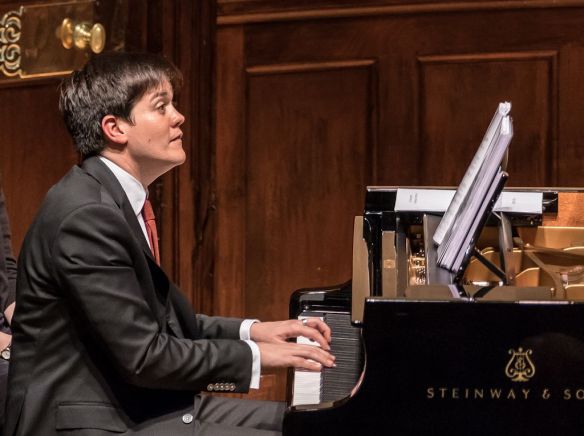
Kathryn Rudge (mezzo-soprano), Gary Pomeroy (viola) & James Baillieu (piano, below)

Howells Come sing and dance (1927)

Quilter Go, lovely rose (1922), Now sleeps the crimson petal (1897), Music, when soft voices die (1926)

William Charles Denis Browne To Gratiana, dancing and singing (1913)

Howells Peacock Pie Op.33 (1919)

Ivor Gurney Sleep (1914); Most holy night (1920); The Fields are full (pub. 1928); By a bierside (1916)

Bridge Three songs with viola [Far, far from each other; Where is it that our soul doth go?; Music when soft voices die] (1903-06)

Listen to the BBC broadcast here

Written by Ben Hogwood

Kathryn Rudge has a special affinity with English song, and in particular the music of Herbert Howells. I remember an especially moving account of his most famous song King David at the Wigmore Hall a few years back, and here she and pianist James Baillieu enjoyed the open-air sonorities of his song Come sing and dance (from 1:26 on the broadcast).

Howells is one of several English composers who excelled in the form of song, but who are not heard often in concert programs, so it was gratifying to see these two BBC Radio 3 New Generation Artists trying something different.

Roger Quilter was the most celebrated song composer of the five here, and the selection of three of his most famous songs was lovingly performed. Go, lovely rose (from 6:02), Now sleeps the crimson petal (9:08) an Music, when soft voices die (11:38) all showed off his melodic craft and subtly rapturous word settings, not to mention flowing piano accompaniment that was superbly played by Baillieu.

Most striking of all those here was the biggest rarity, a song by William Denis Browne, who was killed in the First World War. He left a tiny output of music, dying at the age of 27, and this song – To Gratiana dancing and singing (from 13:47) – left a lasting impression with its strong melody and bold, grand piano part.

james-baillieu-clive-bardaAfter the war English composers were attracted to the simple poetry of Walter de la Mare, and Howells delivered a short, six-part song cycle Peacock Pie, setting verses for children. Here it was oddly enchanting, especially the story of Tired Tim (19:37), who took an age to get up the stairs, the strangely charming figure of Mrs MacQueen or the lumbering profile of The dunce (25:35), a kind of march gone wrong. Rudge could perhaps have used more variety in her portrayal of the characters here, but Howells’ invention and distinctive harmonies shone through, especially in the magical Full Moon (26:45).

On to the tragic figure of Ivor Gurney, much of whose output remains unpublished after his tragically early move to the asylum. The quartet of songs here were dramatic in the extreme though – a resigned Sleep (30:51), a protective Most Holy Night (33:50) the heady, summer stillness of The fields are full (39:49) – vividly caught by both performers – and finally the terrible truth of By a bierside. Written in the trenches in France, its coda (43:20) sings of how ‘it is most grand to die’. This was the loudest and most painful music of the concert, but Baillieu’s response was magical, subtly moving the music through the keys to reach a less painful finish.

Finally we heard songs by Britten’s teacher and friend Frank Bridge, a masterful viola player who wrote his own instrument into these three songs, written between 1903 and 1906. In this performance they were highly charged, and could perhaps have done with more light and shade from singer and viola, but these minor gripes were outdone by the enjoyment of Bridge’s turbulent writing in Far, far from each other (47:10), the resignation of Where is it that our soul doth go? (from 51:00) and finally the warmer heart of Music, when soft voices die (54:45).

As an encore Rudge and Baillieu chose perfectly, opting for Alan Robert Murray’s song I’ll walk beside you (58:33), uncannily sharing a wish for a better, more inclusive world.

Further listening

Kathryn Rudge and James Baillieu made their debut album as a partnership for Champs Hill Records in 2014 – and it complements the songs in this concert perfectly.

Wigmore Mondays – Peter Moore & James Baillieu: Trombone showpieces

peter-moore

Peter Moore & James Baillieu: Trombone showpieces

James Maynard Urban Variations (2016, world première)

Schumann Fantasiestücke Op. 73 (1849)

Axel Jørgensen Romance Op. 21 (publ.1921)

Duparc La vie antérieure (1884)

Rachmaninov Cello Sonata in G minor Op. 19 (3rd movt, Andante) (1901)

Hindemith Trombone Sonata (1941)

Arthur Pryor Annie Laurie (early 1900s)

Listen to the BBC broadcast here

Written by Ben Hogwood

Peter Moore is a remarkable talent.

Winner of the BBC Young Musician of the Year crown at the age of 12, co-principal trombone of the London Symphony Orchestra at 18 and now one of the BBC Radio 3 New Generation Artists, he looks set for a long and lasting career at the top, if this superb recital is anything to go by.

The same can be said for partner in crime James Baillieu, a pianist of great sensitivity and style, whose musicality and technique mark him out as a very fine accompanist – using that term with the knowledge that it is not a secondary role!

The recital, a rare chance to experience the trombone in a solo capacity, was full of thrills and spills. Moore began with a flourish, the enjoyable Urban Variations of fellow trombonist James Maynard an evocation of three different cities – Berlin (from 1:42 on the broadcast), London (a calm St John’s Wood park at 3:10) and the bustle of New York (8:13)

Then Moore explored more romantic repertoire in straight transcriptions of three Fantasy Pieces by Schumann (10:59), a song by Duparc (26:13) and the slow movement of Rachmaninov’s Cello Sonata (30:55), with an original piece from the Danish composer Axel Jørgensen added for good measure.

The Schumann was a tricky one for both performers to balance. It was superbly played but at the back of the hall the piano was a way back in the balance at times. The Duparc and Rachmaninov fared very well, an inspired pairing that proved a great showcase for Moore’s breadth of tone, while the Jorgensen (from 21:00) was a bright piece, dappled with sunshine.

The coup de grace, though, was a brilliant performance of Hindemith’s Trombone Sonata (from 38:25). Rarely heard in the concert hall these days, the composer’s music gets an unfair deal. Moore and Baillieu showed us why this is wrong, with plenty of humour, grace and a gritty resilience, the latter quality due in part to the work’s composition in 1941, around the Second World War. Both players performed heroically, whether it was Baillieu catching the rhythmic drive of the music, or Moore moving between technical trickery and sudden if brief lyrical asides. The third movement, wonderfully described as a Swashbuckler’s Song, found Moore at his outspoken best.

The two followed with a work by Sousa’s go-to trombone man, Arthur Pryor (from 48:50). Annie Laurie, an air and variations on the traditional Scottish tune, was a winning performance, the audience alternately gasping at Moore’s technique or laughing at some of the outrageous and funny musical statements. The encore, which was inevitable after a concert of such good quality, was an arrangement of Charlie Chaplin’s Smile (54:38)

If brass playing is your thing, I would urge you to catch Peter Moore live – and soon!

Further listening

The music played by Peter Moore and James Baillieu is included in the Spotify playlist below.

Ailish Tynan and James Baillieu – French Song at the Wigmore Hall

French Song at the Wigmore Hall

ailish-tynan

Ailish Tynan (soprano), James Baillieu (piano) – Wigmore Hall, London, live on BBC Radio 3, 22 June 2015

Listening link (opens in a new window):

http://www.bbc.co.uk/programmes/b05zh7pr

on the iPlayer until 21 July

Spotify

In case you cannot hear the broadcast, I have put together a Spotify playlist of most of the music in this concert, including recordings the artists have made where possible. The playlist can be found below:

What’s the music?

Hahn: Fêtes galantes; En sourdine; A Chloris (various) (9 minutes)

Poulenc: La courte paille (1960) (11 minutes)

Poulenc: Trois poèmes de Louise de Vilmorin (1937) (7 minutes)

Hahn: Venezia – Chansons en dialecte vénitien (1901) (16 minutes)

What about the music?

There is something rather special about a recital of French songs, and this intriguing program brings together one of its best exponents – the soprano Ailish Tynan – and one of the best up and coming accompanists, pianist James Baillieu. Of course to call him an ‘accompanist’ recognises just how important that role is, setting the tone and providing the colour.

The two composers here are well matched, despite their very different styles of writing. Reynaldo Hahn, born in Venezuela but moving to Paris when three years old, is best known for his songs, especially settings of Victor Hugo and Paul Verlaine. The BBC Radio 3 announcer Sara Mohr-Pietsch sums up the songs in the first trio as ‘a group of young men serenading their beloveds, the piano imitating a mandolin’ (Fêtes galantes), ‘a muted nocturnal love song’ (En sourdine) and ‘a love poem set with a loving nod to Bach (A Chloris). In contrast the cycle of five songs Venezia glorifies the gondoliers in the city, setting it as ‘the elegant playground of the rich and famous’, in Graham Johnson’s words.

Francis Poulenc, meanwhile, is completely different, writing with economy but also with an appealing brashness and humour that mean he gets away with some pretty outrageous settings. There are touching moments too, though, and in his last song cycle La coute paille (The short straw) he sets seven nonsense rhymes, a present for realised in music for the singer Denise Duval, so that she could sing them to her young boy. The simplicity of Poulenc’s musical language is perfectly suited to the text.

Complementing this is a short mini-cycle of poems set in 1937 to the poetry of another good friend, Louise de Vilmorin.

Performance verdict

Ailish Tynan is in her element in this sort of program, and the combination of Poulenc with Hahn is not one to miss. Poulenc can never resist humour in his songs and Tynan makes it her mission to seek it out, from the zany and oddball moments of La coute paille to the heady eroticism of his three de Vilmorin settings.

The performance of Venezia is glorious, and even listening on the radio you can tell just how much fun she gets from Che pecà. Before then however there are the heady heights of La barcheta, Tynan’s voice both flexible and incredibly well controlled.

James Baillieu’s setting of each scene is also carefully managed and vividly painted.

What should I listen out for?

Hahn

1:11 – Fêtes galantes A lively song, begun by the clang of the piano in the upper register, and a playful interplay between him and the singer, who has quite an unusual contour to the melodic line.

3:05 – En sourdine (Softly) A slower and much more languorous affair this, and it’s easy to imagine a hot and sultry evening where nobody is able to sleep. Verlaine’s text has something else in mind, reflected by Tynan’s wonderful higher note at 6’12” or thereabouts.

6:42 – À Chloris (To Chloris) the tread of the bass line and the profile are indeed similar to Bach, a kind of equivalent to his Sleepers Awake. Baillieu introduces the song with an admirable calm, before the rapturous entry of the singer. This rather wonderful song finishes softly at 10:08.

Poulenc

La courte paille (The short straw) – with words here

11:37 – Le sommeiil (Sleep) A light and graceful song to start the cycle – though there is a dark underside to it, as ‘sleep is on vacation’ and the mother is frustrated.

13:35 – Quelle aventure! (What an adventure!) This song trips along with outbursts in the higher register of the voice, reflecting the nonsense text of the flea pulling an elephant in a carriage. A surreal dream!

14:46 – La reine de cœur (The Queen of Hearts) This sleepy song depicts the enchantment of the queen, beckoning the listener into her castle.

16:40 – Ba, be, bi, bo, bu The nonsense is evident in the spiky piano part – depicting the cat who has put his boots on! – and in Tynan’s shrieks and whoops, brilliantly stage managed. It’s all over in a flash!

17:16 – Les anges musiciens (The musician angels) A more sombre and graceful affair, again suggesting the onset of sleep as the angels play Mozart on their harps

18:42 – Le carafon (The baby carafe) The alternation in the vocal part between swoops and gliding notes gives an indication of the surreal nature of the text.

20:01 – Lune d’Avril (April moon) Initially lost in thought, this final song of the cycle builds to an impressive climax

Trois poèmes de Louise de Vilmorin

23:45 – Le garçon de Liège (The boy of Liège) A fast moving and breathless song with plenty of ‘wrong’ notes in the piano part.

25:16 – Au-delà A colourful piano introduction alternating between two chords as the singer goes on a breathless voyage of self-examination.

26:43 – Aux officiers de la Garde Blanche (To the officers of the White Guard) A thoughtful mood runs through this song, which Graham Johnson notes to be unusual in Poulenc’s output for its contemplation.

Hahn

Ailish Tynan introduces this cycle as a portrayal of ‘sultry, steamy, sensual Venice – where young men lure you into gondolas’!

32:18 – Sopra l’acqua indormenzada (Asleep on the water) This song is notable for its high and clear sound from the soprano, as she entreats her subject to join her in the boat. As part of this she stylishly glides between notes, occasionally sliding between them (a technique known as ‘portamento’)

36:01 – La barcheta (The little boat) The boat itself is home to simmering passion in a minor key. There is a really nice ornamentation to the melody, then a vocalise on the word ‘Ah’ at the end of each verse.

39:26 – L’avertimento (The warning) An urgent song warning the lads off ‘the lovely Nana’, who ‘has the heart of a tiger’. There is an impressive outburst at the end.

41:02 – La biondina in gondoleta (The blonde girl in the gondola) A slower and longer song, describing the raptures of an encounter with the blonde girl. Heady music, with a breathless final verse!

45:35 – Che pecà! (What a shame) Described by Tynan as ‘one of my favourite songs of all time’, this is a stuttering march, perhaps suggesting the rickety man of the text. Tynan’s voice rings out on the high notes, before the ‘Che pecà’ response, a distinctive reply, falls lower down the scale to comedic effect.

Encores

48:59 The boy From… by Mary Rogers, with words by Stephen Sondheim. A send-up of The Girl from Ipanema. You may be able to hear Ailish dedicating the song to the Director of Wigmore Hall, John Gilhooly, before vividly illustrating her comic powers!

52:41 – Extase by the French composer Henri Duparc (1848-1933) The other side of the singer in a carefully controlled but poignant account.

Further listening

If you enjoyed this recital then the next recommendation can only be for more Ailish Tynan, for she is wonderful in French song. Here she is in a disc of Fauré, with the pianist Iain Burnside. Well worth hearing for the composer’s open-air writing style!

For more concerts click here