In concert – Khatia Buniatishvili, Melbourne Symphony Orchestra / Jaime Martin @ BBC Proms: Sutherland, Dvořák & Tchaikovsky

Khatia Buniatishvili (piano), Melbourne Symphony Orchestra / Jaime Martin

Sutherland Haunted Hills (1950) [Proms premiere]
Tchaikovsky Piano Concerto no.1 in B flat minor Op.23 (1874-5)
Dvořák Symphony no.6 in D major Op.60 (1880)

Royal Albert Hall, London
Friday 29 August 2025

Reviewed by Richard Whitehouse Photos (c) BBC / Chris Christodoulou

Eleven years after its well-received debut at these concerts under the late Sir Andrew Davis, the Melbourne Symphony Orchestra made its unintentionally eventful return with current chief conductor Jaime Martin and a programme which, for the most part, played to this orchestra’s strengths.

A significant presence in Australian music throughout the mid-twentieth century, Margaret Sutherland has yet to receive her due in live or recorded terms; making this performance of Haunted Hills the more timely. Inspired by the Dandenong Ranges, just outside Melbourne, her symphonic poem evokes the timelessness of its environment as surely as the fate of the Aboriginals who came there. Its starkly dissonant opening then granitic opening paragraph recall that Vaughan Williams’ Sixth Symphony had been unleashed barely two years earlier, and while much of what follows is notable more for its judicious orchestration than formal cohesion, the musical persona that finally emerges is distinctive enough to warrant further hearings of this piece within the context of Sutherland’s not inconsiderable output overall.

Logistical factors necessitated a reordering such that Dvořák’s Sixth Symphony came before the interval. Not a stranger to these concerts (tonight’s being its ninth hearing in 72 years), it responded well to Martin’s interventionist if rarely intrusive approach – not least an opening Allegro (its non tanto duly observed albeit with no exposition repeat) at its most persuasive in a development whose seeming discursiveness was purposefully reined in, and on to a coda whose heightened sense of arrival was mitigated only by those slightly tentative closing bars.

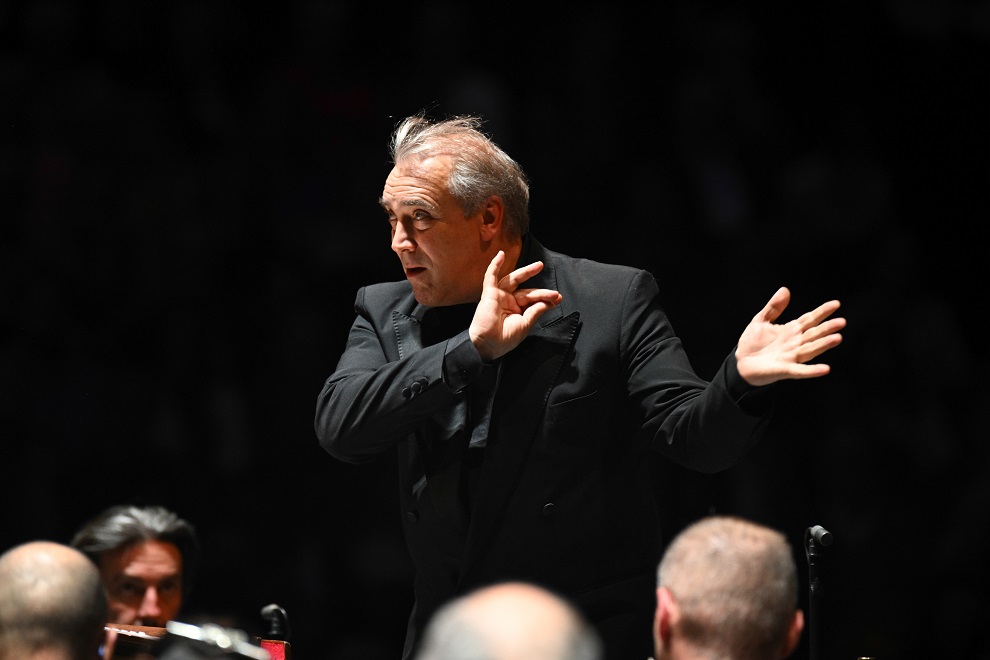
Not the deepest among Dvořák’s symphonic slow movements, the Adagio is surely his most felicitous in its expressive shadings and emotional understatement. Martin made the most of these, as too the contrast between the Scherzo’s impetuous outer sections and its ingratiating trio. The surging acceleration at its close prepared unerringly, moreover, for a Finale as finds Dvořák at his most Brahmsian though, here again, Martin (above), steered a forthright course through its overly rhetorical development before he infused its coda with an exhilarating affirmation.

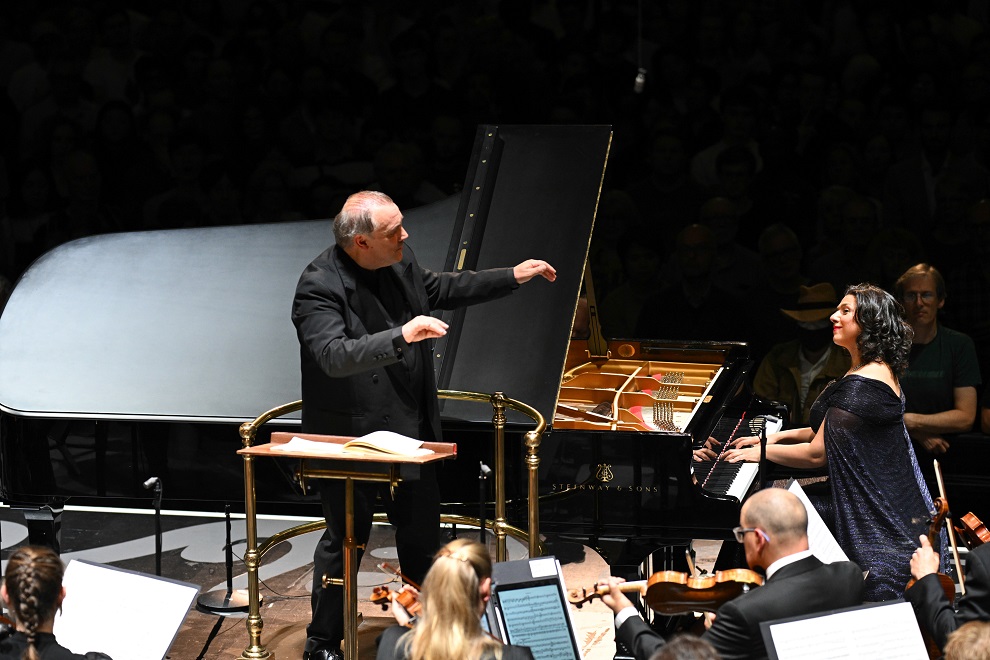
Tchaikovsky’s First Piano Concerto cannot often have occupied the second half of a concert, though Khatia Buniatishvili made the most of her delayed appearance. Most striking was the amount of hushed playing during a lengthy opening movement whose indelible introduction was kept well within emotional limits. If coordination between soloist and orchestra was not all it might have been, the latter’s entry after a suitably dextrous cadenza was an undoubted highpoint, though not a rather blowsy coda. A melting take on the Andantino was enhanced with poetic contributions from flautist Prudence Davis and cellist David Berlin – while if, in the final Allegro, Buniatishvili’s passagework could seem unnecessarily skittish, she and the Melbourne players came together admirably in a surging but not unduly bathetic peroration.

As to extra-musical occurrences at this concert (for a full BBC account, read here), these artists responded simply by focussing on the music. As an envoi, Buniatishvili’s elegant rendering of the Adagio from Alessandro Marcello’s Oboe Concerto in D minor, arranged by Johann Sebastian Bach, could not have been more fitting.

Click on the artist names to read more about pianist Khatia Buniatishvili, the Melbourne Symphony Orchestra and conductor Jaime Martin. Click also for more on composer Margaret Sutherland, and the BBC Proms

Published post no.2,643 – Sunday 31 August 2025

In concert – Estonian Philharmonic Chamber Choir / Tõnu Kaljuste @ BBC Proms: Arvo Pärt at 90

Annika Lõhmus, Yena Choi (sopranos), Toomas Tohert (tenor), Geir Luht (bass), Estonian Philharmonic Chamber Choir, Kadri Toomoja (organ) / Tõnu Kaljuste

Arvo Pärt Da pacem Domine (2004/6); Veni creator (2006); Magnificat (1989); The Deer’s Cry (2007); Für Jan van Eyck (2020) (UK premiere)
Galina Grigorjeva Svyatki – ‘Spring is Coming’ (2004)
Rachmaninov All Night Vigil (Vespers) Op.37 (1915): Slava v vyshnikh Bogu; Bogoroditse Devo
J.S. Bach Motet: Ich lasse dich nicht, BWV Anh.159 (1713)
Arvo Pärt Peace upon you, Jerusalem (2002); De profundis (1980)
Tormis Curse upon Iron (1972, rev. 1991)
Arvo Pärt Vater unser (2005/11); encore: Estonian Lullaby (2002)

Royal Albert Hall, London
Thursday 31 July 2025 (late night)

Reviewed by Ben Hogwood Photos (c) BBC / Chris Christodoulou

The music of Arvo Pärt is ideal for the special atmosphere of a late-night Prom. Yet this was no ordinary concert, being a celebration of the Estonian composer’s forthcoming 90th birthday in September, given by his close friend and collaborator Tõnu Kaljuste, conducting the Estonian Philharmonic Chamber Choir.

This combination of performers have been mainstays of the Pärt discography, forming a celebrated partnership with the ECM label that began with the landmark Tabula Rasa album of 1984, a cornerstone for Pärt’s critical and commercial success.

Pärt is often referred to as a ‘holy minimalist’, to which the response should be that his music is not ‘wholly minimal’. The substantial orchestral works attest to that, though here we heard much slighter but equally meaningful pieces for choir, most given unaccompanied by the 25-strong Estonian ensemble. The Proms audience were commendably quiet, leaning in to appreciate both the delicacy and crystal purity of the voices. The program was well-thought, realising the expressive potential of Pärt’s music alongside that of Bach, Rachmaninov and fellow Estonians, Veljo Tormis and Galina Grigorjeva.

The solemn Da pacem Domine and open-air Veni creator made an ideal opening couplet, the choir projecting with striking clarity rather than volume. For silence, too, plays a critical role in Pärt’s music, and Kaljuste ensured the spaces between the notes were every bit as expressive.

The Magnificat revealed its hidden power, while The Deer’s Cry was perfectly phrased, Pärt’s lilting cadences casting a spell. Für Jan Van Eyck, setting the text of the Agnus Dei, found the ideal balance between the reduced choir and Royal Albert Hall organ, where Kadri Toomoja had the ideal registration. Peace Upon You, Jerusalem, for female voices, contrasted silence with brightly voiced choral statements, while the solemn De profundis, for male voices, began from a small cell, maintaining rapt concentration while punctuated by organ and percussion.

Galina Grigorjeva’s Svyatki was a beautiful meditation, led by the heavenly voice of soprano Yena Choi, her voice with a remarkable bell-like clarity. Bach’s motet, previously attributed to his son Johann Christian, was impeccably voiced and phrased, but while the two excerpts from Rachmaninov’s All-Night Vigil were arguably less successful, they reflected a familiarity with listening to big choirs perform this music, rather than the subtleties of a chamber choir. Purity proved ample compensation for volume here.

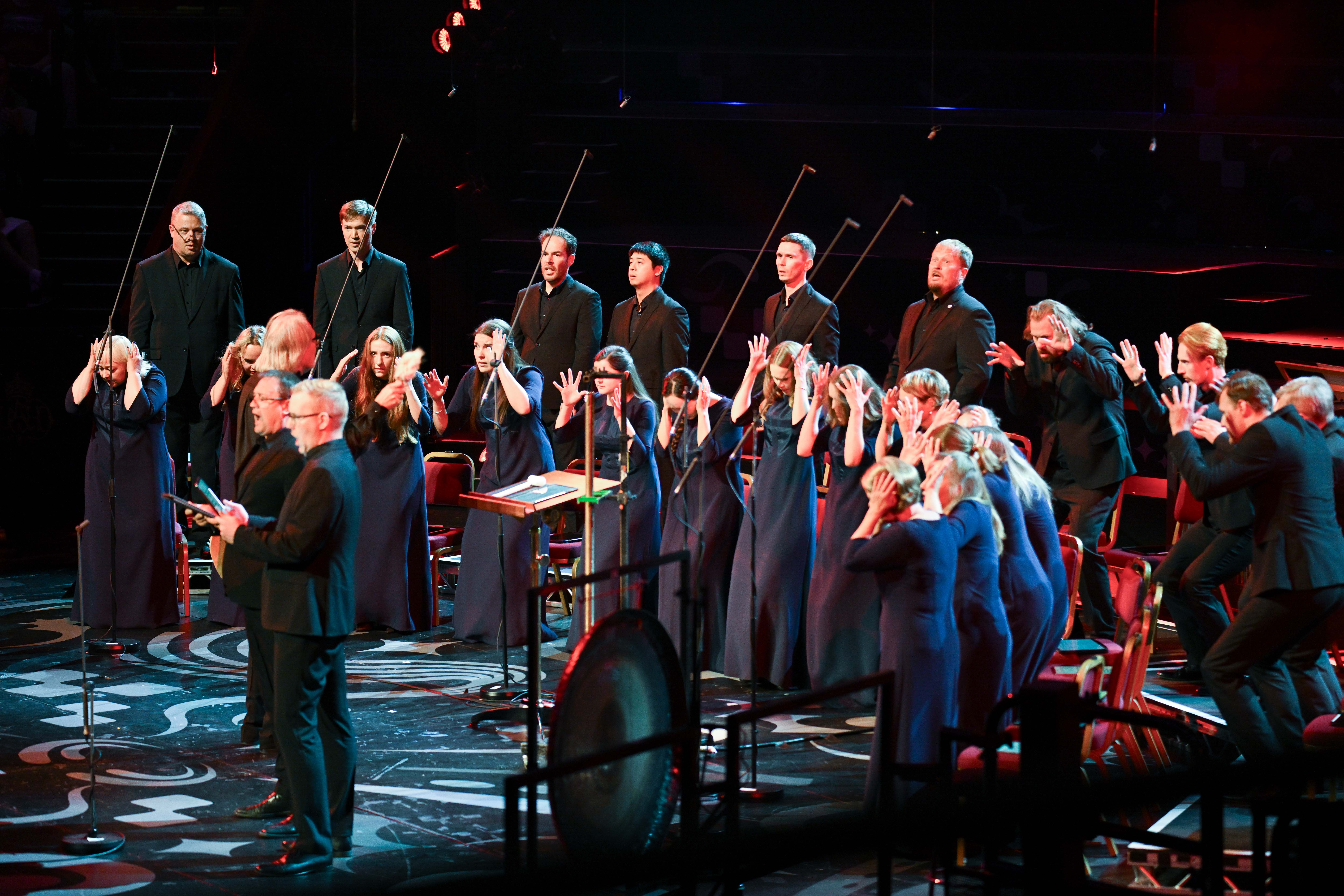
This was emphatically not the case in Curse upon Iron, a remarkable setting from Veljo Tormis, of words from the Finnish national epic, the Kalevala, translated into Estonian. Describing the horrors of war, it sends a chill down the spine right from the primal call to arms of the shaman drum, struck by Kaljuste himself, then from the restrained urgency of the choir, like a coiled spring. While listening it was impossible not to think of the current plight of Ukraine and by extension in fear for the Baltic states, especially as Tormis’ writing was brought to a horrific climax. This was realised through the elemental power of tenor Toomas Tohert, bass Geir Luht and the choir, turning from side to side with watchful dread but then erupting in barely concealed anger. It was a remarkable performance, which will live long in the memory.

After this emotionally shattering encounter, the balm of Vater unser, Pärt’s German setting of The Lord’s Prayer for Pope Benedict, was just what was needed, its simplicity all the more affecting for what went before. As an encore, Kaljuste found just the right complement in the choir and piano version of Estonian Lullaby, its pauses near the end the musical equivalent of drooping eyelids. It was a most effective end to a special concert, Arvo Pärt’s musical essence distilled for a most appreciative audience.

You can listen back to this Prom concert on BBC Sounds until Sunday 12 October.

Click to read more about the BBC Proms

Published post no.2,608 – Sunday 27 July 2025

The Borrowers – Emerson, Lake & Palmer: Knife-Edge

What tune does it use?

The first movement of the Sinfonietta, by Leoš Janáček (born on this day in 1854):

The Sinfonietta is a thrilling orchestral work, begun with a powerful brass fanfare but containing five incident-packed movements.

How does it work?

The main melody of the first movement Fanfare is the basis for Emerson, Lake & Palmer’s song, but in his keyboard part Keith Emerson refers to other parts of the work.

Then, on his solo from 2’40”, Emerson departs from Janáček’s blueprint with a characteristically incisive solo, backed by a virtuosic drum track. From 3’25” the style broadens to include explicit references to J.S. Bach, the Allemande of his French Suite no.1 in D minor:

What else is new?

You can hear the whole of the Sinfonietta below, in a thrilling performance from the Vienna Philharmonic Orchestra under Sir Charles Mackerras, in a recording made in 1980:

Published post no.2,584 – Thursday 3 July 2025

In appreciation – David Watkin

by Ben Hogwood Photo (c) unknown

This week we learned the very sad news of the death of talented cellist David Watkin, at the age of 60. Watkin had to stop playing cello 11 years ago due to scleroderma, but as this moving tribute from fellow Scottish Chamber Orchestra cellist Su-a Lee shows, he was a much-loved character whose influence continued to be an overwhelmingly positive one.

I had the good fortune to witness David in action for the Scottish Chamber Orchestra, and his charismatic playing – with good humour clear to see – left a lasting mark. I am sure that in addition to the Scottish Chamber Orchestra the members of The Academy of Ancient Music, The King’s Consort and the Orchestre Révolutionnaire Et Romantique – to name just three ensembles Watkin played with – would concur.

Watkin made relatively few commercial recordings, but it is very much a case of quality over quantity. His collection of Vivaldi Cello Sonatas for Hyperion is proof of that:

Even more deserving of praise is his cycle of Bach Cello Suites, made for Resonus and carrying remarkable poise and personality, which these two excerpts illustrate:

Published post no.2,535 – Friday 16 May 2025