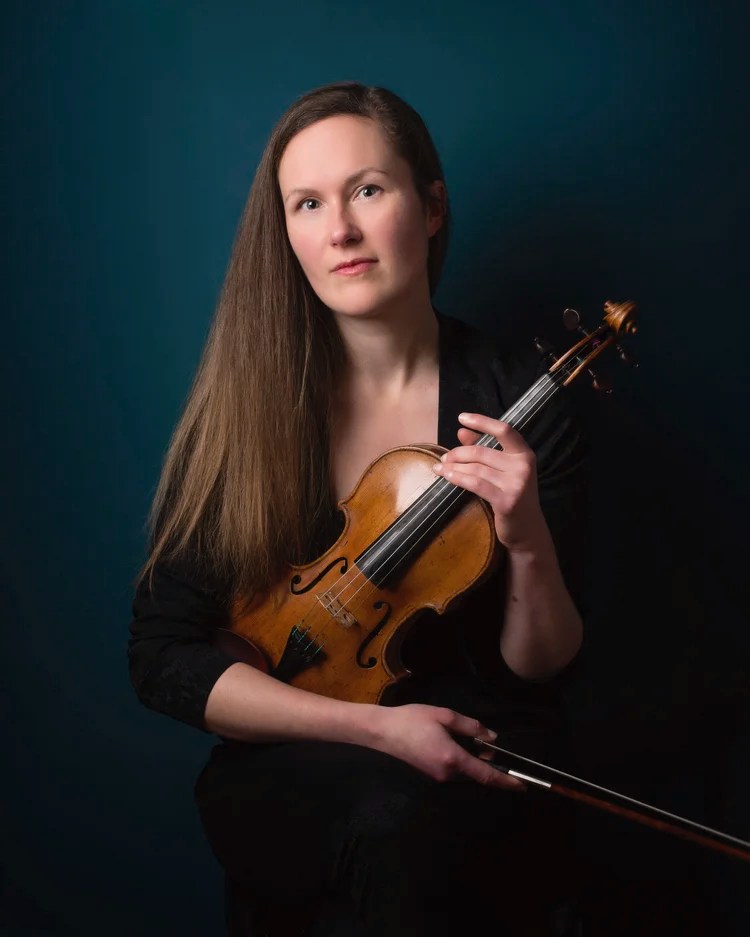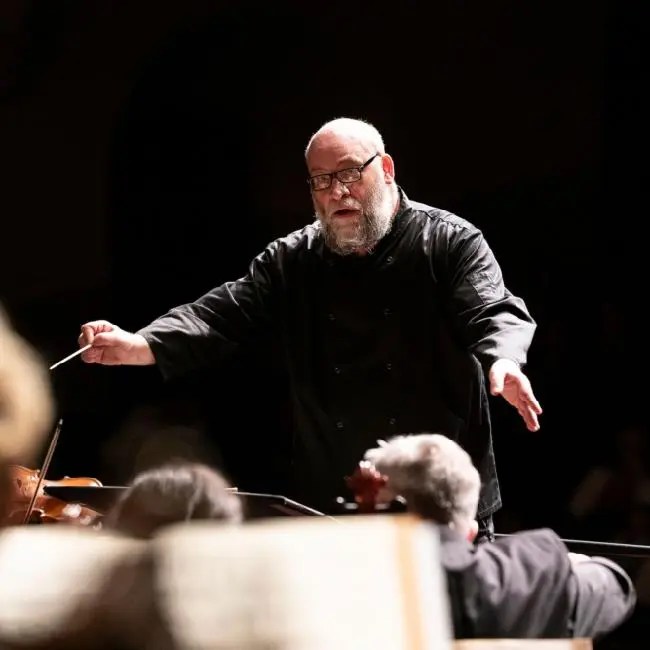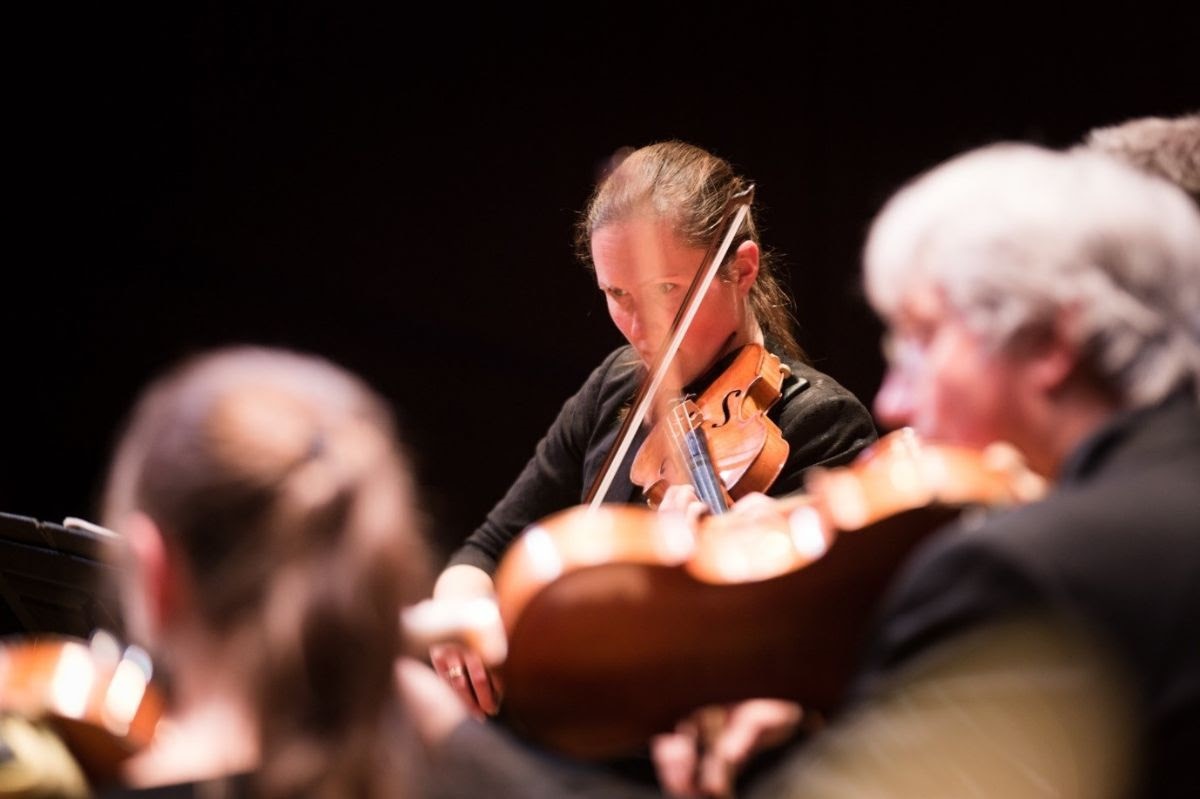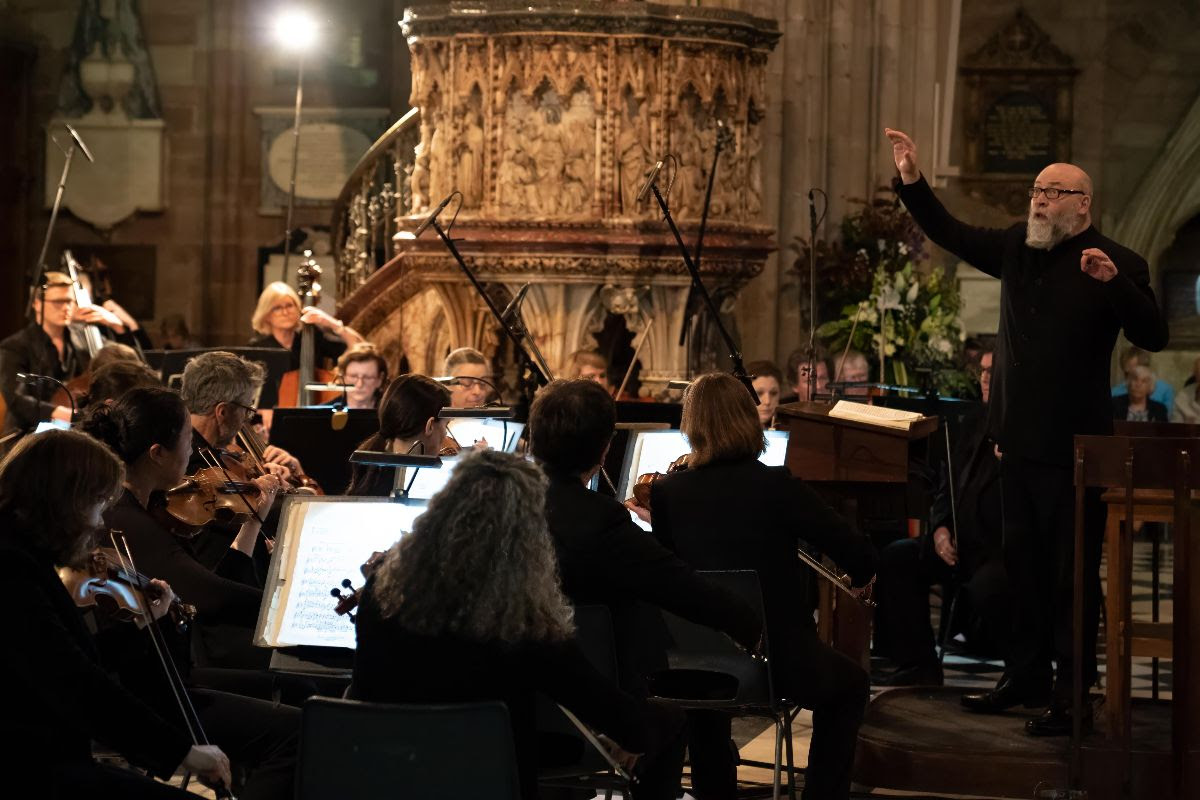
reposted by Ben Hogwood Photo Zoe Beyers leading the English Symphony Orchestra (c) Michael Whitefoot
The renowned English Symphony Orchestra (ESO), under their principal conductor Kenneth Woods, is to make a highly anticipated return to Malvern Theatres, Worcestershire on Wednesday 12 November at 7:30pm with a programme celebrating the adventurous spirit and playful energy of the 1920s, as part of their Autumn-Winter Residency.
LIVELY SPIRIT OF THE ROARING TWENTIES
The evening will feature works by composers who captured the era’s lively spirit, including Erwin Schulhoff’s Suite for Chamber Orchestra, Darius Milhaud’s The Ox on the Roof’ and Kurt Weill’s raucous cabaret songs, to be performed by the ESO’s first affiliate artist, soprano April Fredrick. The programme opens with the music of Joseph Haydn and a performance of his Symphony No. 60 entitled The Absent-Minded Gentleman, delighting in the composer’s celebrated wit and humour.
Kenneth Woods, Artistic Director and Principal Conductor of the ESO, introduces the programme: “Erwin Schulhoff’s suave Suite for Chamber Orchestra takes listeners on a guided tour of 20s dance crazes, from the shimmy to the tango. Milhaud’s zany ballet score The Ox on the Roof was inspired by the comedy of Charlie Chaplin and the dance music of Brazil, while Kurt Weill’s songs reflect life in and around the cabaret scene in all its humour and sensuality. The programme opens with Haydn’s Symphony No.60, The Absent-Minded Gentleman, quite possibly the funniest and most surreal symphony ever composed.”
ENGLISH SYMPHONY ORCHESTRA – MALVERN RESIDENCY
Wednesday 12 November 2025, 7.30pm Malvern Theatres Grange Road, Malvern, Worcs. WR14 3HB English Symphony Orchestra: The Joker’s Wild – Mischief in Music Haydn Symphony No. 60 (‘Il Distratto’) in C Weill Cabaret Songs Schulhoff Suite for Chamber Orchestra Milhaud The Ox on the Roof
April Fredrick (soprano), English Symphony Orchestra / Kenneth Woods
April Fredrick (soprano), Brennen Guillory (tenor – Trost im Unglück, Der Tambourg’ sell; Revelge), Colorado MahlerFest Orchestra / Kenneth Woods
Mahler Symphony no.4 in G major (1892; 1899-1900) Des Knaben Wunderhorn: Lied des Verfolgten im Turm; Des Antonius von Padua; Fischpredigt; Trost im Unglück; Rheinlegendchen; Der Schildwache Nachtlied; Der Tambourg’sell; Revelge
Colorado MahlerFest 195269364564 [two discs, 89’22”] Producer Jonathan Galle Engineer Tim Burton Live performances at Macky Auditorium, Boulder, Colorado, 20 May 2023 (Des Knaben Wunderhorn), 19 May 2024 (symphony no.4)
Reviewed by Richard Whitehouse
What’s the story?
Recorded coverage of Colorado’s MahlerFest continues with these performances taken from the past two editions, duly confirming the significance of this event in the annals of Mahler interpretation and the increasing excellence of the orchestral playing under Kenneth Woods.
What are the performances like?
It may be the shortest of his cycle and the one which initially gained his music acceptance in the UK and US, but Mahler’s Fourth Symphony received as rough a reception as any of his premieres and it remains a difficult work fully to make cohere. While he undoubtedly has its measure, Woods might have pointed up those expressive contrasts in its opening movement a little more directly; the music only finding focus with a development where the emotional perspective opens out to reveal an unforeseen ambiguity. The remainder is unfailingly well judged, while the scherzo impresses through a seamless transition between the sardonic and the elegance of its trio sections. Alan Snow sounds just a little tentative with his ‘mistuned’ violin, but the unexpected panorama of enchantment prior to its coda is meltingly realized.
At just over 20 minutes, the Adagio feels relatively swift (surprisingly so), even if Woods is mindful never to rush its unfolding double variations and what becomes a contrast between intensifying expressive states whose Beethovenian antecedent is not hard to discern. If the climactic ‘portal to heaven’ lacks little in resplendence, it is that hushed inwardness either side such as sets the seal on a reading of this movement to rank among the finest in recent years. Nor is its segue into the finale other than seamless – Mahler having realized that an earlier vocal setting was the natural culmination to where his symphony had been headed. Suffice to add that April Fredrick’s contribution is of a piece with Woods’s conception in its canny mingling of innocence and experience prior to an ending of deep-seated repose.
The second disc features seven songs taken from Mahler’s settings of folk-inspired anthology Des Knaben Wunderhorn. April Fredrick is truly in her element with a Rheinlegendchen of winning insouciance and a Des Antonius von Padua Fischpredigt of deftest irony. Brennen Guillory comes into his own with the final two numbers, Der Tamboursg’sell distilling the darkest humour as surely as Revelge conveys that innate fatalism behind the resolve with which the soldier meets his destiny. Woods provides an astute and sensitive accompaniment.
Does it all work?
Yes, insofar as the collection of folk-inspired poetry proved central to Mahler’s evolution as both a song and symphonic composer. It might have been worthwhile to include the original version of Das himmlische Leben, not least as its appreciably different orchestration shows just how far the composer’s thinking had come during eight years, but the present selection is nothing if not representative. Hopefully those Wunderhorn songs not featured will appear on a future issue from this source, maybe in tandem with the Rückert songs of the next decade.
Is it recommended?
Yes it is. The symphonic cycle emerging from MahlerFest is shaping up to be a significant addition to the Mahler discography, with the latest instalment no exception. Hopefully this year’s account of the Sixth Symphony will find its way to commercial release before long.
Richard Strauss Eine Alpensinfonie Op.64 (1911-15)
Colorado MahlerFest 195269359249 [49’47”] Producer Jonathan Galle Engineer Tim Burton Live performance at Macky Auditorium, Boulder, Colorado, 18 May 2024
Reviewed by Richard Whitehouse
What’s the story?
With its underlying concept that of Mahler and the Mountains, this 37th edition of Colorado MahlerFest was probably the most ambitious yet. As was reflected in those works featured at its main orchestral concerts, and not least this performance of Richard Strauss’s An Alpine Symphony.
What’s the music like?
This being its composer’s final large-scale orchestral piece is not fortuitous, as it concludes a sequence of symphonic works stretching back some 35 years to his Symphony in D minor. Strauss may subsequently have abandoned the symphony for the tone poem, but these latter became increasingly symphonic in formal scope or expressive density with the present work bringing full circle a process as could hardly be resumed given the tonal retrenchment of his idiom henceforth. An Alpine Symphony represents an impressive and a defining culmination.
Although it nominally outlines a day’s ascent then descent in the Bavarian Alps (actually the Heimgarten), this work is equally the ‘journey of a life’ duly articulated through an extended sonata-form design. It is this latter aspect which emerges at the forefront of Kenneth Woods’ interpretation – one which unfolds cohesively and, most important of all, organically out of then back to its evoking of Night. The crescendo of activity through to Sunrise then The Ascent is keenly maintained, with those expository episodes that follow not lacking scenic immediacy or formal impetus. Neither is the ensuing developmental sequence underplayed on route to the emotional crux of On the Summit then Vision: music, it might be added, whose grandiloquent expression is shot through with a knowledge of its imminent demise.
What goes up must inevitably come down: the transition into the reprise is finely handled in terms of its encroaching Elegy, though momentum does falter slightly in the recapitulatory phase of Storm and Descent. Not that the Colorado MahlerFest Orchestra is found wanting as regards its commitment; more likely, the clear if somewhat confined acoustic of Boulder’s Macky Auditorium is not able to encompass the sheer volume of sound effected in this phase. Woods nevertheless heads into Sunset with requisite poise and if the coda that is Ausklang – a term more or less untranslatable but which approximates to ‘catharsis’ – is just a little too passive, its rapt recollections of Wagner and Mahler are eloquently inferred. As is the return to Night, audibly linking into that from the opening for what becomes an indissoluble unity.
Does it all work?
Pretty much throughout. Once a piece reserved for special occasions, An Alpine Symphony is now among the most often recorded of Strauss’s orchestral works but while this performance cedes to others in terms of tonal opulence and visceral impact, it has relatively few peers as regards its symphonic credentials. A pity, incidentally, the performance of Schubert’s Death and the Maiden quartet from the first half, which Woods has elaborated from Mahler’s often sketchy arrangement for strings, could not have been included as to make this a two-disc set.
Is it recommended?
It is. The CD comes with a full listing of personnel on its rear inlay, and you can scan the QR code or click here for Kelly Dean Hansen’s detailed notes. Mahler’s Fourth Symphony from this edition will be issued separately.
Listen / Buy
For further purchase options, visit the MahlerFest website – and for more information on the festival itself, click here. Click on the name for further information on conductor Kenneth Woods
Published post no.2,665 – Monday 22 September 2025
Kenneth Woods issues the debut of his band The Old Blue Gang, less a concept album per se than themed reflections on a shameful while all too typical incident (then as now) of migrant workers who were first exploited then betrayed in the American West of some 150 years ago.
What’s the music like?
Best known as a conductor, notably at the helm of the English Symphony Orchestra for over a decade, Kenneth Woods also works extensively as cellist and guitarist. This latter career is showcased in Silent Spike, the first album with his band The Old Blue Gang, which affords a probing take on the largely forgotten role of Chinese immigrants involved in constructing the Transcontinental Railway line from California via Oregon to Washington. A tale of alienation, exploitation and ostracization which has lost none of its horrific impact over ensuing decades.
Opening track The Voyage emerges ‘Déjà Vu’-like into focus, its commentary about those coming to the New World with little or no expectation delivered in suitably deadpan fashion by Woods, whose searing guitar affords contrast with Joe Hoskin’s methodical yet ominous bass and Steve Roberts’s forceful yet flexible drumming. The arduous workload endured by the immigrants is vividly conveyed by the grunge-inflected Steel Stretcher, before Dead Line Creek puts musicians (and listeners) through their collective paces with its unsparing depiction of mass murder by the gang fronted by Old Blue – an outlaw whose reward is as much destructive as monetary. Much the longest track at 21 minutes and its evolution more instrumentally than narratively driven, this is alt-Americana at its most uncompromising.
It might have been preferable to sequence this epic after the next three tracks, each of them streamed as singles in advance of the album. Sundown Town evokes its intolerance with a fatalism redolent of Johnny Cash, intensified by Lilly White with its chilling recollection of miners being deliberately incarcerated so they need not be paid. Ride the Rails provides a natural continuation with its tale of the immigrants being driven out of town by the under-employed during economic depression, who were (inevitably) acquitted of any wrongdoing. It remains for closing track Gather the Ghosts and Bones to inject a degree of empathy as it recounts the returning of remains of those who received burial in their native China – people otherwise known only through the handful of faded photographs that have come down to us.
Does it all work?
Indeed. Ensemble is unusually dense and layered for a three-piece outfit, though this does not mean excessive ‘noodling’ or wanton virtuosity; the playing being characterized by a restraint or even austerity such as fittingly underlines the grimness of the narrative and the austerity of its realization. Pertinent comparison, conceptually if not musically, can be made with Fairport Convention’s 1971 masterpiece ‘Babbacombe’ Lee – for all that this album touches, however obliquely, upon a redemptive quality understandably absent from what is encapsulated here.
Is it recommended?
Very much so. It hardly makes for comfortable listening, but Silent Spike is a plangent while resourceful treatment of a subject whose contemporary relevance cannot be gainsaid. It also offers intriguing pointers as to where The Old Blue Gang might be headed on future albums.
interview by Richard Whitehouse Picture (c) Julie Andrews
You do not move forward by standing still. That is evidently the maxim of the English Symphony Orchestra, whose first release on its new in-house label has just been issued. Apropos of this and other matters, Arcana spoke recently to Kenneth Woods, the principal conductor and artistic director of the ESO, about his plans for this audacious undertaking.
It made sense to begin with the motivation behind the establishing of ESO Records. ‘‘It’s something I’ve wanted to do for a long time. Being able to release whatever we want, and whenever we want, to is hugely empowering for us as an orchestra. It gives us a chance to align our concert work with our online presence and recording programme more strategically’’.
As to whether these releases will be mainly studio or live recordings, ‘‘It’ll be a combination of both. I think that over the course of the next couple of years, listeners will start to discern a number of threads within the ESO Records portfolio. Our first release is an Elgar Festival disc with Elgar’s First Symphony and his concert overture In the South. This is a great way for us to spread the word about the festival internationally and also to share the exceptional quality of Elgar Festival events. And, with the festival doing so many new or lesser-known works, we can share that music with a world-wide audience.
‘‘As a result of the COVID pandemic, we’ve an enormous amount of material ‘in the can’ that we recorded for ESO Digital (our online video portal). ESO Records gives us a chance to share that body of work, also to highlight and complement our future concerts. For instance, we’ll be releasing our one-per-part version of Mahler’s Ninth Symphony to coincide with a run of performances in December. And there are studio projects such as the Sibelius cycle which have continued as we tie-in the recording of its future instalments to public concerts’’.
Woods is keen to point out that ESO Digital release will complement the orchestra’s ongoing schedule of releases for other labels. ‘‘Since we released the first disc of my tenure in 2015, we’ve worked with Nimbus, Lyrita, Signum, Avie, Toccata and Somm among others. While I hope that many of those partnerships will continue, the economic climate for labels is very difficult. They’ve a lot of fixed costs and declining revenue streams which means that, for a group like us, finding release slots and agreeing repertoire or projects has become more complicated. Something like the Sibelius cycle which, while it is very important to us as an orchestra, is not the kind of repertoire many labels do anymore.
‘‘One can also be hampered through labels having other versions of the same repertoire in the pipeline or in their back catalogue. That said, I’d contend the world does need recordings of pieces which emerge out of shared sympathy and enthusiasm for the music among players, conductor and production team. There’s always more to be said about the greatest music, and if we feel we’ve something meaningful to contribute, then we’re going to say it’’.
Given the varying economic and logistical factors, ESO Records might not always be issued both as CDs and Downloads. ‘‘This will vary according to the release. It makes to put the Elgar Festival Live stuff makes out on CD because they make a great souvenir for attendees. But with most projects today, physical sales are so small it isn’t worth the cost or complexity of maintaining an inventory and shipping it all over the world. Moreover, the argument used to be that CDs sounded better, but the quality now at 24-bit and 96-kHz sampling contains between three and ten times as much detail and information. We want our listeners to hear our work in the best possible quality, and these days that means streaming or hi-res downloads’’.
With this in mind, listeners can look forward to no mean diversity in terms of future issues. ‘‘I mentioned we were looking to create coherent and ongoing threads among our releases. Elgar Festival Live has several more releases ready and we’ll be recording our performances at this year’s and all future festivals. The orchestra’s long-term commitment to contemporary music will be a big part of our future work, and I expect this to feature many of the amazing composers that listeners have come to associate with ESO such as Philip Sawyers, Adrian Williams, Emily Doolittle, David Matthews and Steve Elcock. We’re also keen to draw on the ESO’s extensive archive of performances by composers such as Ireland, McCabe, Maw, Simpson and Arnold, along with performances conducted by the likes of Michael Tippett and Yehudi Menuhin, with a wider public.”
‘‘The Sibelius and Mahler projects are indicative of our desire to put our stamp on so-called standard repertoire or, as I prefer to call it, the greatest music ever written. One of the best things about streaming is that not every release needs to be a 70-minute album. Archival recordings might well come out as singles or EPs to align with composer anniversaries or birthdays, historic occasions and upcoming concerts – so there’ll be releases of Beethoven, Mozart, Brahms, Strauss, Bartók and Shostakovich. I’m also very proud of our track record of championing historically suppressed music, so listeners can expect further issues of Gál, Schulhoff, Kapralova, Krenek and Weinberg.”
‘‘Finally, ESO Records will give us greater freedom to develop collaborative projects with artistic partners including composers, soloists and directors. We’ve just recorded a fantastic disc of organ concertos by Poulenc, Hindemith and Daniel Pinkham with organist Iain Quinn for release next year, and I’m hopeful there’ll be many opportunities in the future to work collaboratively so as to bring worthwhile music to the public’s attention’’.
Much to look forward to, then, from a label whose artists have never shied away in pushing the envelope when it comes to imaginative programming and innovative presentation. Qualities, indeed, that will no doubt prove synonymous with whatever releases emerge from the ever-enterprising English Symphony Orchestra.