Prom 36 – Jennifer France (soprano), Clare Presland (mezzo-soprano), Edvard Grieg Kor, London Philharmonic Choir, Royal Northern College of Music Chamber Choir, London Philharmonic Orchestra / Edward Gardner
Ligeti Requiem (1963-5); Lux aeterna (1966) Richard Strauss Also sprach Zarathustra Op.30 (1896)
Royal Albert Hall, London Friday 11 August 2023
by Richard Whitehouse photos by Mark Allan / BBC
There did not seem any more concrete reason to build a Prom around the music from Stanley Kubrick’s film 2001: A Space Odyssey other than this being the 55th anniversary of its release, but it at least offered an opportunity to revive one of the last century’s defining choral works.
Much has been made of a then avant-garde composer writing a piece based on a seminal text from the Christian liturgy, but centenary composer György Ligeti’s Requiem is anything but beholden to tradition. Focussing on what would normally constitute the first half of the Requiem Mass itself skews the textual imagery away from any hope of attaining ‘eternal rest’ – the four movements duly proceeding from a sombre Introitus in which the music’s conceptual vastness along with its expressive extremes are laid bare. The Kyrie is the most (in)famous part – emerging in two successive and cumulative waves of micropolyphony both overwhelming and disorientating, not least when rendered with the poise and precision that the combined choirs summoned in the Albert Hall’s expanse. Inevitably, the terror of the infinite gives way to that of the absurd.
Hence the Dies irae sequence, designated On the Day of Judgement and a veritable tour de force of choral outbursts with vocal interjections; Clare Presland’s ominous intoning tellingly offset by Jennifer France’s stentorian pronouncements, with the wind and brass of the London Philharmonic Orchestra visceral in their contribution under the attentive guidance of Edward Gardner. Neither did the Lacrimosa lack gravitas, the soloists musing eloquently if wearily against a stark instrumental backdrop whose essential emptiness carries through to the close.
While not intended as a continuation of the larger work, Lux aeterna still makes for a viable resolution in its undulating yet never static textures such as conjure the presence of ‘eternal light’ without any concomitant spiritual aspect. Set high-up in the gallery, to the right of the platform, the Edvard Grieg Kor evinced a faultless intonation along with a tangible sense of the music’s timelessness – though this piece would maybe have been better placed after the Ligeti instead of before the Strauss, not least as there was no segue between the latter works.
Also sprach Zarathustra was, of course, elevated to a new level of public recognition after its Introduction had been utilized as fanfare in Kubrick’s film, and a less than thrilling rendition here at least ensured this Sunrise could not pre-empt the remainder in Strauss’s free-ranging overview of Friedrich Nietzsche’s influential tract. On fine form overall, the various sections of the LPO relished their passages in the spotlight, reminding one that this piece is as much a ‘concerto for orchestra’ before its own time as the musical embodiment of human aspiration. Pieter Schoemann audibly enjoyed setting The Dance Song in motion and while others have made its climax more intoxicating, Gardner brought a rapt serenity to the Night Wanderer’s Song such as made the tonal equivocation of those final bars the more acute and intriguing.
Numerous recent Proms have followed the second-half work with an ‘official’ encore and, while this practice is not always justified, the inclusion tonight of a certain waltz by another Strauss would have extended the 2001 concept still further and effected a more definite close.
Blanche de la Force Sally Matthews (soprano), Madame de Croissy (Old Prioress) Katarina Dalayman (mezzo-soprano), Madame Lidoine (New Prioress) Golda Schultz (soprano), Mother Marie of the Incarnation Karen Cargill (mezzo-soprano), Sister Constance of St Denis Florie Valiquette (soprano), Mother Jeanne of the Child Jesus Fiona Kimm (mezzo-soprano), Marquis de la Force Paul Gay (bass-baritone), Chevalier de la Force Valentin Thill (bass-baritone), Father Confessor Vincent Ordonneau (tenor, Jailer Theodore Platt (baritone), First Commissary Gavan Ring (tenor), Second Commissary Michael Ronan (bass-baritone), Thierry (a footman) Jamie Woollard (bass), M. Javelinot (a physician) Matthew Nuttall (baritone), Sister Mathilde Jade Moffatt (mezzo-soprano), Officer Michael Lafferty (baritone), The Glyndebourne Chorus, London Philharmonic Orchestra / Robin Ticciati
Directed at the Proms by Donna Stirrup
Royal Albert Hall, London Monday 7 August 2023
by John Earls photos by Sisi Burn / BBC; John Earls (panorama pic)
Semi-staged performances of operas can be tricky. Especially if given in the cavernous space that is the Royal Albert Hall.
Glyndebourne Opera’s production of Francis Poulenc’s Dialogues des Carmélites (Dialogues of the Carmelites) this summer had already received some excellent reviews so it was with some excitement and nervousness that I approached this Proms performance directed by Donna Stirrup, based on Barrie Kosky‘s Glyndebourne production.
It was a breathtaking evening combining sensitive and thoughtful staging, outstanding playing of the magnificent score by the London Philharmonic Orchestra under Robin Ticciati, and some stunning individual performances.
Poulenc’s 1957 opera is a fictionalised version of the story of the Martyrs of Compiègne, Carmelite nuns who, in 1794 during the closing days of the Reign of Terror during the French Revolution, were guillotined in Paris for refusing to renounce their vocation. Whilst rooted in this harrowing story this production also touches on the theme of persecution more generally.
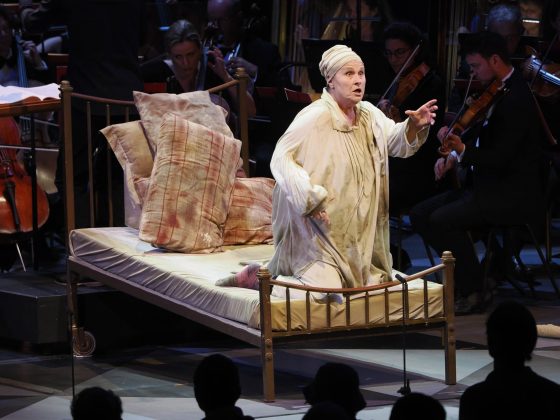
There were a number of outstanding solo performances. Sally Matthews (Blanche), Katarina Dalayman (Madame de Croissy, Old Prioress, above), Golda Schultz (Madame Lidoine, New Prioress), and Karen Cargill (Mother Marie of the Incarnation). But I was particularly taken with Florie Valiquette whose portrayal of Sister Constance of St Denis was gripping throughout and singing incredibly moving – “We die not for ourselves alone, but for one another, or sometimes even instead of each other” (it was good to have surtitles of George Bernanos’ impressive text).
But if the solo performances were captivating, the playing of the London Philharmonic Orchestra conducted by Robin Ticciati was exceptional. The range in colours and timing was just enthralling with Ticciati measuring silences to magical effect.
The concluding march to the scaffold and Salve Regina with accompanying guillotine-drops were affecting and unforgettable. This was a remarkable performance of a remarkable piece.
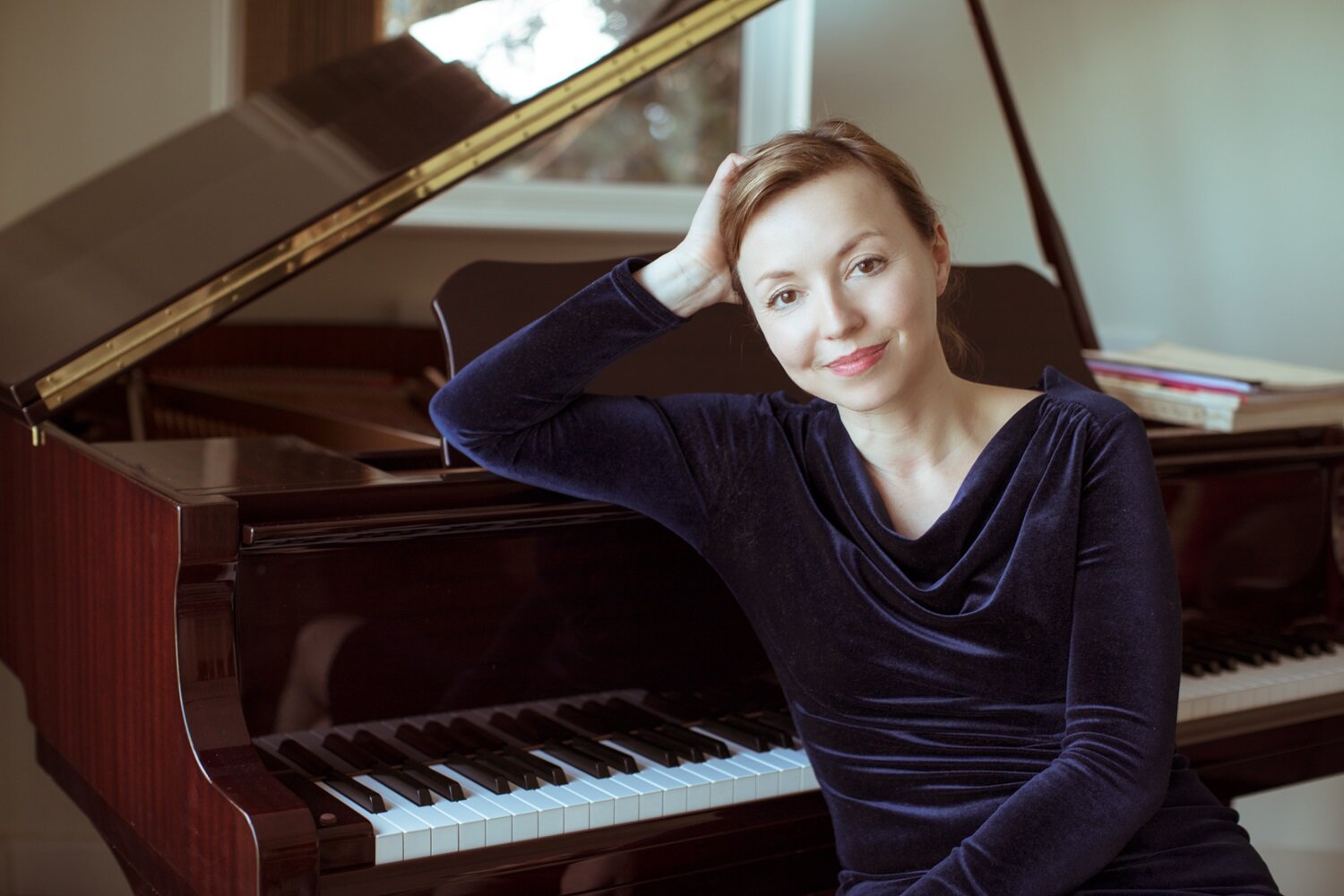
The composer talks about her new work for the London Philharmonic Orchestra, a revival of her opera Four Sisters and how the Russian-born, UK-based composer channels her feelings on the conflict in Ukraine.
Interviewed by Ben Hogwood
Arcana is in conversation with composer Elena Langer. Born in Russia but moving to study in this country two decades ago, she is full of anticipation at the weekend she has coming up. On Saturday 18 March the London Philharmonic Chorus and Orchestra, together with soloist Kristina Blaumane, will give the first performance of The Dong With The Luminous Nose, a major new piece for the forces.
Exercise is uppermost in Langer’s mind when we are connected to our call, however. “I’m rehearsing with the chorus tonight”, she says, “and after our call, I’m going to have a swim. I love cold water swimming, and I go to Hampstead Heath, where there is a well-known ladies’ pool.” Given the temperature on the day we talk is a little above freezing, this is a brave move. “Yes, it’s cold – but it will be a quick swim, and it gives you a kick for the rest of the day. It means I will be nice and well-behaved with the chorus!”
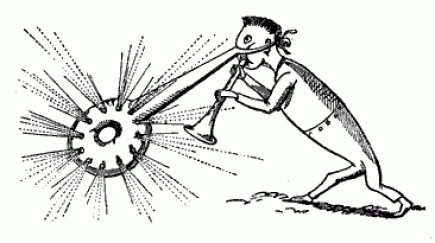
As you will have gathered, Elena has a healthy sense of humour, and a zest for life too. The primary reason for our conversation is to talk about a major new choral piece receiving its world premiere in the Royal Festival Hall soon. The Dong With The Luminous Nose is a setting of a nonsense poem by Edward Lear (illustrated below), though as we quickly establish it is a work of several layers. “It’s not nonsense as such, it is a love story”, she explains. “The Dong is broken hearted, and went mad – but it’s told in the right way.”
She recalls her first encounter with the poem, “maybe about 10 years ago. A journalist friend introduced me to it, and I really liked it – and then forgot about it. Then at the right time I remembered, because when I was asked to write this piece for chorus and orchestra I found it difficult to find the right text. Often composers set religious texts that don’t resonate, and I love setting poems, but poems for the chorus quite often feel wrong – the words never quite come across as they should. With The Dong it is a poem, but it’s a little opera for chorus. It tells a story, and you follow it, and it felt like the perfect vehicle for the task.”
The opening lines of The Dong set a telling scene: “When awful darkness and silence reign over the great Gromboolian plain”. Elena reveals how she set them to music. “I started with a big solo cello, a concentrated line. The cello represents the Dong or his longing, his soul. She is playing that solo, and that tells the story in music from beginning to end. Then the music continues in the very low registers of the orchestra, tremolo – and tam-tam, with low bassoon and trombones, low double basses too. I only used the basses in the beginning and introduce the timbres of the chorus gradually. The story is told by the basses, and then the tenors, who begin on the word ‘light’, and then all the female chorus only appears when it says “The Dong, The Dong”. We are introduced to every layer of the piece gradually, because there are lots of layers, all with the big chorus and the cello.”
With so many forces at her disposal, is it tempting to use them too much? “I have them and I like using everything a lot, but obviously it should make sense. The cello tells the story and follows the climaxes and moods of the text. It’s a strange genre – a cantata on one hand, but at the same time it’s a cello concerto because sometimes the cello is in competition with the chorus or the orchestra, and there are some instrumental bits which make it slightly symphonic.”
Rather than copy established formats, Elena has sought an original approach. “I tend to not think about what genre I’m writing in, like making new film”, she explains. “It’s not a romantic comedy, or a drama – it has everything – a bit like a good salad! This approach runs through my operatic work, when you have these resources and you use them as tools to make the drama and to have an effect on the audience. I want to tell the story as precisely as I can with my resources.”
The cello part is written for Langer’s good friend Kristina Blaumane, principal cello of the London Philharmonic Orchestra. “She’s an old friend of over 20 years, and she has this passionate, romantic side to her personality, with big emotions. I hope the cello part does that – it’s quite virtuosic, and it requires this soulful, deep, rich sound, which she has in her instrument. She looks wonderful on stage and tells the story in a dramatic way!”
Delving deeper into the story itself, the title – The Dong With The Luminous Nose – brings up a parallel with the young Shostakovich, and his first satirical opera The Nose. Would the story have appealed to him, possibly? “The plot is the opposite, as the nose disappears”, points out Langer, “so you have two noses! But you’re right, I love this in Russian literature where you get this fantastical thing which comes from Gogol, and runs through the work of Daniil Kharms, a Leningrad poet who behaved in a very eccentric way, and who I’m sure was influenced by the English tradition of Lewis Carroll and Edward Lear. It’s fantastical and surreal, but at the same time dramatic and real. All kinds of political, horrible things are happening around us, and I don’t feel like the kind of artist who comments directly on direct events.”
Elena qualifies her observation. “My survival technique is escapism, using music as something that when I write I am in control of my notes. I build this world, but I’m not in control of the rest of the world. The events – the real events – seem like a dream. In a way it’s my lament, to comprehend the world and what’s happening, done through this crazy little creature The Dong, who goes mad and loses what’s important to him.”
Inevitably, talk turns to the conflict in Ukraine. Elena may have lived in the UK for over 20 years, but the links are still strong. “I love being here, and I am in some way detached, but in some way not. I still have friends in both places, but I don’t want to run around with flags. I want to express how I feel in my own way.”
Langer’s music is indeed deeply expressive, as attendees to the Royal Philharmonic Society Awards, heard at the Queen Elizabeth Hall recently, will attest. Soprano Anna Dennis, oboist Nicholas Daniel and pianist John Reid gave a moving performance of her song Stay, Oh Sweet. It confirmed Langer’s intensely vocal approach to composition – even when writing for voices. “Yes, I think so”, she agrees, “and my cello writing for Kristina proves that. I see every instrument of the orchestra as a voice, rather than some composers who work the other way round.”
Coincidentally, on the night The Dong receives its premiere, Langer’s one-act opera Four Sisters will be performed in a new production by the Royal Conservatoire of Scotland in Glasgow. It is part of an appealing program, the 2012 opera paired with César Cui’s A Feast in Time of Plague.
“It should be fun!” she says with amusing understatement. “Four Sisters was commissioned 12 years ago by Dawn Upshaw, who had a class at Bard College in the Fisher Arts Centre, in upstate New York. They have a conservatoire there, and Dawn had a nice class there, mostly of girls. She asked me to write something that would involve more girls, as they needed parts for everyone. I thought of a funny mix of Three Sisters by Chekhov and something like Sex And The City! Each part is equal, there are no prima donnas!”
Langer studied briefly with Upshaw, but the pair’s connection goes back still further. “In 2009 I was invited to participate in the project writing for Carnegie Hall writing songs with Dawn Upshaw and Osvaldo Golijov, the Argentinian-American composer. I spent a week or more with Dawn and some singers, and she liked my work – hence the commission. She is a very good teacher, she teaches to sing and to understand what you are doing, what you are thinking about – not just the notes.”
Elena does not sing herself. “Oh no, I have a terrible voice!” she laughs. “I can play on the piano and play my pieces if I need to show them to directors or to performers, but never singing!”
On her arrival in the UK from Moscow, Langer spent one year studying with Julian Anderson, and then moved to the Royal Academy of Music for her PhD. “I saw Simon Bainbridge there, and he was very encouraging, a pleasant presence. That’s also where I met Anna Dennis, who has been my muse since then. When I write for sopranos, I have her timbre in my ears. She is very versatile, and a good musician too. She can play cello and piano.”
After the recent flurry of activity, “like a wave”, Langer is planning to take a short break. “I wanted to have a short break to stop the conveyor”, she says, as I have only just finished the arrangement that we made of Stay My Sweet for the awards. It was originally written for string trio, harpsichord and voice, and I arranged it for voice, oboe and piano. The original is recorded on Harmonia Mundi.”
Her musical thoughts are still active, mind. “It is my week off, but I’m already thinking about a Trumpet Concerto! I was working in November, and had a fantastic concert with the Boston Symphony Orchestra, who were doing a suite from my opera Figaro Gets A Divorce. They have a fantastic, very bright brass sound, polished and very smart. Their trumpeter asked me if it is possible to write a Trumpet Concerto for him and the chamber orchestra, so I agreed – and now I imagine a kind of quasi-Baroque piece, bright and energetic. I will probably write that next.”
Is the Baroque period an inspiration for her work? “It’s one of the colours which I have. My taste, as you can probably tell from my music, is very eclectic. I like all kinds of music, like Baroque and Rossini, Donizetti, Strauss, Wagner and Handel. I get excited by music! The Baroque period I like, and have written a lot for harpsichord and oboe, partly because Anna has sung a lot of Baroque music. I have been commissioned through her – and soon in Aldeburgh, at Snape, they will perform another of my compositions, Love and Endings. They are three songs based on Middle English poems, and they’re written for Anna, Mahan Esfahani and Nick Daniel. It’s going to be performed at Easter.”
She is intrigued by Esfahani’s approach. “It’s going to be the first time that I work with him. While I was writing the new songs, I went to Oxford to visit his harpsichord, and I played the instrument which was specially built for him. It is much more resonant than your normal Baroque instrument, and has more notes. It has a very thick and groovy bass!”
As well as the wide range of classical music above, Langer also encounters pop music through her son. “He’s 17, and sometimes when he’s in a good mood he shares some music that he listens to. I love a lot of it, rap and RnB. He played something that was a crossover between Muslim prayer, and rap, and something else, made in East London. I like this kind of thing, and also older jazz from the 1920s to 1950s. My favourites are Ella, Miles Davis, Coltrane and my favourite, Oscar Peterson.”
Returning to her own compositions, a glance at Langer’s list of works on her website reveals that The Dong has the biggest orchestral group she has used so far. “I’ve never used chorus and orchestra like this, it’s the first time, other than in my operas. I was a bit worried about it, as it’s completely different.”
She will hear the piece in full two days before the concert, “but tonight I’ll rehearse with the chorus. We are rehearsing in bits, to give the chorus more time to prepare – and then Kristina will join the chorus, and only then will we have everyone. I hope it works!”
She laughs, nervously – but also modestly. “This whole thing, you spend so much time orchestrating, doing the parts and this and that, and you just hope it sounds right!” With experience, she is less often surprised by the results. “The older I get, the more close it is to the initial idea. I think it’s a part of being a bit more skilful, although when I studied at the Tchaikovsky Conservatoire some of our teachers would say we must take risks and write something where we don’t know what the sound will be. I don’t want that, as I have a vision. I want it to be like a well-built house, it should not have anything unpredictable.”
The Dong With A Luminous Nose will receive its world premiere on Saturday 18 March at the Royal Festival Hall. For ticket information and purchase, visit the London Philharmonic Orchestra website. Meanwhile you can find information about the performance of Four Sisters at the Royal Conservatoire of Scotland website
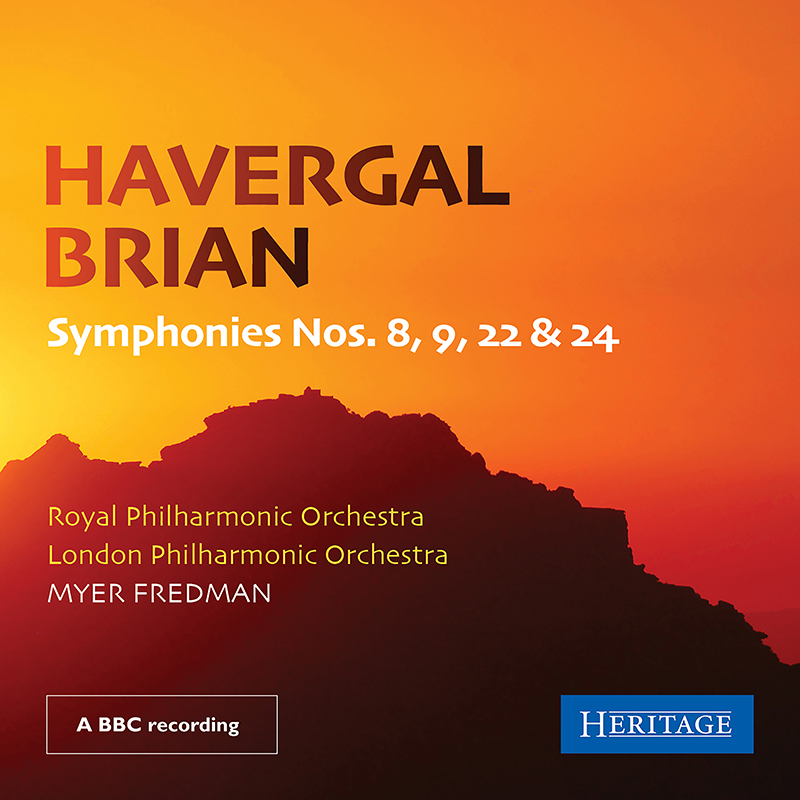
Brian Symphonies – no.8 in B flat minor (1949); no.9 in A minor (1951); no.22 in F minor, ‘Sinfonia Brevis’ (1964-5); no. 24 in D major (1965)
Royal Philharmonic Orchestra (nos.8,9 & 22), London Philharmonic Orchestra (no.24) / Myer Fredman
Heritage HTGCD146 [77’46’’]
Broadcast performances from St John’s, Smith Square, London on 28 March 1971 (nos. 9 & 22) Maida Vale Studios, London on 27 June 1971 (no.8) and 1 April 1973 (no.24)
Reviewed by Richard Whitehouse
What’s the story?
Heritage continues its releases of pioneering symphonic broadcasts by Havergal Brian with this issue of performances from the 1970s conducted by Myer Fredman, two of these being world premieres in what was a productive decade for furthering the music of this composer.
Born in Plymouth and later resident in Australia, Fredman (below) (1932-2014) set down Bax’s first two symphonies, together with Brian’s Sixth and Sixteenth Symphonies (Lyrita) that remain among the finest such recordings. He also made studio broadcasts of the present symphonies which, as John Pickard indicates in his detailed booklet notes, are among the most revealing of Brian performances from the period either side of the composer’s death – making them a natural inclusion for a series such as that now undertaken by the enterprising Heritage label.
What’s the music like?
This was the fourth hearing of the Eighth Symphony, coming after two live broadcasts with Adrian Boult in 1954 and one by Rudolf Schwarz in 1958. In many ways a template for what came after, its single span elides sonata-form and multi-movement design with a cohesion the greater for its overt unpredictability. The initial rhythmic figure (one of Brian’s most striking such openings) is not quite together, but thereafter Fredman exerts firm while never inflexible control over the interplay of martial dynamism and contemplative stasis, building its central climax superbly if losing momentum into the contrasted passacaglias – the second of which brings only a fugitive calm in its wake. Commercially recorded by Charles Groves in 1977 (EMI/Warner) and Alexander Walker (Naxos) in 2016, this work awaits public performance.
Preceded by live broadcasts with Norman del Mar in 1958 and ’59 (the latter now on Dutton), the Ninth Symphony features three continuous movements that outline a Classical framework. Fredman launches the initial Allegro with due impetus and charts a secure course through its quixotic changes of mood – the hushed transition into the reprise especially striking. He is no less focussed in a central Adagio whose musing reverie is constantly undercut by militaristic aggression, a reminder Vaughan Williams’s Sixth had appeared three years before, while the final Allegro tempers its festive cheer with a plaintive interlude which even the jubilant coda only just outfaces. Surprising that since Groves’ public performances in Liverpool and at the Proms in 1976, then his commercial recording a year later, this work has remained unheard.
The remaining performances are both world premieres of works which form outer parts of a symphonic triptych. Lastly barely 10 minutes, the Twenty-Second is (as its subtitle implies) the shortest of Brian’s cycle if hardly the least eventful. More impulsive than Lázsló Heltay with his 1974 recording (CBS/Heritage), let alone Groves in his spacious 1983 performance, Fredman teases out the eloquence of the initial Maestoso through to its fervent culmination, then brings a deft nonchalance to the ensuing Tempo di marcia such as makes contrast with its baleful climax the more telling. Brooding and fatalistic, the coda ranks among the finest passages in post-war symphonic literature and Fredman captures its essence. Walker comes close with his 2012 recording (Naxos), but this account effortlessly transcends its 52 years.
A pity Fredman never tackled No. 23, who three Illinois hearings by Bernard Goodman in October 1973 make it only the Brian symphony premiered outside the UK, but he did give the Twenty-Fourth. After its intense then impetuous predecessors, this one-movement piece feels more expansive for all its methodical ingenuity. The martial opening section is adroitly handled so its breezy extroversion reveals unexpected inwardness towards its centre then at its close; a whimsical and lightly scored interlude making way for the (relatively) extended adagio which, in its searching if often equivocal repose, brings both this work and those two before it to an affirmative end. Walker’s 2012 account (Naxos) enables all three symphonies to be heard in consecutive order, but the insights of this first performance remain undimmed.
Does it all work?
Almost always. Fredman has an audible grasp of Brian’s often elusive thinking, so that these performances unfold with a formal inevitability and expressive focus often lacking elsewhere. The Royal Philharmonic Orchestra betrays passing uncertainty with Brian’s more idiosyncratic touches, whereas the London Philharmonic Orchestra copes ably with what is among his most approachable later symphonies. Heritage has done its customary fine job opening out the sound, and anyone who knows these performances through the pirated Aries LPs will be delighted at the improvement.
Is it recommended?
Indeed. Those familiar with these symphonies from the studio recordings will find Fredman’s interpretations an essential supplement. Hopefully this series will continue apace, ideally with John Poole’s 1974 performance of the Fourth or Harry Newstone’s 1966 take on the Seventh.
For purchase information on this album, and to hear sound clips, visit the Heritage website. For more on the composer, visit the Havergal Brian Society – and for more on Myer Fredman, visit a dedicated page on the Naxos website
Vaughan Williams Fantasia on a Theme by Thomas Tallis (1910) Tom Coult Pleasure Garden: Concerto for Violin and Orchestra (2020) (London premiere) Vaughan Williams The Lark Ascending (1914-20); Symphony no.9 in E minor (1956-57)
Daniel Pioro (violin), London Philharmonic Orchestra / Andrew Manze
Royal Festival Hall, London Wednesday 26 October 2022
Reviewed by Ben Hogwood. Concert pictures with thanks to the London Philharmonic Orchestra; picture of Andrew Manze (c) Benjamin Ealovega
Subtitled Visions of England, this concert from the London Philharmonic Orchestra and Andrew Manze was a celebration of Vaughan Williams, marking 150 years since the composer’s birth. As part of an extremely full conducting CV, Manze has a recently recorded cycle of the composer’s nine symphonies under his belt with the Royal Liverpool Philharmonic Orchestra, and clearly holds a special affection for his music.
Two of RVW’s most popular pieces began each half of the concert, but the main act was a relatively rare encounter with composer’s final symphony, completed a year before his death. The Ninth Symphony is a work needing repeated listening before its treasures can be fully revealed, but more recently it has started to get the performances it needs to make an impact. As Manze himself told us from the platform, it also has a deep resonance for the London Philharmonic Orchestra themselves. On the morning of 26 August 1958 they were rehearsing with the composer’s friend and advocate, Sir Adrian Boult, when news came through that Vaughan Williams had died.
This performance delved into the spidery textures that seem to provide a link to the afterlife itself, rather like one of Holst’s later Planets. Also evident were a series of cloudy, watery vistas, such as those found in Debussy’s Nocturnes. Manze probed deeply into the first movement, helped by the baleful colouring of three saxophones, beautifully managed by Martin Robertson, Tim Holmes and Shaun Thompson to enhance the unusual orchestral textures. The tension between the ‘home’ note of E and its immediate neighbour F was ideally weighted, the thoughtful mood tinged with a sense of foreboding.
These emotions underpinned a convincing performance, with references to earlier, angrier music from the Sixth symphony sharply noted and delivered. There were also moments of calm acceptance, as though the composer was reappraising his life with some satisfaction, the darkness held at bay by silvery strings and consoling woodwind.
The second movement, with its curious rhythmic profile, had nicely balanced syncopations, while the scherzo danced as though in an empty room, the music never quite leaving the leash on which it was held. Segueing directly to the finale, Manze’s control and passion could be felt in equal measure, a sense of resolution hard to come by but ultimately found as the music headed for its final three chords, the ‘E’ and ‘F’ finally resolving their dispute. This beautiful symphonic ending offered genuine light in the darkness, a similar sensation to Shostakovich’s final symphonic statement if seen through very different eyes.
The concert opened with the ubiquitous Fantasia on a Theme by Thomas Tallis, less elusive music perhaps but equally profound when casting its eyes back over time. This ideal concert opener speaks as loudly as it surely did in 1910, providing consolation for the fevered brow through subtle but far-reaching statements. On this occasion the performance did not quite have the ‘tingle’ factor, but it did feature beautiful string playing and finely wrought balance between the ‘choir’ of ten instruments, elevated a little at the back of the stage. Meanwhile the main orchestra could boast excellent contributions from four section principals, Pieter Schoeman and Tania Mazzetti (violins), Richard Waters (viola) and Pei-Jee Ng (cello).
The Lark Ascending holds a similarly treasured status among lovers of Vaughan Williams, remaining one of the calling cards of 20th century English music. In the right performance it creates a magical evocation of George Meredith’s lark, as it ‘drops the silver chain of sound’. Daniel Pioro played the solo part with great sensitivity and more than a little panache, choosing not to overindulge in a relatively straightforward opening sequence, but appearing to add a few extra ‘blue’ notes as the violin warmed to its characterisation, ‘lost on his aerial wings’. Manze’s pacing, initially quite fast, settled to a satisfying pace, with ideal balance between soloist and orchestra. The hall responded with commendable silence to the absolute quiet at the end.
A busy evening for Pioro included a role as soloist in the first London performance of Tom Coult’s Pleasure Garden. A four-movement concerto for violin and carefully chosen orchestra, it is effectively a compilation of four very distinct tableaus, taking its lead from constructed ‘natural spaces’ in and around congested living areas.
The first movement, Starting to rain – Zennyo Ryuo appears, found as vivid a portrayal of rain as you could wish to hear – in my mind I was checking the roof for a leak! Throughout the concerto Coult’s keen ear for orchestral colour was evident at every turn, as was his assured writing for violin, brilliantly played by Pioro. The coloristic effects were enjoyable and easy on the ear, harmonies largely consonant but never over-simplified, and the description of events in Dyeing the lake blue for Queen Victoria, Francesco Landini serenades the birds and The art of setting stones was easy to follow. The birds in particular were vividly portrayed by the soloist.
There was however a fragmented feel to the green spaces, as though they had not fully germinated, and this was exaggerated by the stopping of each movement to pause the descriptive process. When the piece did finally finish there was still an element of unfinished business, in spite of its 27-minute length. Repeated hearing would be welcome to give a more thorough appraisal and understanding, as the warm reception would suggest Coult hit the mark for the vast majority of listeners. His music has many attractive traits and he is a gifted orchestrator, so his is most definitely a space to keep under watch.






 Arcana.fm