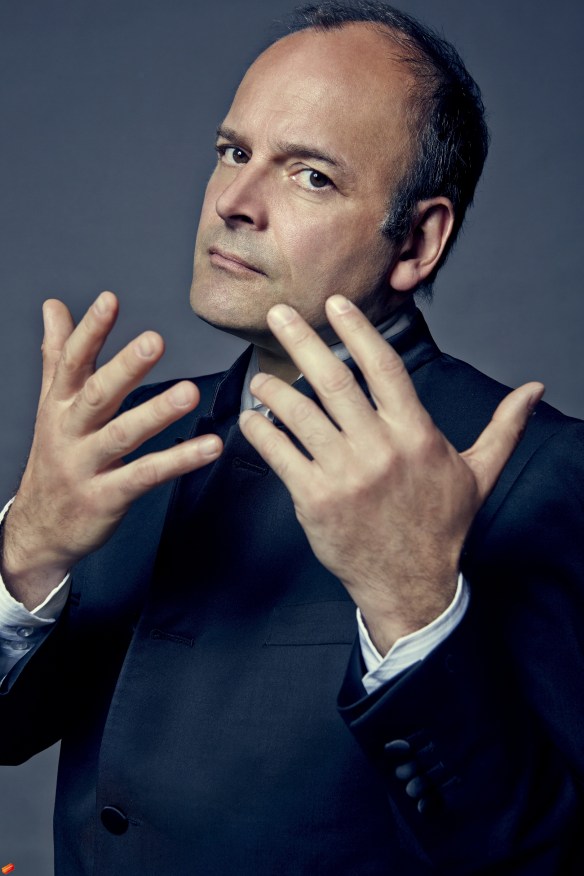
In Concert: Louis Lortie @ Wigmore Hall – Schubert & Rachmaninoff Moments Musicaux

Louis Lortie (piano)

Schubert 6 Moments musicaux D780 (1823-28)
Rachmaninoff Moments musicaux Op.16 (1896)

Wigmore Hall, Monday 25 September 2023

by Ben Hogwood

The term ‘moment musical’ has been seldom used in classical music, with only two significant sets of these ambiguously named piano pieces coming to mind. Yet as Canadian pianist Louis Lortie showed us, in this stimulating BBC Radio 3 Lunchtime Concert at the Wigmore Hall, they are far from insignificant works.

Schubert’s publisher was the first to coin the term, describing his set of six ‘easier’ pieces thus when they were published in 1828. In spite of their sporadic composition period – no.3 was the first written five years earlier – they make a satisfying collection when performed in order. As a common factor they find Schubert alternating between major and minor keys, a tension Lortie was keen to bring forward.

He began with a quizzical account of the first piece in C major, played with more pedal than might normally be the case but with persuasive phrasing. The second piece in A flat major was notable for its touching intimacy, in spite of a troubled middle section where a shadow fell over the music. Schubert’s third piece, a Danse Russe, anticipates Tchaikovsky’s Danse des Cygnes from Swan Lake.  Lortie played it beautifully, with a touch of humour, before the Chopin-esque fourth piece contrasted the darker hues of C# minor with an elegant section in the major key. The fifth piece strode forward with a determined gait, ending in a major key but not shaking off its feeling of inner strife, before a lovingly delivered sixth piece (subtitled A troubadou’s lament) returned to A flat major seemingly lost in thought.

Rachmaninoff’s cycle of six Moments Musicaux, published in 1896, prove rather more challenging for the performer, his aim for professional pianists with a similarly wide span across the hands. He would appear to have known about the Schubert set – that much is implied by the title – but the volume is noticeably louder for these passionate pieces. The opening nocturne in B flat minor started simply enough but soon a cold wind swirled about, Lortie mastering the technical demands with impressive control. This was a feature of his Rachmaninov playing, especially in the third piece, the emotional centrepiece of the cycle with strong, yearning characteristics. Around this we rocked to the turbulence of the second piece in E flat minor and the fourth in E minor, both with a steely glint at the edges and the latter with more bluster. Lortie drew back for a soulful fifth piece, saving the most impressive pianism for the final flourish, a brilliantly played peal of bells bringing us full circle to C major.

This was a fascinating and superbly played programme, the inner thoughts of Schubert complemented by Rachmaninoff’s overt passion, both brought into the open by Louis Lortie for us to fully appreciate. As a parting gesture he acknowledged the piano itself, a Bösendorfer instrument whose tone was ideal for this music.

For livestreamed concerts from the Wigmore Hall, click here

On record – Louis Lortie, BBC Philharmonic Orchestra / Edward Gardner – Saint-Saëns: Piano Concertos 3 & 5 (Chandos)

Saint-Saëns
Rhapsodie d’Auvergne Op.73 (1884)
Piano Concerto no.3 in E flat major Op.29 (1869)
Allegro appassionato in C sharp minor Op.70 (1884)
Piano Concerto no.5 in F major Op.103 ‘Egyptian’ (1896)

Louis Lortie (piano), BBC Philharmonic Orchestra / Edward Gardner

Chandos CHAN 20038 [66’51”]

Producers Mike George and Brian Pidgeon
Engineer Stephen Rinker

Recorded 13 January 2018 (Rhapsodie d’Auvergne), 20 & 25 February 2019 (other works), Media City UK, Salford, Manchester

Written by Ben Hogwood

What’s the story?

This is the second installment of Saint-Saëns piano concertos from Louis Lortie, Edward Gardner and the BBC Philharmonic Orchestra. It completes the cycle of five they have been recording for Chandos.

Saint-Saëns’ Piano Concertos tend to be overlooked in the concert hall, with only occasional performances for no.2 and no.5, which was written in part during a holiday in Egypt. Their neglect is unfortunate, as there is much to enjoy as the pieces unfold. The demands on the solo pianist may be considerable, but the rewards outweigh the effort required for sure.

What’s the music like?

This new release offers the Piano Concerto no.3 in E flat major, still a relatively early work, where Saint-Saëns builds on the influence of Beethoven and Liszt to create a piece with memorable themes and unusual formal devices. We then move to his later period and the Piano Concerto no.5, the ‘Egyptian’. This is a daring piece in the sense that Saint-Saëns was not following the trend of modern music set by the post-Wagner composers, or the new sound worlds offered by Debussy and Ravel. Instead he was writing for the virtuoso pianist in a descriptive and positive sense – conventional but stretching the established ‘rules’ of the concertos. This piece is ultimately fun and packed with tunes, while asking the soloist to achieve some pretty difficult technical feats. There is a faint exoticism capturing the carefree mood of the composer on vacation.

Topping up the positive outlook are the Rapsodie d’Auvergne and the Allegro appassionato, both shorter pieces for piano and orchestra with a similarly sunny outlook. The Allegro appassionato has more drive, while the Rapsodie is a breezy piece for the great outdoors. As the booklet writer Roger Nichols observes, it is based on a tune the composer ‘heard sung by a peasant washing her clothes in a stream in the Auvergne. As such, it is possibly the only folksong from France that Saint-Saëns ever included in his music’.

Does it all work?

Yes. This is extremely positive music, celebrating the combination of piano and orchestra with a good deal of energy.

The concertos are nicely balanced. The better known Fifth, stacked high with good tunes, finds Ed Gardner keen to develop its exotic air with the lush textures of the BBC Philharmonic strings in the first movement. There is a dramatic salvo to begin the second movement, where Lortie gets the melodic inflections just right, then an exotic minimalist passage towards the end, cutting to a real flight of fancy into the finale. Lortie gets a terrific substance to the sound of the lower end of the piano.

The Piano Concerto no.3 if anything fares even better, its status elevated well above the derivative thanks to the stress on its memorable themes. There is a heroic air to the piano part that Louis Lortie develops very nicely, and his commanding performance gives the piece its essential forward drive.

The Rhapsodie d’Auvergne is a bubbly piece, starting softly but gaining ground during the development of its theme. There are brief connections with Brahms before an effervescent and watery sequence, with excellent work in the right hand from Lortie.
Meanwhile the Allegro appassionato is a red-blooded affair very much in the vein of Liszt, asking the soloist for a few feats of athleticism while remaining close to the composer’s melodic heart.

Is it recommended?

Yes. This is an ideal release for banishing any lingering winter blues! There may be some really good recordings around already of the concertos, thanks to Stephen Hough and the City of Birmingham Symphony Orchestra under Sakari Oramo (Hyperion), and looking further back the classic 1980s recordings made by Pascal Rogé and the London Philharmonic Orchestra with Charles Dutoit (Decca).

These sparkling new versions, beautifully recorded, offer a great deal of passion and panache, and at the very least take their place alongside the best..

Listen

Buy

You can listen to clips from this disc and purchase a copy at the Chandos website here

Prom 14 – BBC Philharmonic / John Storgårds: Single-movement Sibelius, Zimmermann, Schubert & Wagner

Prom 14: Elizabeth Watts (soprano), Louis Lortie (piano), BBC Philharmonic OrchestraJohn Storgårds

Wagner Die Meistersinger von Nürnberg – Prelude to Act One (c1861)
Schubert (orch. Liszt) Four Songs (1825/1815/1826/1815, orch. 1860)
Zimmermann Symphony in One Movement (1947-51, rev. 1953)
Schubert (arr. Liszt) Fantasy in C, D760, ‘Wanderer’ (1822, arr. c1850)
Sibelius Symphony No. 7 in C, Op. 105 (1924)

Royal Albert Hall, Tuesday 24 July 2018

You can listen to this Prom by clicking here

Reviewed by Richard Whitehouse

John Storgårds has given some enterprising concerts during his tenure as Chief Conductor of the BBC Philharmonic Orchestra, and this evening’s Prom was a further instance with its programme of mainly one-movement pieces and an underlying emphasis on symphonic cohesion, even unity.

The exception was the sequence of four songs by Schubert, arranged for orchestra by Liszt so that a tenuous cohesion is evident – without this being a song-cycle as such. Elizabeth Watts (below) duly had the measure of their predominantly sombre sentiments – ranging from the distanced recollection of Die junge Nonne, via remorseless passing of experiential time in Gretchen am Spinnrade and speculative radiance of Lied der Mignon, to visceral representation of fate in Erlkönig. Storgårds teased many subtleties from Liszt’s judiciously restrained orchestration.

Preceding this came a surprisingly dour account of the Prelude from The Mastersingers of Nuremburg. This grandest of Wagner music-dramas is also the most symphonic, not least its Prelude as it deftly outlines a four-movements-in-one format. While not being oblivious to this, Storgårds might have characterized these episodes more potently, though this may have been in line with his tendency to play down the music’s opulence and majesty. What resulted was a subdued and earnest performance that hardly marked him out as a budding Wagnerian.

Concluding the first half was the Symphony in One Movement by Bernd Alois Zimmermann; a timely hearing in this centenary year of the composer’s birth. Although the more discursive original version (complete with organ histrionics) has recently been revived, this revision is audibly more focussed in form and expression as it traverses a quirky yet combative sonata design – (modified!) exposition repeat included – before emerging full circle in a mood of unbridled ferocity. Storgårds was at his interpretative best here, maintaining a tensile course over an eventful score where influences of mid-century symphonism do not outface pointers to the intricacy or intensity of Zimmermann’s mature music. A notably enthusiastic reception suggested that tonight’s audience ‘got’ what the composer was about in this singular piece.

Time was when Liszt’s concertante realization of Schubert’s Wanderer Fantasy was a staple at these concerts, but this was only the second hearing in nearly six decades. 33 years ago, the soloist was Jorge Bolet at his unpredictable best, but Louis Lortie’s rendition (above) was altogether subtler as he brought out the pathos of the Andante then jocularity of the Presto. If the outer Allegro sections felt reined-in, this was not at the expense of that keen virtuosity informing Lortie’s playing in his solo passages or coruscating interplay with the orchestra at the close.

A century on, Sibelius not only ran movements together in his Seventh Symphony but fused them into a seamless and powerfully cumulative whole. Storgårds was certainly alive to this in what was a purposeful and often insightful reading; a little unsettled in those introductory pages, perhaps, but thereafter gauging the various transitions with a sure sense of where this music was headed while investing the vertiginous trombone entries with implacable majesty. One of this season’s most absorbing concerts thus far was brought to an impressive close.

Wigmore Mondays – Louis Lortie plays Chopin

Louis Lortie (piano)

George Benjamin Shadowlines (6 Canonic Preludes) (2001)

Chopin 24 Preludes Op.28 (1839)

Wigmore Hall, London; Monday 24 April, 2017

Listen to the BBC broadcast here

Written by Ben Hogwood

Louis Lortie has a long-held affinity with the music of Chopin, and that was abundantly clear in the affection with which he played the composer’s 24 Preludes.

Completed in 1839, they are an extraordinary set of pieces that travel through each of the conventional Western tonal centres in the course of just 40 minutes. Chopin structures them cleverly, pairing them up so that each prelude appearing in a major key (for instance the first one in C major) is followed by its closest relative in a minor key (in this case A minor). The series proceeds using the ancient ‘cycle of fifths’, so that after ‘C’ we move to ‘G’, then ‘D’, and so on until a complete circuit is reached.

Previous exponents of this sort of cycle include Bach, whose famous ‘48’ also uses all the keys, but moves in a stepwise movement from C to C sharp, then D. In visiting the form Chopin was clearly aware of Bach’s efforts in the previous century, for he took the music with him on holiday to Majorca, where some of the preludes were written.

Lortie brought the cycle to life (from 18:06 on the broadcast link provided), with some of the shorter pieces reeled off at dazzling speed. The quick ones, for instance those in G major (21:02) or a particularly stormy affair in F sharp minor (27:29) were on occasion a bit too swift for the phrasing to be abundantly clear, but when he spent time over the melancholic no.4 in E minor (21:57), or the serious no.6 in B minor (24:37), the melodies were beautifully shaped, the depth of feeling immediately evident.

The natural centrepiece of the cycle is no.15 in D flat major, known as the Raindrop (from 36:27). It is at least twice as long as any of the others but also contains at its heart a very strong reference to plainchant, the speculation being that Chopin was capturing a haunted abbey in his writing. It looks forward to Debussy in this sense, and Lortie played it with the grandeur it deserved. Following it with the whirlwind B flat minor prelude (41:50) was the storm after the calm, the whirlwind superbly energised.

A beautifully crafted finish included the delicacy of the F major prelude from 51:35) and the stern countenance of the final D minor prelude (52:25), carrying its head high to put a cap on a superb performance of 24 strongly characterised pieces.

A little less effective were the 6 Canonic Preludes by George Benjamin, written so that whatever is played in one part has to be shadowed by the other. Some of the pieces were effective characterisations, not a million miles from Schoenberg’s mysterious piano pieces, but others felt emptier emotionally. Lortie played them superbly, but perhaps repeated hearing on the broadcast will bring them to life.

Further listening

Lortie is in the process of recording the complete piano works of Chopin, and his first album in the series for Chandos is a great next step after the Preludes, containing as it does the great Piano Sonata no.2.

BBC Proms 2016 – Louis Lortie: Venezia e Napoli

louis-lortie

Louis Lortie (piano) © Elias

Rossini, transcribed Liszt La regata veneziana; La danza (1830-35, transcr. 1837)

Poulenc Napoli (1925)

Fauré Barcarolle no.5 in F sharp minor Op.66 (1894); Barcarolle no.7 in D minor Op.90 (1905)

Liszt Venezia e Napoli (1859)

Cadogan Hall, Monday 22 August 2016

Listen to this concert on the BBC iPlayer

For an hour Louis Lortie managed to transport the Cadogan Hall audience to even sunnier climes – to Venice and Napoli, to be exact. He did this through a well constructed program painting pictures of the Italian cities and regions from afar, for none of the chosen composers were Italian.

All except Rossini, that is – though the two Soirées Musicales chosen for this concert were given in arrangements made by Liszt. Typically these were hyped up for concert audiences, but as in most of Liszt’s transcriptions there is a sensitive side staying true to the original, and Lortie found that unerringly in the humour of La danza.

We transferred from Venice to Naples for Francis Poulenc’s brief but vivid three-movement portrait. The central Nocturne was the great find here, a really lovely bit of descriptive music bookended by two fast movements typical of Poulenc in their wit and, in the Caprice italien, a deceptively soft heart that Lortie delighted in showing us.

It was especially good to hear two of Fauré’s Barcarolles included, especially as Louis Lortie has realised his love of the composer’s music in a new disc from Chandos. The Barcarolles are real diamonds, perfect for listening at either end of the day, and are highly original in their elevation of an older art form all but ignored by other composers. Lortie showed concert audiences need not be dissuaded by them either, with a darkly shaded Barcarolle no.7, which found some of the Fauré’s shadowy writing encroaching from the edges like the approach of night. Meanwhile the distinctive motif of the Barcarolle no.5 was ever-present, though towards the end of this the pianist was too full with his volume at the bell-like top end of the register.

That said, his playing throughout was remarkably accurate and expressive, and both qualities were evident in a superb performance of Venezia e Napoli, the epilogue to part two of Liszt’s piano travelogue Années de Pèlerinage. The virtuosity on show was breathtaking in the final Tarantella, but it was the poetic depiction of the gondola and the slower Canzone, with its majestic interpretation of Rossini’s Otello, that really hit home.

Ben Hogwood