In concert – Viktoria Mullova & Alasdair Beatson @ Wigmore Hall: Beethoven & Schubert

Viktoria Mullova (violin), Alasdair Beatson (fortepiano)

Beethoven Sonata for piano and violin no.6 in A major Op.30/1 (1802)
Beethoven Sonata for piano and violin no.8 in G major Op.30/3 (1802)
Schubert Rondo brillant in B minor D895 (1826)

Wigmore Hall, London
Monday 7 April 2025 (1pm)

by Ben Hogwood

Violinist Viktoria Mullova and pianist Alasdair Beatson have been exploring Beethoven’s works for piano and violin for a while now, and this concert demonstrated the rapport they have built with the music – and the Wigmore Hall audience.

On a bright March day in London the Spring Sonata might have been the most appropriate choice – more of which later – but instead we enjoyed an unsung gem among Beethoven’s works for this combination. This was the Sonata for piano and violin no.6 in A major Op.30/1, the least heard of the trio published as Op.30 and a work brimming with good spirits in this performance.

As our BBC Radio 3 host Andrew McGregor informed us, Alasdair Beatson was playing a fortepiano copy of a Conrad Graf instrument, and it brought a wide range of tonal colour to the hall, with mottled treble and a wonderfully grainy lower register. Beatson and Mullova played as one, finishing each other’s sentences, or joining in unisons which could not be split. Op.30/1 warmed to this treatment, its bursts of energy complemented by tender, charming asides. Mullova’s intonation took a little while to settle, but once secured her phrasing was a delight. The soft centred, sweetly toned second movement was followed by an Allegretto con variazioni finale with terrific energy, driving up to and through a sparkling finish.

The Sonata for piano and violin no.8 in G major Op.30/3 followed – a charming work, especially in a performance such as this. Mullova and Beatson were on the edge, justifying a daringly fast tempo choice for the first movement with tight ensemble and drive, Mullova exaggerating the louder notes to put the listener in mind of the sort of sound Beethoven himself would surely have loved. The bubbly first movement was charming, its confidential asides well worth savouring, the togetherness between the two musicians truly admirable. The Tempo di minuetto explored darker moods, notably its brief passage in the minor key which cast a shadow over the return of the previously sunny first theme. The irrepressible finale enjoyed its humourous ‘wrong’ notes, recalling Haydn’s ‘Bird’ string quartet in their impudence.

It is hard to imagine a better performance of Schubert’s Rondo brillant, with which the concert ended. Here the two performers were like dancers in hold as they explored the composer’s unusual rhythmic terrain, bringing a sense of occasion to the introduction and an attractive sway to the dance rhythms as Schubert’s abundant melodies unfolded. A strong central section set up a series of virtuoso heroics towards the end, falling comfortably under Mullova’s fingers, while Beatson prompted with equal dexterity. The performance was a thrill from start to finish. As an ideal encore we did finally hear from Beethoven’s Spring Sonata – the beautiful second movement Adagio, given a charming lilt from Mullova’s phrasing and Beatson’s flowing accompaniment.

Listen

You can listen to this concert as the first hour of BBC Radio 3’s Classical Live, which can be found on BBC Sounds

Published post no.2,499 – Wednesday 9 April 2025

In concert – Philharmonia Chamber Players – Beethoven: Septet

Philharmonia Chamber Players [Maura Marinucci (clarinet), Zsolt-Tihamér Visontay (violin), Scott Dickinson (viola), Alexander Rolton (cello), Owen Nicolaou (double bass), Sarah Pennington (horn), Marceau Lefèvre (bassoon)

Beethoven Septet in E flat major Op.20 (1802)

Royal Festival Hall, London
Thursday 20 March 2025 6pm

Reviewed by Ben Hogwood Picture (c) Marc Gascoigne

Beethoven’s six-movement Septet is, to all intents and purposes, a Serenade for seven instruments. As such it was perfectly timed in this early evening slot, the ideal piece with which to entertain a relaxed and healthily-sized crowd.

Clarinettist Maura Marinucci introduced the work, and her love of the piece was clearly shared by her Philharmonia Orchestra friends as they went about a performance that was by turns vigorous and lyrical.

Beethoven’s scoring was highly original in 1802, and it is easy to see why the piece proved so popular, with its abundance of good tunes and colourful textures. These were evident right from the opening, the bassoon and double bass giving a lovely heft to the lower end of the sound. They supported the winsome tunes, divided largely between Marinucci’s clarinet and the violin of Zsolt-Tihamér Visontay. Marinucci especially enjoyed the soft-hearted second movement, while Visontay had an increasingly virtuosic role to play, sometimes pushing ahead of the tempo in his eagerness but relishing Beethoven’s technical challenges.

The Minuet, with its impudent theme thumbing a nose at the audience, was nicely done, while the theme and variations forming the fourth movement were especially enjoyable, notably the first variation, assigned to the upper string trio, and the mischievous final variation and coda.

Above all this performance was a great deal of fun, the players enjoying sharing the tuneful material with their audience, an approach capped by a quickfire finale and dazzling cadenza from Visontay. Just as affecting, mind, was the hushed chorale from the winds preceding this moment.

Ultimately the music matched the weather, bringing the vitality of early spring to the Royal Festival Hall stage.

For details on the their 2024-25 season, head to the Philharmonia Orchestra website

Published post no.2,480 – Friday 21 March 2025

In concert – Elizaveta Ivanova, BBC Symphony Orchestra / Vinay Parmeswaran @ Maida Vale: Carlos Simon, Ibert Flute Concerto & Prokofiev Seventh Symphony

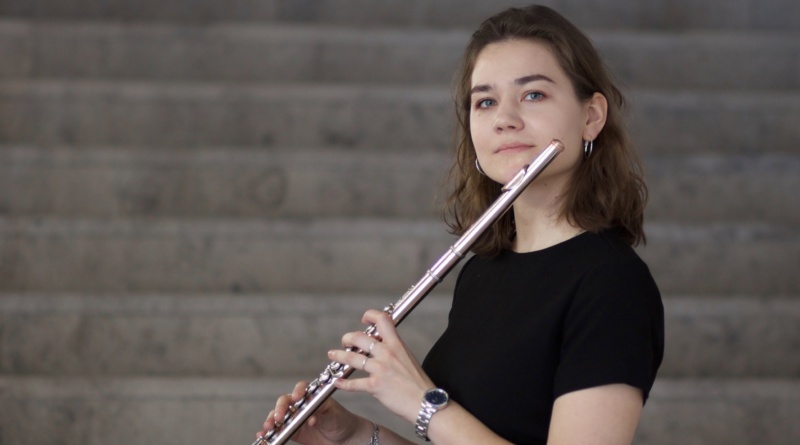
Elizaveta Ivanova (flute, below), BBC Symphony Orchestra / Vinay Parameswaran (above)

Carlos Simon Fate Now Conquers (2020)
Ibert Flute Concerto (1932-33)
Prokofiev Symphony no.7 in C# minor Op.131 (1952)

Studio 1, BBC Maida Vale Studios, London
Tuesday 4 February 2025 (2:30pm)

by Ben Hogwood Photo of Vinay Parameswaran (c) Roger Mastroianni, courtesy of The Cleveland Orchestra

For this concert linking seventh symphonies, the BBC Symphony Orchestra made their first public appearance with conductor Vinay Parmeswaran.

They began with music from Vienna via America, Carlos Simon effectively remixing the second movement of Beethoven’s Symphony no.7 and applying some fresh paint of his own. The piece was inspired by an entry Beethoven made into his journal in 1815, and takes its lead from “the beautifully fluid harmonic structure” of the symphony’s second movement, Simon composing “musical gestures that are representative of the unpredictable ways of fate”. Though Beethoven’s structure could still be glimpsed, it was viewed through music incorporating the language of Sibelius, Copland and John Adams to create a relatively familiar but ultimately thrilling orchestral vista. Simon’s development of the material was enjoyable to witness, though the sudden end felt underpowered in context. Nonetheless, here is a composer to investigate further.

Ibert’s Flute Concerto is one of the instrument’s calling cards from the 20th century, though is heard in concert rather less than it could be. Here it was performed by Elizaveta Ivanova, a flautist recently recruited to the BBC New Generation Artists programme and making her first appearance with the BBC Symphony Orchestra. She brought to the piece a welcome freshness, rising to the challenge of Ibert’s virtuoso solo part while including stylish phrasing and thoughtful dialogue with the orchestra. The graceful second movement Andante is the emotional centre of the concerto, and recalls the equivalent movement in Ravel’s Piano Concerto in G major in its beauty and softer-hearted sentiments. This was in vivid contrast to the outer movements, whose syncopations took the music closer to New York rather than Paris, Ibert’s cosmopolitan style enjoyed by the reduced BBC SO forces as much as by the athletic soloist. A fine performance, and a welcome revival for a composer whose colourful orchestral music and abundant melodies are a tonic.

Melodies, bittersweet or otherwise, are at the core of Prokofiev’s late Symphony no.7, written the year before his death. In a short interview section Parmeswaran implied the work was ‘softer’ than its predecessors, but there were no shrinking violets to be found as the second movement reached a juddering conclusion. Here Prokofiev’s attempts to write a competition winner, simultaneously pleasing Stalin, were affected by his own personal angst, for he was living in poverty at the time.

The weighty bass of the first movement and graceful cello theme of the third movement, marked Andante espressivo, were indicators of the emotional range of the symphony, but the biggest tune, heard from the full orchestra, was the second theme of the first movement, a soaring and winsome melody that returns to crown the final movement. Under Parmeswaran’s affectionate direction it was beautifully judged, though he was careful to ensure the final word in the symphony carried equal impact, the strange ticking of the percussion indicating the creeping passage of time. The symphony ended as it should, its smiling countenance compromised by a frown.

Listen

This concert was recorded for future broadcast on BBC Radio 3. A link will appear here when that becomes available.

Published post no.2,433 – Wednesday 5 February 2025

In concert – Juilliard String Quartet @ Wigmore Hall: Beethoven Op.130 & Jörg Widmann

Juilliard String Quartet [Areta Zhulla, Ronald Copes (violins), Molly Carr (viola), Astrid Schween (cello)]

Beethoven String Quartet no.13 in B flat major Op.130 (1825-6)
Widmann String Quartet no.8 ‘Beethoven Study III’ (2020)

Wigmore Hall, London
Monday 20 January 2025 (1pm)

by Ben Hogwood

Since its formation in 1946, the Juilliard String Quartet has not surprisingly undergone a number of iterations. Its present line-up, nearly 80 years on, has brought new impetus to carry the group far into the 21st century. For this Wigmore Hall visit, a BBC Radio 3 Lunchtime Concert, the quartet paired late Beethoven with relatively late Jörg Widmann – a piece he wrote in the last five years.

More of that below, but the quartet’s decision to begin with the longer Beethoven was vindicated on account of the musical material. The String Quartet no.13 was the second of Beethoven’s five ‘late’ quartets to be published, and the third in order of composition – with its sixth and final movement known as the Grosse Fuge. A highly unusual and forward-looking piece, this movement was initially shunned by audiences, described by a critic as ‘incomprehensible, like Chinese’. Ultimately it has been recognised as a masterpiece of counterpoint and structure.

In light of its reception Beethoven completed an alternative finale for the quartet in November 1826, four months before his death – in fact the last music he wrote. The Juilliard chose this path, changing the balance of the work to place extra emphasis on the penultimate Cavatina, a movement of special grace. Indeed much of this performance found the quartet taking on serenade-like qualities, the Juilliard preferring to stress the sunlit melodies and textures, while emphasising the dance rhythms.

The first movement’s Adagio and Allegro sections had vivid colours and phrasing, brilliantly played but needing more contrast between the sections. The following Prestissimo was over in the blink of an eye, forceful when needed, and providing a contrast with the attractively voiced Andante, with tasteful melodic phrasing. The attractive Alla danza tedesca brought a serenity to Beethoven’s late writing, as opposed to the restrained beauty of the Cavatina, where first violinist Areta Zhulla’s playing was especially fine. The finale introduced a playful approach, especially welcome as the music approached its final bars, which were authoritative while lacking the outright drama the Grosse Fuge would have brought.

The connection between Beethoven and Jörg Widmann is unusually strong, the German clarinettist and composer completing a clutch of works (to date) drawing on his predecessor’s inspiration. Five of those works are his string quartets nos.6-10, a series titled Study on Beethoven, of which this quartet is the third instalment. Taking the fourth movement Alla danza tedesca from the Beethoven we had just heard, Widmann worked the second movement of this quartet into eight striking variations on its theme, explaining the placement of this work in the concert running order.

It was played with commendable virtuosity, and often enjoyable in its knowing use of Beethoven’s themes. The BBC Radio 3 announcer Fiona Talkington said the quartet had confided how Widmann now felt Beethoven was a ‘close friend…someone you can poke fun at!’, and he certainly took the opportunity for high jinks in the finale, where references to the Emperor piano concerto were rather heavily signposted.

The second movement was the most inventive, a fever dream refracting Beethoven’s theme through instrumental prisms of wildly varying shades. Ultimately you had to admire Widmann’s craft, and Beethoven’s initial invention, forgiving the occasional tendency to play more obviously to the audience. On this occasion it proved a most successful tactic, finishing a concert packed with positive energy. The only slight blot on the landscape came via some low frequency drilling which could be heard in quiet passages, no doubt emanating from one of the many building sites currently adorning Central London. Thankfully the music of Beethoven transcends such things!

Listen

You can listen to this concert as the first hour of BBC Radio 3’s Classical Live, which can be found on BBC Sounds

Published post no.2,417 – Tuesday 17 January 2025

On this day…the premiere of Beethoven’s Seventh Symphony

On this day, 211 years ago, the premiere of Beethoven‘s Symphony no.7 in A major took place in Vienna, Austria.

Even within an output as consistently strong as Beethoven’s, the Seventh Symphony enjoys a special place. It is, quite simply, a wonderful piece – from the gravitas of its introduction to the release of purely positive energy once the first movement gets into its stride. The much-played second movement is a profound Allegretto with the implications of a funeral march – sentiments swept aside by the bubbling motifs of the scherzo. The finale is the crowning glory, a wholly affirmative statement that brings the symphony to a bracing conclusion.

And all this from a composer whose hearing was steadily worsening! Have a listen below and enjoy the power and poise of the Royal Concertgebouw Orchestra under Bernard Haitink:

Published post no.2,387 – Sunday 7 December 2024