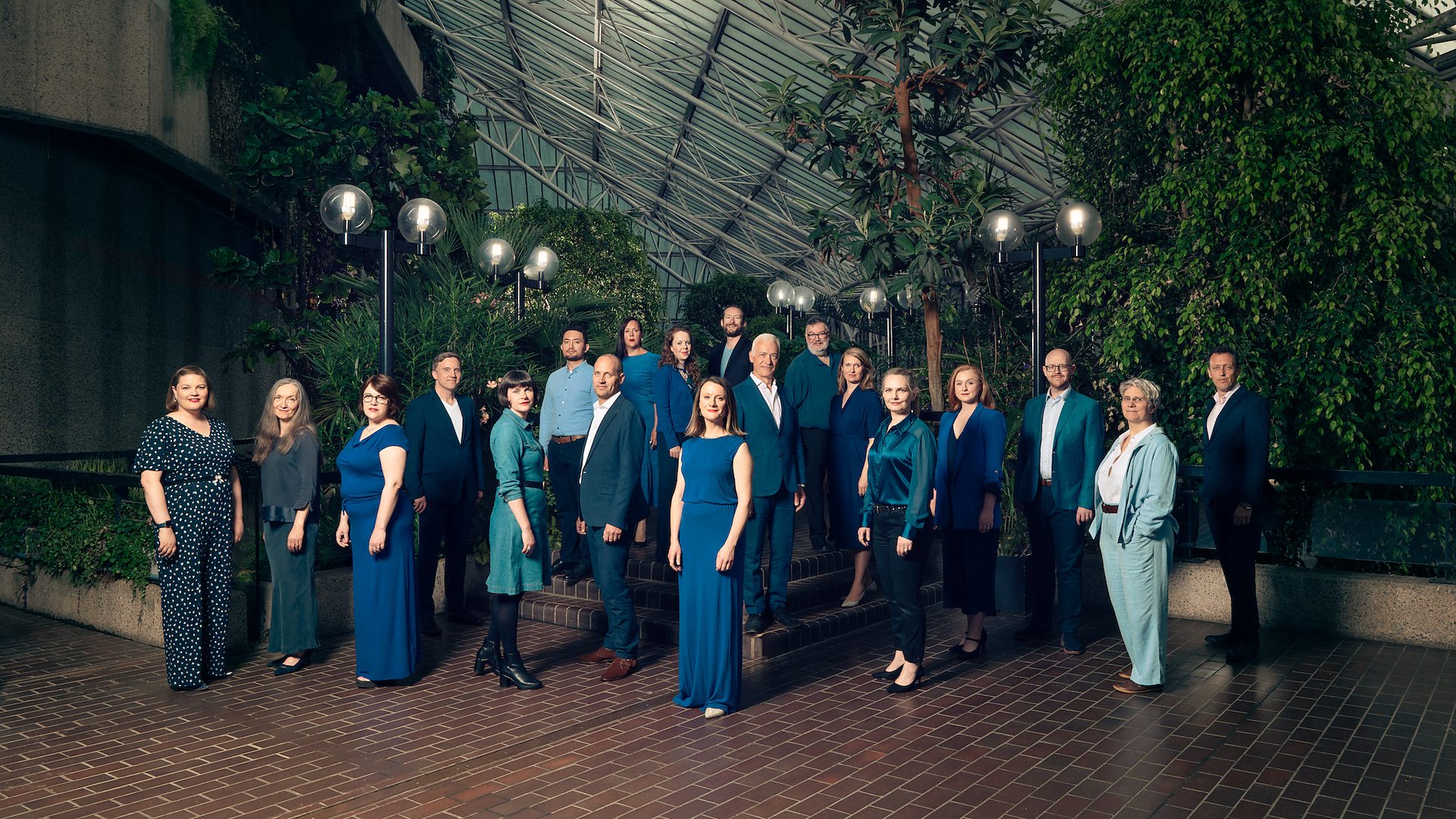
In concert – BBC Singers / Martyn Brabbins @ St Paul’s Knightsbridge – Holst, Britten, Garrard, Elgar & Pickard

BBC Singers, Elizabeth Bass (harp), Richard Pearce (piano), Andrew Barclay (percussion) / Martyn Brabbins

Holst Choral Hymns from the Rig Veda – Group 3, H90 (1910)
Britten The Ballad of Little Musgrave and Lady Barnard (1943)
Garrard Missa Brevis (2017-18)
Elgar Five Part-Songs from the Greek Anthology Op.45 (1902)
Pickard Elemental (2024-25) (BBC commission: World premiere)

St Paul’s, Knightsbridge, London
Friday 19 September 2025

Reviewed by Richard Whitehouse

The upsurge of interest in and performances by the BBC Singers in the wake of its intended demise shows little sign of abating, and there could be few vocal ensembles able to put on a programme as stylistically inclusive or as technically demanding as that heard this afternoon.

Nowhere more so than Elemental by John Pickard, its first performance occupying the second half. Never absent from the composer’s output, choral music came into own with the powerful Mass in Troubles Times (premiered nearby at St Peter’s, Eaton Square in 2019) and the present work can be heard as a continuation in terms of its underlying concept. A further collaboration with author and theologian Gavin D’Costa, its form is of a journey through the elements such as Pickard had favoured earlier in his output but here with its emphasis firmly on the spiritual arising out of human concerns. Whether individually or collectively, the writing for 18 voices could hardly be more varied and imaginative, while the obbligato roles for harp plus a single percussionist playing across the spectrum of instruments enhances these settings accordingly.

After the evocative Prologue with its Paracelsian take on living matter, Earth draws on the recollections of those in the Tham Luang Cave Rescue – notably teenagers of the Wild Boars football team – in music whose initial bravado gradually assumes a near metaphysical import. Fire integrates its Shakespeare quotations into consideration of this most transformative and cathartic of elements. Air centres on Bessie Coleman with her ambition, racially rather than personally motivated, to become the first professional pilot from African-American ancestry – her combative and ultimately ill-fated career depicted with often graphic immediacy. Water then illustrates the Biblical flood narrative from an oblique and even ambivalent perspective, before Epilogue returns to evocation of the numinous as it builds with a frisson of emotion.

Not that the first half was any mere preparation. Most intimate and alluring of four such sets, the third group of Holst’s Choral Hymns from the Rig Veda traverses the ethereal, the limpid, the hieratic then the questing in the company of female voices and harp. The former were no less attuned to the greater astringency of Sara Garrard’s Missa Brevis – its bracing inclusion of traditional Estonian music offset by the greater introspection elsewhere; these contrasted aspects finding at least a degree of release with the emotional immediacy of the Agnus Dei.

Heard in alternation, the male voices duly came into their own with Britten’s The Ballad of Little Musgrave and Lady Barnard – its folk melody (Matty Groves) stretched through this plangent wartime setting with piano of illicit love, innocent betrayal, desperate revenge and stark lament. Facets that barely feature in Elgar’s Five Part-Songs from the Greek Anthology yet these brief if characterful treatments of translations by Alma Strettell, no less typical than his major choral and orchestral works from this period, were dispatched here with due relish.

Whatever else, this showcase with substance was conducted with unfailing insight by Martyn Brabbins, whose prowess in choral repertoire needs hardly more reiterating than his advocacy of Pickard, and is absolutely worth hearing when broadcast by BBC Radio 3 this Wednesday.

You can hear the BBC Radio 3 broadcast on Wednesday 24 September by clicking here

For more information on the artists, click on the names: BBC Singers, Martyn Brabbins, Elizabeth Bass, Richard Pearce and Andrew Barclay, and composers John Pickard and Sara Garrard

Published post no.2,664 – Sunday 21 September 2025

On Record – Sarah Leonard, Xue Wei, BBCSO & BBCSSO / Martyn Brabbins – Naresh Sohal: Lila & Violin Concerto (Heritage Records)

Naresh Sohal
Lila (1996)
Violin Concerto (1986)

Sarah Leonard (soprano), BBC Symphony Orchestra / Martyn Brabbins (Lila)
Xue Wei (violin), BBC Scottish Symphony Orchestra / Martyn Brabbins (Violin Concerto)

Heritage HTGCD133 78’40”
Remastering Paul Arden-Taylor

Live performances at BBC Broadcasting House, Glasgow on 24th October 1992 (Violin Concerto); Royal Festival Hall, London on 13th October 1996 (Lila)

Reviewed by Richard Whitehouse

What’s the story?

Heritage follows up its earlier release of Naresh Sohal with this coupling of major orchestral works, both of them heard in their premiere performances.

What’s the music like?

By the 1990s, Sohal was a well-respected if not regularly played figure. Both these works demonstrate his compositional versatility while being wholly characteristic of his maturity. They were also written before and after his move from Edinburgh to London; having spent more than a decade in the Scottish capital, during which period he embarked on numerous multi-media pieces, he subsequently found himself drawn anew to the Punjabi and Bengali writers whose work frequently informed his compositions over the ensuing quarter-century.

Written a decade apart, these works could hardly be more different in their nominal concerns. At just under half an hour, the Violin Concerto may appear to be firmly within the lineage of such pieces from the Classical and early Romantic eras yet its three movements are hardly, if at all, beholden to precedent. That each is faster as to its underlying pulse than the one before, what one might loosely call an ‘Andante-Allegretto-Allegro’ progression, is less notable than the transformation of ideas and texture from one to the other; resulting in an overall sequence as convinces in its formal discipline and beguiles in its expressive immediacy. Its inhabiting a neo-Romantic world (with significant precursors by David Blake and H. K. Gruber) does not detract from the individuality and sheer attractiveness of Sohal’s contribution to this medium.

By contrast Lila, it title a Sanskrit term for the play of Nature, is the representation in music of the seven stages of development, in yogic philosophy, from the earthbound to the cosmic. That each of these can be linked to a specific colour, sound and elemental force might imply a multi-media presentation, and one as integrated music with dance and lighting was initially planned, but the work succeeds admirably on its own terms as it traverses seven continuous while increasingly shorter sections with its transformation of salient motifs never less than audible. There is no ultimate climax, yet the passing from ‘Consciousness’ to ‘Yoga’ could   be heard as a culmination; after which – this final section is graced with a soaring vocalise, here the late Sarah Leonard in what was a no doubt unintentional but appropriate memorial.

Does it all work?

Yes, once one has grasped the basis of Sohal’s compositional thinking via the essence of what   he was seeking to convey. It helps that both these performances are fully attuned to his idiom – Xue Wei evincing no indecision or uncertainty in the Violin Concerto, and Martyn Brabbins (who replaced an indisposed Andrew Davis for the first rendition of Lila) securing committed playing from the BBC Symphony and the BBC Scottish Symphony orchestras. Any future performances could hardly hope for more persuasive guides when approaching these pieces.

Is it recommended?

Very much so. Paul Arden-Taylor has once again done a fine job in remastering the original broadcasts while Suddhaseel Sen’s annotations, with a biographical note by Janet Swinney, provide all the relevant background. Further releases from this source will hopefully follow.

Listen / Buy

You can explore purchase options at the Heritage Records website

For more on the artists featured, click on the names to read more about Sarah Leonard, Xue Wei, the BBC Symphony Orchestra, BBC Scottish Symphony Orchestra and conductor Martyn Brabbins, and composer Naresh Sohal

Published post no.2,630 – Monday 18 August 2025

In concert – Peter Donohoe, RPO / Brabbins: Elgar ‘Enigma’ Variations; Bliss Piano Concerto; Vaughan Williams @ Cadogan Hall

Peter Donohoe (piano, above), Royal Philharmonic Orchestra / Martyn Brabbins (below)

Vaughan Williams Five Variants of Dives and Lazarus (1939)
Bliss Piano Concerto in B flat major Op.58 (1938-9)
Elgar Variations on an Original Theme Op.36 ‘Enigma’ (1898-9)

Cadogan Hall, London
Wednesday 16 April 2025

Reviewed by Richard Whitehouse Pictures (c) Andy Paradise

June 1939 saw one of the more memorable occasions for British music with several premieres at the World’s Fair of New York, this multi-day festival with its theme of ‘Building the World of Tomorrow’ thrown into ironic relief given the outbreak of war in Europe three months later.

The first half of tonight’s concert by the Royal Philharmonic Orchestra duly replicated that on June 10th, beginning with Five Variants of Dives and Lazarus which Vaughan Williams wrote for the event. One of the few non-symphonic orchestral works from his later years, its scoring for divided strings and harp gives a warmly evocative context to this succession of paraphrases whose steadily unforced evolution is rounded off by one of its composer’s most radiant codas. Various solo passages provided the RPO’s section-leaders with their moment in the spotlight.

That concert 85 years ago continued with the Piano Concerto that Arthur Bliss had written for Solomon which enjoyed frequent revival over the next quarter-century. This 50th anniversary of its composer’s death provided an ideal opportunity to reassess a work conceived within the late-Romantic lineage, notably an opening movement whose thunderous initial gestures set in motion this large-scale sonata design whose overt rhetoric is tempered by an expressive poise and more ambivalent asides which make it anything but the epigone of an already bygone era.

Among a few present-day pianists to have this piece in his repertoire, Peter Donohoe tackled its many technical challenges head-on; the RPO and Martyn Brabbins (who had never before conducted it) overcoming some occasional moments of mis-coordination so as to present it to best advantage. He brought a lighter touch and no little emotional poise to bear on the central Adagietto, its inwardness carried over into a finale whose probing introduction was a perfect foil to the bravura that followed. Whatever qualms Bliss may have had regarding the ‘world situation’, there was little sense of doubt as the music surged to its emphatic and affirmative close – thereby setting the seal on this memorable performance and a work which, whatever it lacks in distinctive invention, vindicates Bliss’s overall ambition to an impressive degree.

A pity that logistics (and economics!) made revival of Bax’s Seventh Symphony, which had originally featured in those New York concerts, impracticable but hearing Brabbins direct so perceptive an account of Elgar’s Enigma Variations was no hardship. Perhaps because of the immediacy of the Cadogan Hall acoustic, it was also one in which the relatively brief livelier variations came into their own – hence the unbridled impetus of the fourth (W.M.B), seventh (Troyte) or 11th (G.R.S) variations, though there was no lack of eloquence in the first (C.A.E) and fifth (R.P.A) variations, or suffused fervour in the ninth (Nimrod). The 10th (Dorabella) variation was made into an intermezzo halting if whimsical, and the 13th became a romanza such as opened out this work’s expressive remit onto an altogether more metaphysical plane.

Those having heard Brabbins conduct this work in the Royal Albert Hall quite likely missed that organ-reinforced opulence afforded the 14th (E.D.U) variation yet, as this finale built to its triumphal conclusion, the unfailing conviction of this performance could hardly be denied.

For details on their 2024-25 season, head to the Royal Philharmonic Orchestra website. Click on the artist names to read more about pianist Peter Donohoe and conductor Martyn Brabbins, and also to discover more on The Arthur Bliss Society

Published post no.2,509 – Monday 21 April 2025

On Record – Gavin Higgins: The Fairie Bride, Horn Concerto (Lyrita)

Gavin Higgins
Horn Concerto (2023)
Fanfare, Air and Flourishes (2021)
The Fairie Bride (2021)

Marta Fontanals-Simmons (mezzo-soprano), Roderick Williams (baritone), Ben Goldscheider (horn), Three Choirs Festival Chorus; BBC National Orchestra of Wales / Jaime Martin (Horn Concerto), Martyn Brabbins (The Fairie Bride)

Lyrita SRCD440 [84’14”] English/Welsh libretto included
Producer Adrian Farmer Engineer Andrew Smilie

Recorded in Hoddinott Hall, 11 January 2024 (Horn Concerto), Concert Hall, Wyastone Leys, Monmouth, 4 April 2024 (Fanfare, Air and Flourishes), live performance from Gloucester Cathedral on 23 July 2023 (The Fairie Bride)

Reviewed by Richard Whitehouse

What’s the story?

Lyrita adds to the already growing discography of Gavin Higgins (b.1983) with this release featuring two recent major works, both of which are heard in their first performances and thereby confirm this composer’s place among the leading British voices of his generation.

What’s the music like?

Listeners may have come across Higgins’s music via the release Ekstasis (see the link below), a collection of chamber pieces which attests to a distinctive and searching personality. Such is equally true of those here, not least the Horn Concerto that takes its place in a notable lineage of such works ‘in E flat’, while taking in Schumann and Ligeti as part of its range of stylistic or conceptual allusions. Its three movements have as their inspiration the Waldhorn – the first, Understorey, duly outlining an emergence from the (Wagnerian) depths to the forest floor in mounting waves of activity. There follow Overstorey with its airily expressive evocation of the forest canopy as builds considerable fervency over its course, then Myelium Rondo with its overtones of the hunt and energetic fanfares which propel this work to an affirmative close.

No stranger to the horn (being his own instrument), Higgins had indirectly prepared for this concerto with Fanfare, Air and Flourishes, a brief but eventful solo triptych which tries out several gestures or motifs to be developed in the larger work as well as in his second opera.

Commissioned by the Three Choirs Festival, The Faerie Bride takes a legend from the Book of Hergest for its synopsis of the coming together but eventual (its being inevitable) disunion between water spirit and earthly man. This is played out over seven scenes divided into two parts – Francesca Simon’s succinct yet artfully constructed libretto moving from their initial encounters at the lake, via the gradual dissolution of their relationship through events during each of the four seasons, to a climactic juncture when the woman returns with her extended family into the depths. Musically the work encompasses the range of Higgins’s idiom up to this point, its richness and variety of texture complemented by an instrumental clarity which ensures vocal audibility throughout – certain discrepancies between the libretto as published and as sung being immediately evident. That this opera keeps its emotions close to its chest much of the time only makes the closing stages the more powerful, not least in the way the ending reaches back to the beginning for a tangible sense of resolution borne of experience.

Does it all work?

Yes, in that Higgins is able to integrate his influences into a coherent and personal language. It helps that these performers are audibly attuned to this music – not least Marta Fontanels-Simmons as an otherworldly Woman and Roderick Williams as the uncomprehending Man – with Ben Goldscheider a consummate exponent of works for horn. The Three Choirs Festival Chorus characterizes the Villagers with suitable aggression, while Jaime Martin and Martyn Brabbins secure idiomatic playing of real finesse from the BBC National Orchestra of Wales.

Is it recommended?

Very much so. Those yet to do so should certainly acquire the earlier release on Nimbus, but the works featured here round out the potency of Higgins’s music accordingly. Detailed and informative notes by Gillian Moore, though watch out for those discrepancies in the libretto.

Listen & Buy

For purchase options, you can visit the Ulysees Arts website. For information on the performers, click on the names to read more about Ben Goldscheider, Marta Fontanals-Simmons, Roderick Williams, Jaime Martin, Martyn Brabbins and the BBC National Orchestra of Wales. Click to read more about composer Gavin Higgins and about Ekstasis

Published post no.2,465 – Thursday 6 March 2025

On Record – Tredegar Town Band / Ian Porterhouse, Martyn Brabbins – Holst at 150: A Brass Celebration (Doyen)

Gustav Holst
Suites for Military Band Op.28:
no.1 in E flat major (1909)
no.2 in F major (1911)
The Perfect Fool Op.39 (1918-22) – Ballet Music (all arr. Littlemore).
A Fugal Overture Op.40 no.1 (1922; arr. Wheeler)
Mr Shilkret’s Maggot (1932; arr. Hindmarsh)
A Moorside Suite (1928)
Imogen Holst
The Unfortunate Traveller (1929; ed. Hindmarsh)
Glory of the West (1969)

Tredegar Town Band / Ian Porthouse and Martyn Brabbins (A Moorside Suite)

Doyen DOYCD435 [74’37’’]
Producer Adam Goldsmith Engineer Daniel Lock
Recorded 18-19 May 2024 at Jack Williams VC Hall, The Works, Ebbw Vale

Reviewed by Richard Whitehouse

What’s the story?

The 150th anniversary of his birth, and 50th anniversary of his death, is an ideal opportunity to reassess the legacy of Holst in all its variety; not least with this anthology of his music for brass band that also finds space for her contribution to the medium by his daughter Imogen.

What’s the music like?

Typical and inimitable Holst – but, as he only wrote one work for the medium, much of this release consists of arrangements. The two Suites for Military Band were obvious candidates: the First Suite’s Chaconne emerges with renewed pathos, as too its whimsical Intermezzo or rumbustious March; no less idiomatic is the Second Suite with its recourse to traditional tunes in such as the effervescent initial March, then the final Fantasia with its memorable rendering of the Dargason. Philip Littlemore is an expert arranger here as of the Ballet Music from the opera The Perfect Fool – the sections that evoke ‘earth’ and fire’ lacking a degree of panache, but that of ‘water’ hardly less magical in this guise. Alastair Wheeler proves no less adept in capturing the impetus of A Fugal Overture, while Paul Hindmarsh gives what ought to be a new lease of life to the ‘jazz-band piece’ designated Mr Shilkret’s Maggot praised but never played by its commissioner. Imogen Holst’s 1967 orchestral arrangement as Capriccio rescued it from oblivion, but this new incarnation makes even more of its recalcitrant humour.

Mention of Imogen leads one to her pieces for brass band, both included here. Compact and characterful, her suite The Unfortunate Traveller was initially more successful as transcribed for strings, though Hindmarsh’s edition adds percussion and clarifies the brass texture as was doubtless intended. Its sure highlight is the winsome Interlude, conjuring a discreet though tangible profundity subsequently glimpsed with The Glory of the West – seven variations on said Morris Dance which confirms music written for amateurs need not involve compromise.

This just leaves A Moorside Suite, a work such as transformed the standing of test-pieces for brass band with that understated acuity surely unique to this composer. Whether in its gently satirical Scherzo, wistful Nocturne whose gradual building to a soulful culmination makes for the highlight of this collection, then a March which fuses energy and eloquence to round off the sequence with irresistible elan – this is Holst at his most engaging and communicative. Music, moreover, Martyn Brabbins clearly relished the chance to conduct for this recording.

Does it all work?

Absolutely, both in this piece and elsewhere, as long-standing music director Ian Porthouse puts the Tredegar Town Band exactingly and admirably through its collective paces. At the forefront of the modern brass-band movement, the latter is ideally placed to find this music an audience outside of its customary domain. That it succeeds is clear from the fact that one listens to this programme without thought of the medium or its context; rather, the emphasis is on those qualities of inspiration and substance as are hallmarks of any worthwhile music.

Is it recommended?

Indeed. Recorded with requisite clarity and definition, and featuring informative annotations by Hindmarsh and Littlemore, this is a significant release in Holst’s anniversary year and an evident first choice for acquiring a representative cross-section of his music in this medium.

Listen & Buy

You can listen to samples and explore purchase options on the World of Brass website Click on the names for more on conductors Ian Porthouse and Martyn Brabbins, the Tredegar Town Band, and for more on the composers Gustav Holst and daughter Imogen Holst

Published post no.2,307 – Friday 20 September 2024