Arcana at the Proms – Prom 53: Remembering Sir Andrew Davis

Stravinsky Symphony in Three Movements (1942-5)
Reich Jacob’s Ladder (2023) [BBC co-commission: UK premiere]
Tippett The Midsummer Marriage – Ritual Dances (1946-52)
Elgar Variations on an Original Theme ‘Enigma’ Op.36 (1898-9)

Synergy Vocals [Tara Bungard (soprano), Micaela Haslam (soprano/director), Will Wright, Ben Alden (tenors)], BBC Symphony Orchestra / Martyn Brabbins

Royal Albert Hall, London
Friday 30 August 2024

reviewed by Richard Whitehouse Photos (c) Andy Paradise

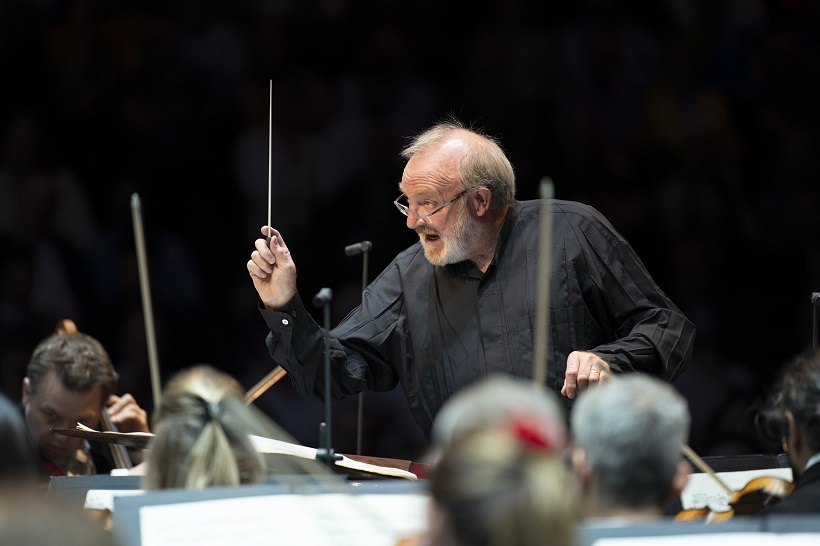
What should have been the 133rd concert that Sir Andrew Davis conducted at the Proms became a commemorative event after his untimely death in April but, with Martyn Brabbins presiding over a thoughtfully amended programme, the outcome could not have been more appropriate.

Proceeding unaltered, the first half began with Stravinsky’s Symphony in Three Movements in a performance redolent of Otto Klemperer in its deliberation if without that conductor’s heft – not least an opening movement whose rhythmic trenchancy felt a little dogged as it unfolded. Best was the Andante – its deadpan humour complemented by the beatific poise at its centre, then a transition of hushed expectancy to launch the finale. Here the closing build-up might have been more visceral, but the conclusiveness of that final chord could hardly be doubted.

Davis (above) was hardly known as proponent of Minimalism in general or Steve Reich in particular, thus his scheduling this first UK performance of the latter’s Jacob’s Ladder could be taken as significant. Playing just under 20 minutes, this is artfully structured as four short ‘expository’ sections followed by four longer ‘developmental’ ones. The former pitted its four vocalists – a telling number in this context of eight strings, six woodwind, two vibraphones and one piano – against an instrumental ensemble that took precedence in those latter sections; the final one brings them together in new-found accord. Dealing with scalic patterns in all their conceptual and metaphorical implications, the musical content typifies late Reich in ruminative elegance or subdued intensity which, if it offers no revelations, is yet satisfying in its stylistic deftness.

Schumann’s Second Symphony had been planned for a second half as now commenced with the Ritual Dances from Tippett’s The Midsummer Marriage – an opera, and composer, close to Davis’ heart. Unfailingly cohesive to the degree its series of elemental and seasonal dances interwove with their respective ‘transformations’ and ‘preparations’, this account was equally notable for its textural clarity even in those most contrapuntally intricate passages, along with a colouristic sense sustained up to the climactic return of its initial music for a magical envoi.

When Brabbins last conducted Elgar’s ‘Enigma’ Variations at the Proms, it was the final item in a 60th-birthday tribute that began with Pictured Within – a latter-day equivalent involving 14 different composers. Tonight’s account gave eloquent insight into what has become almost too familiar a work, evident from the outset in a ‘Theme’ of melting pathos. Highlights from those that followed included the soulfulness of ‘C.A.E.’, pensiveness of ‘R.P.A.’ or elegance of ‘Ysobel’ with its lilting viola from Sebastian Krunnies. ‘Nimrod’ started imperceptibly but built towards a nobly wrought apex, with the affectionate portrayed ‘Dorabella’ or searching evocation of ‘***(Romanza)’ no less affecting. The ‘E.D.U.’ finale moved confidently to an organ-clad peroration exuding what Elgar elsewhere termed a ‘‘massive hope for the future’’.

Just before this performance, Brabbins spoke for a capacity house in paying tribute to Davis with his dedication to music-making in the UK and beyond; something Sir Andrew brought to every one of his 132 appearances at the Proms, across 54 years of dedication to his cause.

You can get details about this year’s season at the BBC Proms website – and you can click on the names to read more about the BBC Symphony Orchestra, their conductor Martyn Brabbins, and an obituary of Sir Andrew Davis himself

Published post no.2,287 – Sunday 1 September 2024

On Record – Emma Tring, BBC NoW / Martyn Brabbins – John Pickard: Symphonies 2 & 6; Verlaine Songs (BIS)

John Pickard
Symphony no.2 (1985-87)
Symphony no.6 (2021)
Verlaine Songs (2019-20, orch. 2022)

Emma Tring (soprano), BBC National Orchestra of Wales / Martyn Brabbins

BIS 2721 [72’51’’] French text and English translation included

Producer Thore Brinkman Engineers Simon Smith, Mike Cox
Recorded 29-31 March 2023, Hoddinott Hall, Cardiff

Written by Richard Whitehouse

What’s the story?

BIS continues its coverage of John Pickard (b.1963) with a pertinent coupling of his Second and Sixth Symphonies, heard alongside his song-cycle to poems by Verlaine, in what is the most wide-ranging release – whether chronologically or stylistically – to date in this series.

What’s the music like?

It hardly seems 35 years since the Second Symphony blazed forth at its Manchester premiere, so establishing Pickard’s reputation. The composer had earlier studied with Louis Andriessen, to whose confrontational minimalism this piece is indebted in certain particulars – but, unlike other among his contemporaries who were so influenced, Pickard was alive to its symphonic potential. Unfolding over six continuous sections, the work builds via an intensifying process of tension and release to a seismic culmination as marks a seamless, even inevitable return to its start. Those familiar with that pioneering version by Odaline de la Martínez (on YouTube) will find this new one hardly less attentive to the visceral power of what, given its predecessor remains unheard, is a symphonic debut with few equals and one that urgently warrants revival.

Almost 35 years on and the Sixth Symphony offers a very different though no less involving perspective on what this genre might be. The first of its two movements channels a modified sonata design such that an almost whimsical opening has become brutalized well before the despairing close. Its successor refashions the expected continuity from an even more oblique vantage – the music heading eloquently if funereally toward a plangent climax that subsides into a delicate intermezzo, infused with the sound of nature, then on to a final section which recalls earlier ideas in a mood of rapt anticipation. Not that this understatement offers in any sense an easy way out: indeed, the work concludes with its composer poised at a crossroads as much existential as musical, and from where the whole creative process can begin afresh.

Separating two substantial statements of intent, the Verlaine Songs continues Pickard’s recent involvement with poetic texts and, while Paul Verlaine might seem far removed from Edward Thomas or Laurence Binyon, his evocations fanciful while sometimes unnerving – hence Le sqelette with its graphic aural imagery – finds the composer reciprocating in kind. Coming in between scorings with ensemble or violin and piano, this version with orchestra finds Pickard enriching a lineage of French song-cycles from Berlioz, via Ravel and Messiaen, to Dutilleux.

Does it all work?

It does, not least because Pickard is conscious of the need for his music to determine its own course. However dissimilar these symphonies might seem, the sensibility behind them is the same and any stylistic differences more apparent than real. It helps when Martyn Brabbins is a conductor familiar with this idiom as to inspire a committed response by the BBC National Orchestra of Wales, with Emma Tring alive to the manifest subtlety of the vocal writing, and the recordings consistently heard to advantage in the spacious immediacy of Hoddinott Hall.

Is it recommended?

Indeed, in the hope this series will be continued. Both the First and Third Symphonies await recording, as do Partita for strings and large-scale choral work Agamemnon’s Tomb, so that Pickard’s discography has a way to go even without addition of new pieces to his catalogue.

Listen

Buy / Further information

For purchase options and more information on this release, visit the BIS website. Click on the names for more on composer John Pickard, the BBC National Orchestra of Wales, conductor Martyn Brabbins and soprano Emma Tring

Arcana at the Proms – Prom 33: Christopher Maltman, BBC Symphony Orchestra / Martyn Brabbins – Elgar, Holst, Stanford & Vaughan Williams London Symphony

Elgar Overture ‘Cockaigne’ (In London Town) Op.40 (1901)
Holst Hammersmith (Prelude and Scherzo) Op.52 (1930)
Stanford Songs of Faith Op. 97 (1906): no.4 (To the Soul), no.5 (Tears), no.6 (Joy, ship-mate, joy); An Irish Idyll in Six Miniatures Op.72 (1901): no.2 (The Fairy Lough)
Vaughan Williams A London Symphony (Symphony no.2) (1912-13, rev. 1918-20)

Christopher Maltman (baritone), BBC Symphony Orchestra / Martyn Brabbins

Royal Albert Hall, London
Friday 9 August 2024, 6pm

reviewed by Richard Whitehouse

Concerts devoted to British music are by no means an unknown quantity at the Proms, but to have one as judiciously planned as that featuring Martyn Brabbins with the BBC Symphony Orchestra, on the conductor’s 65th birthday, was as unexpected as its realization ‘on the night’ proved consistently impressive.

Whether or not this account of Elgar’s Cockaigne ranked among the best of the previous 70 or so hearings at these concerts, it assuredly did the piece justice. Not its least attraction was Brabbins integrating this evocation of London on the cusp of Victorian and Edwardian eras with due perception of its ingenious sonata design, resulting in a reading as characterful as it was cohesive. Such as the emergence of the marching band at its centre and final peroration (Richard Pearce making his presence felt at the organ console) were the highpoints intended.

Whereas Elgar conveys London in its midst, Holst renders Hammersmith at a remove – his Prelude and Scherzo evoking those sights and sounds where the latter long made his home with a poise and precision no less involving for its objectivity. The orchestral version might be less often revived than its wind-band original but it yields little, if anything, in terms of expressive immediacy; not least with Brabbins mindful to underline how its two sections do not just succeed each other but are juxtaposed, even superimposed, prior to the rapt ending.

In the centenary of Stanford’s death, this selection of songs provided a welcome reminder of its composer’s prowess in the genre. The final three Songs of Faith denote an appreciation of Walt Whitman comparable to that of the next generation – whether in the eloquent musing of To the Soul, surging anguish of Tears or effervescence of Joy, shipmate, joy. Christopher Maltman then brought his burnished tone and clarity of diction to an affecting take on Moira O’Neill’s The Fairy Lough – proof Stanford could do ‘lightness of touch’ where necessary.

Whereas Stanford’s songs have barely featured here for almost a century, Vaughan Williams’s A London Symphony has accrued 36 performances, but what might be thought its ‘intermediate version’ had not been heard in nine decades. Actually, this is much closer formally to the final version of 1933 than the original – its main differences centring on those more extensive codas in the Lento and finale which, by aligning them more audibly with the introduction to the first movement, arguably ensures a more thematically close-knit trajectory across the work overall.

The performance was very much in accord with Brabbins’ recording (Hyperion). An unforced traversal of the opening Allegro, impetuous in its outer sections and affecting in that rapturous passage for solo strings at its centre, then a slow movement whose brooding introspection did not omit a sustained fervency at its climax. Nor did the Scherzo lack those ambivalent asides that find focus in its sombre close, while the nominally discursive finale built purposefully to a seismic culmination then an epilogue which drew solace from the aftermath of catastrophe.

‘‘The river passes – London passes – England passes’’. Whether the closing words from H.G. Wells’ Tono-Bungay determined or even influenced it, a sense of renewal was palpable as the music faded towards silence at the end of this persuasive performance and memorable concert.

For more on this year’s festival, visit the BBC Proms website – and to read more on the artists involved, click on the names: baritone Christopher Maltman, conductor Martyn Brabbins and the BBC Symphony Orchestra. Click on the name for more on The Stanford Society

Published post no.2,270 – Wednesday 14 August 2024

On Record – Helsinki Philharmonic Orchestra / Pekka Kuusisto; BBC Scottish SO / Martyn Brabbins – Jaakko Kuusisto: Symphony (BIS)

BBC Scottish Symphony Orchestra / Martyn Brabbins (Birthday Variations); Helsinki Philharmonic Orchestra / Pekka Kuusisto (Symphony)

Various Pictured Within: Birthday Variations for M.C.B. (2019)
Jaakko Kuusisto (comp. Pekka Kuusisto & Eskola) Symphony Op.39 (2020-21)

BIS 2747 [66’32”]
Producers Andrew Trinick (Variations), Robert Suff (Symphony) Engineers Graeme Taylor (Variations), Enno Mäemets (Symphony)
Live recordings, 13 August 2019 at Royal Albert Hall, London (Variations); 8 December 2022 at Music Centre, Helsinki

Reviewed by Richard Whitehouse

What’s the story?

The BIS label issues one of the most fascinating among recent releases, one that juxtaposes a latter-day equivalent to Elgar’s Enigma Variations with a posthumously completed symphony by one of Finland’s leading conductors which now becomes a tribute to his untimely passing.

What’s the music like?

It was clearly a great idea that the BBC commission a piece to mark Martyn Brabbins’s 60th birthday, featuring 14 composers with whom this stylistically most wide-ranging of current British conductors has been associated. The outcome is Pictured Within: Birthday Variations for M.C.B. – each composer having provided a variation on the ‘anonymous’ theme for what here becomes an inverse take on Elgarian procedure in the latter’s Variations on an Original Theme; a work whose ground-plan also furnishes the formal framework of the present piece.

It is worth considering the ways in which these composers seem either inhibited or liberated by their placing (determined beforehand by Brabbins) within the overall scheme. Given this theme – understated to a fault – yields its potential more from the harmonic then melodic or rhythmic angle, the most successful tend to make a virtue of such constraints: thus the ‘Tact 60’ of Variation I finds Dai Fujikura hinting guardedly at ‘C.A.E.’. David Sawer capriciously conjures ‘H.D.S-P.’, while Sally Beamish offers a deftly ironic parallel to ‘R.B.T’ and Colin Matthews rumbustiously complements ‘W.M.B.’ Iris ter Schiphorst captures the pensiveness if not the geniality of ‘R.P.A.’, whereas violist-turned-composer Brett Dean proves a natural fit for the undulating poise of ‘Ysobel’ and Win Henderickx evokes ‘Troyte’ with real gusto.

His ruminative Variation VII finds Richard Blackford emulating more the connection with a country house than ‘W.N.’, while Harrison Birtwistle throws caution to the wind in a darkly inward contrast to ‘Nimrod’, and ‘Sixty Salutations’ finds Judith Weir in an engaging take on the halting charms of ‘Dorabella’. Gavin Bryars rouses himself to unexpected activity in his reading of ‘G.R.S.’, whereas Kalevi Aho is more suited to the sombre eloquence of ‘B.G.N.’ and Anthony Payne ably plumbs the inherent mysteries of ‘***’. John Pickard then takes on the daunting challenge of ‘E.D.U.’ in The Art of Beginning – the mingling of portentousness and humour appearing to make light of its Longfellow association, but whose organ-capped apotheosis confirms real appreciation of the ‘right ending’ as constituting an art unto itself.

The coupling is as unexpected as it proves apposite. Remembered as a notable violinist and a versatile conductor, Jaakko Kuusisto (1974-2022) turned increasingly to composition and, at his untimely death through brain cancer, had planned a symphony for Osmo Vänskä and the Minnesota Orchestra. Acting on behalf of his widow, his younger brother Pekka and copyist Jari Eskola realized this piece from several minutes of extant fragments such that Kuusisto’s Symphony takes its place as the last statement by one who ostensibly had much more to give.

Playing just over 25 minutes, the work falls into two separate movements. Shorter and more outwardly cohesive, the first of these emerges as imperceptibly as it evanesces – taking in a tersely rhythmic central episode, then a warmly expressive melody with more than a hint of American post-Minimalism. Almost twice as long, the Lento seems more discursive but no less absorbing – picking up where its predecessor left off as it builds to impulsive climaxes, separated by an eloquent span derived from a chorale-like theme. Nothing, though, prepares one for the ending – a sequence of quietly interlocking ostinato patterns, evidently inspired by light signals beamed in the Gulf of Finland and underpinned by undulating timpani. The effect is haunting and unworldly but, for these very qualities, wholly fitting as a conclusion.

Does it all work?

Pretty much always. Those expecting an Elgarian ‘re-run’ may be disconcerted by Pictured Within, but this only serves to reinforce the stylistic autonomy and variety of the composers involved (three of whom sadly no longer with us) in what is a tribute to Brabbins’s acumen for involving them in the first instance. Quirky and compelling, the Kuusisto is appreciably more than a labour of love on behalf of those who brought about its completion: both works deserving revival for their intrinsic merits rather than commemorating a particular occasion.

Is it recommended?

Absolutely. These live performances (that of Pictures Within being that of the premiere) have come up well as presented here, while there are detailed notes on each piece by John Pickard and Jaani Länsiö. This fascinating release more than justifies itself musically and artistically.

Buy

For purchasing options, and to listen to audio clips, visit the Presto website. For more information on the artists, click on the names for more on Martyn Brabbins, Pekka Kuusisto, the BBC Scottish Symphony Orchestra and the Helsinki Philharmonic Orchestra For dedicated resources on the composer, you can visit a website dedicated to Jaakko Kuusisto

Published post no.2,265 – Friday 9 August 2024

On Record – BBC Symphony Orchestra / Martyn Brabbins, Sir Andrew Davis – Payne: Visions and Journeys (NMC)

BBC Symphony Orchestra / Martyn Brabbins, Sir Andrew Davis (Visions and Journeys)

Anthony Payne
Orchestral Variations: The Seeds Long Hidden (1992-4)
Half-Heard in the Stillness (1987)
Visions and Journeys (2002)

NMC D281 [62’15’’]
Producers Philip Tagney, Ann McKay (Visions and Journeys) Engineers Simon Hancock, Philip Burwell (Visions and Journeys)
Broadcast performances on 22 September 2006, Maida Vale Studios, London; live performance 9 August 2002 Royal Albert Hall, London (Visions and Journeys)

Reviewed by Richard Whitehouse

What’s the story?

NMC issues a tribute to Anthony Payne (1936-2021) featuring three of the most representative among his mature orchestral works and so makes for a viable overview, featuring an orchestra and conductors who between them gave numerous performances of his music in his lifetime.

What’s the music like?

Earliest here is Half-Heard in the Stillness, a short yet evocative tone poem making use of the Memorial Chimes which Elgar wrote for the Loughborough carillon in 1923. By this stage in his career, Payne had evolved an idiom that effortlessly but meaningfully elides between post -war Modernism and a late Romanticism (not necessarily British in derivation) such as gives his later output its tonal and expressive lustre. The outcome is ‘landscape’ music that intimates far more than it states, to an extent which the senior composer would surely have appreciated.

Most extensive of these pieces, The Seeds Long Hidden is a sequence of orchestral variations which outlines an autobiographical trajectory. Other than the opening gesture from Brahms’s First Symphony (a hearing of which in 1947 determined the course of Payne’s life thereafter), the works alluded to over the course of its 10 variations are not quoted directly but rather flit across the music and so inform the context from which the ‘theme’ variously emerges. While there is a constant and productive eddying between relative stasis and dynamism, moreover, the overall cumulative thrust seems one of clarification towards an emotional climax of self-realization which quickly recedes into the calm equivocation of the closing bars. If this is, as the composer states, a ‘musical autobiography’, it is an overtly self-effacing and oblique one.

As the first major work that Payne wrote in the aftermath of his realization of Elgar’s ‘Third Symphony’, Visions and Journeys is inevitably bound up with the re-establishing of his own idiom: a statement of intent to be pursued over what became the final phase of his creativity. Nominally inspired by frequent journeys he and his wife – the soprano Jane Manning – made to the Isles of Scilly, this is in no sense pictorial or illustrative in intent. That said, its overall follow-through from unforced anticipation, via understated fulfilment, to underlying regret could not otherwise have been made explicit; the degree to which this is transcended being both the music’s purpose and its primary fascination. A blueprint, indeed, for the select few works that were to come and which reinforced Payne’s standing as a composer of substance.

Does it all work?

Yes, as long as one approaches these works not as compromise between competing aesthetic tendencies but as their synthesis in music which is often eloquent and always appealing. The playing from the BBC Symphony Orchestra could hardly be bettered, with Martyn Brabbins and the late Sir Andrew Davis always committed in their advocacy. Occupying that amorphous middle-ground between the rarified and accessible, Payne’s music neither rejects nor courts popularity but the rewards are considerable for those willing to spend time in its company.

Is it recommended?

Indeed, in the hope a follow-up release which features Spirit’s Harvest (initially intended for inclusion here) and Payne’s culminative statement Of Land, Sea and Sky may yet be possible. The composer’s introductory notes explain everything while giving absolutely nothing away.

Listen & Buy

You can listen to sample tracks and purchase on the NMC website. For further information, click on the names for more on Martyn Brabbins, the BBC Symphony Orchestra and composer Anthony Payne

Published post no.2,218 – Sunday 23 June 2024