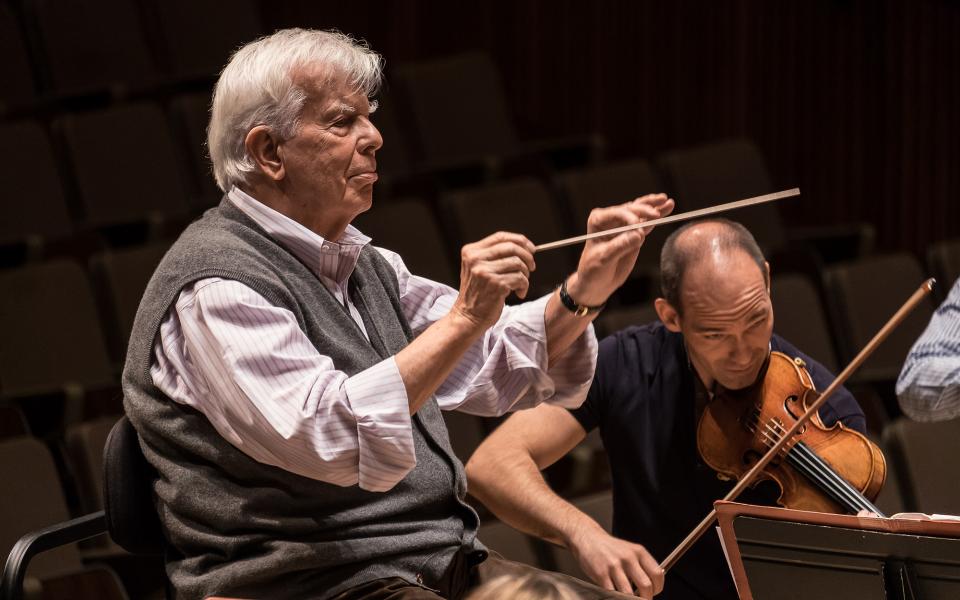
In the last week we learned of the sad news of the death of conductor Christoph von Dohnányi, at the age of 95.
You can read an obituary for him on the Guardian website, and tributes from each of the orchestras with which he had a special relationship – the Cleveland Orchestra, where he was chief conductor from 1984 until 2002, the Philharmonia Orchestra, where he was principal guest conductor, then principal conductor from 1997 to 2008, then honorary conductor for life – and the Vienna Philharmonic Orchestra, with whom he worked from 1966 to 2019.
Dohnányi’s prodigious discography, mostly recorded on the Decca Classics, Telarc and Signum Classics labels, is rich in opera and symphonic repertoire, but he also had a reputation for fine recordings of modern music, including colourful examinations of the worlds of Webern, Carl Ruggles and Lutosławski. These recordings, together with a special Cleveland account of Dvořák’s Symphony no.6, make up the playlist below:
Havergal Brian Symphony no.29 in E flat major (1967) Symphony no.30 in B flat minor (1967) Symphony no.31 (1968) Symphony no.32 in A flat major (1968)
Philharmonia Orchestra / Myer Fredman (nos.29 & 32), Sir Charles Mackerras (no.31), BBC Symphony Orchestra / Lionel Friend (no.30)
Heritage HTGCD130 73’20” Recorded 12 March 1979 (nos.29 & 32) and 16 March 1989 at Maida Vale Studio One, London (no.30), 9 January 1979 at Henry Wood Hall, London (no.31)
Reviewed by Richard Whitehouse
What’s the story?
The enterprising Heritage label continues its coverage of Havergal Brian with this volume featuring the last four of his 32 symphonies, three of them in pioneering studio broadcasts that were organized by Robert Simpson during his last years as music producer at the BBC.
What’s the music like?
The 29th Symphony is the culmination of a classicizing tendency Brian pursued throughout the 1960s, falling into four continuous if clearly demarcated sections whose formal poise is matched by their lucidity of expression. Thus, a ruminative Lento then genial Allegretto are balanced by the rumbustious though not unduly truculent Allegros either side but it is those framing Adagio sections, launching the piece before bringing it full circle in a mood of rapt contemplation, which leave the deepest impression and so set the seal on an eloquent work.
Barely four months later, the 30th Symphony inhabits a wholly different and fractious world. Likely drawing on material for an abandoned opera on Sophocles’ Oedipus Coloneus, its two continuous parts unfold from a restive, increasingly ominous Lento into the most disjunctive of Brian’s numerous Passacaglia movements; its inherent logic countered at every stage with a visceral and even assaultive impetus prior to the suitably implacable apotheosis. Definitely a work for all times, and among a select handful of orchestral masterpieces from this period.
Five months later and the 31st Symphony emerges as among its composer’s most enigmatic statements, abetted by its single movement being the most seamless of Brian’s symphonies and the one whose key-centre is most difficult to discern. Evolving almost intuitively from casual gestures, it builds with unsparing focus towards a climax whose dynamism is thrown into relief by the inevitability of those final bars. Easy to underestimate in context, it might be considered a rule-book for Brian’s late maturity did it not break those rules at every turn.
Completed six months later, the 32nd Symphony is the longest work here – pursuing a sustained evolution across its four movements divided into two parts. Its thoughtful while not untroubled Allegretto is followed by an Adagio of keen inner strength, its seriousness of purpose subtly offset by a leisurely, often capricious scherzo then finale whose contrapuntal ingenuity underpins the determined onward course to a coda defiant in its resignation. Brian was to finish no further works, so leaving this symphony to stand as an inimitable testament.
Does it all work?
Yes, once the essence, recalcitrant but never intractable, of Brian’s symphonism in this final creative decade is grasped. It helps when performances of the 29th and 32nd were entrusted to Myer Fredman, his appreciation of Brian’s music evident elsewhere in this Heritage series, and the 31st to Sir Charles Mackerras who made a fine studio recording eight years on. The 30th is heard in a reading by Lionel Friend far more assured than its premiere by Harry Newstone, but it was not until Martyn Brabbins’s 2010 studio account that this work came into its own.
Is it recommended?
It is. The sound of the older performances has been cleaned up and opened out, much to their advantage, and that of the 30th offsets the dryness of the Maida Vale acoustic. John Pickard’s insightful booklet notes are further incentive to acquiring this welcome and necessary release.
Rebecca Hardwick (soprano), Dame Sarah Connolly (mezzo-soprano), Michael Bell (tenor), Malachy Frame (baritone), Three Choirs Festival Chorus, Philharmonia Orchestra / Adrian Partington
Howells Paradise Rondel (1925) Bliss Mary of Magdala (1962) Howells Hymnus Paradisi (1936-38)
Hereford Cathedral Wednesday 30 July 2025
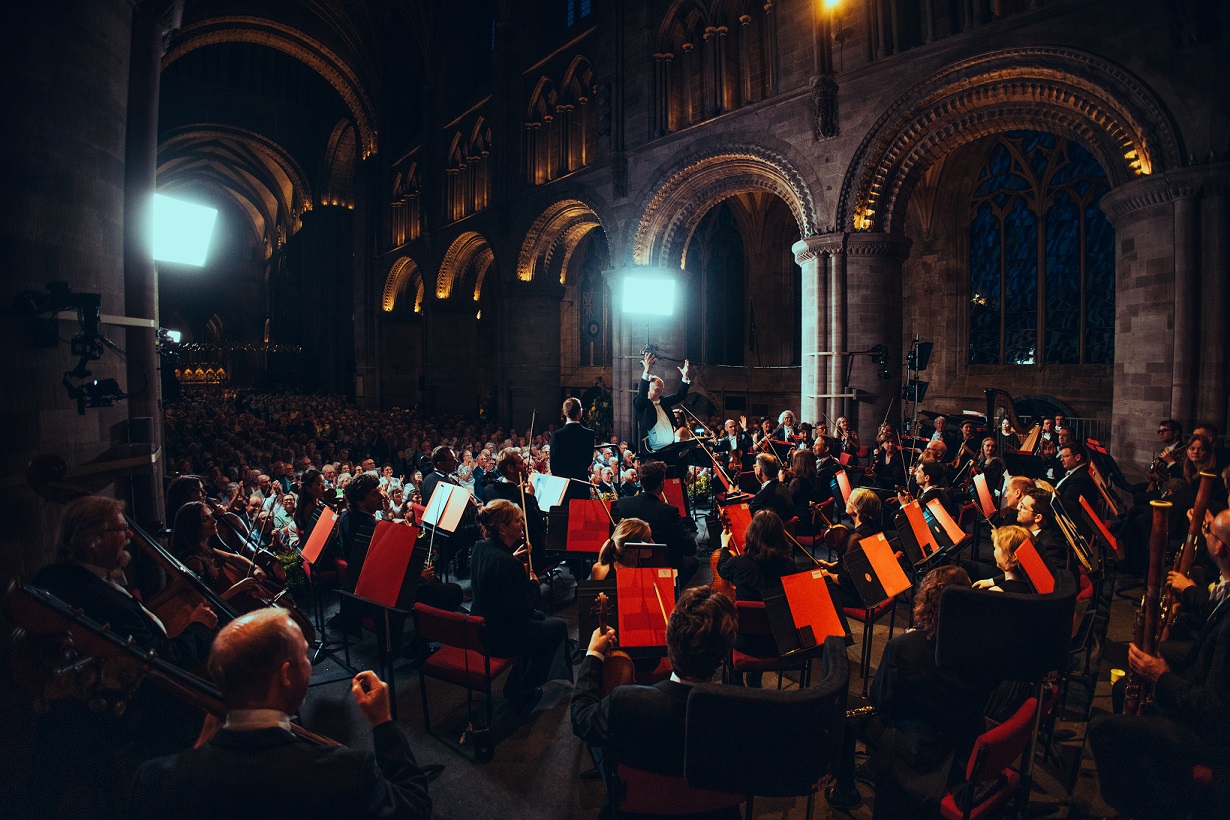
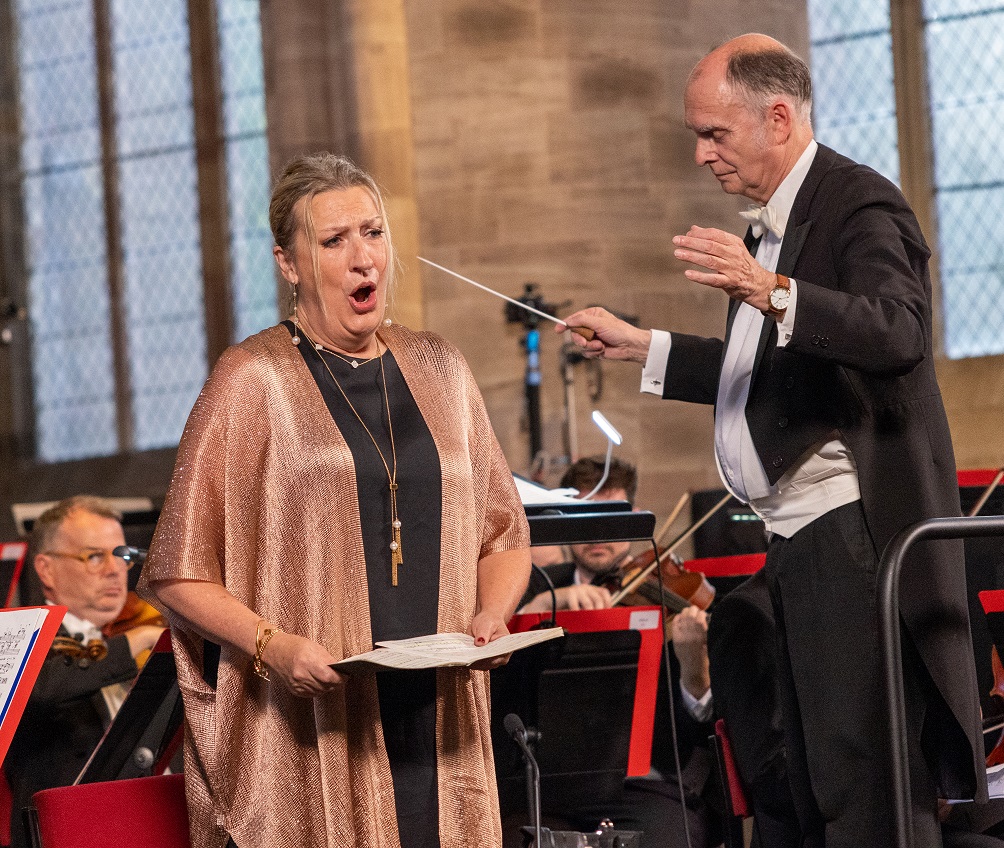
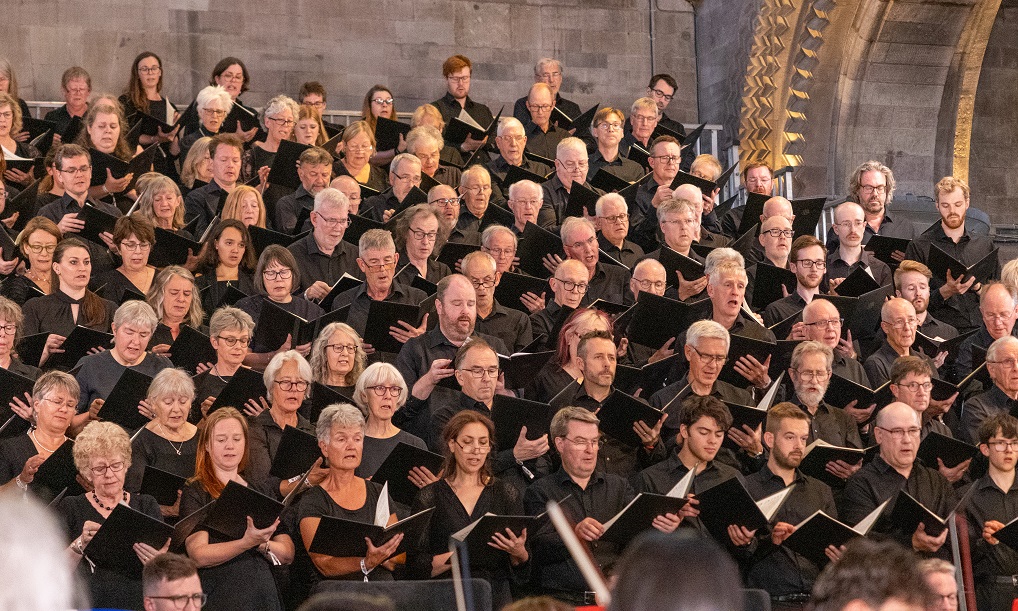
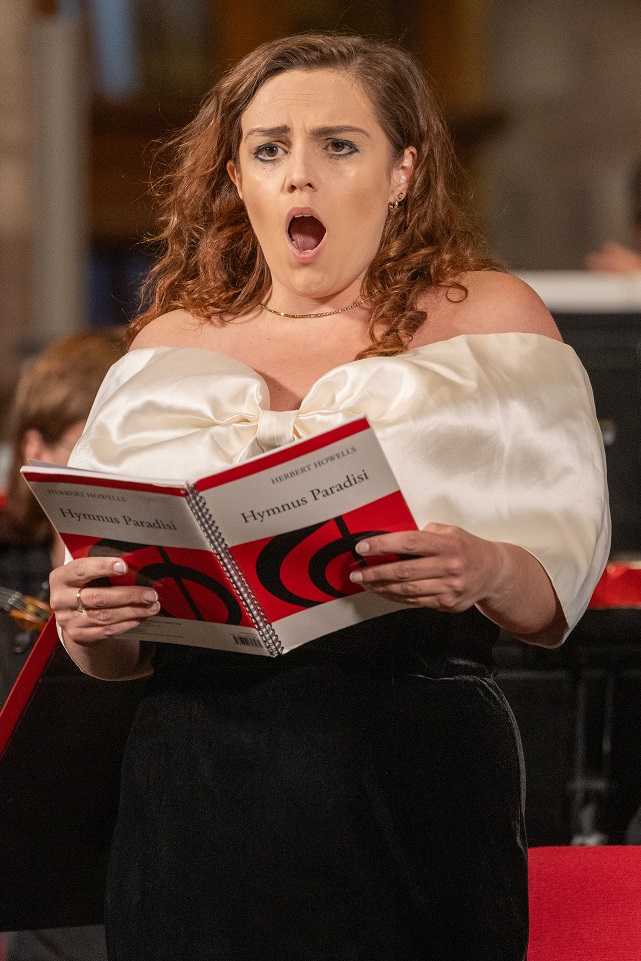
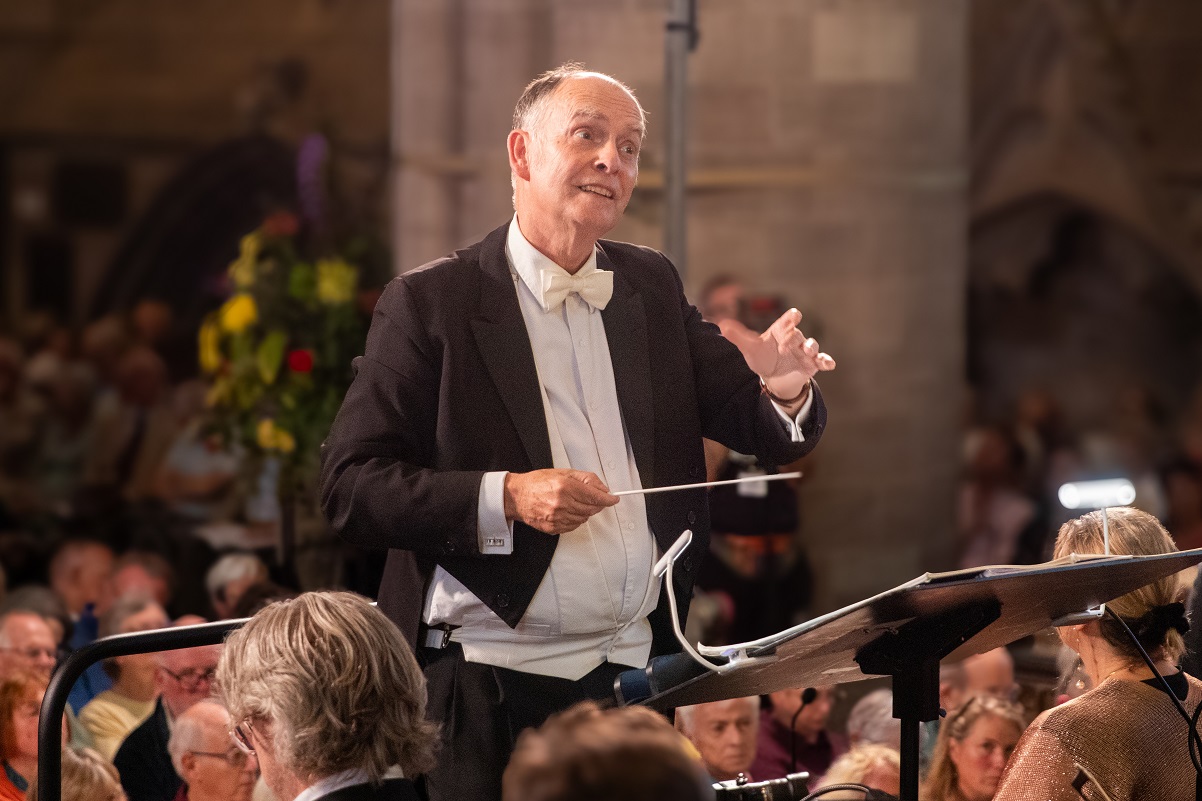
Reviewed by Richard Whitehouse Photos (c) Dale Hodgetts (Dame Sarah Connolly, Festival Chorus), James O’Driscoll (Hereford Cathedral, Rebecca Hardwick, Adrian Partington)
Interesting that all three works comprising this concert were premiered at the Three Choirs in Gloucester or Worcester but they were, for the most part, admirably suited to the less opulent while always spacious ambience of Hereford Cathedral in what was a welcome retrospective.
Upsurge of Arthur Bliss performances in this fiftieth anniversary of his death continued with Mary of Magdala, essentially a cantata albeit with an element of operatic scena in the intense characterization of its title-role. Compiled by Christopher Hassall (the last collaboration with Bliss before his untimely death), its text finds Mary approaching the sepulchre where Christ’s body has been placed after crucifixion only to find it gone – Christ having assumed the guise of a gardener who bestows his blessing upon this most maligned yet most loyal of his circle.
The main part was given by Dame Sarah Connolly (above) with her customary fervour and insight, not least in the final stages after recognition when the music exudes a radiant gentleness rarely, if ever, encountered in Bliss hitherto. Malachy Frame drew an understated strength from the brief yet crucial role of Christus, but excessively large choral numbers rather compromised the relative intimacy of the music. Not that it seriously undermined the conviction of a timely revival for what is one of the least known though inherently personal among the composer’s later works.
It stayed under-wraps for over a decade after completion, but Hymnus Paradisi has long been the best known of Herbert Howells’s larger pieces and something like a ‘sacred text’ in Three Choirs culture. Written after the death of the composer’s son, it is avowedly music within the English choral tradition; not least that Gerontius-like aura of a Preludio (actually written last) whose yearning theme pervades what follows. The Requiem aeternam further intensifies such introspection, and if a setting of Psalm 23 tends towards the discursive, even generalized, that of Psalm 121 has a rapture that builds on an effervescent Sanctus in what is the most arresting section. A ruminative setting from The Burial Service precedes the impulsiveness of that from Salisbury Diurnal, with the return of the Requiem aeternam bringing about a fatalistic repose.
Something of a staple at these festivals it might be, Hymnus Paradisi is never an easy work to sustain in performance and tonight’s was a notable though not unqualified success. The vocal parts were well taken, Rebecca Hardwick’s occasional shrillness ostensibly a price to be paid for surmounting those often dense choral textures and Michael Bell making up for in accuracy what he lacked in personality. The sizable orchestral forces of the Philharmonia proved more than equal to the task, not just of balancing but in opening-out the expressive power of choral writing where the Three Choirs Festival Chorus was wholly in its element. Adrian Partington secured an interpretive focus that gained in conviction as the performance unfolded, making for an account which underlined the strengths yet also the weaknesses of this singular work.
It was the earlier and uninhibited Howells which ushered in proceedings. With its translucent orchestration and, at times, almost concertante-like piano part, Paradise Rondel makes for as irresistible a curtain-raiser as it no doubt was evoking that Cotswold hamlet of a century ago.
Amy Carson (soprano), Harry Jacques (tenor), Christopher Purves (baritone), The Bach Choir, Philharmonia Orchestra / David Hill
Delius The Song Of The High Hills (1911) Blackford La Sagrada Familia Symphony (2022, world premiere) Walton Belshazzar’s Feast (1931)
Royal Festival Hall, London Thursday 8 May 2025
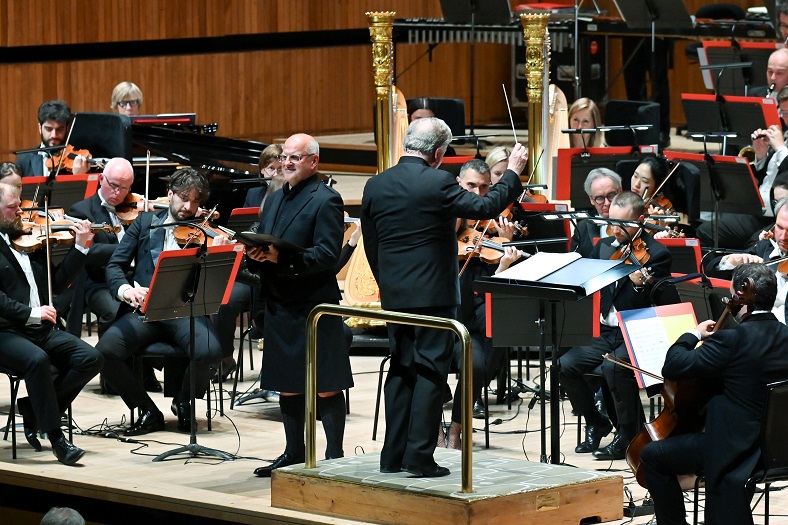
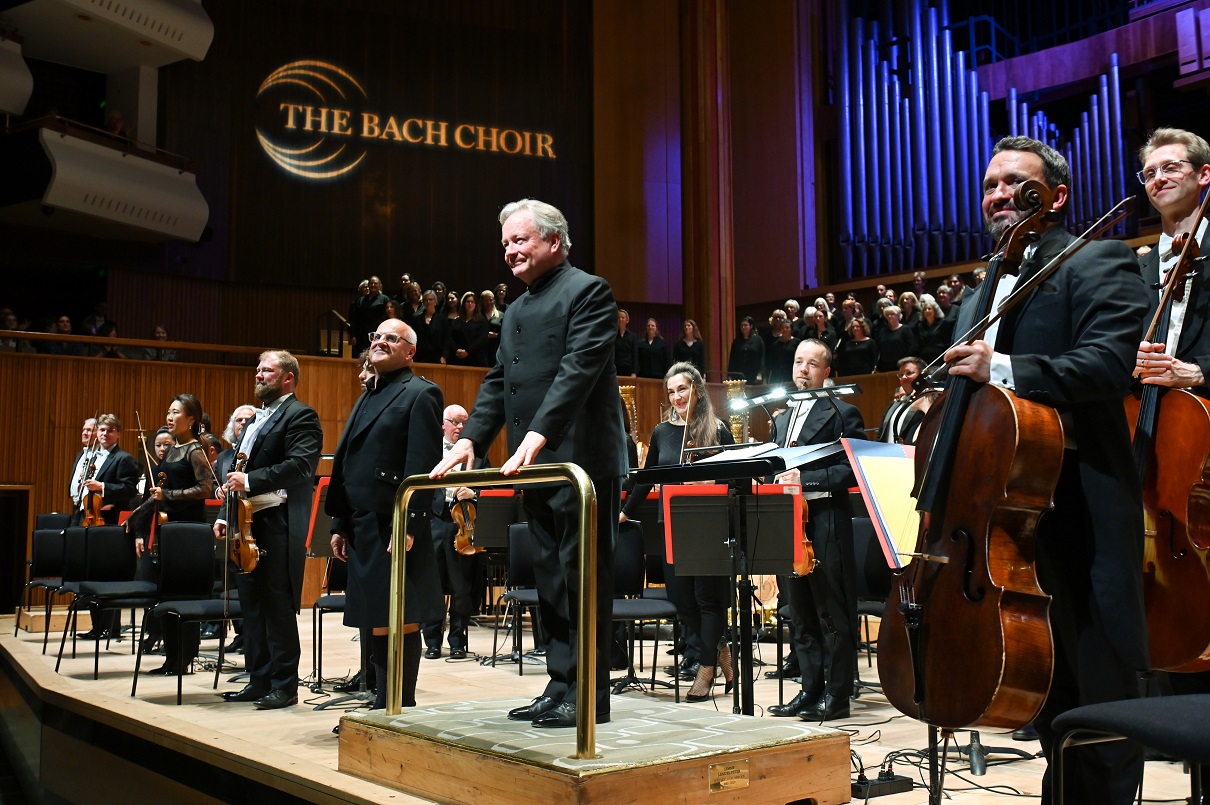
Reviewed by Ben Hogwood Pictures (c) Chris Christodoulou
This imaginative concert presented three British works telling stories from overseas, their reach extending to Norway, Spain and Babylon respectively.
Although born in Bradford, Frederick Delius spent much of his life abroad, living in America and then France – from where he would visit Norway for many a summer holiday with his wife. One such vacation in 1911 inspired him to write The Song Of The High Hills, a continuous sequence in three sections for wordless choir and orchestra capturing the mountain plateau, or ‘vidda’, that they found on their walks. Images from the plateau were shown on a screen behind the chorus as they performed.
Musically the work draws from Grieg and Debussy (his Nocturnes in especially) but inhabits a world all of its own, Delius achieving an unusual, rapt stillness when describing the high plains. David Hill, a long time exponent of his music, marshalled a strong performance, albeit one that didn’t quite sustain the rarefied atmosphere of the central section. It did cast quite a spell, mind, thanks to a beautiful oboe solo from Timothy Rundle on the approach, and some superbly controlled singing from The Bach Choir, headed by soloists Amy Carson (soprano) and Harry Jacques (tenor). The climax of the middle section was bolstered by three timpani, before the orchestra returned us to base camp. Speeds were on the fast side, but the Philharmonia Orchestra gave consistently luminous textures.
London-born composer Richard Blackford has shown considerable flair when writing for orchestra, and this was immediately evident in the world premiere of his La Sagrada Famila Symphony. Completed in 2022 and already recorded on the Lyrita label, it is a musical response to a 2019 encounter with Gaudí’s vision, concentrating on three great facades of the building – Nativity, Passion and Glory.
Blackford’s symphony was rich in colour but also vividly descriptive, his responses matched by an accompanying film, directed by the composer. Nativity began with awe-inspiring salvos from the brass but grew into a more intimate study, with elements of Hindemith and Berg in the orchestral writing, before a propulsive passage threw off the shackles. Passion was the emotional centrepiece, a vivid study in the brutality of the Good Friday story. Grotesque elements were emphasised by sudden closeups of Josep Maria Subirachs’s sculptures, their drawn expressions reflected in the music. The death of Christ was especially notable, marked by a solo of moving eloquence from cellist Martin Smith, then a sharp cry of dismay from Mark van de Wiel’s clarinet.
Glory was less obviously jubilant than might have been expected, mystical and reverent, but again it was an accurate response to the imagery as the film briefly went inside the massive structure. Blackford’s imagery danced in the listener’s mind on its own merits, with the thrilling surge at the end, bolstered by the organ, reminiscent of Messiaen or Scriabin. David Hill secured a fine performance from the Philharmonia, bringing the splendour of Gaudí’s cathedral to the concert hall. The emphatic finish brought with it a reminder of the building’s likely completion in 2026, a mere 144 years after construction began!
A British choral classic followed in the second half. Belshazzar’s Feast was initially denounced by Sir Thomas Beecham (a Delius fan, coincidentally) but Walton’s cantata has become a popular occasion piece. It is a vivid account of Babylonian decadence, before a human hand appears, writing on the wall of the banqueting hall to prophesy Belshazzar’s downfall. David Hill applied expert pacing to the storytelling, the Bach Choir on top form as the tension grew, spilling over into the exultant Praise Ye section. The paeans to the Babylonian Gods were starkly thrilling, contrasted by the terrifying unison shout of “Slain!” at Belshazzar’s death. The Philharmonia were superb, too, offstage brass bringing widescreen sound from either side of the stage and the percussion giving brilliant descriptions of the elements – iron and wood especially.
When the writing on the wall began, an ominous hush descended on the choir, the orchestra spreading a macabre chill through the hall – before the triumph of the closing pages, the Israelites free at last. Baritone Christopher Purves was a fine soloist, narrating the events and capturing the mood throughout. With 220+ in the choir, our ears were ringing long after the concert had finished, a timely reminder of a ruler whose inflated ego had brought about his downfall. Could there be any parallels in today’s world, I wonder?
Mao Fujita (piano), Philharmonia Orchestra / Osmo Vänskä
Missy Mazzoli These Worlds In Us (2006) Mozart Piano Concerto no.25 in C major K503 (1786) Mendelssohn Symphony no.5 in D minor Op.107, ‘Reformation’ (1830)
Royal Festival Hall, London Thursday 20 March 2025
Reviewed by Ben Hogwood Picture (c) Marc Gascoigne
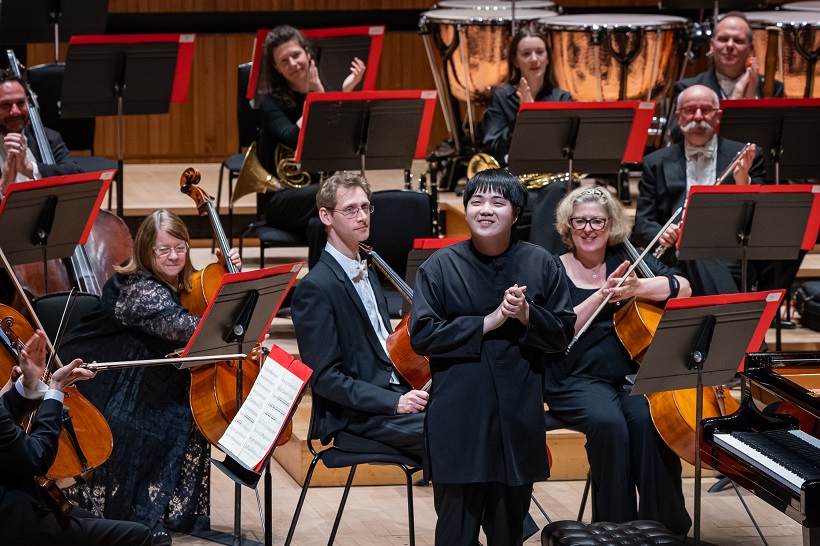
Japanese pianist Mao Fujita has shown his impressive Mozart credentials in highly praised recordings of the composer’s complete piano sonatas. More recently his focus has shifted to the piano concertos.
Here he was partnered by the Philharmonia Orchestra and the visiting Osmo Vänskä in the substantial Piano Concerto no.25 in C major K503, a ceremonial work with fulsome orchestral accompaniment. Yet less is often more in Mozart performance, and that was certainly the case with Fujita as his fingers spun a magical web of notes. The piano’s magical first entry, after the pomp and circumstance of the introduction, was notable for its lightness of touch, Fujita listening closely to the Philharmonia wind players.
With so much to enjoy in this performance, Fujita exuded technical brilliance but also commendable restraint, always with affectionate shaping of the melodic line. That is, until the unattributed first movement cadenza. Here the rulebook was torn asunder, and a flow of unpredictable counterpoint broke loose, revealing links back to Bach but notably forward towards Beethoven.
Back under control, Fujita made the piano sing in the operatic slow movement, aided again by the quality of the wind section under Vänskä, who secured typically detailed, transparent clarity. The first violins began the finale with their touch as light as a feather, after which Fujita put the pedal to the metal once again, taking great pleasure in Mozart’s sparky dialogue with the orchestra. His encore, the first movement of Mozart’s Piano Sonata in C major K545, featured a delightful ‘wrong’ chord near the end, affectionately given and rounding off a truly memorable performance.
Prior to this we heard Missy Mazzoli’s These Worlds In Us, dedicated to her father, who was a soldier in the Vietnam War. Her imaginative orchestration extended to the use of wheezy melodicas in the outer section, adding a dreaminess and heightening the link with the music of Bali. The sighing violin theme was profound, but most telling of all was the soft rat-a-tat of the snare drum, a quiet but ominous reminder of war amidst the otherwise bright scoring. Mazzoli’s music has deeply human qualities that came alive in this performance.
For the second half, Vänskä led a dramatic account of Mendelssohn’s Symphony no.5, the Reformation. Second in order of composition, it was the last of his symphonies to be properly published, on account of its troublesome reception in 1832. In more recent years however the work has enjoyed greater exposure, rewarding its portrayal of triumph in turbulent times.
The magical hush from the strings of the Dresden Amen, quoted by the composer in the first movement, drew the audience in before Vänskä powered through a turbulent Allegro. The second movement danced like a late Haydn minuet, brisk and with a charming trio, while the Andante looked inwards, initially beyond comfort but ultimately softening to the touch. Mendelssohn’s quotation of the Lutheran chorale Ein feste Burg came to the rescue, sweetly intoned by flautist Samuel Coles, before the orchestra enjoyed Mendelssohn’s exuberant finale, and its parallels to Handel’s Messiah. As is his wont, Vänskä revealed previously hidden orchestral detail, giving a fully convincing account of a symphony whose cumulative power is all the more remarkable given Mendelssohn was 21 at the time of composition. Youth and experience were ideal foils here.


 Arcana.fm