

For the latest in Arcana’s Ask The Audience series it’s a family interview, with Sam Hogwood (niece of the editor, above!) giving her verdict on the Scottish Chamber Orchestra’s varied Prom.
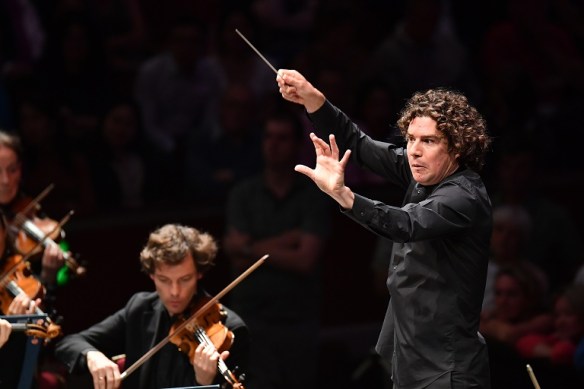
Prom 40: Christian Tetzlaff (violin), Scottish Chamber Orchestra / Robin Ticciati
Brahms Tragic Overture Op.81 (1880)
Berg Violin Concerto (1935)
Thomas Larcher Nocturne – Insomnia (first UK performance) (2008)
Schumann Symphony no.3 in E flat major Op.97, ‘Rhenish’ (1850)
You can listen to this Prom on the BBC iPlayer here
ARCANA: Sam, how would you describe your musical upbringing?
I guess I was privileged in the fact that I got to learn the flute. My earliest memories of music are dancing to my dad’s dance music, and then the radio – the top 40 and dance music with the odd rogue track thrown in – my first record that I ever bought was Donald, Where’s Your Trousers?! I remember buying that and being really pleased with myself! I also remember listening to Peter and the Wolf on my dad’s record player, and there were a few more classical pieces. There was one, a scary story that came with a book – Cranston Thorndike & The Dragon, by Terry Loughlin. We used to have that and play it quite a bit.
With people playing instruments it was you (me playing the cello – ed!) and also my aunt, Clare – I idolized her playing the flute so thought I should do that. When my brother Daniel was doing keyboards, and it turned out she was doing flute my mum and dad got me lessons. So it was a rich and varied upbringing!
Could you name three musical acts you love, and why you love them?
It’s tricky, I’m terrible with favourites! I would say the Foo Fighters, because of the energy they bring on to the stage. I think it’s the way Dave Grohl commands the crowd, no matter how many times you’ve seen them and wherever you’ve seen them it’s always immense.
I think Arcade Fire too, the first time I saw them was at Reading. To see how many of them there were on stage, and the variety of instruments they had – one of them would just suddenly whip out the hurdy gurdy! The fact a few of them would play three or four instruments, and go between them in songs – not even between songs – that’s just mad.
The third one would be The Killers I think. I’ve seen them quite a few times, and again it’s just a great show – because Brandon Flowers is such a great front man. He commands such energy, and demands it back from the crowd at the same time. It’s not just the band, he’s a show man.
How would your experience of the Proms compare with the live music you’ve seen?
I would say it’s more thought provoking, because of the silence. Even though you’ve got the music, there is an incredible amount of silence, whereas I would say that in concerts that aren’t classical there is such a din because of the crowd. That means you’re not necessarily appreciating the musicianship, whereas at the Proms, because there is such a silence, you’d pick up a wrong note or something out of time. There is a lot more pressure on it, and it commands a lot more with the lows and the highs, and it really gets you. There is also the element of deciphering the elements, whereas with pop concerts you are listening more as a whole.
What did you think of the first piece, the Brahms Tragic Overture?
I really enjoyed that. I think for some reason I hadn’t thought before how complementary the wind section is to the strings, and there were points where they were hitting the same notes where I couldn’t tell if it was the violins or the winds. They hit that same point, and then they separate so you can really hear the flutes, and their pitch. Something else I hadn’t really appreciated was with the vast number of strings, and how two flutes commanded as much impact with their melodies.
What did you think of the Berg Violin Concerto?
I enjoyed it. I thought it was interesting. I don’t know a lot about the orchestras, but I assumed the lead violinist, watching him – you could see why he needed to stand up, for space to express himself with the music. It was interesting, how it’s called a Violin Concerto but all the other instruments played throughout as well.
And what did you think of the new Thomas Larcher piece, Insomnia-Nocturne?
I thought about the idea of seeing colours in music that we talked about in the interval, but I thought for me it’s definitely emotion when I listen to music. I definitely thought in this piece a lot of it was very dark and anxious. It made you feel concerned, and it was heavy to the point that when it reached a dream state it was really quite a relief! When it’s that intense, linking back to film, you know why they use certain music in film. If you were to watch a horror film stripped of its music you wouldn’t think too much of it, but it’s the way the music is used that really gets you!
What was your verdict on the Schumann, after that?
It was lovely, and I’m really pleased they finished with that! It was like a magical fairy tale, and then the fourth section got quite dark and dangerous, and then it lightened off again. I thought some of the writing in the book, about the composer and their lives, was entertaining, but then it makes sense later on with what it said about Schumann.
Did you find the notes helpful, reading about the composer while the music is being played?
It’s interesting to read about the origins of the music, but I think it’s a side bit of information because with music you feel your own thing anyway. In the second piece, with the undercurrent about his mistress – you could put that out there but it’s like art, with a brush stroke on a page. The background to it almost becomes irrelevant to the art piece itself. You look at some art works and it tells you how evocative it is, but you look at it and think, ‘I’m not really getting that’ You see it for what it is. I went in the Tate Modern last month and saw the new exhibits, with fire bricks and spirit levels. I’m all for appreciating art but there are some pieces I don’t get, and even as an installation piece I don’t see what you’re telling me!
Thinking of the Proms, was there anything you particularly enjoyed?
The atmosphere; getting to appreciate classical music in a silent state. I don’t think I’ve ever been in a room with so many other people who have been quiet for such a long period of time for a specific reason. With everything else it’s like the more noise the better, everything gets turned up, but with this if you even cough people stare at you. The musicians are that well skilled that some of the music they play is so soft, and if you’re not silent you’re not going to hear it. Having listened to classical music on the radio and now in a room it was very different.
If you could change anything about the Proms, what would you do?
I’d have the performers sat on the back tiers. When we came to see Bring Me The Horizon with an orchestra here, they were sat on the back three tiers, up quite high. Even if you were on the floor you could see them, whereas this time you could only see them if you were on a level above. I appreciate some people have just come to listen and are not so bothered about the visual aspect, but from a technical point of view I would definitely prefer to see them, it gives the music that bit more.
Would you go to the Proms again?
Definitely!
Verdict: SUCCESS
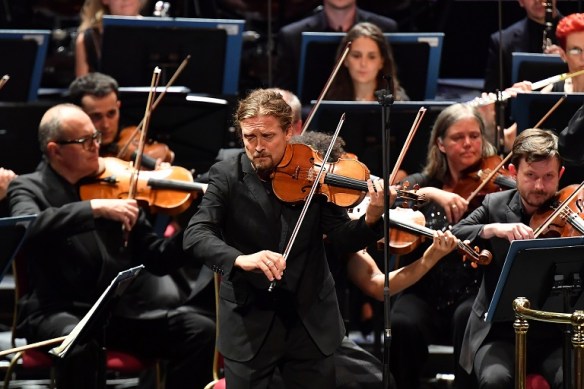 Berg’s Violin Concerto contains music of similarly ominous qualities, in this case uncannily heralding the composer’s final year despite its dedication elsewhere. Though the violin begins with elegiac tones it has a broad emotional range, and Christian Tetzlaff (above) rose magnificently to the occasion, finding Berg’s many and varied colours but crucially balancing them with the excellent orchestral contributions.

 The Germanic second half began in more restrained mood with Schumann’s Cello Concerto. Rarely performed for decades (and more often in the transcription for violin), this deceptively genial piece is among its composer’s most ingenious in terms of form and motivic continuity. Alban Gerhardt (above) maintained a determined while never merely inflexible course across its three continuous movements, the BBC Philharmonic providing support as attentive yet unobtrusive as the music required. Interesting to hear that the soloist thought the finale musically the least successful, as this emerged as arguably the most successful part – not least with its engaging dialogue kept on its toes and with no sense of dourness or grittiness as regarded the orchestral texture. Overall, a perceptive and convincing account of a work still too easily overlooked.
 Storgårds then rounded-off the programme with a taut and tensile reading of the symphony that Hindemith derived from his opera Mathis der Maler. This retelling of cultural meltdown and social antagonism during the Thirty Years War proved too ‘contemporary’ for the Nazi regime to stomach, and it was no surprise that the premiere of the complete opera took place in Zurich. Storgårds had the measure of the Angelic Concert with its austere chorales and angular though never impersonal polyphony. The Entombment of Christ was affecting for all its brevity, while the climactic Temptation of St Anthony built surely and impulsively from its stark introduction, through a central interlude of tangible pathos, to a culmination such as blazed forth in affirmation. All credit to Storgårds for ensuring so cathartic an impact.

 Davis himself is now 73, but still a sprightly figure who lovingly led his BBC Symphony Orchestra charges in a wide variety of English music, recreating the program given for Sargent’s 500th Prom in 1966. We ducked and dived through Berlioz, and his Le carnaval romain overture, before a glittering account of Schumann’s Piano Concerto from Beatrice Rana, herself in glittering green (above). Her quiet moments were especially profound, and she took charge of the more tempestuous passages of the outer movements with impressive control and expression. Balance is often a problem between piano and orchestra in the cavernous Royal Albert Hall acoustic, but here it was nicely achieved, and with phrases that were fleet of foot (and hand!) Rana showed why she is a highly coveted soloist.
 Holst’s ballet music for The Perfect Fool was treated to a delicately shaded performance, sonorous trombones underpinning a rewarding orchestral sound, with dances of great character. Meanwhile Delius gave us a sunkissed reverie, On Hearing the First Cuckoo in Spring, temporarily overriding the clouds outside.
 Arcana.fm