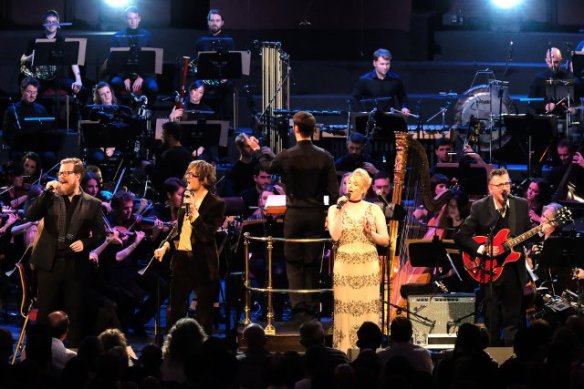
John Grant, Jarvis Cocker, Susanne Sundfør and Richard Hawley (all above), London Contemporary Voices, Heritage Orchestra / Jules Buckley
Walker, arr. Jules Buckley, Stefan Behrisch, Peter Riley and Tom Trapp Titles from Scott (1967), Scott 2 (1968), Scott 3, Scott 4 (1969) & Till the Band Comes In (1970)
Dick Hovenga and Simon Raymonde, creative directors
Royal Albert Hall, Tuesday 25 July 2017 (late night)
This late-night Prom highlighted the song-writing talent of Scott Walker from his late 1960s heyday. Less challenging while no less provocative than the music he has released this past two decades, it is a token of their composer’s fleeting stardom that few, if any, of these songs were played live when they were written; only to be consigned to vinyl limbo once Walker’s star waned and he abandoned live performance in 1978. Tonight’s programme saw a notable line-up of singers assembled to honour this legacy and maybe even give it a new lease of life.
The songs themselves were drawn from the four ‘numbered’ albums released during 1967-69, along with three tracks from Till the Band Comes In – the 1970 offering that Walker himself disowned but which he now seemingly recognizes as a worthy successor to what went before.
Although he has known Walker well since their collaboration on Pulp’s final album We Love Life in 2001, as a vocalist Jarvis Cocker is not best suited to the interpreting of songs whose technical demands brook no compromise. After the plangent orchestral strains of Prologue had died away, he struggled with the ethereal Boy Child (its fusing of music and expression the most perfect of Walker’s song in this period), then under-projected the surreal and ominous imagery of Plastic Palace People. Nor was he a natural choice for the bittersweet poise of The War is Over (probably the most obscure of all these hidden gems), despite rendering it with telling sotto voce understatement, though the breezy litany of chaos and disaster which informs Little Things That Keep Us Together allowed his innately ironic delivery free rein.
There could be no doubt, even so, that John Grant is infinitely more attuned to this music, and so it proved as he brought out the wrenching pathos of Rosemary, then the pert confessional of The World’s Strongest Man. No less telling was the capricious whimsy of Copenhagen or propulsive drama of the Ingmar Bergman-inspired The Seventh Seal; this latter number benefiting from a starkly fatalistic tone such as the 24-year-old Walker could not summon back in the day. A whole album of these ‘covers’ from Grant would be more then welcome.
As also would be one from Icelandic singer Susanne Sundfør (above), whose often brittle yet always focussed delivery teased out the deadpan humour from On Your Own Again then stripped Angels of Ashes of undue preciousness. Best of all was the edgy irony she brought to The Amorous Humphrey Plugg, another highpoint of Walker’s song-writing, while Hero of the War aligned anger and compassion to a telling degree. A slight pity that Long About Now, Walker’s one number intended for a female vocalist, was not featured. Maybe another time?
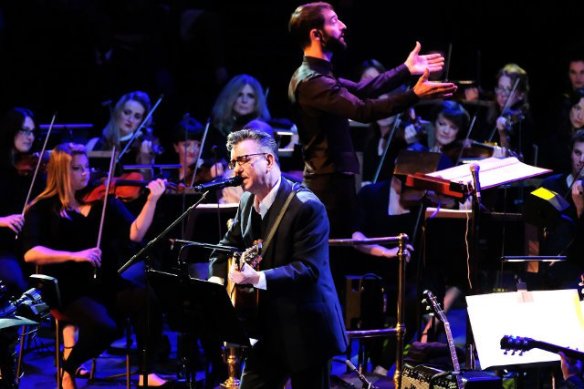
A fine guitarist and distinctive crooner, Richard Hawley proved as attentive to the tangible atmospherics of It’s Raining Today as to the warm evocation (so easy to sentimentalize) of Two Ragged Soldiers. Neither was there any dilution of that yearning for domestic bliss in Montague Terrace (in Blue) or sardonic humour in The Old Man’s Back Again (Dedicated to the Neo-Stalinist Regime) – a song which underlines Walker’s awareness of the political realities during this period, as has surfaced more obliquely in much of his more recent music.
Throughout this 90-minute sequence, Jules Buckley secured vivid and attentive playing from the Heritage Orchestra, while London Contemporary Voices made the most of some brief yet pertinent contributions. They, together with all four of tonight’s singers, united for a rousing Get Behind Me – a surprisingly funky number in context – to end this impressive showcase. Hawley remarked to the audience that such an event might never happen again, though one cannot help feeling Walker’s 1960s output could now be up and running – not before time!
Firmly established at the Proms during this past decade through his high-profile musical and film programmes, John Wilson has enjoyed relatively little exposure in terms of the classical repertoire for which he evidently feels great affinity. His recent appointment as the Associate Guest Conductor of the BBC Scottish Symphony Orchestra should hopefully rectify this, and this early-evening concert cannily juxtaposed what has long been regarded as Vaughan Williams’s most recalcitrant (and underrated) symphony with what will always be Holst’s most popular work.
As dense in texture as it is ambiguous in content, Vaughan Williams’s Ninth Symphony has enjoyed limited advocacy (it went un-played at these concerts for almost three decades after 1960), though it has latterly enjoyed something of a return to favour and one anticipated that Wilson would have its measure. What resulted was something of a curate’s egg in terms of interpretation, not least in an opening movement whose Moderato maestoso marking was scarcely evident – Wilson favouring a fluid approach as emphasized this music’s ominous import while leaving the (often shaky) orchestral ensemble to fend for itself. Better in this respect was the second movement, its sombre and Hardy-inspired imagery made tangible through haunting flugelhorn solos and the baleful music that intervenes at crucial moments.
Neither was the militaristic scherzo wanting in impetus, though here Wilson’s preference for deftly sprung rhythms and relatively transparent textures served to rob this music of its sheer malevolence. Much the hardest movement to bring off, the lengthy finale emerged surely and methodically – its polyphonic weave rendered with a clarity that not even the expanse of the Albert Hall acoustic could deny – to an apotheosis more telling for its tangible equivocation. Whether those blazing E major chords convey affirmation or resignation is open to question.
The Planets has, of course, never looked back over the near-century since it first astounded a public confronted with the terrors of mechanized war. Perhaps one should not be surprised that Wilson was at pains to play down its cinematic quality (hardly something of which Holst could have been aware in any case) – his vehement take on Mars proceeding an eloquent if slightly cloying Venus; itself followed by an almost dance-like Mercury and an incisive Jupiter at its best in a trio section that managed to eschew almost all trace of false solemnity
By contrast, Saturn succeeded better in its listless opening and radiant closing sections than in the anguished music at its centre; Wilson’s preference for measured tempi continuing into an unusually steady Uranus marked by deadpan humour and the spectacularly OTT organ glissando at its climax. The enigmatic Neptune was almost as successful, its disembodied textures securely rendered by the BBCSSO, though a lack of integration with the wordless voices in its latter stages meant that the close felt less ‘other-worldly’ than it needed to be.
Overall, a promising showing for what ought to develop into a productive and worthwhile association. Wilson palpably has much to contribute in this repertoire, and what technical flaws there were only intermittently undercut the qualities of these probing performances.
Richard Whitehouse (photos (c) Chris Christodoulou
Last year Arcana went on a charm offensive, introducing friends to the BBC Proms, some for the first time. For the 2017 season we will continue to bring the festival to people in this way, discovering fascinating musical facts and insights as we go. For our first visit we chose the concert commemorating Sir Malcolm Sargent, one-time conductor of the Proms in the 1960s. The program replicated his 500th Prom, given in 1966 – and to offer an appraisal we invited Rob Chung (above)
Rob is DJ Chug, a drum ‘n’ bass DJ who runs his own Elements night in East London, and he has releases forthcoming this summer on Soul Deep and Co-Lab Recordings. Yet, as he revealed to Arcana, he has a classical past.
Beatrice Rana (piano), BBC Symphony Orchestra / Sir Andrew Davis
arr. Sir Henry Wood The National Anthem; Berlioz Le carnaval romain Overture, Op.9 (1844); Schumann Piano Concerto in A-minor, Op.54 (1845); Elgar Cockaigne (In London Town) Op.40 (1900-01); Walton Façade – Suite No.1; Popular Song (1922-28); Holst The Perfect Fool – Ballet Music (1918-22); Delius On Hearing the First Cuckoo in Spring (1912); Britten Variations and Fugue on a Theme of Purcell (The Young Person’s Guide to the Orchestra), Op.34 (1945)
You can listen to this Prom on the BBC iPlayer here
Arcana: Rob, what was your musical upbringing?
It was quite an extensive one – mainly from my sisters, when I was little. They would have anything from Duran Duran to Wham!, the big pop hits of the 1980s. My parents had a bit of Motown on vinyl, then as my sisters got older the influence came into early ‘80s R&B, swing, hip hop, De La Soul, Public Enemy, a lot of gangster rap – and then some jazz – Courtney Pine, Julian Joseph. And then it was on to drum ‘n’ bass, to Goldie and 4Hero, that kind of stuff. So that was the influence from my sisters, and then because there wasn’t any local radio in East Anglia – it was just Radio 1 or nothing, no pirate radio – I used to listen to a lot of dance DJs in the evening, such as Dave Pearce, Danny Rampling and Tim Westwood. I used to record Tim Westwood’s shows every Saturday, and fell in love with hip hop basically!
My sister came to university in London, and used to record all the drum ‘n’ bass in London, off the pirate radio stations, and she used to send me the tapes back. From there I learned what was going on in London. Then at about 15 or 16 there was a new pirate station in Norwich, of all places, called Flight FM, so I used to listen to that all the time. A lot of local DJs were playing garage and drum ‘n’ bass, and that’s when I discovered UK garage, and bought my first set of decks. I was buying anything and everything – house music, hip hop, drum ‘n’ bass, and it all went from there.
At the same time I played the piano and violin as a kid, at school. I played the violin from six years old to 18, and I was in an orchestra – I got to grade seven. I was in an orchestra at school, we used to play in the chapel and the cathedral, which you take for granted now. I have this recurring nightmare about playing on the second desk of the violins, losing my place and trying to pretend I was playing for the next hour or so. It still haunts me to this day, and I still bring it up with my school mate whenever I see him!
Have you had any other classical music experiences beyond orchestra?
Not really. I used to go to the odd concert with my parents, at Christmas carol time, otherwise not really. Not since school days.
Could you name three musical acts you love, and why you love them?
Currently, Robert Glasper – a great jazz pianist, fusing hip hop, R&B and jazz, three forms I really like. He’s an amazing musician and great live. I’ve seen him about five times now, he blows me away every time.
Stevie Wonder I think is the greatest musician I’ve ever seen. I’ve seen him at Glastonbury, and at Hyde Park last year. He’s got an amazing repertoire, great albums and a great voice. He plays any instrument amazingly well, he just blows me away.
For the third one…a drum ‘n’ bass producer called Serum, who is absolutely smashing it on the drum ‘n’ bass scene at the moment. He covers all styles, has in your face, stupid jump up tunes. Anything he releases at the moment I would listen to it and probably buy it.
How did you rate your first Proms experience?
I would give it 10/10, it was awesome – amazing. Everything about it, the experience, the sound, the crowd, the quality of the orchestra, the conductor – it was a really good experience. I forgot what it was like to be at a concert but the stereo width of the sound blew me away, following the music. I was really impressed with it, and it was the Royal Albert Hall of course. The sound was crystal clear, not loud but you could hear every single thing. It was really impressive.
What was your favourite piece?
I haven’t actually decided on that yet…probably the Elgar piece…or the Schumann, with the piano. I’ll go for that one, I liked the call and response between her (Beatrice Rana) and the orchestra, with the clarinet and the cellos, going back and forth. I really enjoyed that and she was pretty special. It took you all over the place but she was the focal point as well.
You mentioned how you knew it was Elgar during the piece.
Yeah, I don’t know why – and the same with Britten as well. It feels like an English tune, I don’t know what it is. They always used to play Nimrod at the end of every year at our school, and I think it was the harmonics or the chord progression, as soon as they started playing – and how the strings come in and out, with a slow attack.
What was your least favourite?
I think it was The Perfect Fool. I got a bit lost, and couldn’t keep up with what was going on. That was the intention, right?! I couldn’t really follow it. I liked the Walton piece though, it was a bit of fun in the middle, and the fact you could get a crowd laughing at a random ending, that was pretty special. That was where the percussion came out and were really getting into their element.
What did you think of the Delius piece, On hearing the first cuckoo in spring?
I quite liked that, again – spring, the strings coming in, it was a nice, short, to the point piece.
Do you think in terms of the length of the pieces some was too long?
It’s hard to keep up for that length of time. Some of the Schumann I struggled with a bit at the end, but at the same time in the Walton when it was short and sweet I sometimes felt it was too short, a little poem rather than a chapter. It was a nice change, a bit like listening to a Disney score.
It can be quite mentally tiring trying to take all of the music in, you start wandering. But I was comparing tonight to when I saw James Blake play at Shepherd’s Bush, and it was a sensory overload with all the lights and everything, there was a lot to take in. it was like that tonight, with lots of different things going on and trying to keep up – it was a good workout for the brain.
I thought it was also interesting how someone in the orchestra can have just one small part in 30 minutes, but when you come in you can’t miss a place. The Elgar piece I felt a lot of tension building, the Walton piece – I forget you can have things in triple time. These days everything I listen to is in four!
What did you think of the concert as an experience?
It was a lot more informal than I was expecting. I enjoyed the laid back atmosphere, it seems very open – which is not what I expected at all. We had people reading their books, people lying down, a guy reading along to the music which I thought was quite cool. I liked the crowd involvement – not a lot but traditional, it was really nice. The National Anthem at the start threw me a bit (and me! – ed) but at the same time it is nice to do these things, it doesn’t happen very often.
The acoustics vary differently where you are, it’s interesting to compare down in the Arena with up in the gods. I would be interested in how they mic everything up and do the soundchecks. There is the depth of sound as well, you really feel the depth with the violins to the tuba. I liked how the organ just snuck in during the Elgar too. Nobody was out of sync, either! I was trying to spot someone…but not gonna happen!
What we said about the conductor, how much control he has over everything – I was impressed with that, how he sped it up, slowed it down and brought people in. I forget how much hard work that must be. You’ve got to know the pieces inside out, and it was very impressive.
Was there anything you would change about how the concert was staged or presented?
Not really. I guess I’m used to having members of the band introduced, pointing out a certain lead – but I guess that’s done in the programme notes. I don’t think I would change anything.
Beatrice Rana, BBC Symphony Orchestra, Sir Andrew Davis
arr. Sir Henry Wood The National Anthem
Berlioz Le carnaval romain Overture, Op.9 (1844)
Schumann Piano Concerto in A-minor, Op.54 (1845)
Elgar Cockaigne (In London Town) Op.40 (1900-01)
Walton Façade – Suite No.1; Popular Song (1922-28)
Holst The Perfect Fool – Ballet Music (1918-22)
Delius On Hearing the First Cuckoo in Spring (1912)
Britten Variations and Fugue on a Theme of Purcell (The Young Person’s Guide to the Orchestra), Op.34 (1945)
Royal Albert Hall, Monday 24 July 2017
Sir Malcolm Sargent holds a prominent place in Proms history, especially so for those Prom goers of an older vintage. It was therefore only right that in the 50th year since his passing there was a concert commemorating one of English classical music’s favourite sons. Sargent lived in a flat opposite the Royal Albert Hall, a blue plaque marking this clearly visible from Door 4 of the auditorium.
Calling Sargent a ‘favourite son’ is a statement that needs to be qualified, for not everybody held him in such high esteem. For orchestral players he could be anything but, being a hard taskmaster, but he was hugely popular with Proms audiences, boosting the profile of the festival and the Last Night in particular, to an art form fit for television. As tonight’s conductor Sir Andrew Davis recounted in a glowing tribute, he also knew how to get the best out of large choral and orchestral forces. Davis was a prommer in the 1960s, and held fond memories of Elgar, Shostakovich and Britten under the Sargent baton.
Davis himself is now 73, but still a sprightly figure who lovingly led his BBC Symphony Orchestra charges in a wide variety of English music, recreating the program given for Sargent’s 500th Prom in 1966. We ducked and dived through Berlioz, and his Le carnaval romain overture, before a glittering account of Schumann’s Piano Concerto from Beatrice Rana, herself in glittering green (above). Her quiet moments were especially profound, and she took charge of the more tempestuous passages of the outer movements with impressive control and expression. Balance is often a problem between piano and orchestra in the cavernous Royal Albert Hall acoustic, but here it was nicely achieved, and with phrases that were fleet of foot (and hand!) Rana showed why she is a highly coveted soloist.
Davis (below) came into his own for the second half. An English music expert whose interpretations are now virtually unrivalled, he brought forward the bustling streets of London for Elgar’s Cockaigne Overture, balancing the organ with the orchestra impeccably as he did so. The big tunes were affectionately wrought and great fun, as they were in Walton’s mischievous music for Façade, an entertaining suite where the percussion section, led by the ever masterful David Hockings, came out on top form.
Holst’s ballet music for The Perfect Fool was treated to a delicately shaded performance, sonorous trombones underpinning a rewarding orchestral sound, with dances of great character. Meanwhile Delius gave us a sunkissed reverie, On Hearing the First Cuckoo in Spring, temporarily overriding the clouds outside.
Finally we moved to Britten, and a performance of the Young Person’s Guide To The Orchestra that was as much fun to watch as it was to listen to. The composer’s clever navigation of each orchestral section is a great introduction for new listeners but also reminds the older ones of the colours and expressive techniques each instrument can produce. Davis handled the twists and turns to great effect, and this hugely entertaining evening reached its peak with all sections combined, Purcell’s original theme now refracted through Britten’s technicolour lens.
It was a great way to finish and a fitting tribute to Sargent, who conducted the work’s world premiere back in 1946. He would surely have been proud of Davis and his charges, who sent the crowd away smiling – something Sargent himself achieved on countless occasions.
Ben Hogwood (photos (c) Ben Hogwood (plaque) and Chris Christodoulou (performances)
Stay tuned for the first in Arcana’s Ask The Audience series, where drum ‘n’ bass DJ Rob Chung will give his verdict on the Malcolm Sargent Prom. Coming shortly!
Ask The Audience Arcana at the Proms This is the final installment of this year’s series where Arcana invites a friend to a Prom who does not normally listen to classical music. In an interview after the concert each will share their musical upbringing and their thoughts on the concert – whether good or bad! Here, it felt right to bring the editor’s wife along! So Samantha Hogwood (above) gives her thoughts on Prom 74.
Soloists, BBC Proms Youth Choir, Orchestra of the Age of Enlightenment / Marin Alsop
Arcana: Mrs Hogwood, what was your musical upbringing?
Well a lot of it was from my father, who’s now a silver fox…and we were brought up on things like Pink Floyd, Queen and Fleetwood Mac, and lots of blues and jazz – though no specific names jump out at me. He used to play things like Rick Wakeman, Mike Oldfield’s Tubular Bells, Jean Michel Jarre’s Oxygene – all that kind of stuff – and all sorts of what might be considered wacky music! There was one particular album – Rick Wakeman I think – where it was like a battle. King Arthur I think it was, and there was a cover where there was a horse being stabbed, I remember lying on the floor behind the sofa with my dad’s headphones on, imagining what it was like to do battle, and feeling sad that so many horses must have died. I was completely knocked out by things like that.
The cover of Rick Wakeman‘s King Arthur
There are so many amazing bands, but things that stick in your mind…and music I used to hear when sharing a flat with my dear friends Kate and Jan. I think of Fleetwood Mac, Stevie Nicks, Judy Tzuke, then bands like Hawkwind, The Clash and loads more. Listening to Abba with my dear friend Anne as well. I used to hate the Sex Pistols though because they used to gob on everyone! I love Orb-type stuff, the Chemical Brothers, Basement Jaxx, and Underworld had a massive influence on me when I moved down to London. I used to listen to loads of music then, in my room.
Could you name three musical acts you love, and why you love them?
Well we’ve seen the Super Furry Animals together a lot, and I love them so much because they’re wacky, original and colourful:
I used to love David Lee Roth, and had a poster of him over my bed. It wasn’t that I fancied him necessarily – well, I did! – but it was the cockiness he portrayed, the glint in his eye, the kind of music he sang and the humour as well – like the song Just A Gigolo, with his band mates onstage – a bit like Magic Mike. I went to three or four concerts on my own to see him!
I would say Joni Mitchell too, because every time I hear her voice she takes me to a place that I completely identify with, whether it’s Big Yellow Taxi, Blue or Heartbreak – stuff that you’ve done that you know you can’t get back, you have to accept it. It’s joyous but heartbreaking too, and every time I hear her I just want to melt. I know all the words, all the nuances, and all the notes, and I love her songwriting.
What has been your experience of classical music so far?
Well quite a lot from the beginning, because my mum and dad used to listen to stuff like Strauss – the music to 2001 – or Holst‘s The Planets – but there was a whole lot more. Apparently I kicked off about learning classical guitar, so they took me to do that, and I got to grade 8. Mum and Dad do like to regale the fact that I was so frustrated with practising that I once bit my guitar! There were chew marks around it! That’s basically what they will remember. I did very well in exams but I used to bite my guitar a lot and was locked in my room and made to practise. I gave it to a woman in London.
Then I met you – my husband now! – and we realised we had a lot in common. You would suggest stuff to go and see. We talk about music a lot, and I used to regale the music I listened to – and still do now. After a period of time I went to the Proms with you, but I haven’t been very often. I love listening to classical music, and we’ve been to see Holst’s The Planets and Britten’s War Requiem, which was incredible but more depressing – but the voices lifted you up. I’m really lucky to have seen that, but I do find it difficult to sit still while I’m listening for a long period of time at concerts, where I would like to move around. If I was watching a film it would be different.
How did you rate your first Proms experience?
It was mind blowing. It made my hair stand on end, as soon as I heard the orchestra and the singers I was blown away. There was one particular part that they use a lot in the X-factor, that we’re all familiar with – which is really annoying – but I loved it. It was colourful and beautiful. There were dips on occasion when the soloists were singing, which is what seems to happen, but I would say I was really listening to it, and at times I was closing my eyes and feeling the music.
I absolutely loved it, but I’ve been to a few concerts with you and so I guess you knew I would like it! I’m very good at switching myself off and on again from the day, because you can’t go somewhere in a bad mood and enjoy a concert, so I find you do have to do that sometimes.
I haven’t been to the Proms as often as you have but I think it is an amazing cultural institution that has been going for so long. I think they have been good at introducing new things, and having the tickets where you can stand is really good. I definitely think they could do more to introduce classical music to the greater public though, because I know for a fact those who have heard it on advertisements or TV have no idea where it’s come from, or the context, and they would love to go and see it. They could do more to introduce the more general classical music to encourage people.
That’s where I think your website could be the most amazing thing. Nobody makes enough of an effort to introduce people to new kinds of classical music. We’ve got loads of friends who love the classical music we’ve played at parties, from 1 o’clock in the afternoon, people who have loved it but don’t know an awful lot about it. It would be amazing if we could encourage more people like that along to the Proms to experience the environment, because tonight was absolutely gorgeous and amazing!

 As also would be one from Icelandic singer Susanne Sundfør (above), whose often brittle yet always focussed delivery teased out the deadpan humour from On Your Own Again then stripped Angels of Ashes of undue preciousness. Best of all was the edgy irony she brought to The Amorous Humphrey Plugg, another highpoint of Walker’s song-writing, while Hero of the War aligned anger and compassion to a telling degree. A slight pity that Long About Now, Walker’s one number intended for a female vocalist, was not featured. Maybe another time?
 A fine guitarist and distinctive crooner, Richard Hawley proved as attentive to the tangible atmospherics of It’s Raining Today as to the warm evocation (so easy to sentimentalize) of Two Ragged Soldiers. Neither was there any dilution of that yearning for domestic bliss in Montague Terrace (in Blue) or sardonic humour in The Old Man’s Back Again (Dedicated to the Neo-Stalinist Regime) – a song which underlines Walker’s awareness of the political realities during this period, as has surfaced more obliquely in much of his more recent music.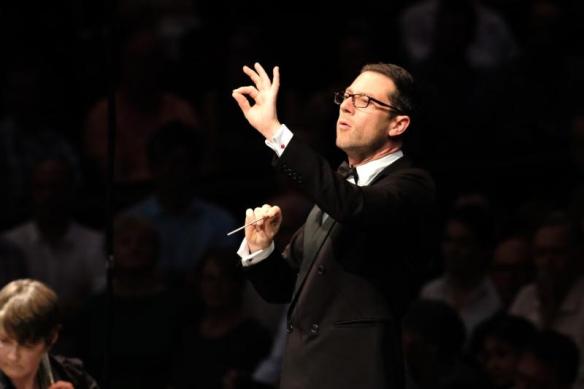
 The Planets has, of course, never looked back over the near-century since it first astounded a public confronted with the terrors of mechanized war. Perhaps one should not be surprised that Wilson was at pains to play down its cinematic quality (hardly something of which Holst could have been aware in any case) – his vehement take on Mars proceeding an eloquent if slightly cloying Venus; itself followed by an almost dance-like Mercury and an incisive Jupiter at its best in a trio section that managed to eschew almost all trace of false solemnity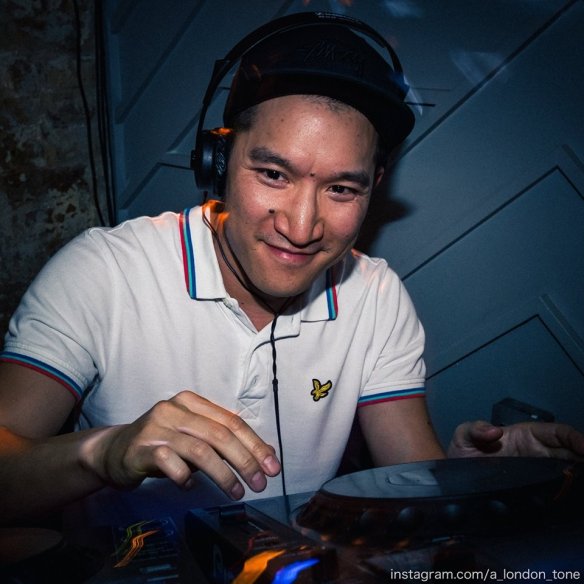

 Davis himself is now 73, but still a sprightly figure who lovingly led his BBC Symphony Orchestra charges in a wide variety of English music, recreating the program given for Sargent’s 500th Prom in 1966. We ducked and dived through Berlioz, and his Le carnaval romain overture, before a glittering account of Schumann’s Piano Concerto from Beatrice Rana, herself in glittering green (above). Her quiet moments were especially profound, and she took charge of the more tempestuous passages of the outer movements with impressive control and expression. Balance is often a problem between piano and orchestra in the cavernous Royal Albert Hall acoustic, but here it was nicely achieved, and with phrases that were fleet of foot (and hand!) Rana showed why she is a highly coveted soloist.
 Holst’s ballet music for The Perfect Fool was treated to a delicately shaded performance, sonorous trombones underpinning a rewarding orchestral sound, with dances of great character. Meanwhile Delius gave us a sunkissed reverie, On Hearing the First Cuckoo in Spring, temporarily overriding the clouds outside.
 This is the final installment of this year’s series where Arcana invites a friend to a Prom who does not normally listen to classical music. In an interview after the concert each will share their musical upbringing and their thoughts on the concert – whether good or bad! Here, it felt right to bring the editor’s wife along! So Samantha Hogwood (above) gives her thoughts on Prom 74.
 Arcana.fm