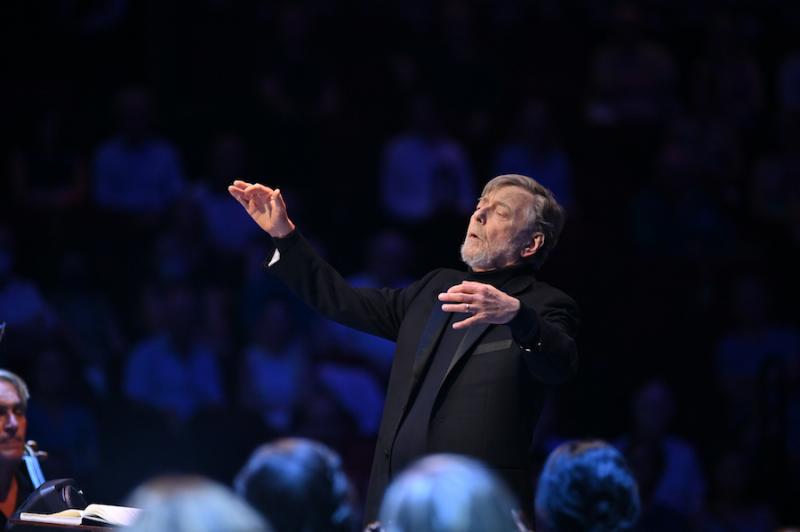
On Record – BBC SSO & BBC SO / Sir Andrew Davis – Naresh Sohal: The Wanderer & Asht Prahar (Heritage)

Naresh Sohal
Asht Pradar (1965)
The Wanderer (1982)

Jane Manning (soprano), BBC Scottish Symphony Orchestra (Asht Pradar), David Wilson-Johnson (baritone), BBC Symphony Chorus and Orchestra (The Wanderer) / Sir Andrew Davis

Heritage HTGCD135 [77’36”] English text included
Remastering Engineer Paul Arden-Taylor

Broadcast performance from BBC Studios, Glasgow on 6 January 1973 (Asht Pradar); live performance from Royal Albert Hall, London on 23 August 1982 (The Wanderer)

Reviewed by Richard Whitehouse

What’s the story?

Heritage issues what will evidently be an ongoing series of archival releases devoted to the music of Naresh Sohal, taken from BBC sources and featuring performers who championed his work over a career whose achievement is not reflected in the availability of recordings.

What’s the music like?

Although he came belatedly to the UK, Sohal (1939-2018) rapidly made up for any lost time when arriving in London in 1962 (further biographical detail can be found in the booklet note for this release and on the composer’s website). Within three years, he had produced his first major (and latterly his first acknowledged) work. Asht Prahar then had to wait until 1970 for its premiere (at the Royal Festival Hall conducted by Norman Del Mar), but it attracted much favourable attention and led to another hearing three years on – the performance featured here.

Taking its cue from the Indian sub-division of the day into eight temporal units (four each for day and night), Asht Prahar unfolds its eight sections as an unbroken continuity. The sizable forces are, for the most part, used sparingly yet resourcefully; as too the deployment of such devices as quarter-tones, along with influences of Ravel and Stravinsky, in music that makes a virtue of its pivoting between East and West. Cyclical if not necessarily cumulative, its final and longest ‘prahar’ brings wordless soprano and orchestra into tangible and haunting accord.

By the time that The Wanderer received its premiere, Sohal had a number of major works to his credit and rationalized his musical idiom accordingly. Setting an anonymous Anglo-Saxon poem in which the male protagonist speaks movingly and often despairingly of his isolation – both physical and spiritual – after the death of his lord, the work divides into two large parts that expand on the narrative’s emotional import. Such ‘‘existential bleakness’’ is intensified by omission of the poem’s last lines with their invoking a specifically Christian consolation. Despite its more than 50-minute duration, there is nothing discursive or unfocussed about The Wanderer’s content. Much of its text is understandably allotted to the baritone, whose austere character is complemented by darkly rhetorical choral passages while offset by an orchestral component with much soloistic writing (notably for flute) in a texture the more involving for its restraint and its strategic use of colour to define specific incidents or emotional responses. Nor is this an opera-manqué, the work succeeding admirably on its inherently abstract terms.

Does it all work?

It does, allowing for the fact that Sohal is not seeking any overt fusion between Occident and Orient, but rather attempting to forge a personal idiom influenced by both while beholden to neither. Both these performances bear out his convictions, Jane Manning adding her ethereal presence to Asht Prahar and David Wilson-Johnson bringing evident compassion to his more substantial role in The Wanderer. Both works benefit from the insightful presence of the late Sir Andrew Davis, whom one regrets never had an opportunity to record them commercially.

Is it recommended?

It is. The sound of these broadcasts has come up decently in remastering, lacking only the last degree of clarity or definition, and Suddhaseel Sen contributes informative annotations. Those looking for a way into Sohal’s distinctive and alluring sound-world need no further incentive.

Listen & Buy

For purchase options, you can visit the Heritage Records website

Published post no.2,451 – Thursday 20 February 2025
Arcana at the Proms – Prom 53: Remembering Sir Andrew Davis

Stravinsky Symphony in Three Movements (1942-5)
Reich Jacob’s Ladder (2023) [BBC co-commission: UK premiere]
Tippett The Midsummer Marriage – Ritual Dances (1946-52)
Elgar Variations on an Original Theme ‘Enigma’ Op.36 (1898-9)

Synergy Vocals [Tara Bungard (soprano), Micaela Haslam (soprano/director), Will Wright, Ben Alden (tenors)], BBC Symphony Orchestra / Martyn Brabbins

Royal Albert Hall, London
Friday 30 August 2024

reviewed by Richard Whitehouse Photos (c) Andy Paradise

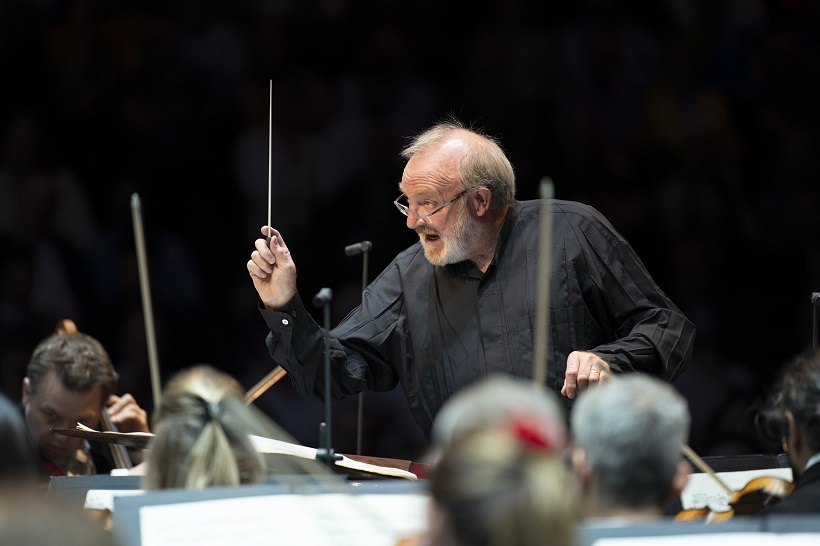
What should have been the 133rd concert that Sir Andrew Davis conducted at the Proms became a commemorative event after his untimely death in April but, with Martyn Brabbins presiding over a thoughtfully amended programme, the outcome could not have been more appropriate.

Proceeding unaltered, the first half began with Stravinsky’s Symphony in Three Movements in a performance redolent of Otto Klemperer in its deliberation if without that conductor’s heft – not least an opening movement whose rhythmic trenchancy felt a little dogged as it unfolded. Best was the Andante – its deadpan humour complemented by the beatific poise at its centre, then a transition of hushed expectancy to launch the finale. Here the closing build-up might have been more visceral, but the conclusiveness of that final chord could hardly be doubted.

Davis (above) was hardly known as proponent of Minimalism in general or Steve Reich in particular, thus his scheduling this first UK performance of the latter’s Jacob’s Ladder could be taken as significant. Playing just under 20 minutes, this is artfully structured as four short ‘expository’ sections followed by four longer ‘developmental’ ones. The former pitted its four vocalists – a telling number in this context of eight strings, six woodwind, two vibraphones and one piano – against an instrumental ensemble that took precedence in those latter sections; the final one brings them together in new-found accord. Dealing with scalic patterns in all their conceptual and metaphorical implications, the musical content typifies late Reich in ruminative elegance or subdued intensity which, if it offers no revelations, is yet satisfying in its stylistic deftness.

Schumann’s Second Symphony had been planned for a second half as now commenced with the Ritual Dances from Tippett’s The Midsummer Marriage – an opera, and composer, close to Davis’ heart. Unfailingly cohesive to the degree its series of elemental and seasonal dances interwove with their respective ‘transformations’ and ‘preparations’, this account was equally notable for its textural clarity even in those most contrapuntally intricate passages, along with a colouristic sense sustained up to the climactic return of its initial music for a magical envoi.

When Brabbins last conducted Elgar’s ‘Enigma’ Variations at the Proms, it was the final item in a 60th-birthday tribute that began with Pictured Within – a latter-day equivalent involving 14 different composers. Tonight’s account gave eloquent insight into what has become almost too familiar a work, evident from the outset in a ‘Theme’ of melting pathos. Highlights from those that followed included the soulfulness of ‘C.A.E.’, pensiveness of ‘R.P.A.’ or elegance of ‘Ysobel’ with its lilting viola from Sebastian Krunnies. ‘Nimrod’ started imperceptibly but built towards a nobly wrought apex, with the affectionate portrayed ‘Dorabella’ or searching evocation of ‘***(Romanza)’ no less affecting. The ‘E.D.U.’ finale moved confidently to an organ-clad peroration exuding what Elgar elsewhere termed a ‘‘massive hope for the future’’.

Just before this performance, Brabbins spoke for a capacity house in paying tribute to Davis with his dedication to music-making in the UK and beyond; something Sir Andrew brought to every one of his 132 appearances at the Proms, across 54 years of dedication to his cause.

You can get details about this year’s season at the BBC Proms website – and you can click on the names to read more about the BBC Symphony Orchestra, their conductor Martyn Brabbins, and an obituary of Sir Andrew Davis himself

Published post no.2,287 – Sunday 1 September 2024

On Record – BBC Symphony Orchestra / Martyn Brabbins, Sir Andrew Davis – Payne: Visions and Journeys (NMC)

BBC Symphony Orchestra / Martyn Brabbins, Sir Andrew Davis (Visions and Journeys)

Anthony Payne
Orchestral Variations: The Seeds Long Hidden (1992-4)
Half-Heard in the Stillness (1987)
Visions and Journeys (2002)

NMC D281 [62’15’’]
Producers Philip Tagney, Ann McKay (Visions and Journeys) Engineers Simon Hancock, Philip Burwell (Visions and Journeys)
Broadcast performances on 22 September 2006, Maida Vale Studios, London; live performance 9 August 2002 Royal Albert Hall, London (Visions and Journeys)

Reviewed by Richard Whitehouse

What’s the story?

NMC issues a tribute to Anthony Payne (1936-2021) featuring three of the most representative among his mature orchestral works and so makes for a viable overview, featuring an orchestra and conductors who between them gave numerous performances of his music in his lifetime.

What’s the music like?

Earliest here is Half-Heard in the Stillness, a short yet evocative tone poem making use of the Memorial Chimes which Elgar wrote for the Loughborough carillon in 1923. By this stage in his career, Payne had evolved an idiom that effortlessly but meaningfully elides between post -war Modernism and a late Romanticism (not necessarily British in derivation) such as gives his later output its tonal and expressive lustre. The outcome is ‘landscape’ music that intimates far more than it states, to an extent which the senior composer would surely have appreciated.

Most extensive of these pieces, The Seeds Long Hidden is a sequence of orchestral variations which outlines an autobiographical trajectory. Other than the opening gesture from Brahms’s First Symphony (a hearing of which in 1947 determined the course of Payne’s life thereafter), the works alluded to over the course of its 10 variations are not quoted directly but rather flit across the music and so inform the context from which the ‘theme’ variously emerges. While there is a constant and productive eddying between relative stasis and dynamism, moreover, the overall cumulative thrust seems one of clarification towards an emotional climax of self-realization which quickly recedes into the calm equivocation of the closing bars. If this is, as the composer states, a ‘musical autobiography’, it is an overtly self-effacing and oblique one.

As the first major work that Payne wrote in the aftermath of his realization of Elgar’s ‘Third Symphony’, Visions and Journeys is inevitably bound up with the re-establishing of his own idiom: a statement of intent to be pursued over what became the final phase of his creativity. Nominally inspired by frequent journeys he and his wife – the soprano Jane Manning – made to the Isles of Scilly, this is in no sense pictorial or illustrative in intent. That said, its overall follow-through from unforced anticipation, via understated fulfilment, to underlying regret could not otherwise have been made explicit; the degree to which this is transcended being both the music’s purpose and its primary fascination. A blueprint, indeed, for the select few works that were to come and which reinforced Payne’s standing as a composer of substance.

Does it all work?

Yes, as long as one approaches these works not as compromise between competing aesthetic tendencies but as their synthesis in music which is often eloquent and always appealing. The playing from the BBC Symphony Orchestra could hardly be bettered, with Martyn Brabbins and the late Sir Andrew Davis always committed in their advocacy. Occupying that amorphous middle-ground between the rarified and accessible, Payne’s music neither rejects nor courts popularity but the rewards are considerable for those willing to spend time in its company.

Is it recommended?

Indeed, in the hope a follow-up release which features Spirit’s Harvest (initially intended for inclusion here) and Payne’s culminative statement Of Land, Sea and Sky may yet be possible. The composer’s introductory notes explain everything while giving absolutely nothing away.

Listen & Buy

You can listen to sample tracks and purchase on the NMC website. For further information, click on the names for more on Martyn Brabbins, the BBC Symphony Orchestra and composer Anthony Payne

Published post no.2,218 – Sunday 23 June 2024

In appreciation – Sir Andrew Davis

by Ben Hogwood

Yesterday we heard the sad news of the death of the British conductor Sir Andrew Davis, at the age of 80.

The warmth of the tributes made on social media to Sir Andrew are an indication of his standing as a highly respected conductor who was for many a friend as well as a fellow musician. As a live performer he excelled at the BBC Proms, becoming the festival’s musical figurehead in the 1990s as chief conductor of the BBC Symphony Orchestra, a post he held from 1989 until 2000. Yet he also made his mark overseas, through posts held with the Toronto Symphony Orchestra (from 1975 until 1988) and the Melbourne Symphony Orchestra (from 2013).

The playlist below attempts to summarise his considerable contribution to recorded music – and in particular his many outstanding discs of British music. The reader is particularly directed towards an extensive and hugely rewarding series of Elgar for Chandos, but the list below includes early Berlioz, Delius, Elgar, a recent highlight of Stravinsky‘s Violin Concerto recorded with James Ehnes and the BBC Philharmonic Orchestra, and an outstanding version of Vaughan WilliamsSymphony no.6, capturing a side of the composer seldom heard at the time of recording.

Published post no.2,156 – Monday 22 April 2024

BBC Proms #6 – BBC Philharmonic Orchestra / Sir Andrew Davis: Vaughan Williams & Tippett Fourth Symphonies

Prom 6 – BBC Philharmonic Orchestra / Sir Andrew Davis

Vaughan Williams Symphony no.4 in F minor (1931-4)
Tippett Symphony no.4 (1976-7)

Royal Albert Hall, London
Tuesday 19 July 2022

Reviewed by Richard Whitehouse Photo (c) Chris Christodoulou

Whether or not the Fourth Symphonies by Vaughan Williams and Tippett had previously been scheduled together, they made for a striking and provocative programme such as was its own justification. Omer Meir Wellber clearly thought so when this concert was planned and, even though indisposition had led to withdrawing from this year’s Proms, the presence of Sir Andrew Davis on the podium could hardly have been more conducive to the BBC Philharmonic Orchestra giving performances of the interpretive insight and technical conviction as were evident this evening.

Admittedly the Albert Hall’s opulent acoustic is never the best setting for VW4, the visceral impact of whose opening was inevitably diluted. Allowing for rather more expressive leeway than he might otherwise have done, Davis paced this explosive movement securely with just a slightly listless take on its coda detracting from the whole. The Andante was the highlight here – its fatalistic course exuding gravitas but never dragging, with the tritonal plangency of its main climaxes palpably in evidence and pathos of its final bars enhanced by an affecting contribution from flautist Alex Jakeman. This acoustic may have obscured something of the Scherzo’s contrapuntal ingenuity but not its sardonic humour or, in the trio, didactic coyness. The stealthy transition into the Finale could have had even greater cumulative focus, but what followed had all the requisite impetus – its central interlude raptly delineated, then the drama of its ‘epilogo fugato’ conveying increasing velocity through to the starkly inevitable return of the opening gesture and what is the most unequivocal four-letter ending of any symphony.

Interesting to recall the temporal distance between these pieces is now less than that between the Tippett and the present. Enthusiastically received at its Chicago premiere and one among a handful of his works still revived following his death, Tippett’s Fourth Symphony evinces  a ‘birth to death’ trajectory that differs – crucially so – from its assumed model of Sibelius’s Seventh in not being a cumulative design; its climax being rather the kinetic developmental paragraph at its centre and from where the piece fans out, in a sequence of evolving episodes, back to the launching of its introduction and onward to the passing of its coda. Although he may have directed performances of greater tautness, Davis here secured a persuasive balance between unity and diversity – bringing a metaphysical poise to its ‘slow movement’ then a deft whimsicality to its ‘scherzo’, whose respective qualities underlined the confrontational drama elsewhere. Lavish writing for brass and percussion helps makes this Tippett’s most virtuosic such statement, in which the BBC Philharmonic was rarely to be found wanting.

A less successful component of this reading was the latest attempt to represent the ‘breathing effect’ specified by the score, in which the real-time voice of CJ Neale seemed hardly more successful than those attempts of wind machine, sampler et al to realize Tippett’s speculative imagery. No matter – any such overreaching was part and parcel of this composer’s inherent ambition; an ambition, moreover, which his present-day successors would do well to emulate. Almost a century and half-century on, both these works pose challenges constantly to be met.