
BBC Proms 2017 – Malcolm Sargent tribute: BBC Symphony Orchestra / Sir Andrew Davis

Beatrice Rana, BBC Symphony Orchestra, Sir Andrew Davis

arr. Sir Henry Wood The National Anthem

Berlioz Le carnaval romain Overture, Op.9 (1844)

Schumann Piano Concerto in A-minor, Op.54 (1845)

Elgar Cockaigne (In London Town) Op.40 (1900-01)

Walton Façade – Suite No.1; Popular Song (1922-28)

Holst The Perfect Fool – Ballet Music (1918-22)

Delius On Hearing the First Cuckoo in Spring (1912)

Britten Variations and Fugue on a Theme of Purcell (The Young Person’s Guide to the Orchestra), Op.34 (1945)

Royal Albert Hall, Monday 24 July 2017

Sir Malcolm Sargent holds a prominent place in Proms history, especially so for those Prom goers of an older vintage. It was therefore only right that in the 50th year since his passing there was a concert commemorating one of English classical music’s favourite sons. Sargent lived in a flat opposite the Royal Albert Hall, a blue plaque marking this clearly visible from Door 4 of the auditorium.

Calling Sargent a ‘favourite son’ is a statement that needs to be qualified, for not everybody held him in such high esteem. For orchestral players he could be anything but, being a hard taskmaster, but he was hugely popular with Proms audiences, boosting the profile of the festival and the Last Night in particular, to an art form fit for television. As tonight’s conductor Sir Andrew Davis recounted in a glowing tribute, he also knew how to get the best out of large choral and orchestral forces. Davis was a prommer in the 1960s, and held fond memories of Elgar, Shostakovich and Britten under the Sargent baton.

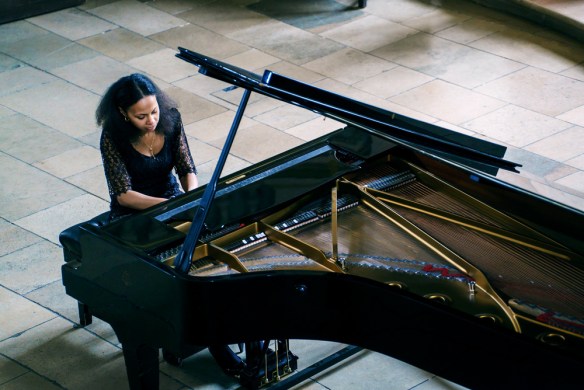
Davis himself is now 73, but still a sprightly figure who lovingly led his BBC Symphony Orchestra charges in a wide variety of English music, recreating the program given for Sargent’s 500th Prom in 1966. We ducked and dived through Berlioz, and his Le carnaval romain overture, before a glittering account of Schumann’s Piano Concerto from Beatrice Rana, herself in glittering green (above). Her quiet moments were especially profound, and she took charge of the more tempestuous passages of the outer movements with impressive control and expression. Balance is often a problem between piano and orchestra in the cavernous Royal Albert Hall acoustic, but here it was nicely achieved, and with phrases that were fleet of foot (and hand!) Rana showed why she is a highly coveted soloist.

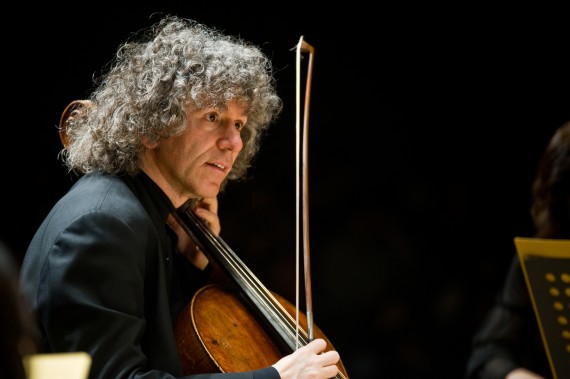
Davis (below) came into his own for the second half. An English music expert whose interpretations are now virtually unrivalled, he brought forward the bustling streets of London for Elgar’s Cockaigne Overture, balancing the organ with the orchestra impeccably as he did so. The big tunes were affectionately wrought and great fun, as they were in Walton’s mischievous music for Façade, an entertaining suite where the percussion section, led by the ever masterful David Hockings, came out on top form.

Holst’s ballet music for The Perfect Fool was treated to a delicately shaded performance, sonorous trombones underpinning a rewarding orchestral sound, with dances of great character. Meanwhile Delius gave us a sunkissed reverie, On Hearing the First Cuckoo in Spring, temporarily overriding the clouds outside.

Finally we moved to Britten, and a performance of the Young Person’s Guide To The Orchestra that was as much fun to watch as it was to listen to. The composer’s clever navigation of each orchestral section is a great introduction for new listeners but also reminds the older ones of the colours and expressive techniques each instrument can produce. Davis handled the twists and turns to great effect, and this hugely entertaining evening reached its peak with all sections combined, Purcell’s original theme now refracted through Britten’s technicolour lens.

It was a great way to finish and a fitting tribute to Sargent, who conducted the work’s world premiere back in 1946. He would surely have been proud of Davis and his charges, who sent the crowd away smiling – something Sargent himself achieved on countless occasions.

Ben Hogwood (photos (c) Ben Hogwood (plaque) and Chris Christodoulou (performances)

Stay tuned for the first in Arcana’s Ask The Audience series, where drum ‘n’ bass DJ Rob Chung will give his verdict on the Malcolm Sargent Prom. Coming shortly!

Live review – Răzvan Suma & Rebeca Omordia: Do you like British Music?

Răzvan Suma (cello, above – photo credit Adrian Stoicoviciu), Rebeca Omordia (piano, below)

Romanian Cultural Institute, London, Thursday 9th March, 2017

Delius Romance (1896); Ireland Cello Sonata in G minor (1923); Elgar Salut d’amour, Op.12 (1888); Venables Elegy, Op.2 (1980); Matthew Walker Fast Music, Op.158 (2016); Enescu Allegro in F minor (1897); Lloyd Webber Nocturne (1948); Bridge Scherzetto, H19 (1902)

Written by Richard Whitehouse

It is not often musicians get the chance to tour unusual repertoire, though Răzvan Suma and Rebeca Omordia have been doing just so with a recital of mainly British music which tonight arrived at the Romanian Cultural Institute as part of its enterprising Enescu Concert Season.

Playing continuously for just over an hour, their choice of music made for a varied as well as cohesive programme. Opening with the discreet charm of Delius’s early Romance, its echoes of Grieg and Massenet not precluding a more personal expression, the duo continued with an account of Ireland’s Cello Sonata that was a world away from the sombre introspection most often associated with this composer’s chamber output. After a taut and impulsive take on the initial Moderato, the slow movement exuded an anxiety that motivated the expected fatalism, then a finale whose tensile progress resulted in a peroration of unusual eloquence and resolve. Certainly, Ireland’s music only stands to benefit from such a forthright approach, and it is to be hoped that Suma’s and Omordia’s advocacy will continue long beyond their present tour.

After an elegant if not too indulgent reading of Elgar’s Salut d’amour, the duo played pieces by two contemporary figures. If Ian Venables is best known for a substantial contribution to English art-song, his chamber music is not insignificant and this early Elegy gave notice of an immersion in the ‘British tradition’ never insular or derivative. Keen to offset the inward tendencies of this repertoire, Robert Matthew Walker penned Fast Music as a toccata which veers engagingly between the incisive and ironic on its way to a decidedly nonchalant close.
The performers’ Romanian lineage was acknowledged with a propulsive account of Enescu’s Allegro in F minor that seems to have been a ‘dry run’ for the opening movement of his First Cello Sonata. The suave second theme is almost identical and while the stormy main theme of this piece is a little short-winded, and its development lacks focus compared to that of the sonata, the impetus sustained here is demonstrably greater than is found in its more rhapsodic and discursive successor. Such, at least, was the impression left by this persuasive rendering.

The recital concluded with two further miniatures by English composers. Rediscovered only after his death, the Nocturne by William Lloyd Webber evinces an appealing soulfulness the greater for its brevity: to which the early Scherzetto (also relocated posthumously) by Bridge provided a telling foil in its capricious humour and flights of fancy. It certainly made for an appropriate ending to this well-conceived and superbly executed programme; one, moreover, that is eminently worth catching at one of the subsequent appearances by this impressive duo.

Further information about these artists and their current UK tour can be found at website and website

The 2016 BBC Proms are go! Here’s what happened in Prom 1…

proms-2016

The national flag of Argentina waves in response to Sol Gabetta‘s account of the Elgar Cello Concerto

(c) Ben Hogwood

The BBC Proms are go!

The 2016 season is underway, and in a packed Royal Albert Hall this evening we were treated to the first of 75 Proms. As is traditional Sakari Oramo and the BBC Symphony Orchestra gave us a flavour of the season, but also a substantial second half in the form of Prokofiev‘s cantata and film score, Alexander Nevsky.

To begin, a sad reflection of the world’s troubles could be keenly felt in La Marseillaise, the Proms showing solidarity with France after the horrors in Nice. After such an event music can feel inconsequential but it can also bring people together and provide some sort of comfort – and in the big, swooning tunes of Tchaikovsky‘s Romeo and Juliet Oramo provided just that. The woodwind chorale on the approach to the end was particularly moving.

Sol Gabetta then stamped her own personality on Elgar‘s Cello Concerto, taking a few liberties with the tempo – but none of these were for personal gain, rather reflecting her own interpretation of the music. The pauses at the end of some of Elgar’s phrases were unexpected but profound, while the silvery accompaniment of the BBC SO spoke of Autumn rather than our supposed high summer. Gabetta’s encore, Dolcissimo by the Latvian composer Peteris Vasks, found her singing as well as playing cello, reducing the Royal Albert Hall to reverent silence.

Things got even colder for Prokofiev‘s film score Alexander Nevsky, though there were thrilling moments when the massed choir of the BBC National Chorus of Wales – just over 200 in all – let rip. The basses reached their lowest notes with commendable accuracy, while the Battle On The Ice, where Nevsky faces his German and Estonian foes, was thrilling and immediate.

Yet the show was stolen by Olga Borodina, the Russian mezzo-soprano ghosting onto the stage for a keenly felt account of The Field of the Dead near the end. Her emotion was first hand, and Oramo’s sensitive hand on the tiller encouraged a similarly heartfelt response from the orchestra.

It was a concert that bodes well for the season – and this year Arcana is planning two different approaches to its coverage of the BBC Proms. There will be a few straight ‘reviewed’ concerts, but the focus of our coverage will be on taking people to the Proms who have not been before. To that end our reviews of Proms will not be by experts, rather by first-time punters chosen from a pool of friends and contacts. Further to that, all reviews will be from the Arena, which is the ultimate Proms experience – and which to my knowledge is the best place for sound quality, let alone atmosphere.

No other source reviews from here as far as I am aware…so stick with Arcana in the weeks ahead, particularly through August. I can assure you we will be bringing classical music to new audiences on a weekly basis!

Ben Hogwood

Steven Isserlis – revisiting Elgar and discovering Walton

steven-isserlisCellist Steven Isserlis is one of Britain’s best-loved classical artists – loved for his highly respected interpretations of the cello repertoire, but also for his open, honest and enthusiastic approach to classical music.

Isserlis, an author of books introducing children to the likes of Beethoven, Handel and Schumann, generously donated time to talk to Arcana about the roots of his love of the cello, his new disc of Cello Concertos by Elgar and Walton and his new work as an author.

Can you remember your first encounters with classical music?

I can’t remember a time without music! From the time I remember anything, my sisters were already learning instruments, and I used to go to sleep at night to the sound of my father practising the violin and my mother the piano.

How did you develop a love of the cello?

My sister Rachel played the violin, and my elder sister Annette was always going to play the viola. So a cellist was needed – that would be me. So my parents took me to a local teacher, and – after a false start at the age of four or five – I began lessons from the age of six. I think my love for the cello developed as I came to realise that if I played OK I could be the centre of attention!

What was it like returning to record Elgar’s Cello Concerto? Was it invigorating in the company of someone (the conductor Paavo Järvi) who may not have encountered the composer’s music so much?

Well, I’ve played the Elgar so many times over the 25+ years since I first recorded it that it seemed a good idea to record it again. It’s true that Paavo needed a bit more persuading than he did for our Prokofiev / Shostakovich disc, but not much more; he’s always up for a challenge.

Was it your aim to bring out a little more of the humour in the last movement of the Elgar, given the relative darkness around it? It also feels a little quicker than your first recording of the concerto.

It was not a conscious aim – I really didn’t think about (or listen to) the earlier recording. But yes, there is humour in parts of the last movement – which for me throw the tragedy into even sharper relief.

This is the first time you have recorded the Walton (I think!) I’m assuming you knew it very well before, but what effect did it have on you in the recording process?

I’m not sure it had any particular effect on me ‘in the recording process’, but I’d been wanting to record it for some years, since I feel passionately about it. I always name the Schumann, Dvorak, Elgar and Walton concertos as the four very greatest cello concertos (though I’d be bereft without those of Haydn, C.P.E. Bach, Boccherini, Saint-Saëns, Prokofiev, Shostakovich, Dutilleux etc).

It feels like a very romantic piece, with sighing melodies and deeply felt thoughts. Given your booklet note for the release, is that how you would view it?

Definitely – romantic, poetic, impassioned, magical.

The Gustav and Imogen Holst pieces make fascinating complements. Do you think people are in neglect of just how adventurous Gustav’s music could be?

Perhaps. To my shame, I know very little of it. But I love Invocation, maybe especially so since I had something of a part in its rediscovery.

What do you remember of Imogen Holst as a person, and of the piece here? Her ‘Presto’ seems to me (a bit of wishful thinking I’m sure!) to depict birds chasing each other in the reeds at Aldeburgh.

I remember Imogen as a wonderfully quaint personality who was also sharp as a stainless steel razor! Wonderful. I’ve always thought of the Presto as depicting leaves flying around in a storm. Recently I was sent a note by the work’s dedicatee, Pamela Hind O’Malley, apparently written with Imogen’s approval, which describes it as ‘the scuttering of leaves in a high wind’. I like that word ‘scuttering’!

I understand you have just completed a book – are you able to tell us more about it at this stage?

It’s advice for young musicians – incorporating and updating Schumann’s book of the same name. I suppose that means that I’m now an old musician – groan…

Is it important for you to communicate to people, young and old, in a language that brings classical music to everybody?

Absolutely! And I enjoy playing for children, as well as writing for them – it can be tremendous fun.

Do you think classical music should do more to get the music beyond its ‘inner circle’, so to speak?

Well, yes – but not if that means distorting it, or promoting sugary crossover stuff. Classical music doesn’t need that!

You can hear extracts from the new Steven Isserlis disc of cello concertos by Elgar and Walton, released by Hyperion Records, here – including shorter pieces by Gustav Holst – his Invocation – and his daughter Imogen, a short suite for solo cello The Fall of the Leaf.

Meanwhile forthcoming concerts from the cellist are listed on his website

In concert – Benjamin Baker and Daniel Lebhardt @ St James’s Piccadilly, London

benjamin-baker

Benjamin Baker (violin, above), Daniel Lebhardt (piano), St James’s Church, Piccadilly, 18 January 2016

Reviewed by Ben Hogwood

Britten – Suite for violin and piano, Op.6 (1934-35)

Elgar – Sonata for violin and piano in E minor, Op.82 (1918)

Violinist Benjamin Baker and pianist Daniel Lebhardt are both promising musicians in their twenties, and here they performed an attractive pairing of the young Britten and the ageing Elgar. This was part of the Richard Carne Trust Series, a lunchtime concert given in the generously lit, spacious surrounds of St James’s Piccadilly, a fine Christopher Wren church.

Britten was a relatively serious child, and although the Suite for violin and piano is an early work, completed in his early twenties, it has the mark of a composer already sure of himself in form, melody and writing for the violin. Britten still has fun through a number of dance forms, though, and after a bold as brass introduction Baker and Lebhardt strode confidently through a March, well balanced and intuitively finding the flexibility in Britten’s rhythms.

This togetherness was even more apparent in a dramatic Moto perpetuo, a nervy piece of writing, but this fraught mood dissipated in the bell-like chords with which Lebhardt began the Lullaby. Finally the Waltz, a brazen but very enjoyable affair where the performers could perhaps have been more exuberant, but where they took some very tasteful liberties with the rhythm, as Britten instructs in the score.

Elgar’s Violin Sonata was a different story, darkly passionate in the intial outpouring of feeling in its first movement but contrasted with a ghostly quieter section that even on a cold January lunchtime sent a shiver down the spine. Elgar is fiercely lyrical in the outer movements of this work, and Baker did well to project this over an equally active piano part. The two found the grace of the Romance, where it felt as though they were dancers in hold, charming with slow steps but occasionally drifting apart.

Elgar’s determination returned in the finale, the tune consistently putting its head above that of the piano and achieving a well-won victory by the end. The two showed great understanding of the older man’s music, a fine interpretation that reminded me this piece was one of Nigel Kennedy’s earliest recordings. Baker and Lebhardt, then, have followed in illustrious footsteps!