In concert – English Symphony Orchestra / Kenneth Woods @ Kings Place: Elgar, Truscott, Fribbins, Weinberg & Shostakovich

Laura Jellicoe (flute), Rosemary Cow (bassoon), Rosalind Ventris (viola), English Symphony Orchestra / Kenneth Woods

Elgar Romance in D minor Op.62 (1910)
Truscott Elegy in E flat major (1944) [London premiere]
Fribbins Folk Songs (2022) [London premiere]
Weinberg Flute Concerto no.1 in D minor Op.75 (1961)
Shostakovich arr. Barshai Chamber Symphony in A flat major Op.118a (1964, arr. 1971)

Kings Place, London
Sunday 23 March 2025

Reviewed by Richard Whitehouse

What has become the English Symphony Orchestra’s annual appearance in London Chamber Music Society’s season saw an appealing programme of (relatively) familiar and (relatively) unfamiliar British and Soviet-era music as wide ranging as it had been carefully assembled.

It cannot often have begun a concert, but the Romance that Elgar wrote for bassoonist Edwin James made an attractive entrée – its pathos and eloquence fully conveyed by ESO principal Rosamary Cow, always heard to advantage against the strings’ warmly ruminative backdrop.

Harold Truscott finished only three works for orchestra, his Elegy for strings the undoubted masterpiece – eliding intuitively between the already burgeoning British lineage with that of Central Europe (Dvořák’s crepuscular Nocturne, heard at last year’s ESO concert, affords an interesting precedent). Despite its major-key grounding, this is music of intense while often anguished emotion – Truscott bearing his soul to a degree he was rarely, if ever, to do again. As in Worcester four seasons ago, Kenneth Woods searched out its every expressive nuance.

Concertante pieces have featured prominently in Peter Fribbins’s output, with Folk Songs the most recent example. Those traditional tunes range widely geographically and expressively – the Prelude drawing on Welsh melody Bugail Yr Hafod (When I was a Shepherd) in soulful restraint, the Fugue on Serbian tune Ajde Jano (C’mon Jana) in animated dexterity, then the Fantasia on Hungarian song Azt gondoltam eső esik (I thought it rains) in elegant profundity. Superbly played by Rosalind Ventris, it makes a welcome addition to a still-limited repertoire.

Hardly less valuable in its own context is the First Flute Concerto by Mieczysław Weinberg. Written for Alexander Korneyev, its modest proportions fairly belie its substance – whether the energetic interplay of its opening Allegro, the deftly understated threnody of its Adagio, or the whimsical humour of an Allegro anticipating numerous Weinberg finales. It was also the ideal showcase for ESO principal Laura Jellicoe to demonstrate her solo prowess, with ESO strings responding ably to what must be among its composer’s most performed pieces.

Dedicated to Weinberg and written over just 11 days, Shostakovich’s Tenth String Quartet is something of a standalone in the composer’s cycle – coming between four innately personal quartets and four dedicated to each member of the Beethoven Quartet. Yet it is music no less focussed in intent and Rudolf Barshai’s arrangement for string orchestra defines its character more markedly – not least the winsome ambivalence of its initial Andante or visceral force of its ‘furioso’ scherzo, the ESO players tackling those fearsome rhythmic unisons head on. The cellos came into their own with the emotionally restrained variations of the Adagio before, its link seamlessly effected, the final Allegretto built methodically if inexorably to a heightened restatement of the passacaglia’s theme before tentatively retracing its steps to a wistful close.

An impressive demonstration overall of the ESO’s prowess and, moreover, the ideal way to close 17 seasons of LCMS recitals at Kings Place. September finds this series relocating to the newly refurbished St John’s Church at Waterloo, ready for a new chapter in its existence.

Visit the English Symphony Orchestra website to read more about the orchestra, and click on the artist names to read more about flautist Laura Jellicoe, bassoonist Rosemary Cow, viola player Rosalind Ventris and conductor Kenneth Woods. Click also to read more on composers Peter Fribbins and Harold Truscott

Published post no.2,483 – Monday 24 March 2025

In concert – Westminster Philharmonic Orchestra / Jonathan Butcher: Bliss: A Colour Symphony

Westminster Philharmonic Orchestra / Jonathan Butcher (below)

Elgar In the South (Alassio) Op.50 (1903-4)
Bernstein On the Waterfront – Suite (1954-5)
Bliss A Colour Symphony (1921-2, rev. 1932)

St John’s Church, Waterloo, London
Saturday 1 March 2025

Reviewed by Richard Whitehouse

The Westminster Philharmonic Orchestra has given any number of well programmed concerts over the 53 years of its existence and tonight’s was no exception, featuring as it did a welcome revival of A Colour Symphony with which Arthur Bliss nonplussed first-night listeners 102 years ago.

Much has been written about the relationship between the colours as referenced in each of the movement headings with the music in question. In fact, the heraldic source from which these are derived was the means to focussing what could otherwise have remained the ‘Symphony in B’ of its working-title. The Purple of its opening movement evokes a processional whose emergence then retreat sets out the salient ideas in its wake, while that of Red is a scherzo with its two trios drawn into a sonata form whose unwavering impetus makes contrast with Blue more potent. Nor is this latter an archetypal slow movement – its expressive eddying an anticipation of that inexorable momentum with which Green traverses its double fugue, towards an apotheosis that sets the seal on the overall design with unmistakable conviction.

A Colour Symphony is not an easy work to make cohere – in which respect, this performance succeeded admirably. Jonathan Butcher ensured that Purple fulfilled its preludial function with sufficient gravitas to launch Red with an energy as amply underpinned its productive thematic elaboration; the work effectively becoming a tale of two halves, with the latter an extended and varied take on the ideas already established. The nervous energy that informs Blue was admirably conveyed, with the WPO giving of its collective best, while Butcher (rightly) did not rush the unfolding of Green – its respectively methodical then impetuous fugal subjects persuasively fused into a coda whose affirmation is far from that of a ‘‘mere paragraphist’’, as Elgar lamented, but of one able to refashion symphonic principals at will.

In the first half, Leonard Bernstein demonstrated a symphonic cohesion far greater than that of his actual symphonies in the suite from his score to Elia Kazan’s film On the Waterfront. For all its violent energy (and lessons well learned from Copland’s ballet Billy the Kid), this is music defined by its wind solos and it was to the credit of horn player Adrian Wheeler, oboist Tony Freer or alto saxophonist Bernie Hunt they were never less than plangently emotional. Whether or not Bernstein’s most ambitious orchestral work, this is by some way his finest.

Music by Elgar had opened the concert. His In the South might be as much a tone poem as a concert overture, but its effective overall design – anticipating those first movements of the symphonies to come – is its own justification. While he eschewed something of this music’s often scenic opulence, Butcher certainly had the measure of its formal ingenuity – with only the final peroration failing to deliver that necessary emotional frisson. Earlier on, Jonathan Welch’s viola playing brought pathos as well as tenderness to its exquisite ‘canto populare’.

Overall, a concert such as matched in execution what it had in ambition and which should equally be the case with the WPO’s next concert, where highly contrasted works by Barber and Tchaikovsky are to be followed by the mighty edifice of Bruckner’s Ninth Symphony.

For more information on the orchestra’s 2024-25 season, head to the Westminster Philharmonic Orchestra website Click on the names to read more about conductor Jonathan Butcher, and about Sir Arthur Bliss himself. You can also find out more about The Bliss Trust

Published post no.2,464 – Wednesday 5 March 2025

In concert – Best of British @ Royal Birmingham Conservatoire

Recital Hall, Royal Birmingham Conservatoire, Birmingham
Monday 17 & Tuesday 18 February 2025

Reviewed by Richard Whitehouse

Royal Birmingham Conservatoire has put on some notable extended events over recent years, the latest being Best of British – a two-day retrospective of piano music from UK composers past and present, all performed by current, former and associated musicians of this institution.

Monday lunchtime centred on composers ‘Made in Birmingham’, beginning with the Second Sonata of John Joubert. His three such works encompass almost his whole maturity, of which this is the longest – taking in a cumulatively intensifying Allegro, volatile Presto with a more equable trio, then a finale whose fantasia-like unfolding culminates in a powerful resolution. Rebecca Watson was a sure and perceptive exponent. Dorothy Howell’s Toccata was given with verve by Rufus Westley, with Christopher Edmonds’ Prelude and Fugue in G elegantly rendered by Ning-xi Wu. Chiara Thomson was dextrousness itself in Howell’s Humoresque, then Zixin Wen found quixotic humour in her Spindrift, before John Lee and Ruimei Huang enjoyed putting Joubert’s early and engaging Divertimento for piano duet through its paces.

Monday afternoon opened with Frank Bridge – his Three Lyrics given by John Lee with due appreciation of their keen insouciance, as too the menacing aura of his much later Gargoyles. Established as the pre-eminent English art-song composer of his generation, Ian Venables is no less adept in combining violin and piano – witness the expressive poise but also rhythmic impetus of his Three Pieces, to which RBC alumni Chu-Yu Yang and Eric McElroy were as emotionally attuned as they were in plumbing the expressive depths of Gerald Finzi’s Elegy.

Next came John Ireland – his imposing if somewhat discursive Ballade finding a committed advocate in Roman Kosyakov, who had no less the measure of his atmospheric Month’s Mind with its undertones of Medtner. Yinan Tong proved suitably alluring in The Island Spell (the first of Ireland’s Decorations), while Ruimei Hang conveyed elegance as well as playfulness in Bridge’s Three Sketches. Expertly partnered by Sarah Potjewijd, clarinettist Jamie Salters steered an insightful course through the diverting formal intricacy of Ireland’s Fantasy Sonata.

Monday evening commenced with further Ireland in ‘Phantasie’ mode – his First Piano Trio finding a productive accord between its Brahmsian inheritance and his own, subtly emerging personality at the hands of violinist Roberto Ruisi, cellist Nicholas Trygstad and pianist Mark Bebbington. They were joined by violinist Shuwei Zuo and violist Jin-he Huang in Venables’ Piano Quintet, among the most substantial and certainly the best known of his chamber works. Its opening Allegro is preceded by an Adagio whose acute pathos underlies the robust energy of what follows, before a Largo such as takes in the capriciousness of its scherzo-like central section without disrupting its soulful discourse; while the finale’s animation is not necessarily resolved by its slow postlude, a sense of this music come affectingly full circle is undeniable.

The second half found these artists in a performance of Sir Edward Elgar’s Piano Quintet doing full justice to a work which, whatever its eccentricity of form and content, is worthy to stand beside any of his mature masterpieces. How persuasively they elided between the haunting ambivalence of the first movement’s introduction and its trenchant Allegro, with the central Adagio gradually emerging as a statement of great emotional import, then the final Allegro building inevitably to an ending of fervent affirmation. Memorable music-making indeed.

Tuesday lunchtime brought more ‘Made in Birmingham’. Michael Jones gave an interesting overview of his teacher Christopher Edmonds, two more of whose Preludes and Fugues – the elegance of that in E then the rapture of that in A – preceded his Aria Variata which, inspired by wartime experiences in the Crimea, channels the influences of Scriabin and Cyril Scott to personal ends. Zoe Tan teased out unity from within the diversity of Howell’s appealing Five Studies, before Duncan Honeybourne gave of his best in the Third Sonata written for him by Joubert. Inspired by lines from Thomas Hardy on the innate futility of the human condition, its three movements unfold an inevitable trajectory from aggression, through compassion, to a resolution more powerful for its inherent fatalism. A fine piece and performance to match.

Tuesday afternoon brought a varied programme in terms of style and media. Chian-Chian Hsu was alive to the limpid poise of Frederick Delius’s Cello Sonata, while otherwise leaving her attentive pianist Charles Matthews to set the interpretive parameters. Honeybourne was then joined by Katharine Lam in the Sonata for Two Pianos by Andrew Downes – whose subtitle A Refuge in times of trouble indicates the ominous unease, shot through with a consoling warmth, that pervades these three, lucidly designed movements by its underrated composer.

Jing Sun gave her own, attractive take on Bridge’s Rosemary (second of his Three Sketches) – before which, Ren-tong Zhao and Jake Penlington offered an unexpected highlight in Ralph Vaughan Williams’ Fantasia on a Theme of Thomas Tallis as stylishly arranged for two pianos by Maurice Jacobson. A not inconsiderable composer, the latter was represented by his quirky Mosaic with Zijun Pan and Julian Jacobson as fluent duettists; Julian returning for his Piccola musica notturna that feels more Busoni than Dallapiccola, if a haunting study in its own right.

Tuesday evening consisted of four notable works. Daniel Lebhardt opened proceedings with Joubert’s First Sonata, this tensile single movement fusing a variety of ideas into an eventful and, above all, cohesive whole through a masterly formal and motivic development. Not that Ethel Smyth’s Second Sonata was lacking such cohesion and if its three movements, arrayed in the expected fast-slow-fast sequence, seemed indebted to the pianistic idiom of Schumann more than that of Brahms, the unbridled rhythmic elan of its opening Allegro (set in motion by a no less forceful introduction), the gently enfolding harmonies of its central Andante (a ‘song without words’ in spirit), then its impulsive final Presto as surges to an aptly decisive close needed no apology. Just the sort of piece that is worth revival at a festival such as this.

As equally was Howell’s Piano Sonata, its more understated and equivocal emotion no doubt representative of a very different persona and one which Rebecca Watson duly brought out – whether the eddying motion of its initial Moderato, intimate calm of its central Tranquillo, or mounting resolve of its final Allegro to a (more or less) decisive close. Yun-Jou Lin rounded things off with Sarnia – An Island Sequence that is arguably Ireland’s most successful such piece for its keenly evocative quality, as was conveyed here though her scintillating pianism. Quite an embarrassment of riches, but one which came together effectively in performance – thanks not least to Mark Bebbington in his curating of the event. It hardly needs adding that there is an abundance of this music for a ‘Best of British, Part Two’ on some future occasion.

For artist and repertoire details in listing form, head to the Royal Birmingham Conservatoire website – clicking here for Day One and here for Day Two

Published post no.2,455 – Monday 24 February 2025

In concert – David Cohen, London Symphony Orchestra / Sir Antonio Pappano: Vaughan Williams 9th Symphony, Elgar & Bax

David Cohen (cello), London Symphony Orchestra / Sir Antonio Pappano

Vaughan Willams Symphony no.9 in E minor (1956-57)
Elgar Cello Concerto in E minor Op.85 (1919)
Bax Tintagel (1917-19)

Barbican Hall, London
Sunday 15th December 2024

Reviewed by Richard Whitehouse Picture (c) Mark Allan

Sir Antonio Pappano‘s conducting of Vaughan Williams’s Sixth Symphony in March 2020 will be recalled as almost the final live event before the descent of lockdown. Forward to the present found him tackling the composer’s Ninth Symphony under outwardly different circumstances.

Such context is significant given this work picks up where its predecessor left off, the Sixth’s fade into nothingness making possible that ominous and otherworldly beginning of the Ninth. Few conductors opt for its rapid metronome markings, but Pappano’s was an unusually broad conception of a first movement whose Moderato maestoso marking was evident throughout. Any lack of cumulative fervency was more than countered by a luminosity which permeates the music’s textures, and nowhere more so than with that lambent aura conveyed by its coda.

More an intermezzo than slow movement, the ensuing Andante sostenuto may have taken its cue from Hardy’s Tess of the D’Urbervilles but its interplay of bleakness, violence and ardour satisfies on its own terms and Pappano’s take was audibly cohesive. Nor did he misjudge the Allegro pesante of a scherzo which veers between the martial, sardonic and the ethereal with as much formal freedom as VW allows his ‘reeds’ in pointing up its expressive recalcitrance. Despite being marked Andante tranquillo, the finale is no peaceful comedown and Pappano was mindful to balance the expansively unfurling arcs of its opening half with the mounting intensity of what follows. Moreover, those three seismic ‘gestures of farewell’ summoned an emotional frisson that felt comparable to anything Vaughan Williams had previously written.

If it no longer elicits the lukewarm response as at its premiere, the Ninth Symphony remains elusive and often disquieting. Securing an impressive response from the London Symphony Orchestra, flugel horn and saxes evocatively in evidence, Pappano certainly had its measure.

A pity it was thought necessary to place this work in the first half, as following it with Elgar’s Cello Concerto felt a little anti-climactic. Not that David Cohen, securely established as LSO section-leader, was other than committed – his reading, gaining conviction as it unfolded, at its best in an Adagio of suffused eloquence then a finale that built purposefully to a soulful if not unduly emotive culmination and brusque payoff. Neither the unfocussed first movement nor a brittle scherzo hit the mark but, overall, this account was more then the sum of its parts.

Following Vaughan Williams’s and Elgar’s last major works with a middle-period one by Bax might be thought sleight-of-hand as regards programming, but the latter’s March for the 1953 Coronation would hardly have seemed apposite and Tintagel provided an undeniably rousing send-off. For all its indebtedness to Debussy, its surging Romanticism is its own justification and Pappano ensured that every aspect of this alluring (and on occasion lurid) seascape could be savoured to the fullest – not least its apotheosis then a conclusion of resplendent opulence.

Hopefully Pappano will schedule further British music in addition to continuing his Vaughan Williams cycle. Whatever else, Bax seems tailor-made for the LSO’s virtuosity such that his Second or Sixth symphonies, or another of his tone poems, would assuredly leave their mark.

For more on the 2024/25 season, visit the London Symphony Orchestra website – and for more on the artists click on the names David Cohen and Sir Antonio Pappano. Resources dedicated to the composers can be found by accessing the Vaughan Williams Society, The Elgar Society and the recently formed Sir Arnold Bax Society

Published post no.2,397 – Thursday 19 December 2024

In concert – Eugene Tzikindelean, CBSO / Kazuki Yamada: Elgar Violin Concerto & Walton Symphony no.2

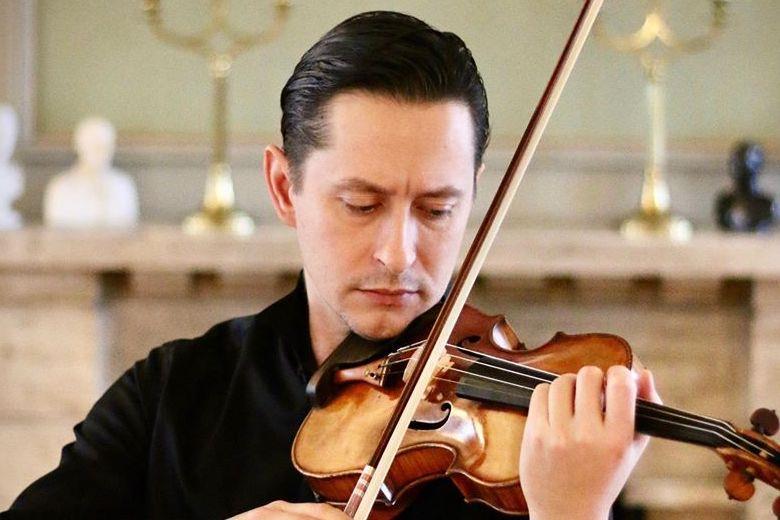
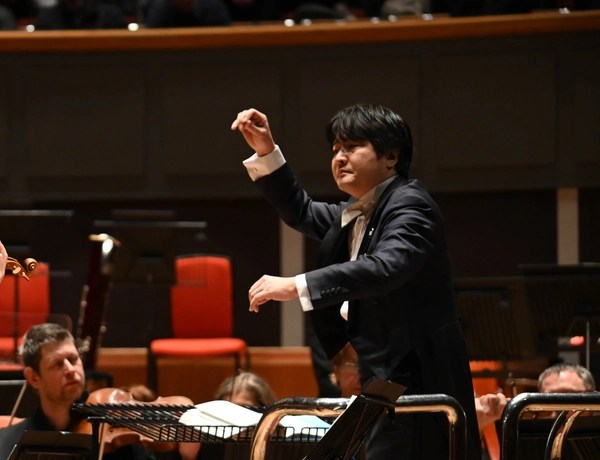
Eugene Tzikindelean (violin, above), City of Birmingham Symphony Orchestra / Kazuki Yamada (below)

Elgar Violin Concerto in B minor Op.61 (1909-10)
Walton Orb and Sceptre (1952-3)
Walton Symphony no.2 (1957-60)

Symphony Hall, Birmingham
Wednesday 4 December 2024

Reviewed by Richard Whitehouse

His tenure so far as music director of the City of Birmingham Symphony Orchestra has shown Kazuki Yamada to have real sympathy for British music, hence it was no surprise to encounter this programme of works by Elgar and Walton, which itself proved (unexpectedly?) satisfying.

Following on his highly regarded performances of Nielsen and Walton over previous seasons, CBSO leader Eugene Tzikindelean took on Elgar’s Violin Concerto for a reading which was fine if not consistently so. The opening movement, in particular, lacked forward momentum in its restless first theme so that not enough contrast was established with its rapt successor – the highlights being Yamada’s vigorous handling of its orchestral introduction and a development as powerfully sustained as it was combatively rendered. Tzikindelean was more fully at home with the central Andante, its variously reflective and heartfelt melodies drawn into a seamless continuity enhanced by a notably beguiling response from the CBSO woodwind. Whether or not the most profound of Elgar’s slow movement, this is arguably his most perfectly achieved.

The finale was, for the most part, equally successful – this being hardly the first performance setting off at a suitably incisive tempo, only to lose impetus once the poised second theme has entered the frame. Not that there was insufficient energy to make the emergence of its lengthy accompanied cadenza other than startling – this latter proceeding with a suffused mystery and poignancy, not least in recalling previous themes, as finds Elgar as his most confessional; the movement then resuming its earlier course as it surged on to a decisive and affirmative close.

Although his later orchestral works have never quite fallen into obscurity, Walton’s tended to fare better in the US than in the UK. Not least the coronation march Orb and Sceptre – all too easily denigrated next to the opulent grandeur of predecessor Crown Imperial, but evincing a jazzy lack of uninhibition and, in its trio, a suavity Yamada clearly relished in the company of an orchestra that made benchmark recordings with Louis Frémaux almost half a century ago. Even the latter could not summon the pizzaz conveyed here with that trio’s infectious return.

Walton’s Second Symphony has been equivocally regarded ever since its Liverpool premiere, but Yamada clearly harboured few doubts as to its conviction. The opening Allegro unfolded methodically if remorselessly, its main themes subtly yet meaningfully differentiated not least in bringing out the compositional mastery of sizable orchestral forces. Nor was there any lack of pathos in the ensuing Lento, its ominous tones denoting music shot through with intensely ambivalent emotion. Much the most difficult movement to sustain, the final Passacaglia was no less successful – Yamada binding its successive variations into a tensile if never inflexible whole, while making a virtue of Walton’s premise that a 12-note theme can resolve effortlessly in tonal terms at the peroration: a journey as fascinating as its destination proved exhilarating.

Interesting to note this concert was ‘being recorded for future release;, given the Walton was undoubtedly an account to savour. Yamada is back with the CBSO next week in a programme which pairs Mozart’s penultimate piano concerto and Bruckner’s (unfinished) final symphony.

For details on the 2024-25 season A Season of Joy, head to the City of Birmingham Symphony Orchestra website. Click on the names to read more about CBSO leader, violinist Eugene Tzikindelean – and the orchestra’s principal conductor Kazuki Yamada

Published post no.2,386 – Saturday 7 December 2024