

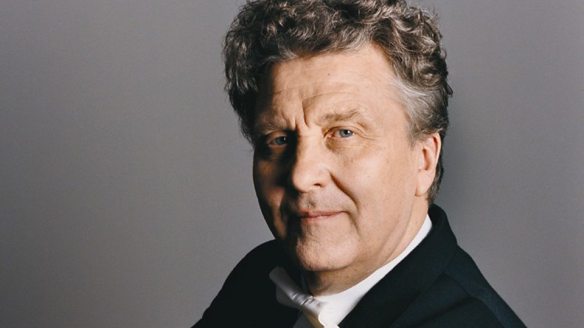
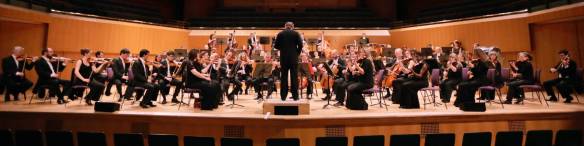
Benjamin Grosvenor (above, piano), City of Birmingham Symphony Orchestra / Vassily Sinaisky (below)
Symphony Hall, Birmingham
Thursday 25 October 2018 (matinee concert)
Wagner Der fliegende Holländer – Overture (1841)
Mozart Piano Concerto no.21 in C major K467 (1785)
Sibelius Symphony no.1 in E minor Op.39 (1899)
Written by Richard Whitehouse
It has often been remarked that concerts adhering to the once ‘standard’ format of overture, concerto and symphony are hardly frequent nowadays, so making this afternoon’s concert from the City of Birmingham Symphony Orchestra and Vassily Sinaisky the more welcome.
Wagner has always made for an effective curtain-raiser, not least his overture to The Flying Dutchman. Earliest of his acknowledged operas, its eventful 10 minutes fairly encapsulate the salient incidents and principal themes – not least in this performance, Sinaisky confirming his operatic credentials (in which capacity he has been regrettably little heard in the UK) with an assured reading; most perceptive in its approach to Senta’s eloquent ballad near the beginning and in its Tristanesque return during the closing bars such as Wagner transformed in revision.
A scaled-down CBSO was equally responsive in Mozart‘s K467, happily no longer indelibly associated with one of the dreariest 1960s films. Often at his most perceptive in 19th-century music, Benjamin Grosvenor is no slouch in Mozart and his performance – as was that at this year’s Proms with the BBCSO and Sakari Oramo – was full of felicitous phrasing, even if the formal focus of the imposing first movement was likely of Sinaisky’s choosing. The Andante was affecting without affectation, Grosvenor embedding the solo part closely into that of the orchestra, then the final rondo conjured up effervescence at a not unduly headlong tempo. All credit to Grosvenor in choosing cadenzas by Robert Casadesus (whose Mozart recordings are required listening) and for a limpid reading of Rachmaninov‘s Lilacs as his encore.
Although his ambivalent relationship with the Austro-German symphonic tradition has often been noted, Sibelius’s Russian heritage is often downplayed – yet his first two symphonies would be inconceivable without Tchaikovsky’s input. The First of these has been compared with the Pathétique in its epic and ultimately tragic nature, but the influence of the Russian’s Fifth Symphony feels even more overt in its sombre clarinet-led introduction and an Allegro with its ingenious take on the sonata format. Sinaisky duly has the measure of its brooding power and surging energy, then opted for a flowing account of the Andante that brought out its pathos and quixotic changes of mood without it seeming turgid or episodic. The Scherzo, too, had the requisite dynamism and, in its trio, an appealing whimsy that was deftly drawn.
The highlight, though, was the finale – most often the movement which fails to ignite by dint of its discursive structure. Yet ‘Quasi una Fantasia’ need not imply rhapsodic and Sinaisky treated it accordingly, characterizing its dramatic then fervent themes with due appreciation of their formal integration towards an impassioned climax whose fateful outcome was never in doubt. It helped that orchestral playing was of unwavering commitment, with the CBSO giving of its collective best in a piece which it has played frequently over the past 86 years.
It set the seal on a concert which was a reminder one that even a mainstream programme can surprise and engage when the constituents are thoughtfully planned and performances never less than responsive. The enthusiastic reception of a sizable house was its own confirmation.
For more information on future CBSO concerts head to their website


 Amy Beach was one of the first women composers to really make a lasting impression in classical music, terrible as that sentence sounds. Some of her songs are well known, in particular these three short settings of poetry by Robert Browning (31:02-33:50 on the broadcast). The first, The Year’s at the Spring! (31:02), was a rapturous picture postcard with which to throw open the doors, while Ah, Love, but a Day! (32:13) grew gradually higher in range, Schultz making the most of this with an exquisitely floated delivery. Finally I Send My Heart Up To Thee (33:50) was a joyful ray of light.
 This was followed by an extremely tasteful reading of Mozart’s Symphony no.34. This is a work that doesn’t get to poke its head above the parapet as much as its neighbouring ‘named’ symphonies in the composer’s output such as the Haffner and Linz. Wigglesworth chose his speeds well, so that the lovely Viennese textures were just the right density for Mozart’s lighter (but not lightweight) melodies. The energetic Hallé strings went well with the more graceful woodwind, particularly in the joyful finale, while the serene slow movement was also a highlight.
 Mahler’s Symphony no.4 is, on face value, his most ‘classical’, following traditions established by Schubert and the like, innovatively adding a soprano for the final movement, a child’s vision of heaven. Wigglesworth’s interpretation was carefully thought out and extremely well played, the woodwind of the Hallé rising to the considerable challenges posed by this deceptively difficult symphony.
 Arcana.fm