Eighty years ago today, two landmark operas of the 20th century received their world premieres.
Britten’s Peter Grimes, given its first performance at Sadler’s Wells under Reginald Goodall on 7 June 1945, is a breakthrough work in his output, one that would tie his music indelibly to the Suffolk coast. Telling the story of Grimes, the outcast fisherman, it captures the mysterious North Sea in rare clarity. You can read more about the opera’s history at my Good Morning Britten site, dedicated to the composer. The video links below are to a complete performance of the opera, with the Royal Opera conducted by Colin Davis:
Meanwhile the famous 4 Sea Interludes extracted from the work, Britten’s remarkably pictorial orchestral suite, are below – where you can follow the score:
Prokofiev‘s War and Peace is an altogether different beast – a mammoth project which first reached the public in the Great Hall of the Moscow Conservatory on 6 June 1945, where nine scenes from the opera were performed.
The finished opera is an epic dramatisation of Leo Tolstoy’s novel, which occupied Prokofiev from 1941 right up to the year of his death, 1953. Here is a famous recording conducted by Mstislav Rostropovich:
by Ben Hogwood Picture from the Bain Collection, Library of Congress
This day marks the centenary of the premiere of one of Prokofiev‘s most remarkable works, the Second Symphony. It was first performed in Paris on 6 June 1925, under the baton of Serge Koussevitsky.
It is difficult to imagine a work of greater contrast to the first symphony in the composer’s output, the much-loved ‘Classical’. Where that was a masterly updating of the classical style, bursting with good tunes, the Second initially impacts as a cacophony of noise and seemingly devoid of melody.
Listen more closely, however, and you will hear some distinctive themes beyond the bluster, some innovative orchestration and a highly original approach to form drawing initially from Beethoven’s 32nd and final piano sonata. Perhaps inevitably these qualities were lost on the first audience, who recoiled from the piece. Their reaction gave Prokofiev serious doubts about his ability as a composer.
Yet time has treated this piece relatively well, with no less a composer than Christopher Rouse showering it with praise. Listen below and see what you think:
Marie-Christine Zupancic (flute), Sebastian Heindl (organ), City of Birmingham Symphony Orchestra / Kazuki Yamada
Berlioz Le Corsaire Op.21 (1844) Takemitsu I Hear the Water Dreaming (1987) Respighi I Fontane di Roma P106 (1916) Saint-Saëns Symphony no.3 in C minor Op.78 ‘Organ’ (1886)
Symphony Hall, Birmingham Wednesday 4 June 2025
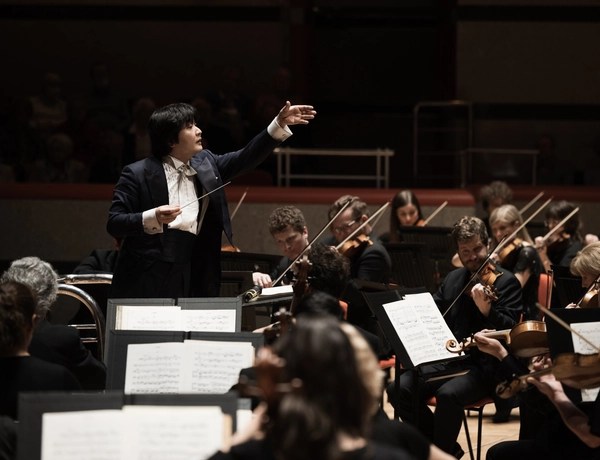
Reviewed by Richard Whitehouse Picture of Kazuki Yamada (c) Benjamin Ealovega
The dashing upsurge at the start of The Corsair launched this evening’s concert by the City of Birmingham Symphony Orchestra under its music director Kazuki Yamada in fine style. Nor was the pathos in this last of Berlioz’s concert overtures downplayed, and if the main portion lacked the pizzazz of illustrious predecessors, Yamada’s handling of the apotheosis proved an object-lesson in controlled spontaneity – setting the seal on a fine account of a piece that long -standing attendees will recall as a favourite of one-time principal conductor Louis Frémaux.
The music of Tōru Takemitsu was often heard in the era of Simon Rattle, but not I Hear the Water Dreaming. Taking its cue (along with other works of this period) from the ‘Dreamtime’ tradition of Aboriginal art, here a painting from the Papunya region of Western Australia, this short though eventful piece typifies its composer’s final creative phase – the formerly radical tendencies from previous years not so much disowned as finding an accommodation with the impressionist leanings of his earliest maturity. A sonic canvas, moreover, against which solo flute pursues its capricious course, with only a hint of something more confrontational either side of the cadenza-like passage towards its close. Certainly, this was music to which Marie-Christine Zupancic (taking time out as the CBSO’s first flute) sounded unerringly attuned.
CBSO regulars will recall Yamada presenting the whole of Respighi’s ‘Roman Triptych’ at a memorable concert four years ago. Tonight, Fountains of Rome rounded off the first half in a performance at its best in the effervescence of Triton at Morning or the dazzling majesty of Trevi at Midday, fading as if suspended in the Symphony Hall ambience. If Valle Giulia at Dawn felt a little passive in its allure, the enfolding serenity of Villa Medici at Sunset was fully sustained – the delicacy and suppleness of its entwining melodic lines accorded full rein.
The CBSO has been identified with Saint-Saëns’s Organ Symphony since Frémaux’s lauded recording of half-a-century ago, and it remains a work in which this orchestra excels. Yamada was (rightly) intent on stressing its symphonic cohesion, drawing ominous expectancy from the first part’s introduction and building no mean momentum in its ensuing Allegro. Sebastian Heindl’s hushed entry duly set the tone for a raptly eloquent slow movement, measured while never sluggish as it headed toward its heartfelt climax then on to a coda of bittersweet repose.
There was no lack of incisiveness or humour in the scherzo which opens the second part – its scintillating passagework for piano duet artfully integrated into the orchestral texture, with an ideally paced link into the finale with its indelible main melody and methodical build-up to a majestic peroration. Those thunderous initial chords aside, Heindl made less of an impact than might have been expected, but his always resourceful choice of registrations underlined the extent to which both he and Yamada continually had the ‘bigger picture’ uppermost in mind.
Overall, then, a concert which manifestly played to this orchestra’s collective strengths. The CBSO is back next week with its former music director Mirga Gražinytė-Tyla for what will be only a second UK performance, 63 years after the first, for Weinberg’s Fifth Symphony.
Last week we learned of the sad loss of influential Danish composer Per Nørgård, at the age of 92. Nørgård was regarded as one of the finest living composers, and you can read why in a tribute from his publishers Wise Music Classical.
Having written in a wide variety of forms, and imposed his direct and fiercely individual style on each, here is a playlist to reflect some of Nørgård’s musical achievements:
Cellist Peter Gregson releases a self-titled album, his most profound and direct expression yet.
This is partly because his set-up is a very personal one, his cello complemented by a homemade synthesizer. As he describes in the press release, “A modular synthesizer typically would have an oscillator, and then go into filters, maybe a sequencer, reverb, delays – things to create a complete sound world”.
The synthesizer is entirely in thrall to the cello, with a mic input allowing him to use every sound the cello makes, at a wide range of frequencies, for expressive purposes. This he does on the album, with nine fluid and personal pieces.
What’s the music like?
Intimate – but with surprising and pleasing twists and turns along the way.
Vision is cleverly realised and highly expressive, using treated pizzicato to good effect from the outset.
Constellation repeats the trick but with a more obviously poppy riff, the pizzicato supporting a songful line, over which Gregson develops an appealing electronic chatter that becomes ever more mesmerising.
Song is at the heart of utterances such as Ritual and Prayer, which by their titles are more inward looking pieces but where Gregson also reveals the influence of composers who wrote more explicitly for the cello, such as Ernest Bloch.
Does it all work?
Yes, it does – Gregson plays with a beautiful sound, and the electronic enhancements are tastefully and thoughtfully applied.
Is it recommended?
It is, both for those looking for periods of reflection and for listeners who enjoy the creative process laid bare..
For fans of… Max Richter, Julia Kent, Nils Frahm, Ryan Teague





 Arcana.fm