Unknown's avatar

About Arcana

My name is Ben Hogwood, editor of the Arcana music site (arcana.fm)

In concert – Susan Bullock & Richard Sisson @ Bechstein Hall, London

Susan Bullock (soprano), Richard Sisson (piano)

Bechstein Hall, London, 21 February 2025

by John Earls. Photo credit (c) John Earls

There can’t be that many connections between Richard Wagner and the Great American Songbook, but Susan Bullock is one of them.

The revered British soprano has appeared as Wagner’s Brünnhilde in opera houses around the world, and has also performed the role of Isolde.

Last year she and pianist Richard Sisson released Songs My Father Taught Me, an album of songs from and inspired by some of the classics from the Great American Songbook, and that formed the basis of this wonderful recital at the shiny new Bechstein Hall in London’s Wigmore Street (a stone’s throw from Wigmore Hall).

It was clear from the start the genuine affection and affinity both musicians have for these songs. Bullock’s father was, she tells us, “a policeman by day and a wannabe Bing Crosby by night”. Sisson’s grandmother was a fan of the classic musicals.

I’ve Got the World on a String (Harold Arlen and Ted Koehler) and Hello Young Lovers (Rodgers and Hammerstein) were a fine opening to the show, before Sisson drew the audience’s attention to the full programme listing displayed on the digital notice boards in the hall – “the writing’s on the wall. It’s like Belshazzar’s feast!”

And what a programme! In the first set alone we had greats from Rodgers and Hart (My Funny Valentine), George and Ira Gershwin (‘S Wonderful) and Jerome Kern and Oscar Hammerstein (Bill and Can’t Help Lovin’ That Man), as well as a zingy What About Today (David Shire).

There was also a gorgeous Bewitched, Bothered and Bewildered (Rodgers and Hart) and a charged If I Loved You (Rogers and Hammerstein) with Bullock ranging from whisper to exhortation and Sissons eulogising afterwards about the amazing “symmetrical chords”.

The first half finished with a fabulous One for My Baby with Bullock playing the part perfectly, sat at the piano looking weary before finally walking down the aisle still singing to exit out the back door.

Alas, Bullock was not to be seen nursing ‘one for the road’ in the bar during the interval but thankfully returned for an excellent second set. This started by acknowledging some great heirs to the American Songbook. Firstly, Stephen Sondheim (Oscar Hammerstein II was a mentor to Sondheim and something of a surrogate father) with a moving Send in the Clowns, a very humorous The Boy From… and a dramatic Losing My Mind. This was followed by a beautiful arrangement and performance of Bert Bacharach and Hal David’s A House Is Not a Home.

A warm The Folks Who Live on the Hill (Kern and Hammerstein) was then followed by a magical medley from songwriters featured earlier – Stormy Weather, The Man I Love, All the Things You Are, What’s the Use of Wond’rin’ plus Tommy Wolf and Fran Landesman’s The Ballad of the Sad Young Men.

Of course these songs have wonderful tunes and beautiful melodies, which is why they have been, and continue to be, frequently covered as instrumentals, particularly by some of the jazz greats. But they also have stunning lyrics that can be touching, witty and poetic. One could grab lines from any of the songs in this programme but Sisson made a particular reference to the lyrics of The Ballad of the Sad Young Men. Take these closing lines:

While a grimy moon, watches from above
All the sad young men, who play at making love

Misbegotten moon shine for sad young men
Let your gentle light guide them home again
All the sad, sad, sad, young men.

The show ended with a delightful take on the Gershwins’ Let’s Call the Whole Thing Off and a moving encore of You’ll Never Walk Alone from Rodgers and Hammerstein’s Carousel.

This was a superb celebration of magnificent songs. Bullock’s singing was expressive and crystal clear, Sisson’s piano accompaniment was wonderfully balanced with some lovely flourishes. These great songs have endured for a reason. And with advocates and performances such as this they will be around for a good while yet.

John Earls is Director of Research at Unite the Union. He posts on Bluesky and tweets / updates his ‘X’ content at @john_earls

Published post no.2,454 – Sunday 23 February 2025

In concert – Hyeyoon Park, CBSO / Alexander Shelley: Gershwin, Florence Price, Ravel & Stravinsky

Hyeyoon Park (violin, above), City of Birmingham Symphony Orchestra / Alexander Shelley (below)

Gershwin An American in Paris (1928)
Price Violin Concerto no.2 in D minor (1952)
Price arr. Farrington Adoration (1951)
Ravel Le Tombeau de Couperin (1914-17, orch. 1919)
Stravinsky The Firebird – suite (1910, arr. 1919)

Symphony Hall, Birmingham
Thursday 20 February 2025 (2:15pm)

Reviewed by Richard Whitehouse

Although he holds major posts in Canada and Naples and has a longstanding association with the Royal Philharmonic, Alexander Shelley seems not previously to have conducted the City of Birmingham Symphony Orchestra, and this afternoon’s concert made one hope he will return soon.

An American in Paris was a tricky piece with which to open proceedings, but here succeeded well on its own terms. Somewhere between tone poem and symphonic rhapsody, Gershwin’s evocation of a compatriot (maybe himself?) not a little lost in the French capital was treated to a bracingly impulsive and most often perceptive reading. A slightly start-stop feel in those earlier stages ceased well before Jason Lewis’s eloquent though not unduly inflected take on its indelible trumpet melody, with the closing stages afforded a tangible sense of resolution.

Much interest has centred over this past decade on the music of Florence Price – the Chicago-based composer and pianist, much of whose output was thought lost prior to the rediscovery of a substantial cache of manuscripts in 2009. One of which was her Second Violin Concerto, among her last works and whose 15-minute single movement evinces a focus and continuity often lacking in her earlier symphonic pieces (not least a Piano Concerto which Birmingham heard a couple of seasons ago). Its rich-textured orchestration (but why four percussionists?) is an ideal backdrop for the soloist to elaborate its series of episodes commanding, ruminative then impetuous, and Hyeyoon Park made the most of her time in the spotlight for an account that presented this always enjoyable while ultimately unmemorable work to best advantage.

The concerto being short measure, Park continued with an ideal encore. Written for solo organ, Price’s Adoration was given in Iain Farrington’s arrangement that brought out its elegance and warmth, if also an unlikely resemblance to Albert Fitz’s ballad The Honeysuckle and the Bee.

After the interval, music by composers from whom Gershwin had sought composition lessons when in Paris. Orchestral forces duly scaled down, Ravel’s Le Tombeau de Couperin was at its best in a deftly propelled Forlane, the alternation of verses with refrains never outstaying its welcome, then a Menuet whose winsome poise – and delectable oboe playing from Hyun Jung Song – emphasized the ominous tone of its central section. The Prélude was a little too skittish, while a capering Rigaudon was spoiled by an excessive ritenuto on its final phrase.

Interesting how the 1919 suite from Stravinsky’s The Firebird has regained a popularity it long enjoyed before renditions of the complete ballet became the norm. Drawing palpable mystery from its ‘Introduction’, Shelley (above) secured a dextrous response in Dance of the Firebird then an alluring response from the woodwind in Khovorod of the Princesses. Contrast again with the Infernal Dance of King Kashchei, even if its later stages lacked a measure of adrenalin, then the Berceuse had a soulful contribution by Nikolaj Henriques and fastidiously shaded strings. Hardly less involving was the crescendo into the Finale, started by Zoe Tweed’s poetic horn solo and culminating in a peroration with no lack of spectacle. It made an imposing end to this varied and cohesive concert, one that confirmed Shelley as a conductor with whom to reckon.

For details on the 2024-25 season A Season of Joy, head to the City of Birmingham Symphony Orchestra website. Click on the names to read more about violinist Hyeyoon Park, and conductor Alexander Shelley, or for more on composer Florence Price

Published post no.2,453 – Saturday 22 February 2025

In concert – Mark van de Wiel, Philharmonia Chamber Players – Gipps & Weber

Philharmonia Chamber Players [Mark van de Wiel (clarinet, above), Eugene Lee, Fiona Cornall (violins), Scott Dickinson (viola), Karen Stephenson (cello)]

Gipps Rhapsody in E flat major (1942)
Weber Clarinet Quintet in B flat major Op.34 (1811-15)

Royal Festival Hall, London
Thursday 20 February 2025

Reviewed by Ben Hogwood Picture of Mark van de Wiel (c) Luca Migliore

This free concert in the Royal Festival Hall was a breath of fresh air. Bolstered by visitors, the auditorium was a heartening two-thirds full, the audience made up of families, tourists and workers seeking musical enlightenment. Yours truly fell into the latter category!

The Philharmonia Orchestra have played to this type of crowd for decades now, either by way of introduction to their evening concerts (like this one) or providing a standalone concert focusing on a particular composer (Music of Today) or instrument.

In this instance they covered all bases, with music for clarinet and string quartet introduced from the stage by principal clarinet Mark van de Wiel. The ensemble began with a relative rarity, Ruth GippsRhapsody in E flat major only coming in from the cold in recent years. Dedicated to her fellow RCM student and future husband, Robert Baker, it is an attractive piece with affection evident from its soft, pastorally inflected first statement. However Gipps’ folk-inspired variant on the opening theme steals the show, firstly heard on cello then subsequently joined by its companions, the clarinet finally singing eloquently over pizzicato strings.

In his talk Van de Wiel’s love of the piece was evident, before he introduced another sleeping giant, Weber’s Clarinet Quintet. Often sitting in the shade of its illustrious companions by Mozart and Brahms, this winsome piece – written for clarinettist Heinrich Baermann – demonstrates just how far the instrument had progressed in the two decades since Mozart’s Clarinet Concerto.

Van de Wiel demonstrated how his clarinet, with 17 keys, was at an advantage to that of Baermann’s ten, in theory reducing the difficulty. His modesty, however, was made clear in the virtuoso demands Weber still makes on the instrument, a fully-fledged soloist, with all manner of tricks up its sleeve.

To Weber’s credit this is not at the expense of musical quality or emotional impact, for although we enjoyed some flights of fancy in the first movement Allegro there was plenty of feeling in the dialogue between clarinet and string quartet. A tender, operatic second movement followed, then an airy and enjoyably mischievous Menuetto rather fast for dancing perhaps but charming all the same. Then came the brilliantly executed finale, living up to its Allegro giojoso marking as Van de Wiel mastered Weber’s increasingly athletic demands with flair and musicality.

Happily both pieces have been recorded as part of a new album forthcoming from the quintet on Signum Classics, where they will team this repertoire with Anna Clyne’s Strange Loops. If the performances match these live accounts, they will constitute a fine document from one of Britain’s very best clarinettists. As though to confirm this, the assembled throng left wreathed in smiles.

For details on the their 2024-25 season, head to the Philharmonia Orchestra website

Published post no.2,452 – Friday 21 February 2025

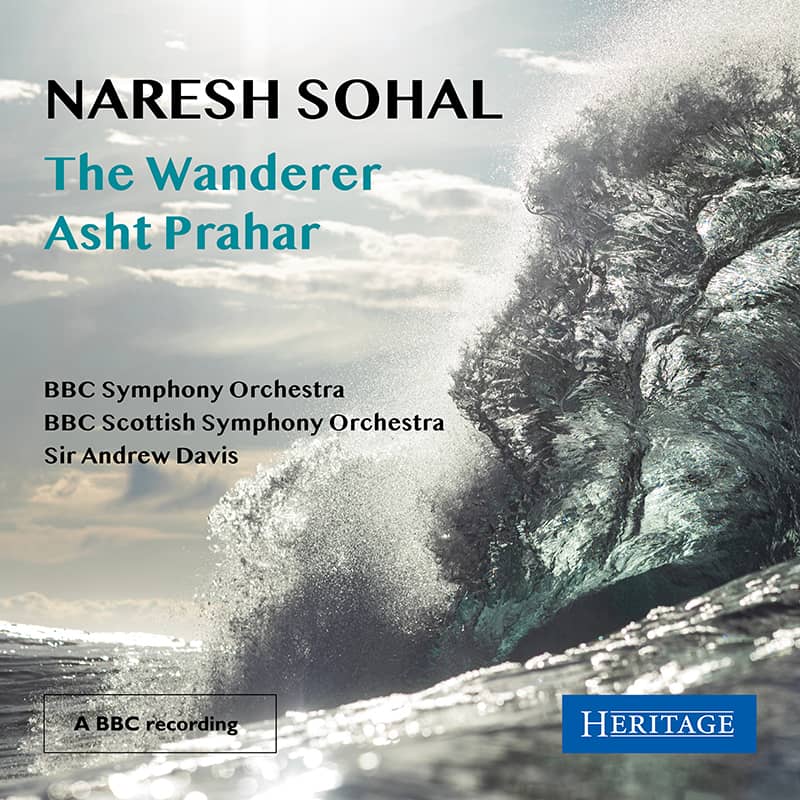
On Record – BBC SSO & BBC SO / Sir Andrew Davis – Naresh Sohal: The Wanderer & Asht Prahar (Heritage)

Naresh Sohal
Asht Pradar (1965)
The Wanderer (1982)

Jane Manning (soprano), BBC Scottish Symphony Orchestra (Asht Pradar), David Wilson-Johnson (baritone), BBC Symphony Chorus and Orchestra (The Wanderer) / Sir Andrew Davis

Heritage HTGCD135 [77’36”] English text included
Remastering Engineer Paul Arden-Taylor

Broadcast performance from BBC Studios, Glasgow on 6 January 1973 (Asht Pradar); live performance from Royal Albert Hall, London on 23 August 1982 (The Wanderer)

Reviewed by Richard Whitehouse

What’s the story?

Heritage issues what will evidently be an ongoing series of archival releases devoted to the music of Naresh Sohal, taken from BBC sources and featuring performers who championed his work over a career whose achievement is not reflected in the availability of recordings.

What’s the music like?

Although he came belatedly to the UK, Sohal (1939-2018) rapidly made up for any lost time when arriving in London in 1962 (further biographical detail can be found in the booklet note for this release and on the composer’s website). Within three years, he had produced his first major (and latterly his first acknowledged) work. Asht Prahar then had to wait until 1970 for its premiere (at the Royal Festival Hall conducted by Norman Del Mar), but it attracted much favourable attention and led to another hearing three years on – the performance featured here.

Taking its cue from the Indian sub-division of the day into eight temporal units (four each for day and night), Asht Prahar unfolds its eight sections as an unbroken continuity. The sizable forces are, for the most part, used sparingly yet resourcefully; as too the deployment of such devices as quarter-tones, along with influences of Ravel and Stravinsky, in music that makes a virtue of its pivoting between East and West. Cyclical if not necessarily cumulative, its final and longest ‘prahar’ brings wordless soprano and orchestra into tangible and haunting accord.

By the time that The Wanderer received its premiere, Sohal had a number of major works to his credit and rationalized his musical idiom accordingly. Setting an anonymous Anglo-Saxon poem in which the male protagonist speaks movingly and often despairingly of his isolation – both physical and spiritual – after the death of his lord, the work divides into two large parts that expand on the narrative’s emotional import. Such ‘‘existential bleakness’’ is intensified by omission of the poem’s last lines with their invoking a specifically Christian consolation. Despite its more than 50-minute duration, there is nothing discursive or unfocussed about The Wanderer’s content. Much of its text is understandably allotted to the baritone, whose austere character is complemented by darkly rhetorical choral passages while offset by an orchestral component with much soloistic writing (notably for flute) in a texture the more involving for its restraint and its strategic use of colour to define specific incidents or emotional responses. Nor is this an opera-manqué, the work succeeding admirably on its inherently abstract terms.

Does it all work?

It does, allowing for the fact that Sohal is not seeking any overt fusion between Occident and Orient, but rather attempting to forge a personal idiom influenced by both while beholden to neither. Both these performances bear out his convictions, Jane Manning adding her ethereal presence to Asht Prahar and David Wilson-Johnson bringing evident compassion to his more substantial role in The Wanderer. Both works benefit from the insightful presence of the late Sir Andrew Davis, whom one regrets never had an opportunity to record them commercially.

Is it recommended?

It is. The sound of these broadcasts has come up decently in remastering, lacking only the last degree of clarity or definition, and Suddhaseel Sen contributes informative annotations. Those looking for a way into Sohal’s distinctive and alluring sound-world need no further incentive.

Listen & Buy

For purchase options, you can visit the Heritage Records website

Published post no.2,451 – Thursday 20 February 2025

In appreciation – György Kurtág at 99

by Ben Hogwood Picture of György Kurtág (c) Filarmonia Hungaria

This is a post in honour of the remarkable composer György Kurtág, celebrating his 99th birthday today.

You can read about his work with baritone Benjamin Appl in an interview published on Arcana last week, but to get some appreciation of Kurtág’s remarkable music, here are a few pointers:

It is perhaps a bit restrictive trying to listen to Kurtág’s music via a YouTube link, so if you can find a widescreen system to play Grabstein für Stephan on then I fully recommend it. Following the score will show just how imaginative his orchestration is, and how compressed and concentrated the music becomes.

Meanwhile the Microludes, for string quartet, encapsulate Kurtág’s economical and pinpoint style, pieces whose every move and aside is critical to the whole.

One of my favourite live experiences was watching Kurtág and his now late wife Márta play exquisite duets at the Wigmore Hall for the composer’s 80th birthday. It was like eavesdropping on a private conversation between two intimately connected souls, no more so than when they were playing Kurtág’s own arrangements of J.S. Bach:

Published post no.2,450 – Wednesday 19 February 2025