Live review – Kensington SO / Russell Keable: William Schuman 3rd Symphony, Adams, Bernstein & Tower

Kensington Symphony OrchestraRussell Keable (above)

St. John’s, Smith Square, London. Monday October 15, 2018

Tower Fanfare for the Uncommon Woman No. 1 (1986)
Bernstein Divertimento (1980)
Adams Doctor Atomic Symphony (2007, rev 2008)
Schuman Symphony No. 3 (1941)

Written by Richard Whitehouse

The Kensington Symphony Orchestra‘s 63rd season got off to a most impressive start with tonight’s concert of American music (simultaneously continuing the Americana ’18 festival taking place at St John’s during this year), opening with the Fanfare for the Common Woman with which Joan Tower launched her wider reputation over three decades ago. Rhythmically bracing while not without harmonic subtlety, it provided a fitting showcase for the KSO brass and percussion as well as a pertinent tribute to this composer in the year of her 70th birthday.

Leonard Bernstein‘s centenary was marked with his Divertimento, seven succinct movements that touch upon most of his salient traits and a reminder that his latter-day creativity was one where less equals more. Highlights include a delectable Waltz (enjoying frequent exposure on Classic FM), wistful Mazurka, evocative Blues then a rousing March: The BSO Forever whose Johann Strauss take-off duly makes for an uproarious close. Suffice to add the KSO was not found wanting in a piece written for the Boston Symphony’s own 100th birthday.

As Russell Keable‘s opening remarks made plain, John Adams’s Doctor Atomic Symphony was an altogether more serious proposition. First heard at the 2007 Proms, the rather diffuse 45-minute work in four movements was duly streamlined into a continuous structure lasting barely half an hour. Surprising, then, that the result seems less than cohesive – its reworking of material from the composer’s third opera one of cinematic contrast than symphonic unity. Some of his most virtuoso orchestral writing, which the KSO tackled with relish, is hampered by the recourse to post-minimalist gestures that remain Adams’s (unwitting?) stock-in-trade. Even the final section, a setting of John Donne‘s sonnet Batter my heart with its baritone part taken by trumpet (here the mellifluous Stephen Willcox), felt less than truly affecting.

After the interval, a welcome revival (likely the first in London for two decades) for William Schuman‘s Third Symphony. One of a triumvirate of such pieces by American composers to emerge either side of the Second World War, it evinces a formal integration and expressive panache that its composer never surpassed – not least in the way its four movements are arranged in two larger parts such as complement each other unerringly, and with a steadily accumulating momentum which emerges across the whole in what is itself a marvel of tensile dynamism.

Keable delineated the variations of the initial Passacaglia with assurance, ensuring textural clarity here and in the ensuing Fugue while underlining how the numerous woodwind and brass solos emerge naturally from the string polyphony rather than sounding laminated onto it. Nor was there any lack of emotional poise with the Chorale, its understated eloquence in contrast to the inexorably mounting impetus of the closing Toccata whose final pages are as visceral as any in the symphonic literature – not least when rendered with such verve as here.

A memorable reading of a seminal though under-appreciated piece such as the KSO has long championed. Hopefully future seasons will see revivals of comparable American works – the Second Symphony of Roger Sessions and Seventh (Variation) Symphony of Peter Mennin.

For further information on the Kensington Symphony Orchestra you can visit the orchestra’s website

Live review – Nash Ensemble: War’s Embers – Elgar Piano Quintet & John Ireland Piano Trio no.2

Nash Ensemble (above) [Ian Brown (piano), Stephanie Gonley, Michael Gurevich (violins), David Adams (viola), Adrian Brendel (cello) (N.B. the line-up pictured above is not the same as the one appearing at this concert)

LSO St Luke’s, Friday 12 October 2018 (lunchtime concert)

Ireland Piano Trio no.2 (1917)
Elgar Piano Quintet in A minor Op.84 (1918)

Written by Ben Hogwood

The First World War had a profound effect on composers of classical music. Many of them served or were closely involved with the conflict, and even those who weren’t used their music as a vehicle for the shock and dismay felt at the turn of events.

John Ireland expressed his horror through two chamber works completed in 1917, the Violin Sonata no.2 and the Piano Trio no.2. The latter work began this concert from the Nash Ensemble, part of their War’s Embers series focusing on music written around the War in England. Set in one compact movement, it is a powerfully expressive utterance, even when the music is quiet – as it was when the first cello melody began – to when it reaches peaks of intensity in the march sections, depicting the war itself. Ian Brown, Stephanie Gonley and Adrian Brendel were united in voice, their three instruments often linked in melody, while Brendel’s eloquent solo at the start set the solemn tone.

Stylistically the work draws part of its inspiration from Debussy and Ravel, and these links were nicely played up by the trio, but the opening music dominated to the point of obsession, sweeping all before it. As evidenced in an interview with BBC Radio 3 host Fiona Talkington after the performance, the players had a clear understanding of Ireland’s writing, and his still underrated status in chamber music form.

Ireland’s trio was first heard at the Wigmore Hall in June 1917, and at the same venue nearly two years later audiences heard the premiere of Sir Edward Elgar’s Piano Quintet. Composed in Sussex, this autumnal work, written just prior to the Cello Concerto, reflects a fascination the Elgars held with a group of dead trees in Flexham Park, their branches twisted ‘in an eerie manner’.

The spidery tendrils of the first few bars reflected this eerie vision, and refused to release their grip on the piece despite a first movement that really got into top gear in this performance, passionately played and majestically poised. There was an affecting second theme before we heard for the first time some Spanish rhythms, also inspired by legend around the dead trees and refracted through a prism in Elgar’s mind, strangely sketched but never fully coloured-in.

The relative serenity of the slow movement, was countered by an emotional distance, as though here Elgar was conscious of the War, itself audible to him through the use of artillery just across the Channel. Perhaps because of this the trees made themselves known in closer proximity as the finale began, though here Elgar – and the Nash Ensemble – threw off the shackles to power through to an upward looking conclusion.

This was a fine performance of a work the Nash – and certainly Ian Brown – have had in their repertoire for more than 25 years. Brown displayed a natural instinct with the tricker phrases and was helped by a lovely string tone from the quartet in a performance that made sense of some of Elgar’s more distorted rhythms.

War’s Embers will come to BBC Radio 3 on Tuesday 13 November and I urge you to hear it, placing this elusive work in the context of a fine performance.

Further listening

You will be able to listen to this concert on BBC Radio 3 on Tuesday 13 November. In the meantime recordings of the works heard are on the Spotify playlist below:

For further information on the Nash Ensemble’s War’s Embers series, visit the diary section on the ensemble’s website

Live review – Yulianna Avdeeva, CBSO / Constantinos Carydis – Skalkottas, Tchaikovsky & Beethoven

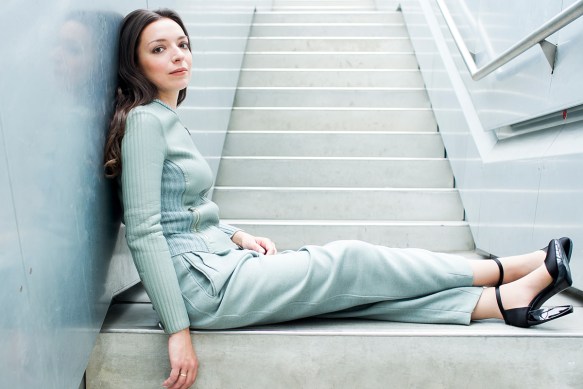
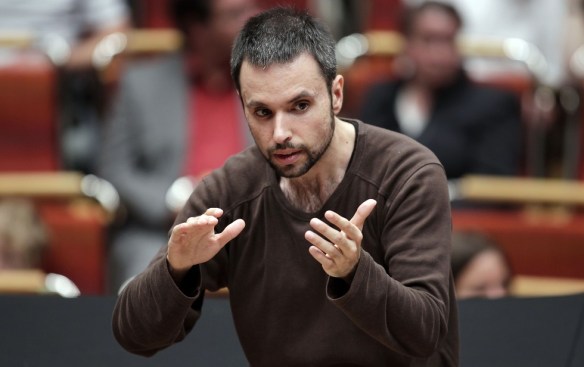
Yulianna Avdeeva (below, piano), City of Birmingham Symphony OrchestraConstantinos Carydis (above)

Photo credits: Thomas Brill (Constantinos Carydis), C Schneider (Yulianna Avdeeva) 

Symphony Hall, Birmingham. Thursday October, 2018

Skalkottas Four Images (1948)
Tchaikovsky Piano Concerto no.1 in B flat minor Op.23 (1875)
Koukos In Memoriam Y. A. Papaioannou (1989)
Beethoven Symphony no.7 in A major Op.92 (1812)

Written by Richard Whitehouse

Conductors are not obliged to programme their compatriots, though Constantinos Carydis certainly rang the changes by including music by Nikos Skalkottas (1904-49) – who, along with Xenakis, is undoubtedly the leading Greek classical composer from the 20th century.

Nor is the City of Birmingham Symphony unacquainted with his work, having given the first complete performance of his First Symphonic Suite in 1972. That piece typifies the intricate, serially-derived music of his earlier maturity, whereas the Four Images comes from his last years when tonal music predominated. Derived from a longer ballet score for piano, these characterful miniatures amply evoke folk scenes (without using actual folk themes) in a way recalling Bartók’s Dance Suite or, more directly, the dances from Ginastera‘s ballet Estancia.

Carydis accordingly had their measure – whether the forceful rhythms and acerbic harmonies of The Harvest, or wistful pathos of The Sowing with its resplendent, bell-capped climax. After this, The Vintage provides a scherzo of no mean propulsion and Carydis was right to lead directly into The Grape Stomping for a finale of scintillating vigour and impetus. Such were the qualities that the CBSO brought to this music, in what was a captivating account of a piece which could easily become as familiar as those aforementioned given such advocacy.

Tchaikovsky’s First Piano Concerto has never wanted for exponents, so credit to Yulianna Avdeeva for her engaging perspective on music to which the ‘war-horse’ epithet is too often applicable. The indelible opening melody was majestic without being portentous, with the imposing first movement convincingly held together so that the accrued momentum carried through to a searching take on its lengthy cadenza. There was no lack of deftness during the Andantino, replete with woodwind playing of real elegance, while the finale had energy to spare on its way to a surging peroration. This is an impressive interpretation in the making.

As well as his illustrious forebears, Carydis was intent on promoting the music of his Greek contemporaries. Well regarded for his operas, Periklis Koukos (b.1960) is little known in the UK, but the tribute to his teacher In Memoriam Y. A. Papaioannou suggests a composer of no mean eloquence – this threnody for strings not a little redolent of Nino Rota in its restrained sentiment, and a solo violin part that leader Anna-Liisa Bezrodny rendered with ideal poise.

Carydis then headed directly into Beethoven’s Seventh Symphony, here given a reading that was always invigorating and often electrifying. Dynamic contrasts occasionally verged on the contrived, and the repeat of the scherzo’s hymnal trio was almost parodic in its stateliness, but these were outweighed by the power and incisiveness elsewhere. Carydis drove the CBSO hard in the finale, but the players admirably rose to the challenge – antiphonal violins to the fore as the coda reached its visceral culmination. Whatever its inconsistencies, this was a performance to reaffirm the greatness of this music, as an enthusiastic reception testified.

A persuasive programme of the evergreen and unfamiliar. Should Carydis include Skalkottas’ ballet The Maiden and Death in a future engagement with the CBSO, then so much the better.

Tonight’s concert will be repeated at Symphony Hall on Sunday 7th October at 3pm. For more information on future CBSO concerts head to their website

Live review – O/Modernt / Hugo Ticciati at Kings Place: Looping Time

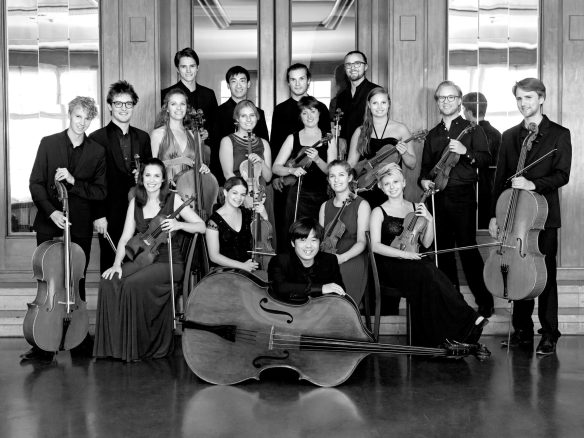
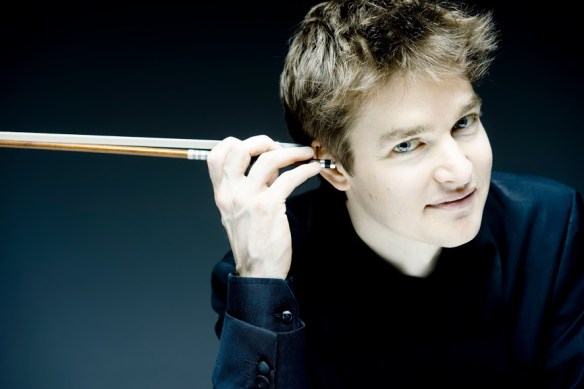
O/Modernt (above) / Hugo Ticciati (below)

Hall One, Kings Place, Friday 21 September 2018

Tüür Violin Concerto no.2 Angel’s Share (2018)
Adams Shaker Loops (1978)
Pérotin arr. Johannes Marmén Viderunt omnes (c1200)
Glass Symphony no.3 (1995)

Written by Ben Hogwood

The Time Unwrapped series at Kings Place has dealt out a number of very interesting concerts. This program from the young Swedish-based but European-sourced O/Modernt chamber orchestra combined established minimalist forebears with new interpretations of working with small musical cells – or waveforms as the program called it.

In a change to the order of the program we began with the Violin Concerto no.2 of Erki-Sven Tüür, premiered in the composer’s native Estonia earlier this year. Tüür has an intriguing past where progressive rock meets classical, and it has furnished him with a very strong sense of dramatic structure and the gift for vivid storytelling. This work, subtitled Angel’s Share, was all about interpreting the gap of air that appears in the barrel during the ageing of whisky, and how that can be applied to the wisdom of an adult as they grow older, ‘letting go of the unpleasant tastes’ in the words of the composer.

Cannily he captured this in musical terms, culminating with the release of the cork at the start of the concerto’s third movement, where the (sadly unnamed) percussionist dealt a striking blow. The start employed the other end of the percussive spectrum, with a high metallic note from which Ticciati’s solo part germinated. The soloist was superb, inhabiting the part and its distinctive figures, while the strings’ counterpoint was consistently absorbing and meaningful, right up to the affirmative finish. It would be great to hear this work again soon, and certainly those present appreciated it – among them violinist Fenella Humphreys.

John AdamsShaker Loops followed, a relatively early minimalist classic from 1978 that remains a success in concert. The near-constant tremolos require great stamina and control on the part of the string players, but that was never an issue with the 19-strong orchestra here, who danced and shimmered in tune with a sensitively handled light display. Double bassists Ben Griffiths and Jordi Carrasco Hjelm were the rock on which the three-movement piece stood, but the way the slower lines undulated over the top was particularly affecting, capturing the deep spiritual roots of the piece – which is after all a representation in music of ‘shaking’. Adams is in thrall to Sibelius when he writes for strings in this way, but the harmonic language is an extension and has a distinctly wide-open, American feel. Ticciati and his charges took us out onto that plain.

Johannes Marmén‘s arrangement of Pérotin’s Viderunt omnes opened the second half, a curiousity that showed how even in the 1200s music had minimalist tendencies. On occasion it was difficult to see Perotin’s original thinking, however, as the arrangement took hold, but the final paragraph from the double basses took us back into his world. It showed how ancient and modern can still integrate – we use largely the same notes after all – and how both are still relevant and complement each other. The fly in the ointment, unfortunately, was extraneous but unidentified noise from the roof of Hall One that threatened to disrupt the performance.

Ticciati had to acknowledge it with a rueful smile before moving straight into the jewel of tonight’s crown, Philip Glass’s Symphony no.3. The previous work in his symphonic output is on Brucknerian dimensions, running for nearly an hour, but in the Third Glass compresses his musical argument into an impressive, cohesive whole. O/Modernt got right to the heart of the small cells that are cleverly manipulated here, but also found the deep emotion of the central Chaconne, which has a dark heart but opens out with major key harmonies to find greater optimism – before going back into the minor key again. It is an ebb and flow that proves extremely affecting on repetition, and was the centrepiece of a fine performance, whose outer movements showed the virtuosity of these string players to the highest degree.

This was a very fine concert and an ideal showcase for minimalism as an extremely valid form of composition, showing also that there is a sizable library beyond the works of Steve Reich. By way of an encore we had Rufus Wainwright in the style of John Adams, his song Across the Universe played with beautiful precision and lovingly directed by Ticciati.

London Sinfonietta 50th Anniversary Concert

Tamara Stefanovich (piano), Simon Haram (saxophone), London Sinfonietta , London Sinfonietta Academy Alumni / David Atherton, George Benjamin, Vladimir Jurowski

Birtwistle The Message (2007)
Stravinsky Octet (1923)
Ligeti Chamber Concerto (1970)
Deborah Pritchard River Above (2018) (World premiere)
Samantha Fernando Formations (2018) (World premiere)
Abrahamsen Left, alone for piano (left hand) & orchestra (2015) (London premiere)
Various Encore! (14 Variations on a Hornpipe by Purcell) (2018) (World premiere)

Royal Festival Hall, London; Wednesday 24 January 2018

Written by Ben Hogwood

You can listen to this concert on the BBC iPlayer by clicking here (available until 22 February 2018)

With a bold slogan Unfinished Business – We’re 50, the London Sinfonietta illustrated at their birthday concert exactly why the ensemble remains such a vital cog in the musical life of the capital and the UK.

Their relentless drive for the new, the original, and the game-changing, is coupled with a level of musicianship that remains at the very highest in all they do. This concert reminded us of those things, while a couple of tactful presentations drew attention to the inspirations behind the music, as well as highlighting those who were sadly not able to experience the half-centenary birthday.

To the music – and a short fanfare to begin in the form of The Message, written for the Sinfonietta’s 40th birthday by one of the composers to help shape the ensemble, Sir Harrison Birtwistle (from 4:43 on the broadcast link above). It began proceedings with appropriate ceremony, brilliantly played and controlled by the spotlit trio of clarinettist Mark van der Wiel, trumpeter Alistair Mackie and percussionist David Hockings.

Stravinsky’s Octet followed (from 7:43-23:19), conducted by one of the ensemble’s founders, Sir David Atherton. This was a colourful account, enjoying the outdoorsy and often playful writing for the less-than-usual combination of flute, two clarinets, two bassoons, two trumpets, trombone and bass trombone.

The short introduction ushered in the perky main theme of the first movement (from 9:12), but it was in the second movement (12:01) where the Sinfonietta really excelled, the flurries of notes brilliantly delivered by clarinets and bassoons. The third movement (12:10) enjoyed Stravinsky’s pointed interactions between the instruments, bassoons again dictating the rhythmic impetus.

The first half ended with Ligeti’s Chamber Concerto, written in 1970 and continuing to dazzle with its innovations in tone and sonority (from 27:35-47:05). Atherton worked with the composer on the score, so this ‘first hand’ performance had real authority. It was a performance of exceptional detail, the atmospheric effects hushing the audience almost in to a stage of hypnosis in the quieter moments.

By complete contrast the harsher interventions had the power to make the listener jump, meaning a return to the state of hypnosis was needed for some nerves to be kept intact! The players were terrifically alive to the changes in mood and colour, and in those loud moments (e.g. 38:54) Clive Williamson’s piano added an edge of visceral power.

If the first half was a summation of the London Sinfonietta’s expertise with established 20th century repertoire, the second reaffirmed their commitment to the very new.

Deborah Pritchard’s commission River Above, a world premiere, gave us a marked change in sonority as we turned to the solo saxophone of Simon Haram. This was a brilliantly played piece, exploring the timbre of the instrument to good effect through long-breathed phrases (1:28:00-1:36:49 on the broadcast).

This was followed by a second world premiere, Samantha Fernando’s Formations (1:40:41-1:49:17) for an ensemble of 15 players. This was much more immediate in its impact, beginning with imposing block chords before moving to a section with sharp, barbed wire edges to the texture. Throughout there were fascinating and colourful sonorities and strong tonal associations, before the piece began to move forward with greater purpose towards the end, which if anything came too soon.

Danish composer Hans Abrahamsen has enjoyed a close association with the ensemble since the late 1960s, so the inclusion – and London premiere – of Left, alone, a Concerto for piano (left hand) and orchestra (1:58:30-2:19:00), conducted by George Benjamin, was wholly appropriate. The much larger orchestra and piano required a considerable break while the heroic front of house team expanded the, but the wait was worth it – for this was an apt choice.

Starting with a real show of strength, soloist Tamara Stefanovich had terrific energy, the piano outlining a bold rhythmic profile in the lower register but then moving higher, accompanied by the large ensemble. As Abrahamsen says in the interesting interview with Sara Mohr-Pietsch on the radio broadcast, the wiry tones of the large ensemble are essential to the overall sound, preferable to the fuller symphony orchestra approach. This was clear as the piece progressed, becoming less of a battle between left hand and orchestra; more an integration of the two different sound worlds, so that when twinned with the bassoons at the end the sound palette burbled like a hot spring.

Finally there was a collaborative commission, a collage of Variations on a Hornpipe by Henry Purcell (from 2:24:31-2:42:46 on the broadcast link), conducted by Vladimir Jurowski. The variations were written by 14 composers with Sinfonietta connections, and were followed by an altered statement of the hornpipe itself written by 10 more. All contributions were woven together under the direction of John Woolrich, who composed the beginning and end.

The best advice here is to listen to the introduction on the radio, then to guess who might be the composer of each fragment as the piece proceeds! A stately, ceremonial air surrounded the piece at its start but gradually the variations moved it further from the source. Perhaps inevitably the fragmented approach led to a disjointed whole at times, with a short attention span – due to the number of composers involved rather than Woolrich’s sterling work in getting the music together.

It was however a suitable showcase for the Sinfonietta as an ensemble, proving beyond doubt once again that their virtuosity knows no bounds, and ended with a flourish – as though to say, “Here’s to another 50 years, at the very least”. And so say all of us!

A 50th anniversary tribute will follow on these pages soon.

Further listening

You can listen to an album of Hans Abrahamsen’s music made by the London Sinfonietta in 1997 on Spotify: