Wigmore Mondays – Marwood, Power and Crawford-Phillips play Brahms

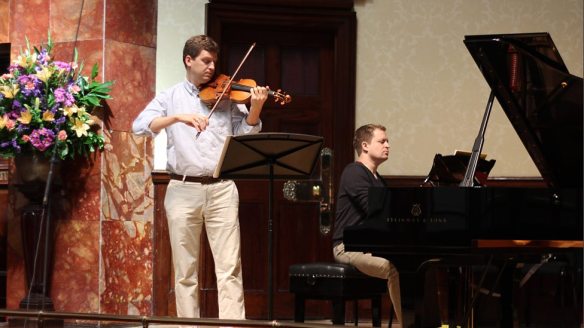
Anthony Marwood (violin), Lawrence Power (viola) and Simon Crawford-Phillips (piano) perform music by Rebecca Clarke, Martinů and Brahms

Wigmore Hall, London, live on BBC Radio 3, 28 September 2015

Listening link (open in a new window):

http://www.bbc.co.uk/programmes/b06dbdk3

on the iPlayer until 27 October

Spotify

In case you cannot hear the broadcast, here is a Spotify playlist of the music in this concert, from available versions on Spotify. The Horn Trio is very rarely heard in the version for violin, viola and piano, but a recent recording from Maxim Rysanov and friends is included:

What’s the music?

Rebecca Clarke: Dumka for Violin, Viola and Piano (1941) (8 minutes)

Martinů: Three Madrigals for Violin and Viola (1947) (16 minutes)

Brahms: Trio for Violin, Viola and Piano (1884) (28 minutes)

What about the music?

rebecca-clarke

The music of Rebecca Clarke has taken a long while to reach our concert halls, but thankfully it is not the rarity it once was. A viola player of some distinction, she wrote a wonderful competition-winning Sonata for viola and piano in 1919. This Dumka comes towards the end of her career as a composer, though she lived for nearly 40 more years without consistent inspiration to compose. The piece alternates slow, melancholic figures with an attractive and dramatic dance.

Like Clarke, Czech composer Bohuslav Martinů had relocated to New York, and his Three Madrigals for violin and viola, essentially a late wartime work, were inspired by hearing the English Singers in concert in Prague. They were written for the brother and sister duo of Joseph and Lilian Fuchs. Though instrumental the pieces are clearly written with voices in mind, and through clever use of double stopping techniques (where the instruments play more than one string at once) it often feels as though more instruments are in the room.

Brahms wrote his Horn Trio, for horn, violin and piano, in memory of his recently-departed mother. A profound work, it contains a passionate and often stormy pair of slow movement, placed first and third, and two faster movements – a triple time Scherzo of more lyrical design and then a finale tailor made for the horn, sending the audience away with a vision of adversity conquered by strength.

Performance verdict

This was a very well-chosen program by the three friends, and it was especially rewarding to hear the music of Rebecca Clarke, a composer who is gradually feeling her way back to the exposure she deserves.

The Dumka performance was deeply felt, the slower music elegiac in tone through Marwood and Power’s closer harmonies.

These two excelled in Martinů’s Three Madrigals, which were surprisingly vigorous in content. The central madrigal was the charmer, its trills like autumn leaves in the breeze, calm but yet strangely restless.

The Brahms is an emotional work that tugs at the heart strings in the third movement Adagio, where the trio found the depth of the composer’s feeling. Yet the horn, for which this piece was ultimately written, was conspicuous by its absence and the viola – nicely played as it was by Lawrence Power – could not hope to fully deputise. Without the horn the fast music felt too polite, with no brassy rasp to enjoy in the Scherzo, nor fullness of tone towards the climax of the first movement. The finale was too fast, and although it is great ‘chase music’ this was a helter-skelter dash, the strings skating swiftly over thin ice rather than ducking and diving.

What should I listen out for?

Rebecca Clarke

2:13 – the stringed instruments are in close unison at the start, with a gentle melancholy running through their musical thoughts.

4:03 – the pace quickens and now the music dances, the stringed parts moving more independently of each other but still in close musical discussion. Their destination is less certain, as though dancing around the room unpredictably, and the mood becomes fractious.

7:58 – after the music reaches an emotional high – though not wholly positive – we return to the relative calm of the opening music, violin and viola back in close harmony.

Martinů

13:10 – the first madrigal is typical of Martinů, bustling into action with busy figurations from both instruments. There is energy aplenty, and it sounds as though both instruments are engaged in deep and earnest conversation. Martinů throws in some unexpected harmonic diversions to keep the listener on their toes. There is no let up, the music rushing towards a bright conclusion at 17:03.

17:27 – a complete change of mood for the second madrigal, a mysterious and enchanting piece that often sounds like the rustle of wind in branches. Martinů uses double stopping and trills here to give a fuller sound. Gradually the music becomes more positive and full in texture, Martinů working around to the same key of the first madrigal. The close harmony mirrors the brother-sister relationship of the dedicatees. The trills return at the end but are now settled.

23:51 – the third and final madrigal, an open-air burst of positivity! Again the music is busy, and here as elsewhere Martinů seems to be thinking of the dances of his home country. The trills return briefly at 27:41, before Martinů launches back into his main idea. In this performance the tempo is quick!

Brahms

32:33 – the first movement begins, marked Andante (at a walking pace). This is a slow walk at the beginning, with serious thoughts at a subdued volume. Soon the music becomes more animated, supported by a characteristically full-bodied and flowing piano part. In this version the violin and viola are close in harmony and dynamic; when the horn is involved it takes a greater lead. At 36:14 the viola introduces a halting second idea.

Around 37:00 the tone darkens, anticipating the sombre mood of the third movement, but this does not last too long – and at 39:02 Brahms can be heard at his most passionate before the movement ends.

40:09 – the second movement, a Scherzo. The restless piano establishes the triple time while the strings pull against the rhythm with syncopations – all typical Brahms qualities. The theme appears again at 41:41, then receives a stern development. At 42:45 Brahms effects a transition into the Trio section, which is slower, darker and reflective – and then at 44:26 the Scherzo returns.

47:29 – the mood darkens considerably for one of Brahms’s most profound utterances. This is the only instance in his music where Brahms uses the term Adagio mesto (slow and sad), and the heavy tread of the piano, and the instance at 49:19 where the stringed instruments are alone, are both instances that tell of the grief felt at losing his mother. It is not all doom and gloom however, for there are shafts of light at 52:08 – before the heavy heart is laid bare again towards the end.

54:26 – in which Brahms swiftly clears away his grief to write a wonderfully positive finale with a spring in its step, the three instruments seemingly chasing each other in flight. Nothing more to be said, except enjoy the wonderful music!

Further listening

There are not many opportunities to hear horn, violin and piano together – and since that combination is the original trio Brahms wrote for, the recommendation is for that version in a recording made for the Swedish record company BIS, by Marie-Luise Neunecker, Antje Weithaas and Silke Avenhaus.

Also on that recording is the trio for the same combination by Ligeti, which makes a vivid and intriguing contrast – titled as it is Hommage a Brahms:

Bedroom Community at the Royal Festival Hall

Organist James McVinnie and Bedroom Community take on the Royal Festival Hall organ for a night.

james-mcvinnie
James McVinnie Picture (c) Magnús Andersen

This thoroughly absorbing and often invigorating showcase for Icelandic record label Bedroom Community centred around the Royal Festival Hall organ. Yet at the same time it gave the audience an introduction to the diverse talents on the label, perhaps best described as a Nordic counterpart to ECM.

However that description shouldn’t typecast the label, as the evening began with a singer-songwriter. I have to say the tremulous voice of Puzzle Muteson was not to my taste, especially when covering New Order’s True Faith, but it is undoubtedly individual and charmed many of those present. His performed his own material with his own intricately picked guitar and sensitive accompaniment from James McVinnie on the piano. Meanwhile another vocalist, the new Bedroom Community signing Jodie Landau, gave us a hint of things to come with a rich, sonorous vocal that made Valgeir Sigurðsson’s Do but kill me something of a showstopper, uplifting in spite of its title.

McVinnie himself was the curator of the evening, and although it was nearly half an hour before we heard the organ itself, in his hands we got a sense of just how diverse the great Festival Hall instrument can be. We enjoyed the delicate but pointed approach of Nico Muhly in Rev’d Mustard his installation prelude and Beaming music, the notes positioned like stalactites in a cave, but it was the contrasting sonorities of Philip Glass’s Mad Rush that proved the big talking point of the first half. This was vintage Glass; soft, mellow asides on one registration cutting dramatically to imposing, craggy features where the organ resounded heroically. McVinnie’s performance was superb.

bedroom-community

James McVinnie and friends at the Bedroom Community night, Royal Festival Hall, Thursday September 24. Photo (c) Ben Hogwood

Equally thrilling was Bach’s Passacaglia and Fugue, the registrations again imaginatively thought out so that we got a strong sense of the composer’s genius, threading the variations on the steady bass line through the eye of a needle before the great fugue stacked up in front of us.

The new music here was most impressive, and for that we also had viola player Nadia Sirota to thank. A vivid Étude 3 by Muhly set her against the organ, while Bryce Dessner’s solo piece Delphica 3 used the instrument in a knowledgeable but passionate way, building from the profile of a study to a heart on sleeve utterance. We also heard the world premiere of Median Organs by Dessner, written for McVinnie and again notable for intricacy and strength of feeling. Dessner’s compositional career dovetails with his work as part of The National to increasingly powerful effect.

The addition of stringed instruments gave the show variety and extra depth. Double bassist Borgar Magnason lent eerie lines to the Ben Frost film soundtrack There are no others, there is only us, where hordes of starlings assembled in black and white on the projection, to music that matched their movements. It was a moving portrait of one of nature’s mystifying yet wholly affirmative wonders.

In the second half viola da gamba player Liam Byrne explored the limits of his instrument, joining McVinnie and composer Sigurðsson in a response to the Bach Chorale Prelude Ich ruf zu dir. Although the bass notes on the electronics resounded too heavily this was a brilliant piece of musicianship from all three players, sensitively expanding on Bach’s music to illustrate its contemporary dimensions, while also clearly listening to each other as the improvisation took hold. It was unexpectedly moving and, in its free approach and generous musicality, symptomatic of the evening as a whole.

Wigmore Mondays – Kathryn Stott

kathryn-stott
Photo (c) Nikolaj Lund

Kathryn Stott (piano) performs piano music by Fauré, Franck, Ravel and Graham Fitkin

Wigmore Hall, London, live on BBC Radio 3, 14 September 2015

Listening link (open in a new window):

http://www.bbc.co.uk/programmes/b06c9nwj

on the iPlayer until 20 October

Spotify

In case you cannot hear the broadcast, here is a Spotify playlist of the music in this concert – most of which Kathryn Stott has recorded.

https://open.spotify.com/user/arcana.fm/playlist/14B8Ld3EVlXF6jlyZUeA9y

What’s the music?

Fauré: Nocturne no.4 (1884) (8 minutes)

Franck: Prélude, Chorale et Fugue (1884) (20 minutes)

Ravel: Sonatine (1905) (12 minutes)

Fitkin: Relent (1998) (10 minutes)

What about the music?

Fauré wrote a good deal of extremely attractive piano music, ranging from dreamy Barcarolles and Impromptus to the Nocturnes, which tend to be more moody. Kathryn Stott’s choice for this concert, the fourth of thirteen such works Fauré completed, is one of the lighter coloured examples.

César Franck, treated as French although he was born in Liège, which is now Belgium, wrote a lot of organ music – but is not often regarded as a composer of piano music. This is a shame, because in the Prélude, chorale et Fugue he shows off a distinctive style and an adventurous harmonic approach, while also acknowledging a debt to J.S. Bach in the form and construction of the piece. This reaches its apex in the central chorale, a kind of hymn tune that is first heard in a solemn intonation but which then rings out in glorious technicolour.

Ravel completes the triptych of French piano works, his Sonatine a model of economy and precision – but also an intimate piece of three movements that is quite beautifully written for the piano. The word Sonatine refers to the short length of the piece rather than anything else that might be modest – for this is one of Ravel’s finest piano works.

Kathryn Stott ends her recital with Graham Fitkin’s Relent, completed in 1998 and written for Stott herself. On the composer’s website, Fitkin writes of how “This piece is about time. It is about my perception of time, its various manifestations and ultimate inevitability. I think about the way I use my time, how much I need and just how long it feels like. I think about continuous time, circular time and our society’s preoccupation with marking the passage of time. And then I think about the relentless addition of time and how for me some day it will just stop.”

Performance verdict

Initially this concert was to be given by Tine Thing Helseth, with Kathryn Stott in support at the piano, but the Norwegian trumpeter sadly had to withdraw through illness.

In her place Stott constructed a fine recital, moving naturally from the nocturnal thoughts of Fauré through a passionate performance of the Franck, beautifully played and extremely well voiced so that the themes could be clearly heard.

Stott is a modest performer – by which I mean she has a gracious air when performing – and that suited her performance of the Ravel and Fauré especially. However when she needs the power it is easily found, and the performance of Fitkin’s Relent brought out the kinetic energy of the piece perfectly.

What should I listen out for?

Fauré

1:22 – a relatively gentle beginning to the piece, which is deceptively simple in its execution, harking back a little to Chopin. The theme comes back at 2’29, this time in ‘octaves’ – that is, the tune is doubled by another finger in the right hand playing an octave higher on the keyboard.

The mood then darkens as we head into the minor key. As Stott herself was quoted in Fiona Talkington’s introduction on Radio 3, Fauré’s “harmonic language is fascinating, and I’m never bored by it”. Greater turbulence can be felt in the music – but an inner radiance returns with the theme at 6:41. The piece finishes in serene mood at 8’53”.

Franck

10:51 – the Prélude suggests a relatively relaxed approach and is almost improvisatory at first, before we hear the main theme in octaves. Despite being based on an older form this to me is a forward looking piece, using some spicy harmony and strong romantic leanings.

16:18 – the Chorale section begins (chorale essentially another word for hymn), and we first here the Chorale itself in subdued form at 17:21. At 18:37 we hear it in another key, the mood of contemplation starting to give way to more passionate thoughts – and when we hear it once more at 20:20, the effect is like a peal of bells.

21:30 – the fugue section begins, though the fugue itself doesn’t start until 22:56, initially retreating into quiet thoughts but then gathering momentum. Once again it softens though, the choral theme peeping through the rippling piano textures at 27:58. At 30:06 the final peal of bells rings out, ending with an emphatic double ‘B’ from the left hand.

Ravel

32:24 – this piece is notable for its clean lines and immaculate structure but also for the intimate atmosphere that Ravel immediately conjures within seconds of this first movement beginning. It has a slightly melancholic feel but is essentially positive. Some of the quieter music is beautiful and dreamy, especially at the end.

37:05 – Ravel leads more or less straight into the second movement, a Minuet (a dance in triple time). This has a persuasive lilt, as well as the same feel of intimacy carried over from the first movement.

40:07 – the third movement, a much more forthright piece of music marked Animé (Animated).The textures of the piano here suggest rippling water. The piece moves to a convincing finish at 43:54, Ravel’s structure nigh-on perfect.

Fitkin

44:57 – immediately Fitkin’s use of the piano suggests mechanical movements. The writing is incredibly bold, from the big, beefy sound of the lower register of the piano – often dealt out in octaves – to the syncopated lines from the right hand. These suggest a strong jazz influence, but possibly even the sound of a gamelan.

As the piece progresses so its mechanical nature continues, with a terrific amount of energy generated in its ten minute duration.

Encore

55:57 – ChopinPrelude for piano in E minor (3 minutes) – an encore of suitable stillness to follow the Fitkin, Chopin’s E minor prelude is one of his most popular, and one of his most sorrowful too.

Further listening

There are plenty of options available for further listening after this varied concert. Those enjoying the Ravel would be urged to seek out more of the composer’s piano music, in particular Gaspard de la nuit. The Franck may have its roots in the past a bit more but has some pretty exotic harmonies – and anyone enjoying it might want to head for Debussy’s suite Pour Le Piano, another look back to the past with an especially beautiful Sarabande at its heart.

Meanwhile for lovers of the Fauré the composer’s piano music has a particular late night beauty, as this selection of Barcarolles and Impromptus suggests. All are tagged onto the end of the original playlist here:

https://open.spotify.com/user/arcana.fm/playlist/14B8Ld3EVlXF6jlyZUeA9y


Proms premiere – Tansy Davies – Re-greening

tansy davies composer

Tansy Davies

National Youth Orchestra of Great Britain – without a conductor (Prom 31)

Duration: 9 minutes

BBC iPlayer link

http://www.bbc.co.uk/events/e8r2mb

What’s the story behind the piece?

In an interview for Arcana, Tansy Davies detailed how Re-greening, written for all 164 players of the National Youth Orchestra without a conductor, is essentially an introduction to Mahler’s Symphony no.9, the piece they performed without a break afterwards.

In the interview, which can be read in full here , Davies explains how “the way the music is layered to me suggests a forest like quality; interweaving arpeggio-type figures bubbling or erupting up from the cold earth in winter, and scales or lines reaching up to the light”.

Did you know?

Before making her way as a composer, Davies sang and played guitar in a band. That was probably until she won the BBC Young Composers’ Competition in 1996!

Initial verdict

Re-greening begins with bright sounds like a forest coming to life – the opening percussion stroke, a bright, metallic sound, feels like the first sun of the day.

Then we hear the rustling of the orchestra, with harmonics from the stringed instruments and shrill woodwind that sound like the birds, sonorous brass. A song is sung by the orchestra, the popular and ancient song Sumer is icumen in, essentially a hymn that glorifies in the arrival of a new season or a new day. The chant continues, surrounded by a large orchestral sound that is used economically. The brass are prominent, Davies making great use of a big space with percussion and a huge string section.

Davies layers the sounds, so that it feels like several chords are piled up on top of each other in a full bodied texture. Then towards the end the orchestra sing again, this time a canon from English Renaissance composer Thomas Tallis, set like the earlier song in C major,. This proves an unusual and moving experience when set among the excited cacophony from the rest of the instruments.

Second hearing

tbc!

Where can I hear more?

There are a couple of excellent Tansy Davies discs in circulation, partly because her music seems to be very aware of its surroundings, i.e. it is aware of the culture – both popular and classical – in which it is written. So far she has tended towards chamber pieces that are of manageable length but considerable intensity. That much is very clear from her Troubairitz disc for Gabriel Prokofiev’s Nonclassical label, which includes the excellent Neon for chamber ensemble – and from the Spine disc for NMC, which includes the Saxophone Concerto with Simon Haram:

https://open.spotify.com/album/6RZsGqMpOm3D9Kgx3YH1l3

https://open.spotify.com/album/1lr0MOXLf5xc1nLmER9EGY

Wigmore Mondays – Anna Caterina Antonacci & Donald Sulzen

antonacci

Anna Caterina Antonacci (soprano), Donald Sulzen (piano) perform Poulenc melodramas

Wigmore Hall, London, live on BBC Radio 3, 14 September 2015

Listening link (open in a new window):

http://www.bbc.co.uk/programmes/b069x6kh

on the iPlayer until 13 October

Spotify

In case you cannot hear the broadcast, here is a Spotify playlist of the music in this concert – none of which Anna Caterina Antonacci or Donald Sulzen have yet recorded. Poulenc wrote these pieces either for voice and piano or voice and orchestra, and the playlist opts for the latter as Felicity Lott is the vocalist.

https://open.spotify.com/user/arcana.fm/playlist/2Xn85iACUoZurViTV2qiFs

A voice and piano version can be heard from Denia Mazzola Gavazzeni and Eric Hull here:

https://open.spotify.com/album/0CM2nBzQxiGys75arYMAki

What’s the music?

Poulenc: La dame de Monte Carlo (1961) (7 minutes)

Poulenc: La voix humaine (1958) (36 minutes)

What about the music?

poulenc-cocteau

A brave program to start the Wigmore Hall’s new lunchtime season! Francis Poulenc (left picture above) is a composer loved for his humour and witty tunes, but these two melodramas bring out his darker side. The humour remains at a much-reduced level, as does the melodic interest which tends to be assigned more to the piano.

La dame de Monte Carlo, written to words by Jean Cocteau (right picture above), describes a suicidal woman who goes to the principality for a bout of gambling before ending her life in the Mediterranean.

La voix humaine is a much more substantial piece, written three years earlier. It was found by Poulenc and Cocteau to mimic their own lives, and Poulenc identified himself with the subject, a woman whose lover of five years is about to get married. We don’t meet the lover but the study of the woman, carried out in the form of a telephone call, builds a picture of both parties from her perspective. The woman is starting to come to terms with her lot, and has herself taken an overdose the previous night. Over the course of nearly 40 minutes Poulenc and Cocteau explore a wide range of feelings from earlier in the relationship, but above all they bring out the insecurities and terror of starting again alone without a loved one.

Their innovative script – telephones not being that widespread in 1958 – is well ahead of its time, still very relevant to the present day, and Poulenc portrays the phone ringing with uncanny accuracy through the piano. Not only that, he uses the piano to set the mood, describing not just the woman’s movements but also anticipating what is said on the other end of the line. It is an often uncomfortable but mesmerising experience.

Performance verdict

Anna Caterina Antonacci and Donald Sulzen were superb in this performance of both works, allowing a more light-hearted approach in La dame de Monte Carlo but getting right to the heart of the matter in La voix humaine, which turned into a harrowing experience as Antonacci walked restlessly up and down the stage.

Her text was especially clear, which proved to be a real asset when following the quick moving thoughts of the woman. Donald Sulzen was similarly profound in his communication of the piano part, even taking some elements from Poulenc’s orchestral arrangement to bolster his depiction of the unravelling emotions on stage. It all made for a powerful and unsettling concert – a bold season opener!

What should I listen out for?

La dame de Monte Carlo

Words are here, part of a massive Hyperion set of the complete Poulenc songs. The words can be found on Page 126

Described by the composer as ‘the lamentable story of an old, abandoned, miserable floozy who, instead of suicide, tries her luck at Monte Carlo and finally throws herself into the Mediterranean’.

2:16 – a gentle if quite sorrowful introduction from the piano, followed by the soprano with a downbeat assessment of life. Here Poulenc is describing sadness, and the different verses follow with descriptions of pride (from 4:24), lyricism (5:28), violence (6:37) and finally sarcasm (7:18). The sorrowful tale ends with the subject throwing herself into the sea – described impishly by the piano with a chord that sounds like a small ‘plop’!

La voix humaine

Words are here (no English translation available)

Antonacci played the role with a telephone either in her hand or on the table next to her, walking distractedly around the stage as the part demanded.

12:48 – the piano sets the rather fraught scene as the subject waits for the phone to ring – which it finally does (13:45). However it’s a wrong number, so the tension grows further until…

14:55 – the phone rings for a third time, and finally to her relief it is the woman’s lover. The conversation can begin. Initially she is strong but by 18:00 the façade is beginning to crack, as the husk in Antonacci’s voice shows. The speech is more faltering.

21:30 – the woman begins to panic, and then, as the two are momentarily disconnected at 22:15, her distress gets ever closer to the surface. Her lover does not sound the same – and then comes the confession, from 24:30, that ‘J’évite de me regarder’ (‘I no longer look at my face’)

26:06 – the quality of the line deteriorates, the piano becomes discordant and the operator has to intervene. The tension goes up another couple of notches!

29:37 – now the woman begins her confession, that she is close to ruin and took an overdose the previous night. She becomes agitated and starts to move around the stage, which you can hear as the perspective of the singer changes. The piano matches her mood.

32:22 – the music now reflects the sadness and emptiness of the subject, as the woman details the details of her overdose the previous night. Whenever the phone comes close to dying she becomes nearly hysterical.

35:43 – a tender moment as the woman recalls time with her lover, but the reverie is broken as the piano plays jazzy music, which she can hear over the phone.

38:39 – ‘I love to hear you speaking’, the woman confesses – and then she looks back on the five years they have spent together. Again this bout of nostalgia is rudely interrupted by an interloper on the line (39:31). Gradually the woman begins to imagine them making up – before around 42:00 declaring that ‘a telephone is cold, what we had is lost for ever’.

43:52 – the two become disconnected, and the woman feverishly wishes for her subject to call back. Her very life seems to depend on it.

44:51 – now the woman becomes gradually more resigned to the lovers’ fate, and the drama ends with a final declaration of love at 48:40. Here the waltz theme Poulenc has worked into the piano part returns in a poignant gesture, before a final piano chord.

Further listening

Normally Arcana would recommend a piece or two by the same composer, but in this case a strong recommendation is put forward for a live recording of Antonacci and Sulzen at the Wigmore Hall a few years back, performing a recital including French and Italian songs by Hahn, Tosti, Cilea and Respighi:

https://open.spotify.com/album/4MTzyat9ZtmmgHozyaUFwu