
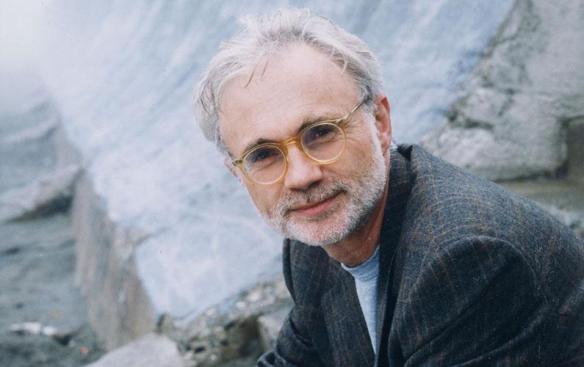
Marianne Crebassa (mezzo-soprano), Philharmonia Voices and Orchestra / Esa-Pekka Salonen
J.S. Bach arr. Stravinsky Canonic Variations on Vom Himmel hoch, da komm, ich her (1956)
Ravel Shéhérazade (1904)
Adams Naive and Sentimental Music (1999)
Royal Albert Hall, Wednesday 2 August 2017
You can listen to this Prom here for 28 days from the date of the performance
This year’s Proms celebration of John Adams‘ 70th birthday moved on to some Naïve and Sentimental Music. Not my label, but the composer’s own – and a misleading one at that. The title implies a sketchily composed, throwaway fragment, but what we actually get is something very substantial, longer than many symphonies. The construction of the three sections making up the piece illustrate the ease with which the music of Adams expands to fill such dimensions, not something you could always say about the music of like-minded ‘minimalists’, Philip Glass and Steve Reich.
Where others of his ilk tend to work in smaller melodic units, Adams thinks nothing of spinning out a long, intense melody over several minutes, hanging like a long telegraph wire above the sun-drenched plains. Such an image came to my head as we listened to the second movement of three, Mother of the Man, where the guitar of Huw Davies sounded rather like the early music of Pat Metheny in its deceptively lazy traversal. The strings held fast, creating the wide expanses of which Copland would surely have been proud. The treble textures were especially rich, but when the dynamic dropped to a barely audible whisper on the violins, members of the audience were subconsciously leaning forward to follow developments in the music.
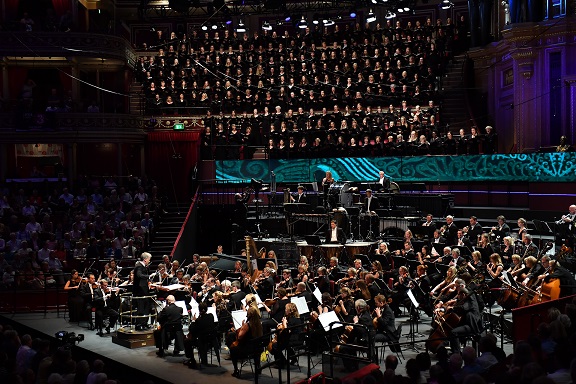
It helped that the conductor was also the dedicatee of Adams’ sizeable score, Esa-Pekka Salonen taking delivery on behalf of the Los Angeles Philharmonic in 1999. Here he secured some outstanding playing from the Philharmonia Orchestra, who responded to the virtuoso demands of the music with impressive rhythmic impetus, intense focus and characterful phrasing. When the music gathered itself several times in the first movement, Naïve and Sentimental Music, the pacing and rhythms felt just right, with especially good work from harpists Heidi Krutzen and Stephanie Beck, not to mention percussionists Antoine Siguré, Scott Lumsdaine, Peter Fry, Stephen Burke, Tim Gunnell and Karen Hutt.
Towards the solemn close of Mother of the Man it was the brass bringing deeper shades to the forefront of the picture with exquisitely held chords. As Chain to the Rhythm hurried along the intensity built steadily and inexorably until it became nerve-shredding, the piece thundering along with gongs, bass drum, cymbals and massive timpani strokes giving it a mountainous perspective. We ended through the altitude of the violins, these massive orchestral sounds now a huge echo. It was a moving finish to a piece that is clearly underrated in Adams’ canon. Salonen clearly believes in it, and this audience did too.
A curious (but very interesting) first half began with Stravinsky’s arrangement of J.S. Bach’s Canonic Variations on Vom Himmel hoch, da komm, ich her, a recomposition made to accompany the world premiere of the latter composer’s Canticum Sacrum in St Marks, Venice in 1956. This was an oddity of economical orchestration and sung text from a reduced choir. There was some quite tart colouring in the manner of Stravinsky’s later style, and his additions to the music of Bach added extra spice to the harmonies at unexpected points. An intriguing but puzzling arrangement, and one that threw the softer textures of Ravel’s Shéhérazade into relief.
 This was no doubt intentional, for we were privy to a wonderful performance from French mezzo-soprano Marianne Crebassa (above). Shéhérazade is a magical song cycle when performed well, but here it transcended all expectations – in fact I don’t recall ever seeing a singer who gauged the acoustic of the Royal Albert Hall with quite the accuracy of Crebassa. Her direct communication with the audience was reinforced by the elegance and understated strength of her vocal delivery, a truly beautiful tone that caressed Ravel’s lines with clear love and affection.
The first song, Asie, held an exquisite tension as the travelling scene unfolded, while La flûte enchantée, the instrument itself beautifully played by Samuel Coles, thrilled with its orchestral colours and heady textures. L’indifférent was a little more mischievous, and again the exquisite tones and textures were in full accord with the very best Ravel performances.
Crebassa is most definitely an artist for the future, and her blend and rapport with the Philharmonia was something to behold. The reverent string textures and typically pinpoint orchestration were viewed through Salonen’s technicolour lens, but the team brought something very special to Klingor’s text. If you get the chance to hear the broadcast, do so as soon as you can. You will hear one of the best young singers in classical music right now!
Ben Hogwood
Stay tuned for the next in Arcana’s Ask The Audience series, where Steve Hodges will give his verdict on the John Adams Prom. Coming shortly!
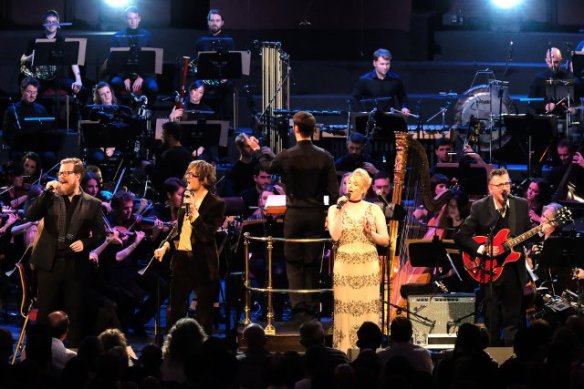
 As also would be one from Icelandic singer Susanne Sundfør (above), whose often brittle yet always focussed delivery teased out the deadpan humour from On Your Own Again then stripped Angels of Ashes of undue preciousness. Best of all was the edgy irony she brought to The Amorous Humphrey Plugg, another highpoint of Walker’s song-writing, while Hero of the War aligned anger and compassion to a telling degree. A slight pity that Long About Now, Walker’s one number intended for a female vocalist, was not featured. Maybe another time?
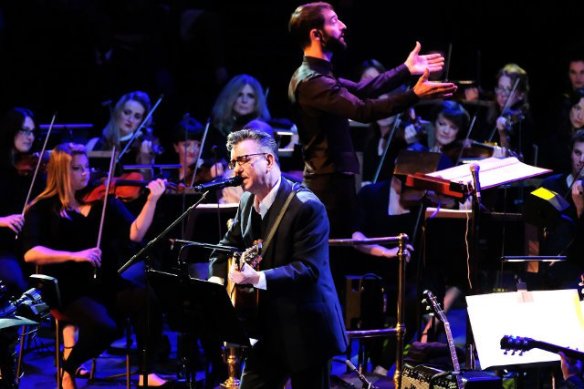 A fine guitarist and distinctive crooner, Richard Hawley proved as attentive to the tangible atmospherics of It’s Raining Today as to the warm evocation (so easy to sentimentalize) of Two Ragged Soldiers. Neither was there any dilution of that yearning for domestic bliss in Montague Terrace (in Blue) or sardonic humour in The Old Man’s Back Again (Dedicated to the Neo-Stalinist Regime) – a song which underlines Walker’s awareness of the political realities during this period, as has surfaced more obliquely in much of his more recent music.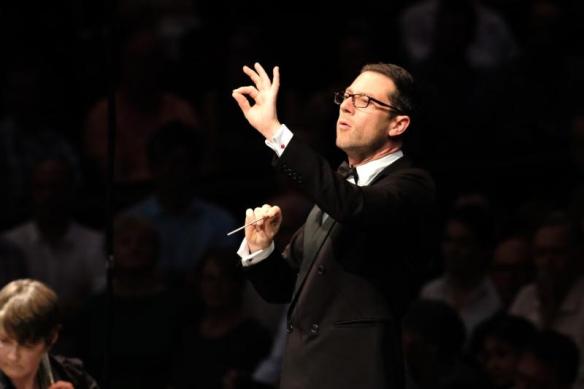
 The Planets has, of course, never looked back over the near-century since it first astounded a public confronted with the terrors of mechanized war. Perhaps one should not be surprised that Wilson was at pains to play down its cinematic quality (hardly something of which Holst could have been aware in any case) – his vehement take on Mars proceeding an eloquent if slightly cloying Venus; itself followed by an almost dance-like Mercury and an incisive Jupiter at its best in a trio section that managed to eschew almost all trace of false solemnity
 Davis himself is now 73, but still a sprightly figure who lovingly led his BBC Symphony Orchestra charges in a wide variety of English music, recreating the program given for Sargent’s 500th Prom in 1966. We ducked and dived through Berlioz, and his Le carnaval romain overture, before a glittering account of Schumann’s Piano Concerto from Beatrice Rana, herself in glittering green (above). Her quiet moments were especially profound, and she took charge of the more tempestuous passages of the outer movements with impressive control and expression. Balance is often a problem between piano and orchestra in the cavernous Royal Albert Hall acoustic, but here it was nicely achieved, and with phrases that were fleet of foot (and hand!) Rana showed why she is a highly coveted soloist.
 Holst’s ballet music for The Perfect Fool was treated to a delicately shaded performance, sonorous trombones underpinning a rewarding orchestral sound, with dances of great character. Meanwhile Delius gave us a sunkissed reverie, On Hearing the First Cuckoo in Spring, temporarily overriding the clouds outside.
 The first night of the BBC Proms is a watershed moment in the summer of a classical music lover. Yet increasingly the festival is working on being more inclusive, and some of this year’s BBC Proms Youth Choir (seen above the BBC Symphony Orchestra and conductor Edward Gardner) had not even sung in public before, let alone attended the festival.
 Levit (above, at the piano) also had quiet asides, but his were absolutely spellbinding – the first movement cadenza and slow movement introduction in Beethoven‘s Piano Concerto no.3 both cases in point. Here we could easily have been back at the Wigmore Hall, witnessing a solo sonata performed to a select few, such was the intensity of his communication at a quiet dynamic. When he was with the orchestra the intensity subsided a little, not least because the balance favoured a coarse timpani sound. That said, the playing of the BBC Symphony Orchestra woodwind was particularly beautiful under Edward Gardner’s watchful eye.
 Arcana.fm