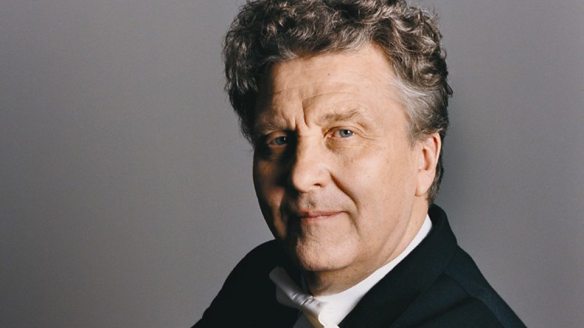
On record: BBC Symphony Orchestra / Martyn Brabbins – Vaughan Williams: A Sea Symphony (Hyperion)

Elizabeth Llewellyn (soprano), Marcus Farnsworth (baritone), BBC Symphony Chorus and Orchestra / Martyn Brabbins

Vaughan Williams
A Sea Symphony (Symphony no.1 in B flat minor) (1903-09)
Darest thou now, O soul (1925)

Reviewed by Richard Whitehouse

What’s the story?

Following his impressive take on A London Symphony (given in the 1918 version), Martyn Brabbins here continues his Vaughan Williams cycle with its predecessor A Sea Symphony, coupled with a choral setting which reinforces the composer’s adherence to Walt Whitman.

What’s the music like?

Now that most of the numerous orchestral pieces Vaughan Williams wrote at the turn of the 20th century have been recorded, the context for the present work is far clearer than hitherto. Yet it still took six years before A Sea Symphony was completed; during which time, both its actual concept and his musical aesthetic underwent radical change. The premiere in Leeds on 12th October 1910 may have overshadowed by that of the Tallis Fantasia just a month before, but the larger work likewise confirmed VW’s arrival as a leading composer of his generation.

While not an overly long work (lasting around 67 minutes), A Sea Symphony feels expansive as compared to Vaughan Williams’s later such works and benefits from a formally focussed approach. This it receives from Brabbins, who controls the first movement securely from its magisterial opening, through its eventful if prolix ‘development’ then on to a rapt conclusion. The ensuing nocturne is less problematic and Brabbins duly points up the contrast between its fervent climax and pensive introspection on either side. He secures a rousing response in the scherzo, with its unabashed echoes of Elgar and Parry, then steers a convincing course across the expansive finale – whether in its cumulative earlier stages, its eloquent central vocal duet or the closing stages with their stark juxtaposing of bracing peroration and ethereal postlude.

Throughout this recording, the playing of the BBC Symphony Orchestra is responsive and committed, while the singing of the BBC Symphony Chorus leaves nothing to be desired in terms of tonal finesse and rhythmic articulation. The two soloists are less consistent. Marcus Farnsworth lacks presence during the combative baritone contribution to the first movement, though his stoic musing in its successor is far more persuasive. A soprano with the requisite mezzo range, Elisabeth Llewellyn yet evinces a vibrato in her higher register that can prove distracting, but this is less of a problem in the finale – she and Farnsworth exuding warmth and ardency in its lyrical central duet, while bringing poise without indulgence towards its close as vocal phrases stretch out in parallel to the expanse of that ‘journey’ being evoked.

Does it all work?

Yes, notwithstanding those reservations noted above. Brabbins adopts a firm though flexible approach which is demonstrably in the lineage of Sir Adrian Boult and Vernon Handley. Both orchestral playing and choral singing are first rate (in advance of that for Andrew Davis in the BBC’s first VW cycle a quarter-century ago), and there is once again an enterprising coupling. Darest though now, O soul finds Vaughan Williams briefly revisiting a Whitman text he set 18 years before in Toward the Unknown Region, reduced to a hymnal setting for unison chorus and strings.

Is it recommended?

Indeed. The sound finds an ideal balance between spaciousness and definition, with probing notes by Robert Matthew-Walker. If Brabbins’s Sea Symphony is slightly less fine than his London Symphony, it is a consistent follow-up in what looks set to be impressive VW cycle.

For further information on this release, visit the Hyperion website, or the BBC Symphony Orchestra. You can also read more about Martyn Brabbins here

Wigmore Mondays: Aleksey Semenenko & Inna Firsova – Grieg, Ysaÿe, Debussy, Tchaikovsky & Paganini

Aleksey Semenenko (violin), Inna Firsova (piano)

Grieg Violin Sonata no.3 in C minor Op.45 (1886-7) (1:40-23:34)
Ysaÿe Violin Sonata in D minor Op.27/3 ‘George Enescu’ (1923) (25:34-32:13)
Debussy La plus que lente (1910) (34:17-38:16)
Tchaikovsky Valse-scherzo in C major Op. 34 (1877) (38:55-45:06)
Paganini, arr.Kreisler La Campanella (1826) (46:30-54:16)

Wigmore Hall, London; Monday 5 November 2018

You can listen to the BBC Radio 3 broadcast by clicking here

Written by Ben Hogwood

There were fireworks at the Wigmore Hall rather earlier than planned on this particular November 5th. The reason for this was the inflammatory partnership of violinist Aleksey Semenenko and pianist Inna Firsova, whose high voltage program of Grieg, Ysaÿe, Tchaikovsky and Paganini really got the heart rates fluttering.

The duo began with one of Grieg’s finest chamber works, the Violin Sonata no.3. While his first two works in the violin sonata are dressed in relatively sunny clothing, this third one has a lot more grit and determination in the notes. This was evident right from the start (1:40 on the broadcast, marked Allegro molto ed appassionato), a memorable theme given authoritative treatment by Semenenko and Firsova. The music drew back for some more intimate thoughts, but soon, as the main theme gets developed, a deeply passionate dialogue between violin and piano played out.

The second movement, a Romance (10:13), began with a clear and delicate melody from Firsova, a beautifully poised response to the first movement. Soon however a more agitated section started (12:18), led by the violin, but soon the glassy, soft-hearted music returned. The third movement Allegro moderato (16:06) began with a melody that feels like a folk tune, especially with the rustic piano accompaniment, and we were back into the urgent mood of the first movement. At 18:53 a rich second theme could heard, played by Sememenko with a very full, gorgeous sound, if just occasionally over-reaching on his tuning.

The Ysaÿe Sonata is for solo violin, directly inspired by the music for violin of J.S. Bach – but with considerably more display factored in. It is third of a set of six he completed in a short space of time and published as Op.27 in 1923. That said, the Belgian composer still writes with a keen sense of form, and this compact sonata, dedicated to fellow violinist / composer George Enescu, packs a lot into its six and a half minutes. So too did Semenenko, whose dazzling virtuosity (from 25:34) added to a beautiful tone gave it the best possible platform. Some of his bowing was razor sharp, especially in the fast music, but the attack was always impressively clean.

Semenenko and Firsova followed these fireworks with a pair of waltzes. Debussy’s example (34:17), originally for solo piano, is a sugar-sweet but elusive piece of work, beautifully harmonized by Firsova in this version. Tchaikovsky’s (38:55) is another story, a swaggering dance piece that both performers relished, swaying in and out of time with the familiarity of seasoned partners. It was all instinctive and brilliantly done, with Semenenko’s bow acting like a pond skater over the strings at times! An earlier performance of this work from the pair can be seen below:

One of the ultimate violin showpieces is La Campanella, written by Paganini in 1826 as the third and final movement for his Violin Concerto no.2, but arranged here for violin and piano by Fritz Kreisler – like Paganini a virtuoso of incredibly high standing.

Gravity is surely defied in this version, right from the main theme (46:30) to a series of contrasting sections, each of eye-watering difficulty – try from 52:00 on the broadcast to get some incredible dexterity between plucking (pizzicato) and bowing.

Great credit should go to Irina Firsova, too, for her mastery of what is effectively an orchestral score compressed for piano. The lightness of touch meant this was never a heavy account, despite the number of notes, and Semenenko’s agility fair won the day.

A spectacular recital indeed, which I would urge you to hear from the start. The pair weren’t quite finished, though, and complemented their fireworks with a little sparkler, Tchaikovsky’s Valse sentimentale in F minor Op.51/6 (56:12-58:21)

Further listening

As a good companion to this playlist, Aleksey Semenenko and Inna Firsova have recorded a disc of similar themes, taking a Grieg sonata and virtuoso showpieces from Tchaikovsky, Paganini and Castelnuovo-Tedesco, ending with an intense account of Schubert’s Fantasy in C major:

If that isn’t enough, and to whet the appetite for more French music for violin and piano from the Wigmore Hall in a couple of weeks’ time, here is another Semenenko and Firsova double act in music by Poulenc, Chausson, Debussy and Saint-Saëns:

On record: Vassilis Varvaresos – V for Valse (Aparté)

V for Valse

Vassilis Varvaresos (piano)

Liszt Allegro spiritoso in A major S427/7 (1852), Mephisto Waltz no.1 S514 (1862)
Ravel La Valse (1920)
Rosenthal Carnaval de Vienne (1889)
Schumann Faschingsschwank aus Wien Op.26 (1838)
Scriabin Waltz in A flat major Op.38 (1903)
Tchaikovsky Valse sentimentale Op.51/6 (1882)

Aparté AP172 [61’31”]

Producer / Engineer Pierre Fenouillat
Recorded 22 & 24 July 2017 by Little Tribeca at Hotel de l’Industrie, Paris

Reviewed by Richard Whitehouse

What’s the story?

The first recital disc from Greek pianist Vassilis Varvaresos, winner at the 2016 Enescu Competition, and already heard on Schubert’s Winterreise with Dimitris Tiliakos as well as works for violin and piano by Schumann and Richard Strauss with Noe Inui (both on Navis Classics).

What’s the music like?

In an interesting conceptual ploy, the Valse (Waltz) has been taken as basis for an overview of almost a century’s piano music – during the course of which, keyboard virtuosity veered away from uninhibited display to reinforcing the emotional complexity of the piece at hand.

Varvaresos starts his recital in media res with Liszt‘s First Mephisto Waltz – the touchstone for a virtuosity fused with psychological complexity, rendered here with a combination of technical brilliance and emotional understatement as extends right to the scintillating final bars. The seventh from his Soirées de Vienne, a set of Valses-Caprices after Schubert, finds Liszt in more equable if hardly less resourceful mood, not least in the way he channels his borrowed ideas into a study as subtle formally as it is poetic and affectionate expressively.

A further highlight is Faschingsschwank aus Wien, last of Schumann’s piano cycles from his first full decade of creativity and one which tends to be overlooked in the context of several more innovative predecessors. Its outer movements can run the risk of mindless display, but this is never an issue for Varvaresos, who leavens their boisterousness with almost Classical objectivity. This applies equally to the three central movements, not least a Romanza whose poise and inwardness uncannily anticipate the piano miniatures of its composer’s last years.

Tchaikovsky‘s piano output remains relatively neglected, so it was astute of Varvaresos to include his Valse sentimentale, last in a set of six pieces which point up his indebtedness in this medium to earlier models (notably Schumann), yet whose melodic eloquence is wholly characteristic. Scriabin‘s Waltz in A flat makes for a telling foil, its melody line diffused into a harmonic radiance which blurs the expected tonal focus with teasing playfulness. Here, as throughout this programme, the suppleness of Varvaresos’s pedalling is of the highest order.

Discretion is hardly to be expected of an archetypal virtuoso such as Maurice Rosenthal, yet his Carnaval de Vienne is a riotous humoresque on themes by Johann Strauss II that makes a fittingly uproarious encore (as Varvaresos demonstrated at last year’s Enescu Festival). The virtuosity of Ravel’s La Valse is of an altogether more speculative manner, but this account makes a virtue of such ambiguity as this plays out across a structure audacious in its formal design and unnerving in its emotional follow-through – not least those fateful closing pages.

Does it all work?

Very much so. Varvaresos is evidently among a younger generation of pianists for whom virtuosity is neither to be played up to nor fought shy of; but rather placed at the service of the music in question so its salient qualities can more fully be appreciated and savoured.

Is it recommended?

Indeed. The sound is ideal in its realism and immediacy, with Jean-Yves Clement’s fanciful note complemented by a photo which looks rather like a still from an Alain Resnais film. An auspicious release by a pianist from whom much can be expected. V for Varvaresos indeed!

You can read more about this release on the Aparté website, or get more information on Vassilis at his website The full album can be heard on the Spotify playlist below:

Live review – Benjamin Grosvenor, CBSO / Vassily Sinaisky – Mozart, Sibelius & Wagner

Benjamin Grosvenor (above, piano), City of Birmingham Symphony Orchestra / Vassily Sinaisky (below)

Symphony Hall, Birmingham
Thursday 25 October 2018 (matinee concert)

Wagner Der fliegende Holländer – Overture (1841)
Mozart Piano Concerto no.21 in C major K467 (1785)
Sibelius Symphony no.1 in E minor Op.39 (1899)

Written by Richard Whitehouse

It has often been remarked that concerts adhering to the once ‘standard’ format of overture, concerto and symphony are hardly frequent nowadays, so making this afternoon’s concert from the City of Birmingham Symphony Orchestra and Vassily Sinaisky the more welcome.

Wagner has always made for an effective curtain-raiser, not least his overture to The Flying Dutchman. Earliest of his acknowledged operas, its eventful 10 minutes fairly encapsulate the salient incidents and principal themes – not least in this performance, Sinaisky confirming his operatic credentials (in which capacity he has been regrettably little heard in the UK) with an assured reading; most perceptive in its approach to Senta’s eloquent ballad near the beginning and in its Tristanesque return during the closing bars such as Wagner transformed in revision.

A scaled-down CBSO was equally responsive in Mozart‘s K467, happily no longer indelibly associated with one of the dreariest 1960s films. Often at his most perceptive in 19th-century music, Benjamin Grosvenor is no slouch in Mozart and his performance – as was that at this year’s Proms with the BBCSO and Sakari Oramo – was full of felicitous phrasing, even if the formal focus of the imposing first movement was likely of Sinaisky’s choosing. The Andante was affecting without affectation, Grosvenor embedding the solo part closely into that of the orchestra, then the final rondo conjured up effervescence at a not unduly headlong tempo. All credit to Grosvenor in choosing cadenzas by Robert Casadesus (whose Mozart recordings are required listening) and for a limpid reading of Rachmaninov‘s Lilacs as his encore.

Although his ambivalent relationship with the Austro-German symphonic tradition has often been noted, Sibelius’s Russian heritage is often downplayed – yet his first two symphonies would be inconceivable without Tchaikovsky’s input. The First of these has been compared with the Pathétique in its epic and ultimately tragic nature, but the influence of the Russian’s Fifth Symphony feels even more overt in its sombre clarinet-led introduction and an Allegro with its ingenious take on the sonata format. Sinaisky duly has the measure of its brooding power and surging energy, then opted for a flowing account of the Andante that brought out its pathos and quixotic changes of mood without it seeming turgid or episodic. The Scherzo, too, had the requisite dynamism and, in its trio, an appealing whimsy that was deftly drawn.

The highlight, though, was the finale – most often the movement which fails to ignite by dint of its discursive structure. Yet ‘Quasi una Fantasia’ need not imply rhapsodic and Sinaisky treated it accordingly, characterizing its dramatic then fervent themes with due appreciation of their formal integration towards an impassioned climax whose fateful outcome was never in doubt. It helped that orchestral playing was of unwavering commitment, with the CBSO giving of its collective best in a piece which it has played frequently over the past 86 years.

It set the seal on a concert which was a reminder one that even a mainstream programme can surprise and engage when the constituents are thoughtfully planned and performances never less than responsive. The enthusiastic reception of a sizable house was its own confirmation.

For more information on future CBSO concerts head to their website

Live review – London Contemporary Orchestra @ The Barbican: Other Worlds

London Contemporary Orchestra & Choir / Robert Ames
Universal Assembly Unit (art direction)
Artrendex (artificial intelligence)

Barbican Hall, London
Wednesday 31 October 2018

Scelsi Uaxuctum (1969) (UK premiere)
John Luther Adams Become Ocean (2013)

Written by Ben Hogwood

If the apocalypse comes while we are alive, what music do you want played?

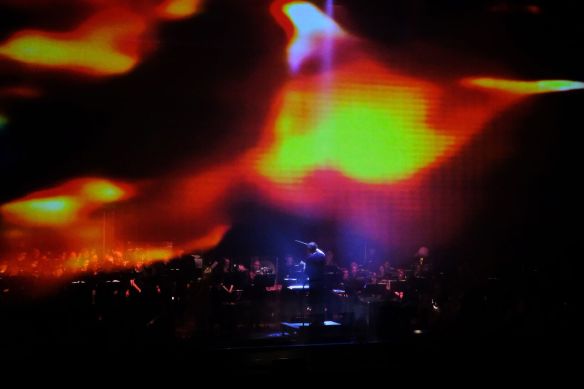
It is a thought-provoking question, one that some composers have tackled head-on by writing music of their own. The end of days provided the link for this programme of polar opposites from the London Contemporary Orchestra, given at the Barbican to the accompaniment of images dictated by algorithmic responses, thanks to the AI technology of Artrendex and the Universal Assembly Unit.

The first part was the end of days in the darkest possible sense. Giacinto Scelsi’s five-part Uaxuctum takes as its inspiration the Legend of the Maya City, and its self-destruction for religious reasons. Due to the demands made on the performers – and, the programme argued, an overly conservative approach to using Scelsi’s music – this was the UK premiere of a piece written nearly fifty years ago.

The textures were remarkable, achieved through a variety of vocal techniques such as trills, tremolos, hissing, deep breathing and nasal sounds. The use of quarter tones lent an extra level of difficulty and a sense of dread to the music, the vocals stubbornly sat in between the instrumental notes at times. The London Contemporary Choir met these demands heroically, stood on the left under a screen whose barbed imagery and sudden explosions of orange and red light were wholly appropriate.

The sizable orchestra was bolstered by a massive battery of percussion, including an enormous barrel rubbed with a ‘thundersheet’ – which made a suitably massive noise. This provided some chilling, incendiary shocks, while the percussion themselves supported the music from what felt like underneath the floorboards.

Perhaps because of the massive screen the edge was taken off the sound a little, which compromised the raw impact of the piece, but Scelsi’s often monotone musical language left an incredibly strong impact under the passionate direction of Robert Ames. Its resultant chill stayed throughout the interval.

John Luther Adams, environmentalist as well as composer, has garnered many plaudits for Become Ocean, a 2013 composition that sees the Earth returning to its early state of complete water coverage. Should it happen again, this form of apocalypse would be man-made; the ultimate destination should global warming continue in the way it does.

Adams chose not respond to this with the sharp edges and doom-mongered percussion of an industrial age. Rather he utilises the orchestra as a single instrument of subtly altering shades, beginning low in the murky depths of the piano but gradually superimposing layers to make a wonderfully sonorous block chord the listener can literally dive into.

Interpreting this as a colour, it could only be the deepest blue of the unfathomable ocean, and the imagery responded as such, submerging the orchestra in slow moving waves under deep, grey cloud. We were, it seemed, cast out in the middle of the ocean, as far from land as could be, but this was to be a meditative exile, accepting of its fate if not wholly aspiring to it.

The music carried for 45 minutes and there were several climax points, where the images grew deeper, before Ames pulled us back to the bare bones again. Adams ended where he had begun, back in the lower reaches of the piano.

Silence was the only appropriate response to this wall of water through sound, a wonderful contemplation and immersion that proved unexpectedly moving, the realisation hitting home of just how much damage we have inflicted on our own planet.

If they ever met, Scelsi and Adams would surely have found a common ground, despite the fascination of their wildly different responses to the final, greatest destruction. They left us with much to ponder and admire, especially from the London Contemporary Orchestra, whose standard of performance was unstinting, and whose virtuosity behind the scenes ensured these two apocalyptic visions met their final destination.

Further listening

The works in this concert can be heard on the Spotify playlist below: