Jean-Guihen Queyras – Bach and Britten at the Wigmore Hall

Jean-Guihen Queyras plays works for solo cello by J.S. Bach and Benjamin Britten at the Wigmore Hall

jean-guihen-queyras

Jean-Guihen Queyras (cello) – Wigmore Hall, London, live on BBC Radio 3, 6 July 2015

Listening link (opens in a new window):

http://www.bbc.co.uk/programmes/b060zmjg

on the iPlayer until 5 August

Spotify

In case you cannot hear the broadcast, here is a Spotify playlist of the music in this concert, in recordings made by Queyras for Harmonia Mundi:

What’s the music?

Britten: Solo Cello Suite no.1 (1964) (20 minutes)

J.S. Bach: Solo Cello Suite no.6 (c1724) (30 minutes)

What about the music?

The idea of a cello playing on its own was only fully cultivated in the twentieth century – when Pablo Casals recorded the six Bach suites in the 1930s and they became part of the repertoire once again. Until then, unbelievably, they had lain dormant – but now they stand as arguably the most-played body of works for cello in existence. They are wonderfully flexible pieces, because the easiest parts of the suites can be played by budding amateurs. Generally, the higher the number of the suite, the more technically demanding they are.

Hence the Sixth and last suite in the set is extremely virtuosic. It is thought to have been written for a five-string instrument known as the violoncello piccolo, like the one in the picture below:
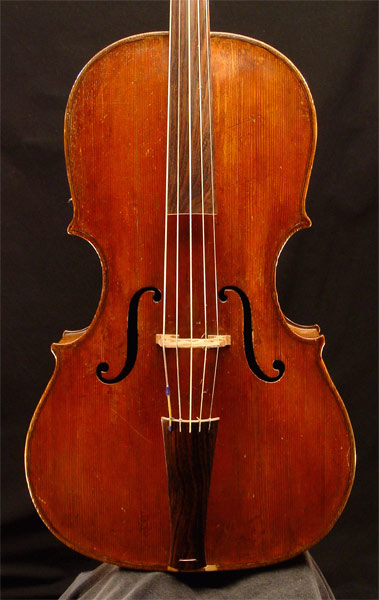
violoncello-piccolo

The Sixth is the longest of the suites, and often features multiple stopping – i.e. more than one note played at once. Because the fifth string of the violoncello piccolo would have been a higher one (an ‘E’ above the highest cello string of ‘A’) the suite is unusual for its treble-rich sound.

Britten stole into the world of the solo cello by way of his dear friend Mstislav Rostropovich, who threw down the gauntlet to him to write a number of compositions for the instrument. In taking on writing for the solo cello he was one of the first since Bach to take it on in a solo capacity – Zoltán Kodály and Max Reger being the others.

Britten made an explicit homage to Bach’s works in the use of different dance forms, and like the elder composer he often wrote out multiple stopping, using the confines of the instrument to somehow write independent parts for it. These can be heard especially as the second movement Fuga takes shape.

Britten was to write another two suites for solo cello, for it was clearly an instrument that pricked his compositional interest.

Performance verdict

If ever proof were needed that Bach can make you happy, Jean-Guihen Queyras supplied it handsomely in this wonderful hour of music. Each of the six movements making up the Sixth Cello Suite danced persuasively, although in the slower Allemande and Sarabande dances Queyras achieved a wonderful, all-encompassing peace. Technically he was superb – this is far from easy music to play in public – with rock solid intonation and an easy way that endeared him to his audience.

The Britten made a good contrast, for this is a very serious piece, with inner strife that Queyras built perceptibly as the final flurry of notes grew closer. Here he was careful to bring out Britten’s part writing for the instrument, so that on occasion it felt as though there were many more instruments than just one in the room. The cello’s probing tone still brought each melody to the front, while the technical effects Britten uses to enhance the impact of the piece were brilliantly executed.

What should I listen out for?

Britten

1:41 – the Canto primo, where the cello proclaims the theme majestically. Immediately you can hear Britten’s use of multiple stopping, which is where the cello plays chords from several strings at once. This moves into…

3:39 – the Fuga begins. It seems very unlikely that a fugue could work on a cello but it somehow does – when at 3:52 the next entry of the tune comes in, meaning several parts can exist simultaneously. The ear is led this way and that, as though two or even three cellos are playing. From hear the mood darkens to…

7:42 – the Lamento, which starts with a broad intonation, like a solo singer. Britten wrote so many of his instrumental pieces as though they are vocal.

10:07 – the Canto Secondo. In response to the Lamento the cello gives a subdued account of the Canto theme, appearing lost in thought.

11:07 – Serenata. Marked Allegretto pizzicato (quite fast but with the strings plucked) this is a more playful homage to the second movement of Debussy’s Cello Sonata, which Britten and Rostropovich recorded together in 1961.

13:33 – a movement marked as Marcia – where Britten achieves ghostly sounds firstly through the use of harmonics, where the left hand rests very lightly on the string, and then through the wood of the bow banging on the string (14:14). The mood is now agitated.

16:40 – from the murky depths of the cello we hear the solemn Canto terzo, another variant of the tune from the start. The music becomes gradually more forceful, moving into…

18:29 – the Bordone begins – an unusually titled movement that features a drone on the note ‘D’ – mostly from the open string. Around it a cluster of notes can be heard, while the left hand plucks the string absently. Again it sounds like there are two or three instruments playing, such is the density of Britten’s music.

21:39 – the final section, marked Moto perpetuo – and now the cello sounds like a group of excited insects, the melody fluttering around restlessly. At 23:02 the main tune returns but sounds breathless in this company, as it does until the end – which is deliberately distorted and angry.

J.S. Bach

27:08 – the expansive Prelude, rooted in D major by frequent sounding of the open ‘D’ string, before gradually opening out. Bach’s main tune returns at a lower pitch (‘G’) at 29:33 – but then the music climbs to a peak at 30:28.

32:16 – the slow Allemande dance begins. This is the longest single movement in all of Bach’s music for solo cello, and it resembles a religious contemplation. Time really does seem to stand still as the cello’s music unwinds with a great inevitability. When he repeats the first section (from 33:57) Queyras plays much quieter.

40:34 – the triple-time Courante dance, a lively affair that finds the cello jumping around its range.

44:31 – the slow, serene Sarabande – which inhabits a similar world to the earlier Allemande. It requires clarity on the part of the cellist, who is playing high chords for much of the sequence, but when played well it is very beautiful, as here.

49:46 – a lightness of touch runs through the two Gavottes. The first of these uses a lot of multiple stopping, while the second (beginning at 51:25) is more purposeful and works its way into a bit of a frenzy over a drone. The first Gavotte is repeated at 52:34.

53:25 – the last of the dances, a Gigue – again in triple time. This has a rustic feel and keeps the wide open sound Bach has used throughout the suite, which reaches a thoroughly uplifting finish at 57:33.

Further listening

If the sound of the cello on its own appeals, the rest of the Bach and Britten suites are wholeheartedly recommended. In the Britten, one of many fine recordings comes from Norwegian cellist Truls Mørk, made for Virgin Classics. It can be heard on Spotify here:

In the Bach works interpretations are many and varied, so it is advisable to try a number of different sources. One of the earlier classic recordings that is always rewarding comes from the French cellist Pierre Fournier, made for Deutsche Grammophon’s side label Archiv Produktion in 1960. Here it is on Spotify:

For more concerts click here

Vaughan Williams and Sir James MacMillan – Oboe Concertos

macmillan-vw-daniel

Nicholas Daniel teams up with the Britten Sinfonia and Harmonia Mundi to present the recorded premiere of the Oboe Concerto by the recently knighted Sir James MacMillan. He couples this with a much shorter piece by the composer, One, and another British oboe concerto, the well-loved Vaughan Williams. Completing a varied cross-section of styles is Britten’s Suite on English Folk Tunes (A Time There Was), his final completed orchestral work.

What’s the music like?

MacMillan has written a bold Oboe Concerto, a substantial work lasting nearly 25 minutes that makes great technical demands on its soloist. It is a rewrite of an earlier piece for oboe and orchestra, In Angustiis, which responded to the horrors of 9/11. While the piece is essentially optimistic in tone, these thoughts can be felt in the second movement, essentially a lament, where the strings sigh painfully, and in a moment of deep thought that occurs towards the end of the first movement – in complete contrast to the jaunty, angular main material.

Vaughan Williams’ concerto is a lovely piece, its dreamy first theme coloured with strings to evoke a picture of hazy sunshine. Completed in 1944, it is a largely positive work in the face of the Second World War, especially in the third movement, where a dance plays out between oboe and strings.

Britten’s suite, as with so many of his orchestral works, is a model of economy, saying in fifteen minutes what many lesser composers would do in 25. It is extremely resourceful in its use of ten folk tunes, but it is also tinged with pain, the composer aware that he is in his last days – and this is felt in Daniel’s cor anglais solo in the tune Lord Melbourne.

One, the second MacMillan piece here also shows his love for his home country, based on a single, arching tune based on the traditional song of Scotland and Ireland.

Does it all work?

Nicholas Daniel is one of our finest oboists, and although even he admits to difficulties in learning the part for the MacMillan his playing is absolutely superb. The energy of that work contrasts with the soulful Vaughan Williams, an affectionate performance where the slightly reduced forces of the Britten Sinfonia (in comparison to a full scale orchestra) mean more detail can be heard and enjoyed. Turning his hand to a conducting role, Daniel teases out Britten’s subtle affection for folk tunes through the relative darkness of illness.

Is it recommended?

Yes – and how satisfying to listen to such a substantial contemporary piece for oboe, which could hardly have a better advocate than it does here.

With contrasting styles of music this disc is an unrestricted pleasure, and is recommended for all fans of classical music from these shores.

Listen on Spotify

This disc can be heard here:

Under the surface – Mendelssohn String Quartets

mendelssohn-escher

Composer: Felix Mendelssohn (1809-1847)

Nationality: German

What did he write? Mendelssohn was a child prodigy, a composer into his stride long before his teens were out. He wrote in most classical forms, and two of his five symphonies, the Italian and Scottish, are extremely popular. Almost singlehandedly responsible for the nineteenth century revival of Bach, Mendelssohn effectively showed his gratitude in the big sacred piece Elijah, an account of the Old Testament prophet’s life.

He wrote two concertos for piano and a celebrated example for the violin, while an impressive list of published works includes piano music, songs and chamber works, with two sonatas each for cello and violin. An organist as well as a pianist, Mendelssohn wrote for the instrument both on its own and as support for a large body of choral music.

What are the works on this new recording? This is the first volume of a three-part survey of Mendelssohn’s complete music for string quartet from the Escher String Quartet. They choose the first of his six numbered String Quartets, written when the composer was still only twenty. In the same key is a piece of juvenilia, a substantial unpublished quartet from the fourteen year old fledgling. Completing the disc is one of Mendelssohn’s quartet masterpieces, in E minor – part of a set of three published in 1837.

Why aren’t these works more popular? Mendelssohn quartets are heard quite often in the concert hall and have a decent recorded history, but are still not fully appreciated – those of Beethoven, Haydn and Mozart tend to get a lot more coverage.

What is the music like? The busy, purposeful early teenage quartet bears similarity with Haydn, but even at this early stage it is possible to detect Mendelssohn’s fluency as a composer. It flows easily from one idea to another.

The published E flat quartet is even more impressive in this regard, introducing more of a Beethoven influence but retaining its elegance also, but it is the E minor quartet that really shines on this disc. Brilliantly played by the Eschers, it shows how Mendelssohn can generate terrific energy in his string writing, the Scherzo playing out between the violins as though they are two butterflies in a dance. The slow movement reveals a more romantic beauty.

What’s the verdict? This is an ideal place to start for an introduction to Mendelssohn’s string quartets, because they are a great illustration of his craft as a composer. The Escher Quartet have clearly gone to great lengths to understand his methods, and their interpretations unfold as easily as the composer’s music, enjoying its subtle humour, digging in for the more serious sides and giving clean and very committed performances. As is so often the case, BIS provide a natural and very realistic recorded perspective.

You can listen to excerpts from this disc on the Escher String Quartet website

Francesco Tristano – Mixing it up

francesco-tristano
Picture by Marie Staggat

Francesco Tristano has a number of musical specialities. You may know him as a pianist, partner with Alice Sara Ott in recent concerts revealing the percussive power of Stravinsky’s The Rite of Spring. Or you may know him as a pianist who has shown his worth in improvisation, playing alongside Carl Craig – and showing his love of techno in a pioneering arrangement for piano of Rhythim is Rhythim’s Strings of Life.

If you know him for this, you are likely to be aware that Tristano also DJs regularly – and has added his voice to the already illustrious crowd who have mixed an instalment of the Get Physical label’s Body Language series. Tristano’s own brand of body language consists largely of his own work, either through originals, remixes or collaborations, but it is clear from this interview he is far from self-centred. Though of course we had to ask him a few things about himself…

How long have you been DJing, and how did you start?

I got in touch with the DJ world when I was living in New York City in the late nineties. By the end of my NYC stay, in the year 2003, I was DJing in a bar/lounge downtown. But I knew my thing was to play live. So I didn’t really DJ publicly except for one party at the Rex club in Paris and I recorded a DJ set for BBC Radio 1. Body Language isn’t really a DJ mix either – it’s more like a produced session with many live elements such as live synths playing.

I gather you had a shortlist for Body Language of several hundred tracks. How do you go about choosing a selection for commercial release from that list?

It was important for me to find a common thread of melody and harmony throughout the mix. It was mostly about listening to which collection of tracks would make sense harmonically together.

You included the Joe Zawinul track The Harvest, which really stands out early on in the compilation. What made you want to choose it?

Zawinul is arguably my greatest inspiration, and from a very early age. I guess I just had to have one of his tracks on the album. The Harvest is taken from his 1985 solo album Dialects – that’s just after the break-up of Weather Report.

Would you say some of the pieces here – Amnesie with Luciano, for instance – are more about rhythm and atmosphere than out-and-out melody?

We actually made the track for a film, Barbet Schroeder’s Amnesie which, you guessed it, takes place on the island of Ibiza. In accordance with the script I was working with cello samples, and also a vague harmonic relationship to the film’s main theme (which is also played by the cello). The rhythmic programming is Lucien’s, and provided a great drive for the minimalistic cello figures.

Does the mix tap in to your own clubbing experiences?

Sure. I like techno which is not limited to kick drum and high hats. Bring in some vintage synths please.

Why do you think the piano is so important both in club music and in your own music making?

The piano has been my companion since I’m five years old. I can always count on it. It doesn’t even need power. . . As for the piano in club music, I am not entirely sure. Chicago house made ample use of piano samples, but it wasn’t really using live pianos. Maybe piano is present in electronic music symbolically because it is the ancestor of the synthesiser…

Would you say constructing a DJ mix is similar to constructing a larger-scale piece of classical music, in terms of key relationships and development?

Sure. Beat-matching is not enough.

Can you remember your first encounters with classical music?

There was a piano at my house. My mother listened to Bach, Wagner, but also Pink Floyd and Vangelis all day long. It was only a question of time until I touched the keyboard.

How does your work with Alice Sara Ott, playing Bach and Stravinsky, complement the work you do as a DJ?

Since I don’t work as a DJ (live sets only) it’s pretty much the same. Music is like cuisine: you have ingredients, and you can create very different dishes with the same set of ingredients.

Do you think dance / electronic music and classical music have a lot more in common than we realise?

I wish we would loosen up these denominations. Who decides if a given piece is classical? Detroit techno classics are called classics for a reason. Mozart never thought of writing a ‘classical’ sonata. It was the contemporary (‘techno’) music of his time.

What does classical music mean to you?

The same as techno ¬ i.e. nothing. Music is one long, universal continuum of which we are all part.

What are you listening to at the moment, and what piece of classical music would you recommend Arcana readers go out and find?

I am listening to Bach’s St. John Passion and I can only recommend it. But I would also recommend Starlight by Model 500. . .

Francesco Tristano’s contribution to Get Physical’s Body Language series is out now. The series includes mixes by DJ Hell, Modeselektor and Dixon. Meanwhile Scandale, his piano duet album with Alice Sara Ott, includes Stravinsky’s The Rite of Spring and Ravel’s La Valse. For more information click here – it is available now on Deutsche Grammophon

Ilya Gringolts and Ashley Wass – Debussy and Korngold at the Wigmore Hall

A beginning and an end – Debussy and Korngold Violin Sonatas at the Wigmore Hall

ilya-gringolts-ashley-wass

Ilya Gringolts (violin), Ashley Wass (piano) – Wigmore Hall, London, live on BBC Radio 3, 29 June 2015

Listening link (opens in a new window):

http://www.bbc.co.uk/programmes/b060brzw

on the iPlayer until 28 July

Spotify

In case you cannot hear the broadcast, here is a Spotify playlist of the music in this concert (which Gringolts and Wass have not yet recorded):

What’s the music?

Debussy: Violin Sonata (1917) (12 minutes)

Korngold: Violin Sonata (1912) (42 minutes)

What about the music?

Perhaps surprisingly, the violin sonata was one of the main forms in use for chamber music in the first few decades of the twentieth century. Perhaps aware that composers such as Mozart, Beethoven, Brahms and Schumann had mastered the form impressively, others took up the challenge as the new century began its musical breakaway. Ravel, Vaughan Williams, Fauré and Walton – these and more were authors of one or more sonata for violin and piano. Meanwhile an elderly Debussy and child prodigy Korngold offered their own take on the form within four years of each other.

The composers could not have been more different in their circumstances or approach. Debussy was fading fast due to cancer, and the Violin Sonata – a compact yet concentrated piece – was his final published work, meaning we would not get to see the last three sonatas of his projected six-part series. Those that remained – the Sonata for flute, viola and harp, the Cello Sonata and the Violin Sonata – are rightly held in high regard.

Korngold, meanwhile, was just into his teens, somehow with an orchestral work under his belt at the outrageously young age of twelve. This sonata, only three years later, was written just after he had been learning with Zemlinsky, who taught Berg and Schoenberg. It was completed for no less a pair than violinist Carl Flesch and pianist Artur Schnabel. It is an imposing work, clocking in at over forty minutes, and is full of big, romantic gestures and rich, chromatic harmony. It also contains melodic pointers towards the much shorter Violin Concerto he was to complete in 1945.

Performance verdict

A fascinating double act, this – chalk and cheese, but the two works complementing each other perfectly as they represent two centres of musical development in Europe at the start of the century.

Debussy, representing Paris, is by far the more concentrated, and both performers are careful not to be too outrageous with the sudden loud bits, nor too restrained in the quiet moments. Technically very sound, Gringolts has a consistently appealing tone, and the shading from Ashley Wass’s colourful piano part brings out the detail.

The Korngold could not be more different – more than three times the length, and focussing in on Vienna with its rich musical language, its big gestures and its long, florid tunes. With this we hear something of what composers like Zemlinsky (his teacher) and Schoenberg (in his early works) were up to.

Both performers give this their all, and the balance between singing violin and quasi-orchestral piano is impeccably observed, particularly in the heavy set second movement. Gringolts really sings in the more lyrical passages – notably the trio of the second movement – and the whole performance stands as a most impressive achievement, with its most concentrated moment right at the end.

What should I listen out for?

Debussy

1:42 – the first of three short movements in this sonata, notable for its brief but intense ideas, and a tendency to go from private thoughts to sudden outbursts. The use of chromatic harmony makes the music a bit wary at times, before it signs off quickly and emphatically.

6:01 – Gringolts and Wass waste no time in moving straight into the second movement, which is once again elusive. Several ideas sound instinctive, almost improvised, and perhaps indicate the composer’s restless move. Debussy makes a very distinctive sound when the two instruments play the same tune at 7:56. The performers lead straight into…

10:13 – the final movement, which moves swiftly into a memory of the main tune from the first. Again the violin and piano spar with each other, sometimes playfully, and sometimes with brief aggression that Debussy lets loose. The end, when it comes, is high-spirited.

Korngold

16:02 – this massive work begins quite innocuously, with a movement marked ‘ben moderato, ma con passione’ (a moderate tempo, with passion). Then it really gets going, as though the young composer is straining at the leash. The piano part is expansive and wide ranging, as though Korngold has an orchestral sound in his head.

All the opening thoughts head for a massive climax point at 21:43, after which point the music subsides a bit, though the rich, lyrical melodies continue to pour from the violin.

26:39 – the second movement, a scherzo, reveals two very different musical strands. The first is jumpy, with an angular line, both players are performing gymnastics as they leap up high and crouch down low. Then at 27:12 there is a sly melody that slips down on the violin, with a languid piano line for company. This is at odds with most of the movement though, as the high voltage musical exchanges continue – with the sly melody now heard at full volume (around 29:10).

Then at 31:12 the contrasting ‘trio’ begins, with a beautiful and graceful melody from the violin and flowing piano. This reverie is broken at 33:56 by the return of the jumpy opening material, and around 35:30 we hear some pretty savage chords from the piano, leading to the end at 37:49

38:14 – the slow movement, and a time for a little respite. Korngold once again writes a tune with some unusual contours to it, but one that suits the singing tone of the violin. From 40:55 the violin uses a mute briefly, the sound constricted and quite ghostly, but by the time we reach 43:00 there are forceful and passionate thoughts once again – leading to the soaring violin of 45:58. After that it effectively collapses in a heap!

46:56 – quite an elusive tune from the violin to begin the finale, wandering amiably. Gradually the music picks up momentum and Korngold introduces more dialogue between the instruments, culminating at 51:09 when a fugue starts in the piano left hand, picked up by the violin at 51:14. Again the lines become more angular – but then at 52:20 calm prevails, and a beautiful coda begins. Both violin and piano are serene, the passion of the preceding forty minutes or so summed up in the soft but heartfelt closing pages, finishing at 55:06.

Further listening

If you want further music for violin and piano, a nice calling point from the Debussy is the Violin Sonata no.1 by fellow French composer Fauré:

If however it’s more Korngold that you want the album below offers you a way in to The Sea Hawk, one of his finest film scores – while the one below that will introduce you to the substantial Symphony in F sharp, an increasingly popular orchestral work.

For more concerts click here