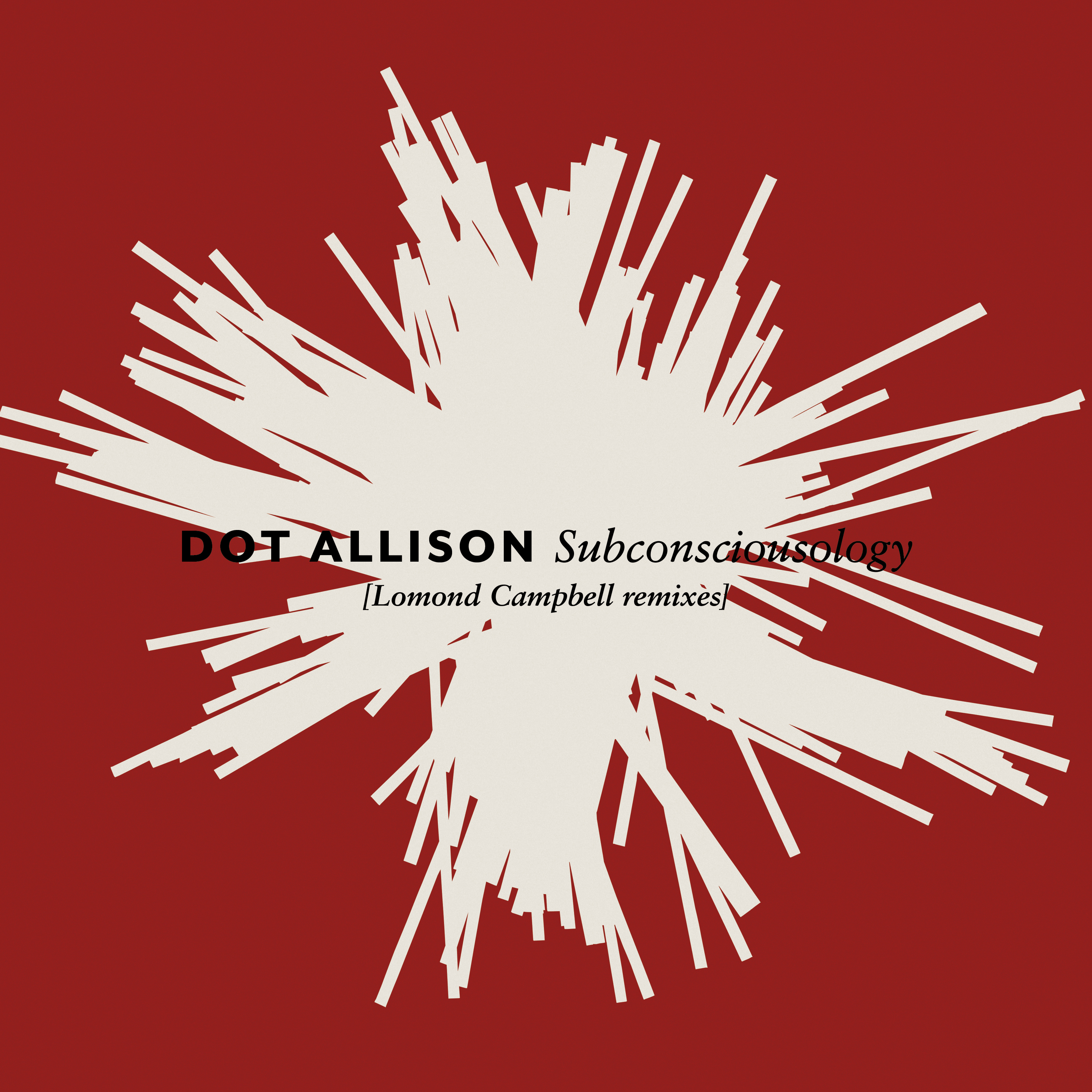
Electronic beatsmith Lomond Campbell, however, has seen the potential to make this album “deeper, darker and dancier”, departing from the pastoral outdoors to take the music underground to a club. The pair were introduced by Hannah Peel, after which Campbell remixed Ghost Orchid, from her previous album Heart-Shaped Scars. So impressed was Allison that she asked him to remix the whole of Consciousology.
What’s the music like?
Campbell is notable for his consistently inventive approach to beat making and colour shading, and that is certainly the case here.
He has a refreshing originality that complements Allison’s thoughts and lyrics, too. Double Rainbow shifts restlessly, with added colour from arpeggiated synths. Allison’s haunting voice suits Campbell’s inventive beatmaking on Bleached By The Sun, which harks memories of Kavinsky’s Night Call – in a good way. Meanwhile Mother Tree breaks out into a psychedelic, dubby groove Andrew Weatherall would be proud of.
Weeping Roses is the real eyeopener, as it unexpectedly opens up into a big room floor filler, with what Allison notes is the “light and dark clash of worlds and sounds that Lomond has created from the roots and stems of the original.”
Comparisons are inevitably drawn with Allison’s work as part of One Dove, and in a good way – for electronic music feels not only like Dot Allison’s home turf, but an essential part of her musical make-up that drives a great deal of creativity.
Does it all work?
Yes – and it there is something refreshingly rugged about the end result, putting Dot Allison’s voice through a very different emotional wringer.
Is it recommended?
It is – but should be heard right next to the original, to appreciate Lomond Campbell’s creativity and Dot Allison’s emotional connections. Both forces are extremely well matched here.
Listen / Buy
Published post no.2,639 – Wednesday 26 August 2025
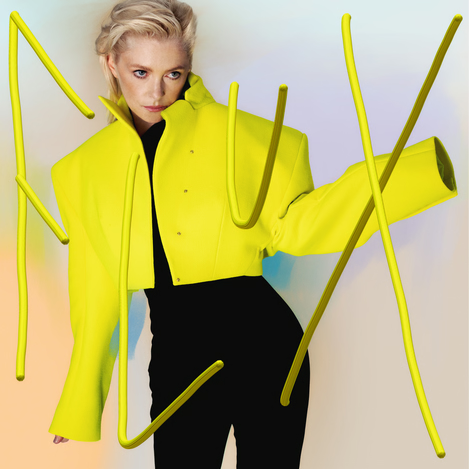
As Goldfrapp continue their hiatus as a band, singer Alison Goldfrapp adds a second notch to the belt on her solo career.
Most of Flux was made in Sweden, working with producer and songwriter Stefan Storm, with the renowned Richard X also appearing in a collaborative guise.
What’s the music like?
For Alison Goldfrapp, this is a relatively safe move, but it certainly plays to the strengths of her vocals. The songs are well-written, with some telling explicit stories. By a quirk of fate Sound & Light was written earlier on the same day that Goldfrapp saw the Northern Lights for the first time, and it captures the rarefied atmosphere of their appearance.
The vocals are ice-cold, the productions clean and relatively clinical, and many of the songs become earworms after a few listens. Hey Hi Hello is an excellent opener, while the sultry Reverberotic works up a sweat at a slower beat. Find Xanadu brings the best out of Richard X, with a fine vocal to boot, while some much-needed heat is added by Ordinary Day, a quality pop-house cut spending time by the pool.
Does it all work?
It does, though there is a wish that Goldfrapp would let herself go emotionally a bit more. These are excellent club cuts, but most are on safe ground where feelings are concerned.
Is it recommended?
It is, thanks to some classy work in league with Stefan Storm and Richard X. Alison Goldfrapp remains one of the most recognisable voices in pop music currently, and she certainly knows her way around a dancefloor. Add a bit more explicit feeling and her music would be irresistible.
In a changing, unpredictable and turbulent world, something we can always rely on is a new Orb album, with the next holiday-for-the-head never far away. On what is quite possibly the millionth longplayer helmed by electronic lifer Alex Paterson; partnered with the now firmly-entrenched boy wonder Michael Rendall; the inspirationally productive outfit yet again deliver the goods, with one of their best yet.
“I was having a dream, and in this dream was an escalator descending out of the clouds, upon which were Buddhists and hipsters travelling downwards, and beckoning me down from the top, was Roger Eno. When I woke up, I had a text from him, asking if we fancied more collabs, so he’s on the record, amongst other friends.
New single Under The Bed, the second track to be taken from forthcoming album Buddhist Hipsters sees long-time Orb cohort Andy Falconer, whom Alex calls “an ambient god”, join forces with Alex, and the pair go so many fathoms deep that they aren’t merely out of their pit, but Under The Bed, and it displays all the awe of the cosmos like a planetarium from heaven. As the press release says – it is nearly ten minutes of pure, easy, hot-weather ambience.
“Recording the album and playing recent gigs have been comfortable, happy, and therapeutic experiences, largely due to Michael Rendall, who’s a genius that picks up anything he turns his hand to. We have a wonderful, simpatico relationship on record and on stage. Overall, the length, arc, and energy of Buddhist Hipsters energy mirrors one our fans’ faves, U.F. Orb.”Alex Paterson
Spontaneously Combust kicks off in fine style, with Steve Hillage’s unmistakeable guitar, Miquette Giraudy on vintage EMS synth, plus blue roomy bass, backwards vocals, and gentle dream house grooves. It features a top-secret sample, suggested to Alex by shopkeeper-par-excellence Michael King, taken from his mythical basement vaults at West Norwood’s Book and Record Bar.
A recent live set starter, P~1 slowly builds into firing cosmic D&B cyclones, whilst the bleeped-up late 70s synth of Baraka is an ode to a famous Kenyan blind rhino, who, tellingly is known as a symbol of resilience. Already a firm live favourite, A Sacred Choice is prime leaping reggae skank, with Youth on bass, Paul Ferguson on drums, Andy Falconer on atmospherics, and vocals by Eric Von Skywalker.
The title of the eastern influenced, orchestral drama of hip hop banger Arabebonics is a word invented by rapper Rrome Alone, who lends vocals to the track, with added BVs and strings from Violeta Vicci.
Elsewhere, prog-throbber It’s Coming Soon features Andy Cain’s dulcet tones, that grace this plaintive-arpeggiated-prog-throbber, on which Alex manages to smuggle a nod to his aunties Rose and June into the lyrics, before the dusty nostalgic vibes of Doll’s House glows and pulsates in all the right ways, scattering sound beams like a planet sized disco ball.
With Alex having met lovers rock legend Trevor Waters and discovering his classic Love Me Tonight, Rendall isolated the vocal using Logic, transforming the original into the pinnacle of the LP’s house music passage. Newly titled The Oort Cloud (Too Night) and aided by cult Manchester disc jockey Dr D, they embark on a classic NYC deepside journey, for a moment of dancefloor ecstasy.
Elsewhere, Andy Falconer joins forces with Alex on Under The Bed, while the delightful Khàron, named after the sister planet of Pluto, conjures a universe alive with light and celestial beings, largely aided by Roger Eno’s stunningly sparing piano. Finishing on a high, it bids us a warm goodnight.
Buddhist Hipsters is released on October 10th via Cooking Vinyl and will be available on CD with a 6 panel fold out sleeve, black double LP vinyl with a gatefold sleeve and limited-edition rust red, pink marble and yellow marble vinyl.
Clarice Jensen unveils new single Unity from her upcoming fourth solo album Inholidayclothing, out of the great darkness.
Composer and cellist Clarice Jensen unveiled Unity, the second single taken from her upcoming fourth solo album, In holiday clothing, out of the great darkness, out on October 17, 2025 via FatCat Records’ 130701 imprint.
In ‘Unity’, Jensen builds a symmetrical four-chord pattern that repeats steadily, through looping. Upon this she imposes a scampering arpeggio pattern that is irregular and additive, elongating itself through the repeats. She says,’The concept of unity suggests that many are being joined as a whole. In mathematics it is literally the number one. Unity depicts the multitudes (the evolving arpeggios) contained within a unified whole (the four-chord motif), examining the implications of one, or solo, or solitude and how oneness can imply both solitude and interconnectedness.’
‘Unity’ is the second glimpse of Jensen’s new material, following July’s ‘From a to b’. Jensen has been performing ‘from a to b’ as a solo piece while touring with My Chemical Romance, where it has resonated strongly with audiences. The track explores the idea of how and when a solo line becomes two, and how a singular melodic voice can become its own counterpoint.
In holiday clothing, out of the great darkness showcases Jensen’s distinctive compositional approach, in which she improvises and layers her cello through shifting loops and a chain of electronic effects, exploring a series of rich, drone-based sound fields. Pulsing, visceral and full of color, her work is deeply immersive, marked by a wonderful sense of restraint and an almost hallucinatory clarity. The album was recorded as part of the Visiting Artist Programme at Studio Richter Mahr, the creative space co-founded by Yulia Mahr and Max Richter in Oxfordshire, England.
Having made a solo move to the Berkshire Mountains in upstate New York in September 2020 after many years living in Brooklyn, Jensen found herself confronting and enjoying a newfound solitude as the non-stop movement and collaboration of city life as a musician had come to a standstill. The first LP she made post-move – Esthesis, released on 130701 in 2022 – is largely devoid of cello, synth heavy, and examines emotions in a self-conscious way from an isolated point of view that is nearly one-dimensional.
Jensen sets new parameters for In holiday clothing, placing the acoustic sound of the cello at the fore, and affecting the sound only through a few effects (octave displacement, delay, tremolo and looping). ‘It felt necessary to return to the rich acoustic sound of the cello that I’ve loved and produced for nearly my entire life, and to return to an expression of emotion that’s multi-dimensional and sincere,’ she notes.
As a soloist, Jensen endeavors to establish a new tradition of solo cello performance that integrates electronics with the storied and beloved performance practice intrinsic to the instrument. She places great importance on finding and working with effects pedals that integrate well with the cello, and avoids overt use of plugins or playback. Jensen considers the solo cello works of Johann Sebastian Bach as a central backdrop to this new album. Bach’s Solo Cello Suites display a rich range of voices created by one instrument. Having found ways to expand the sound and voice of the instrument through electronics, Jensen found it fitting to return to Bach’s works – music she has played for many years – as a way to touch back in with the tradition of the instrument.
As a composer, Jensen insists that the programmatic elements of her albums align and ring true. This album’s title is taken from the quote from Rainer Maria Rilke’s Letters to a Young Poet, ‘… what steps forth, in holiday clothing, out of the great darkness’. She writes, “the quote from Rilke had been bouncing around my mind for many years; the visualisation of musical ideas being born and echoing inside a ‘great darkness,’ then emerging ‘in holiday clothing’ felt very beautiful and tangible, and this essay, which to me is a manifesto in celebration of solitude, depicts what so many artists and composers experience when they endeavor solitary work. This album reflects a personal and conceptual exploration of what solo means.”
In holiday clothing, out of the great darkness is due out on 17th October 2025, and is available for pre-order on vinyl and pre-save on supporting digital streaming platforms.
Malcolm Arnold, by permission Fritz Curzon. Text adapted from press release by Ben Hogwood
Demonstrating why Sir Malcolm Arnold is one of the most versatile and resourceful composers; ’20 for 20’ is the theme celebrating the 20th Malcolm Arnold Festival with performances of all 20 of the composer’s Concertos for solo instruments taking place in Northampton, the town of his birth, over the course of the weekend 18-19 October 2025.
Directed by Paul Harris, The Malcolm Arnold Festival is an annual programme of events celebrating one of England’s most prolific, colourful and charismatic composers – Sir Malcolm Arnold (1921-2006), who is probably best known for his internationally famous film scores, symphonic showpieces, and a canon of powerfully emotive semi-autobiographical symphonies.
INVENTIVENESS ON A SMALLER SCALE – MALCOLM ARNOLD’S CONCERTOS
Perhaps less well-known are Malcolm Arnold’s concertos, written throughout his long career and characteristic of the composer’s versatility in writing for a wide range of instruments and in appealing to both performer and listener alike; as such, they demonstrate all the hallmarks of the composer’s inventiveness in smaller scale.
Malcolm Arnold’s scoring for the concerto tends to favour the reduced forces of chamber orchestra or string orchestra and, according to Arnold authority Timothy Bowers; “Within an Arnold Concerto we find a lighter and more intimate world of expression. The influence of Sibelius in particular was embedded in Arnold’s concept of symphony form and scale”, explains Bowers. “He was also attracted to the sound world of Béla Bartók, particularly his ‘night music’.”
As a composition student of Gordon Jacob at the Royal College of Music and honing his craft as Principal Trumpet amongst the brass elite of the London Philharmonic Orchestra, Malcolm Arnold immersed himself in the workings of the orchestra and went on to become one of England’s most skilled and versatile composers, with the ability to write for any instrument that was called for.
“Arnold was far more productive in this field than most of his contemporaries”, says Timothy Bowers, “and this suggests that the concerto was especially important to him as a form. The best of his Concertos are amongst the finest works that Arnold created, and as a body of work they represent a highly personal approach to the genre. The experience of listening and studying the Concerto series as a whole is immensely rewarding.”
Of the twenty ‘Concertos’ with opus numbers, seventeen are for instrumental soloist, of which three are duo-concertos, the majority lasting around fifteen minutes. The earliest were written for friends and colleagues, which lead to commissions from world-renown soloists including Denis Brain (horn), Julian Bream (guitar), Benny Goodman (clarinet), Michala Petri (recorder), and Julian Lloyd Webber (cello), hence those written for more unusual solo instruments, such as harmonica, organ, and piano duo, and in some cases more than one work for the instrument requiring both a different approach in style and orchestral forces.
Some are better known and more regularly performed than others and some are considered masterpieces of the genre, such as the Flute Concerto no.2, and the Concerto for Guitar and Chamber Orchestra.
HEAR ALL 20 CONCERTOS OVER A WEEKEND OF LIVE MUSIC
Festival Director Paul Harris is a composer and clarinettist as well as one of the UK’s leading educationalists and authors. As Malcolm Arnold’s co-biographer, he has worked tirelessly, as Founder-Director of the Malcolm Arnold Festival, to present the composer’s genre in an accessible and exciting format and to provide a platform for both professional and student musicians to perform the composer’s works.
“We’re delighted to be holding the Festival at the very prestigious Cripps Hall which is part of Northampton School for Boys – the very school the young Malcolm Arnold attended!”, says Paul Harris. “For Saturday’s evening concert we transfer to St Matthew’s Church which will provide the opportunity to hear a rare performance of the ‘Grand Concerto Gastronomique’ for Waiter, Eater and Food; a suite of short orchestral pieces, in characteristic Arnold style, and calling for a wordless soprano in tribute to Dame Nellie Melba!
Taking part this year are the LGT Orchestra – an award-winning string ensemble featuring talented young soloists from over 20 nations; Equilibrium Symphony Orchestra – who’s young musicians already have professional solo experience, as well as regional orchestras and youth ensembles that include Bedford Sinfonia, Berkshire Youth Symphony Orchestra, and the London Choral Sinfonia.
GALA CONCERT, GUEST SOLOISTS AND A WORLD PREMIERE
Saturday evening’s Gala Concert provides the opportunity to hear Malcolm Arnold’s Concertos for Trumpet, Harmonica, and Organ, with soloists Nick Budd, Shima Kobayashi and Thomas Moore, while pianist John Lenehan will perform a World Premiere of his own two-hand arrangement of the Concerto for Two Pianos (3 hands) and Orchestra.
The Festival will be welcoming a plethora of guest soloists including: Joshua Milton and Nico Varela, (piano); Poppy Beddoe and Christian Hoddinott, (clarinets); Emmanuel Webb and Elif Ece Cansever, (violins); Hugh Millington and Gonçalo Maia Caetano, (guitars); Michala Petri, (recorder) –who will also be giving a talk; Maria Filippova and Daisy Noton, (flutes); Sarah-Jane Bradley, (viola); Daniel Fergie, (oboe); Junyu Zhou, (saxophone), and Ben Goldsheider and Finnian Smith, (horns).Conductors include Hilary Davan Wetton, Mattea Leow, Ian Smith, Jonathan Burnett and Ben Copeman.
The Festival programme will include complementary works by Malcolm Arnold’s composition teacher, Gordon Jacob; one of his major influences, Jean Sibelius, and fellow composers William Walton, Ruth Gipps, and Malcolm Williamson.
HOW TO BOOK
Day Ticket – allows entry to either Saturday or Sunday’s concerts, priced at £15
Weekend Ticket – allows entry to both days, priced at £25 Under 18s/Students, FREE
Gala Concert – priced separately at £10. Under 18s/Students, FREE