The 6Music Prom – Nils Frahm and A Winged Victory For The Sullen

Prom 27: Late Night With … BBC 6 Music: Nils Frahm and A Winged Victory For The Sullen
a-winged-victory-for-the-sullen
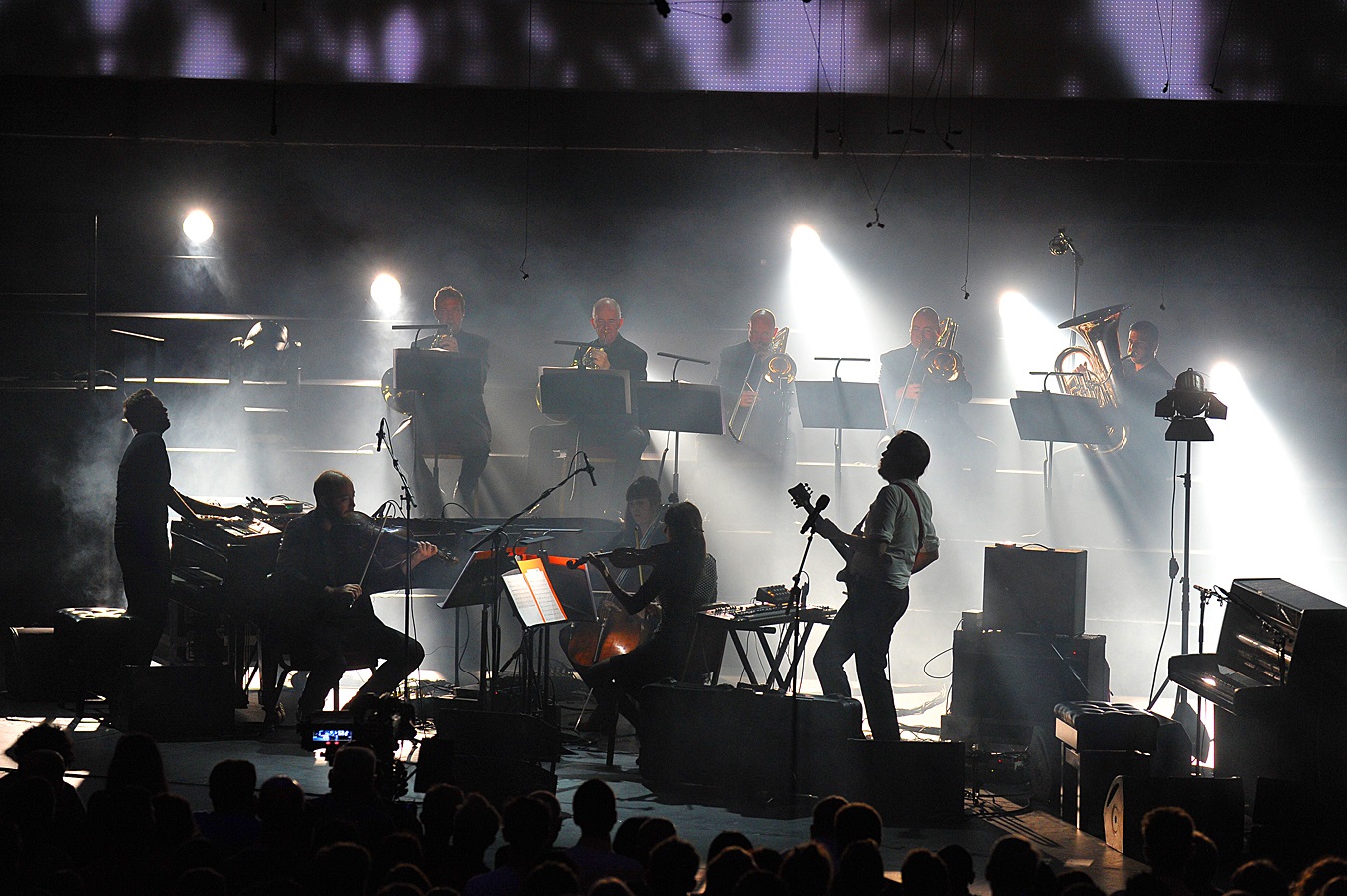
A Winged Victory For The Sullen at the 6Music Prom Picture (c) Chris Christodoulou

Watch here:

http://www.bbc.co.uk/events/empxj5#b0640mhj

The story behind the second BBC 6 Music Prom was a gratifying one, built on a desire for classical music to make itself more available. Mary Anne Hobbs was the catalyst, playing music by Nils Frahm to enthusiastic listeners worldwide. Their response encouraged her to introduce them to his Erased Tapes label mates, A Winged Victory For The Sullen, a duo comprising Dustin O’Halloran and Adam Wiltzie.

Both acts were part of an extended mix for this late night event, aided by atmospheric lighting and smoke to turn the Royal Albert Hall into an after-hours club. Into this already heady environment came A Winged Victory, playing much of their second album ATOMOS. They were joined by an unnamed string trio and London Brass, their task to provide sonorous colour and slow but far-reaching melodies. O’Halloran and Wiltzie were on keyboard duties, drawing out chord patterns and soundscapes to give the listener an airborne sensation. This was further enhanced by members of the Random Dance Company, whose chief Wayne McGregor provided the stimulus for ATOMOS. Their relaxed interpretations of the music belied the effort required to contort their limbs!

The music was expansive, like a slowly changing cloud formation, and crucially had beauty of timbre to match. From the simplest of melodic cells came music of primitive meaning, evoking memories of pop music’s ambient craze twenty years ago but without any vocal samples. Here music was stripped back to its basics, and was all the more moving for the lack of incident and chatter. The crowd was thoroughly absorbed, most stock still but some perceiving the latent energy running through the music.

In truth London Brass could have been used more, their potential to add brightness only sparingly glimpsed. The string trio were more gainfully employed, the cello particularly beautiful when raised above the textures. As their set came to an end so Nils Frahm joined the stage, the two acts uniting in an improvised piece that brought more rhythmic definition – a sign of what was to come from the German pianist.

nils-frahm
Nils Frahm at the 6Music Prom. Picture (c) Chris Christodoulou

Frahm used a team of keyboard instruments, including two ‘prepared’ pianos – that is, with keyboards, hammers and strings all modified to secure the all-important timbres required. Frahm’s music is more obviously derived from classical music, with Beethoven’s Moonlight Sonata, Chopin and Debussy all discernible influences. It has more obvious kinetic energy, moving quickly during Hammers to imply a strong beat, even before the introduction of an incredibly warm bass note to rattle the ribcage.

Frahm was a hyperactive presence, rushing urgently between his pianos and synthesizer, occasionally looping small clumps of chords in the manner of Steve Reich or even Dave Brubeck, but always intent on carrying his music forward. It was largely successful, though the introduction of two toilet brushes for the closing number felt like a gimmick.

What really carried, though, was the intense desire for discovery on the part of the audience. 6 Music had been playing classical music in the lead-up to this Prom, sensitively chosen with the pop music lover in mind, hoping to arouse curiosity – and that is exactly what this sort of Prom should be doing, bringing in people who find classical music and its terminology a daunting proposition.

It was a handsome success, Hobbs having found a way of communicating its appeal while showing how electronic and classical styles are on a fruitful collision course. We should not just be limited to Erased Tapes, though, as Warp, Glacial Movements, Bella Union and One Little Indian are just four more labels excelling in this area.

It is to be hoped that at the very least we will have a sequel. Tom Service presents a program along these lines on 6 Music this Sunday, showing how the two stations do on occasion overlap. Both have open musical policies, and in their current state show the BBC at its best, providing musical stimulation for a clearly hungry crowd.
Under the Surface at the Proms – British composers

Prom 26, 5 August 2015 – BBC National Orchestra of Wales / Tadaaki Otaka at the Royal Albert Hall

ailish-tynan-tadaaki-otaka

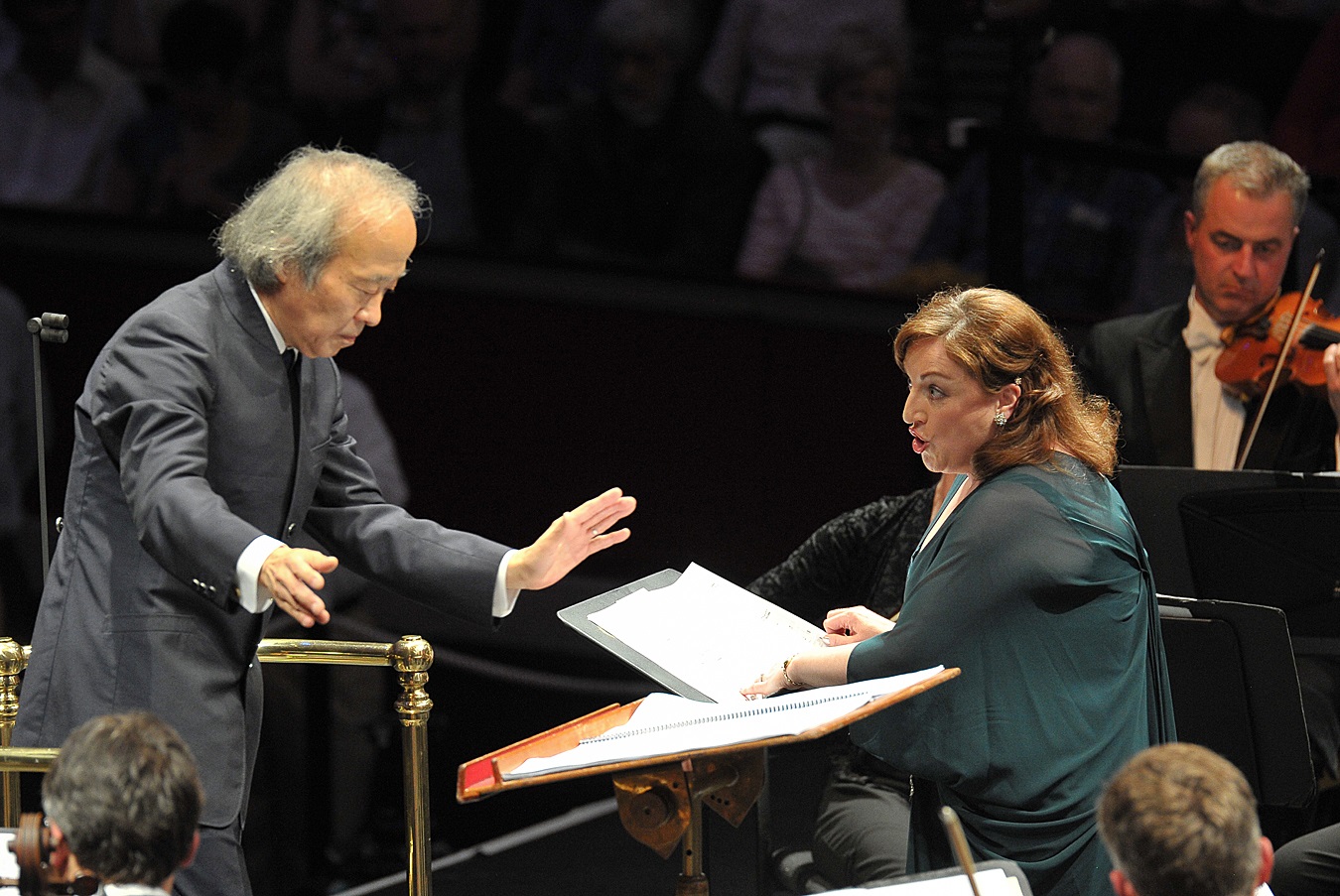
Ailish Tynan and Tadaaki Otaka performing Grace Williams’ Fairest of Stars at the BBC Proms Picture (c) Chris Christodoulou

Only the BBC Proms could come up with a night like this, a programme of partially or wholly neglected British music flattering not only the composers but the BBC National Orchestra of Wales, who had clearly invested a lot of rehearsal time.

Their greatest triumph came last, the Symphony no.2 of William Walton, written in 1957 but receiving only its fourth ever performance at the festival and its first since 1996. Walton’s First gets all the glory in his symphonic output, and understandably so – it’s bold, has strength of character, some terrific tunes and bright orchestral colours. Yet the Second deserves far more, as conductor Tadaaki Otaka showed us here:

http://www.bbc.co.uk/programmes/p02yxs45/player

Although it is a much more anxious and questioning piece it is tightly structured, its melodies unusual but somehow memorable too. The first movement tune has a steep incline to its melody but remains in the head, and certainly did so after this performance, beautifully coloured as it was with orchestral piano and glockenspiel. The second movement had softer colours but was equally worrisome, while Walton, thumbing his nose at ‘serial’ composers who had opted out of tonality, uses all twelve tones in his theme for the finale, in a tuneful sense. Here they were hammered home in orchestral unison, and the climax of the work was hugely impressive.

Earlier we heard some better known works from Walton – a bracing Spitfire Prelude and Fugue – and Elgar, his first orchestral work the Froissart Overture, played with a smile on its face.

Then it was over to do two very different Williams. Ralph Vaughan Williams completed his Concerto accademico, for violin and string orchestra, in 1925. It pays explicit homage to Bach but not in the way Stravinsky and co liked to do at the time. The composer saw this as a much more tuneful exercise, using folk-based material in the process. Listen here:

http://www.bbc.co.uk/programmes/p02yxlqh/player

Despite a good performance the piece remains a curiosity. The first movement was dogged and rather foursquare, the music pressing on rather grimly, so it was left to the second movement to bring what felt like more genuine emotion, bringing to mind the slow movement of Bach’s Brandenburg Concerto no.1 as it did so. Chloë Hanslip, the excellent soloist, was rich in tone both here and in the finale, which reverted to brisk music but in a much more accessible way this time, with a soft-hearted closing section. This was, for me, not the composer’s best.

Grace Williams, a Welsh composer who was a pupil of Vaughan Williams, is not heard much in the concert hall – but Fairest of Stars, for soprano voice and orchestra, suggested she should be. Her writing for the voice was elevated by Ailish Tynan, who looked ready to burst into song as soon as she appeared on stage. Tynan’s voice was the perfect foil for this music, soaring above the clouds brought by the orchestra, and although the words were not always abundantly clear because of the thicker scoring, very much in the Richard Strauss vein, their sentiment was. The top ‘C’ Tynan hit before the end had to be heard to be believed, the crowning glory of the concert’s first half. Listen to the piece here:

http://www.bbc.co.uk/programmes/p02yxqzy/player

The last few years have seen the Proms bring a number of major but neglected British works in from the cold – we have had music by Moeran, Alwyn, Havergal Brian and Howells to name just a few – and it is heartening to see them continuing that tradition. This night was a great success; let’s hope many more will follow.

There will be more Under the Surface features as the Proms progress, exploring lesser known pieces and composers at the festival

Proms Interview: Tansy Davies – Re-greening

tansy-davies
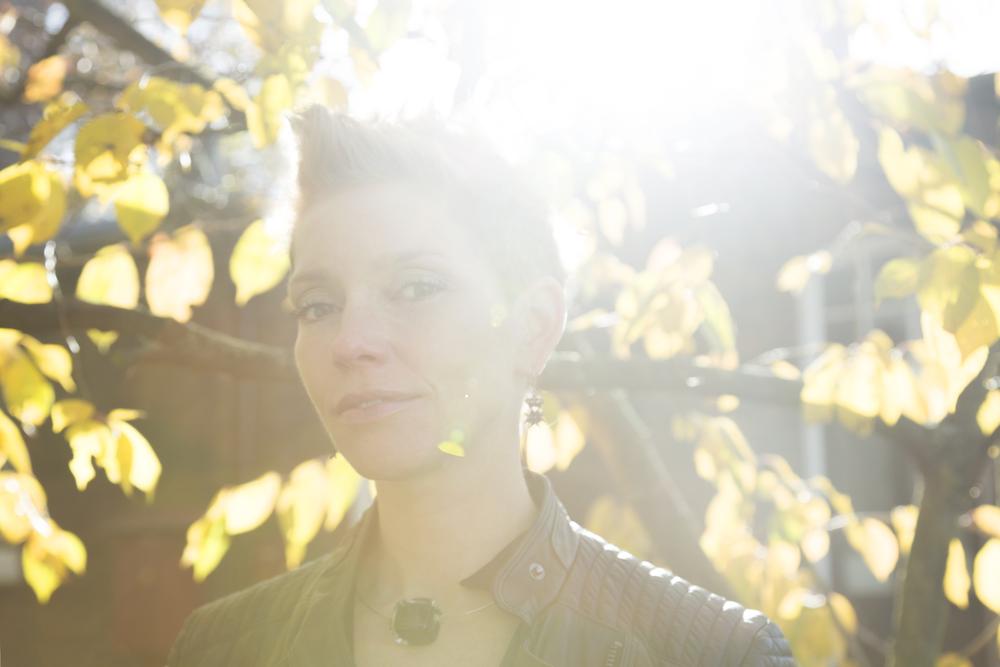
Tansy Davies Photography by Rikard Österlund

For the annual appearance of the National Youth Orchestra of Great Britain at the BBC Proms, listeners will be treated to a performance of Mahler’s farewell to life, the Symphony no.9.

Prior to this, however, they will hear a new piece of music all about bringing new life to proceedings. Re-greening was written by composer Tansy Davies as a complementary piece to the Mahler, and in a short notice and generously arranged interview with Arcana the composer gave a guide to her new work and her Proms history:

Do you remember your first encounter with the Proms?

I must have been aged around 15. I just turned up with a couple of friends, not having planned or looked at what was on. We prommed of course, and I know that the programme included Debussy’s Prélude à l’après-midi d’un faune. The atmosphere was palpable, and I loved every second.

What was your first Prom as a composer?

In 2010, when I wrote Wild Card for the BBC Symphony Orchestra.

Have you written for the National Youth Orchestra before?

No.

Where did the idea for Re-Greening come from?

The concept emerged out of a collaboration between the NYO, Sir Mark Elder and myself. It’s a celebration of youthful exuberance and Spring. The commission brief, which was flexible, included the following ideals: references to old English melodies, singing in the orchestra, no conductor, and the orchestra would consist of upwards of 165 musicians. And it should create a feeling of freedom within the orchestra, before Mark Elder enters the stage as the voice of experience, to lead them through Mahler 9.

Did you have a particular location in mind when writing it?

I see the piece as being rather like a journey around a forest. The place I was thinking of is Earth (Re-greening the Earth…); and an old English forest.

What is it about an old English forest that you have represented in the piece, or were you looking to capture the overall atmosphere more?

That was really just part of my inspiration; drawing on ideas about reaching back to our roots as humans with a deep connection with nature (the structure is loosely based on a shamanic wheel of the year). But I think the way the music is layered to me suggests a forest like quality; interweaving arpeggio-type figures bubbling or erupting up from the cold earth in winter, and scales or lines reaching up to the light.

As you are writing a piece to complement Mahler’s Ninth Symphony, was it important to write a piece with a lot of opposite elements?

It was important to find something unique, performable and right for the group and the occasion, within the given constraints.

What do you like about Mahler as a composer?

The epic film-like quality of his vision.

How do you portray the colour ‘green’ in classical music?

That’s not something I’ve tried to do, although green is the colour of the heart-chakra, and my music mostly comes out of this part of me.

Neon for chamber ensemble of 7 players

Is it fair to say that through your career as a published composer you have tended to work with smaller ensembles, working gradually up to orchestral composition?

No – I think it has been more haphazard than that! It’s true that I wrote for smaller groups in most of my early music, but I’ve actually written quite a lot of orchestral music over the years. You can include chamber orchestra music in that, and my Requiem As with Voices and with Tears, which is for chorus, string orchestra and electronics.

Were you pleased with the production of your opera Between Worlds, and the reception it got?

Over the moon!

Tansy Davies and Deborah Warner talk about their operatic collaboration, Between Worlds, staged at the Barbican Centre recently

What else are you working on at the moment?

My next piece is for symphony orchestra, I’m very excited about it, but I can’t say any more just yet. I’m thrilled to have had so many opportunities to write for orchestra; I never planned it that way, but I absolutely love getting a feel for how to work with the medium.

If you could see one other Prom this season, which one would it be?

There are many and some wonderful things that I sadly can’t get to. But I hope to attend the BBC Scottish Symphony playing Sibelius and Michael Finnissy (16 Aug), and then Esa-Pekka Salonen and the Philharmonia in Bartók and Shostakovich (24 Aug). After that I am also attending the next two Proms – the BBC Symphony Orchestra and Edward Gardner (Prom 54, Nielsen Flute Concerto and Janáček Sinfonietta) and the SWR Symphony Orchestra with François-Xavier Roth (Prom 55, Bartók Concerto for Orchestra and Boulez …explosante fixe…

Tansy DaviesRe-greening will be performed at the Proms by the National Youth Orchestra of Great Britain under their conductor Sir Mark Elder, on 8 August 2015. For more information about the composer head to her website, where you can hear http://www.tansydavies.com/works/ excerpts from her catalogue of works.

Proms guide and review: Prokofiev Piano Concertos

Prom 14, 28 July 2015 – BBC Symphony Orchestra / Sir Andrew Davis at the Royal Albert Hall

prokofiev-piano-concertos

Pianists Sergei Babayan, Alexei Volodin and Daniil Trifonov take a bow alongside conductor Valery Gergiev after their performance of all five Prokofiev Piano Concertos with the London Symphony Orchestra at the Royal Albert Hall on Tuesday 28 July. Photo: Chris Christodoulou

With Leif Ove Andsnes finishing his cycle of Beethoven’s five piano concertos the previous night, it seemed an odd decision by the Proms to embark on another cycle of five from one composer, all in a single night. Yet Valery Gergiev, the London Symphony Orchestra and a trio of fiendishly talented Russian pianists proved us doubters couldn’t have been more wrong.

Prokofiev’s piano concertos vary greatly in popularity, so much so that nos. 4 & 5 were receiving their first Proms performances – incredible for works now 83 years old! They embody the composer’s relative economy, his refusal to take himself too seriously and his use of the piano not just as a purveyor of bittersweet melody but as a percussive instrument too.

We began with the impudent Piano Concerto no.1, an often outrageous piece prone to bouts of cheeky sarcasm and unexpected charm:

http://www.bbc.co.uk/programmes/p02y9wqh/player
Prokofiev: Piano Concerto no.1 in D flat major, Op.10 (1912) 16 minutes

Daniil Trifonov played this piece superbly, exaggerating Prokofiev’s mischievous nature in a way the composer would surely have enjoyed. Gergiev too reminded us why he remains a peerless conductor in this repertoire, coaxing previously unheard detail and colour from the orchestra. If you listen to the clip above, you will agree it is a relative riot from start to finish!

http://www.bbc.co.uk/programmes/p02y9x3n/player
Prokofiev: Piano Concerto no.2 in G minor, Op.16 (1913) 31 minutes

This detail could be heard again in the cool, luminous slow sections of the Piano Concerto no.2, where Sergei Babayan lulled us into a false sense of security with a sombre opening section. Gradually – like Rachmaninov in his Piano Concerto no.2 before him – Prokofiev moved through the gears, the climax a titanic cadenza (a showy solo episode, cue to follow) that Babayan – Trifonov’s teacher, incidentally – played majestically, bringing goose bumps when the bright lights of the orchestra returned.

The Second is a contrary piece, following these bold romantic gestures with a grotesque second movement march owing much to Musorsgky (cue to follow), before a more elegiac third movement and a finale that gathers itself for showy virtuosity again, shown in the terrific closing pages. The house was brought down once again!

http://www.bbc.co.uk/programmes/p02y9xf1/player
Prokofiev: Piano Concerto no.3 in C major, Op.26 (1921) 30 minutes

Trifonov returned to make it three cracking performances out of three with a sparkling account of the Third, revelling in the different characters Prokofiev uses for the central Theme & Variations (cue to follow). The sleights of hand in the outer movements were dizzying, the pianist a study of concentration as his quick fingers deceived the eye. Gergiev again found insight to the colours of the second movement that normally evade the ear.

http://www.bbc.co.uk/programmes/p02y9xyz/player
Prokofiev: Piano Concerto no.4 in B flat major, Op.53 (1931) 22 minutes

And so into the relative unknown for the Fourth, a work commissioned by the fearsome left handed pianist Paul Wittgenstein – and ultimately rejected. His dissatisfaction relegated the piece to an also ran in Prokofiev’s output, but as Alexei Volodin proved here, that tag is undeserved.

This holds especially for the slow movement, which points towards the composer’s ballets, particularly Romeo and Juliet, which was close at hand in 1931. Indeed a forebear of the music for Juliet the Young Girl can be heard in the fourth movement, which scampered off the leash in this performance before disappearing in a puff of air.

http://www.bbc.co.uk/programmes/p02y9yd5/player
Prokofiev: Piano Concerto no.5 in G major, Op.55 (1932) 22 minutes

Sergei Babayan returned for an imposing performance of the Fifth and final concerto, a convincing account that made a mockery of the work’s non-appearance at the Royal Albert Hall. With melodic lines that dipped low before leaping up high he was never still, rising to the technical challenges while applying a lightness of touch needed to dilute the heavier, percussive moments.

Once again Gergiev and the London Symphony Orchestra, whose stamina was especially praiseworthy, propelled the third movement like a machine testing its upper speed limit, while again the slow movement – this time placed four of five – drew a lump to the throat before Prokofiev characteristically girded himself for an emphatic finish.

On the face of it this could have been an ill-judged experiment, especially with the two least-known works placed last. But the audience and social media reaction proved it to be anything but, for the listeners thoroughly enjoyed this colourful and often theatrical riot of ever-changing moods. While the piano will no doubt have needed some tender loving care at the end of it, Prokofiev’s invigorating music emerged defiant.

Proms premiere – Hugh Wood: Epithalamion

hugh-wood

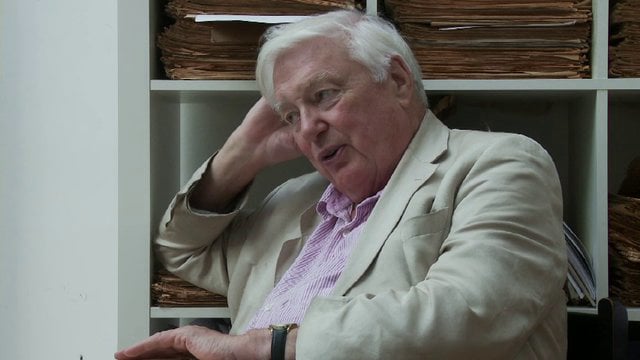
Hugh Wood

Rebecca Bottone (soprano), BBC Symphony Chorus and Orchestra / Sir Andrew Davis (Prom 7)

Duration: 20 minutes

BBC iPlayer link

http://www.bbc.co.uk/programmes/p02xv5wc/player

This piece will shortly be broadcast on BBC4 on July 30, at which point I will provide a new link.

What’s the story behind the piece?

epithalamion
Procession for the wedding of Elizabeth to Frederick VAn engraving by Abraham Hogenberg, c. 1613, used courtesy of the History Today website

Epithalamion, though not one of Hugh Wood’s biggest works, was a mere sixty years in the writing. Wood first started work on it in 1955, only to abandon it, returning to the piece last year.

Epithalamion – an old word for ‘marriage song’ – celebrates the wedding of Princess Elizabeth Stuart, daughter of King James I, and Frederick, Count Palatine, on St Valentine’s Day 1613. The text was written specially for the occasion by John Donne, who used Valentine’s Day as his inspiration for the text.

Wood writes mainly for chorus and orchestra, with soprano and bass soloists (Rebecca Bottone and Nicholas Epton) listed in the Proms programme.

The story takes us through the wedding, as the couple strive to be alone together, to the bliss of the next morning.

Did you know?

Wood writes in largely traditional forms, so as well as a large-scale Symphony he has completed concertos for piano, violin and cello – as well as five celebrated string quartets.

Initial verdict

The celebrations begin with a great swell, the orchestra and choir making a joyful and expansive noise. Yet on first listen from the arena something about Wood’s music did not quite take off in this performance.

That is not a reflection on the quality of the choral writing, nor the brassy fanfares, both of which carry strong echoes of William Walton – who was of course still very active in 1955.

Yet the celebrations did not come through as consistently joyous – perhaps because of the couple striving to get away together – and it was disappointing the soloists were not used more, especially with the quality of Rebecca Bottone’s soprano well in evidence. She comes across fine on the radio but was awkwardly placed in the Hall itself, positioned top left by the percussion. Nicholas Epton, who I assumed to be taking Frederick’s part, had just one tiny cameo.

Wood’s musical language is appealing, with fulsome harmonies and appealing melodies with an upward curve, but although Sir Andrew Davis – to whom the piece is dedicated – gave it maximum input, Epithalamion fell a bit flat. Hopefully the radio broadcast will redress that!

Second hearing

tbc!

Where can I hear more?

You can read more about Hugh Wood at Music Sales, one of his two publishers, – where you can also listen to a short playlist of his compositions.

Meanwhile, here is a performance of his String Quartet no.4 from the Escher Quartet:

Encore: Hugh Wood – String Quartet No. 4 from Royal Philharmonic Society on Vimeo.

As part of the Royal Philharmonic Society's Encore Scheme, this short film opens up the music of British composer Hugh Wood.

Hugh Wood's Fourth String Quartet was selected as one of the works on the current scheme, which focuses on chamber music.

It was performed for Encore by the Escher String Quartet.

Encore is a scheme in partnership with BBC Radio 3. Encore is supported by the PRS for Music Foundation, The Mercers’ Company, The D’Oyly Carte Charitable Trust and the Idlewild Trust.