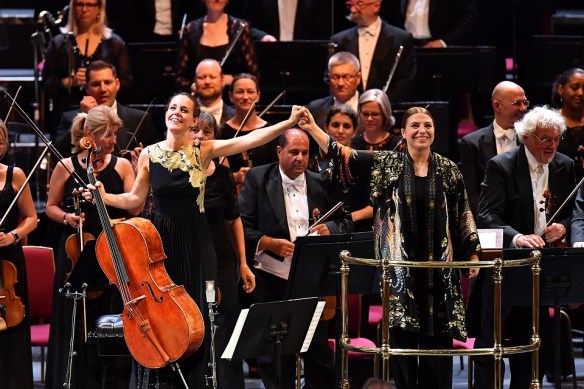
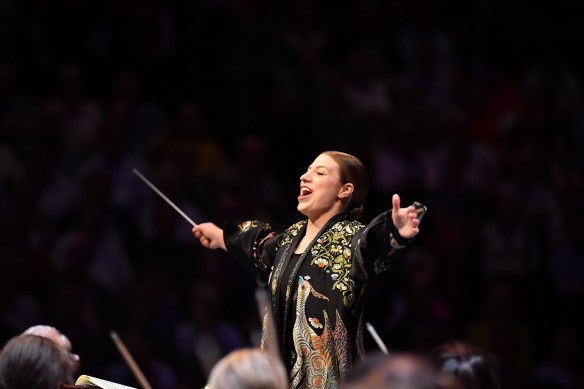
Arcana at the Proms – Prom 53: Sir Andrew Davis conducts Vaughan Williams, Hugh Wood and Elgar’s The Music Makers & Huw Watkins

Prom 53: Stacey Tappan (soprano) Dame Sarah Connolly (mezzo-soprano), Anthony Gregory (tenor), BBC Symphony Chorus, BBC Symphony Orchestra / Sir Andrew Davis

Vaughan Williams Fantasia on a Theme of Thomas Tallis (1910)
Hugh Wood Scenes from Comus (1965)
Elgar The Music Makers Op.69 (1912)

Royal Albert Hall, Thursday 29 August 2019

Reviewed by Ben Hogwood
Photo credits Chris Christodoulou

You can listen to this Prom on BBC Sounds here

A knight of the realm and a dame performing Elgar. It doesn’t get much more English than that! Yet on this humid night in the Royal Albert Hall the continental aspects of the music chosen were just as evident, Sir Andrew Davis securing a trio of very fine performances from the assembled forces.

To begin, the solemn but radiant strains of Vaughan WilliamsFantasia on a Theme of Thomas Tallis, written in the wake of his studies with Ravel in France. That opening chord never fails to transport the listener to another place, and Davis has more experience with it than most. The BBC Symphony Orchestra strings responded as one, their unity as evident in the swelling of the music as it was when the parts were divided. The four soloists at the front – violinists Igor Yuzefovich and Dawn Beazley, viola player Norbert Blume and cellist Susan Monks played beautifully, as did the group of nine instruments on a raised platform at the back of the stage. With these judicious placements Davis ensured the balance of the music – both audibly and emotionally – was firmly aligned.

Hugh Wood’s Scenes from Comus approach Englishness from a very different perspective – that of the Second Viennese School, headed by Schoenberg. Notorious for its rejection of tonality, the school was an incredibly innovative part of 20th century classical music, and Wood was one of several English composers to fall under its spell. Often the accusation is that music without tonality lacks emotion, but Wood refutes that emphatically.

Scenes from Comus may not have an obvious key centre but it treats its story in a powerfully expressive way. The orchestra told the story with strongly rendered colours, with particularly fine playing from principal horn Martin Owen with the opening theme. Soloists Stacey Tappan and Anthony Gregory (both above) found an ideal balance with the orchestra, and the story – where an Attendant Lady, lost in a ‘wilde wood’, is kidnapped by Comus – came to life. The 87 year-old Wood was present in the audience, waving cheerily at Sir Andrew Davis in acknowledgement of an excellent performance of his piece, performed for the first time at the Proms in 1965.

Elgar’s The Music Makers, a setting of Arthur O’Shaughnessy’s Ode, has tended to fall short of critical acclaim, which is unfortunate as it contains some very fine music. In it the composer recycles some of his greatest melodies, quoting and redressing them in the manner of a greatest hits compilation. If anything that approach, when complemented by new musical ideas, makes the piece even more personal, speaking to us of his own favourite moments in music while wrought with worry about the onset of later life and the prospect of war.

The memorable opening line, ‘We are the music makers and we are the dreamers of dreams’, was magical in the hands of the BBC Symphony Chorus, subdued but wonderfully clear as they are in a recent recording made with Sir Andrew Davis for Chandos.

Also on the recording is Dame Sarah Connolly, and her first notes in this particular concert (‘they had no vision amazing of the goodly house they are raising’) sent a shiver down the spine, sung with raw emotion and urgency. She was a dominant figure from her on, passionate yet fully in control of her phrasing, responding forcefully to O’Shaughnessy’s text.

Elgar’s liberal quotations enhanced the music, none of the melodies present for the sake of it, and each reimagined with O’Shaughnessy’s text. The melodies from the Enigma Variations, the Symphony no.1, the Violin Concerto and, most tellingly, The Dream of Gerontius, all contributed to a reading of really impressive gravity and poise. The BBC Symphony Chorus sang with great unity of purpose, aided by sensitive accompaniment from the orchestra and their heartfelt account of the winsome melodies. Sir Andrew Davis is a master Elgarian, and here his credentials were handsomely reinforced.

You can listen to the new recording by these forces of The Music Makers on Spotify below:

On record – BBC Symphony Orchestra / Sakari Oramo: Sibelius: Lemminkäinen Suite (Chandos)

BBC Symphony Orchestra / Sakari Oramo

Sibelius
Lemminkäinen Suite Op.22 (1893-6, rev. 1897/1900/1939)
Spring Song Op.16 (1894, rev. 1895)
Belshazzar’s Feast: Suite Op.51 (1906-07)

Chandos CHAN20136 [71’34”]

Producer Ann McKay
Engineers Neil Pemberton and Rob Winter

Recorded 22-23 May 2018 at the Colosseum, Watford

Written by Richard Whitehouse

What’s the story?

Sakari Oramo extends his discography with this recording of Sibelius’s Lemminkäinen Suite in partnership with the BBC Symphony Orchestra (whose chief conductor he has been these past five seasons), coupled with two rarities among the composer’s shorter orchestral pieces.

What’s the music like?

Emerging from an abandoned opera, the Lemminkäinen Suite followed Kullervo as Sibelius’s second major symphonic work before his actual First Symphony. It only reached its definitive guise over a decade after the composer’s last notable piece, was unpublished until three years before his death and remains on the edge of the repertoire. Opting for the order of movements at its 1896 premiere, Oramo draws a vibrant response in Lemminkäinen and the Maidens of the Island with its heady alternation between energy and ecstasy – underlining its emotional rhetoric without undue histrionics. Sibelius’s masterpiece from this period, Lemminkäinen in Tuonela is more focussed in form and expression – Oramo pointing up the contrast between its stark depiction of the underworld with the premonitions of the hero’s mother at its centre.

Closing with the two shorter movements risks selling short this suite’s overall trajectory, but Oramo ensures their continuity through his searching take on The Swan of Tuonela (soulful cor anglais playing from Alison Teale) such as forms a potent contrast with Lemminkäinen’s Homeward Journey in which the hero marks his being restored to life with a hectic return to the human world. Others have favoured a more headlong approach, but Oramo’s building of cumulative anticipation makes for tangible excitement on the way to a resolute conclusion.

As to the other pieces here, Spring Song was once among Sibelius’s most performed pieces but long ago fell from grace. As Oramo hears it, what can feel a rather half-hearted re-run of Grieg or Svendsen assumes darker and more equivocal shades prior to its hymnic apotheosis – even if the coda still sounds perfunctory. A suite drawn from incidental music for Hjalmar Procopé’s Belshazzar’s Feast has had advocates (such as the late Gennady Rozhdestvensky) and deserves more frequent revivals. Oramo brings out the ominous undertow of Oriental Procession, as also the musing pathos of Solitude (with its wistful interplay of viola and cello) then the evocative arabesques of Nocturne, before rounding off this sequence with the ingratiating poise of Khadra’s Dance – evidently a direct descendant of that by Anitra.

Does it all work?

Yes. Oramo established himself in the UK through his probing cycle of Sibelius symphonies when music director of the City of Birmingham Symphony Orchestra, and this account of the Lemminkäinen Suite completes his traversal of the larger symphonic works (his 2015 Proms reading of Kullervo can be found as a covermount disc on BBC Music Magazine, Volume 25 no.12) in fine style. The recorded sound has all the requisite depth and perspective necessary for this music, and there are typically informative booklet notes courtesy of Anthony Burton.

Is it recommended?

Indeed. The discography for each of these pieces is now considerable but, for its interpretive insight, committed playing and impressive sound, this release gets a strong recommendation. Hopefully Oramo and the BBCSO will soon follow it up with a disc of Sibelius’s tone poems.

Stream

Buy

You can buy this release directly from the Chandos website

Arcana at the Proms – Prom 25: Sol Gabetta, BBC Symphony Orchestra / Dalia Stasevska – Tchaikovsky, Weinberg & Sibelius

Prom 25: Sol Gabetta (cello), BBC Symphony Orchestra / Dalia Stasevska (above)

Sibelius Karelia Suite Op.11 (1893)
Weinberg Cello Concerto in D minor Op.43 (1948, rev 1956) [Proms premiere]
Tchaikovsky Symphony no.6 in B minor, Op.74 ‘Pathétique’ (1893)

Royal Albert Hall, Tuesday 6 August 2019

Reviewed by Richard Whitehouse
Photo credits Chris Christodoulou

You can listen to this Prom on the BBC iPlayer here

This Prom was notable for its being the BBC Symphony Orchestra’s first public concert with principal guest conductor Dalia Stasevska and the first appearance in this (or any previous) season of music by Polish-born Russian composer Mieczysław Weinberg, whose centenary is later this year.

Conceived as a Concertino then expanded eight year later, the Cello Concerto is not untypical of Weinberg’s earlier works in its discrepancy between completion and premiere (by Mstislav Rostropovich in Moscow during 1957). Even more striking is its absence from the repertoire, given its formal clarity and direct melodic appeal. Myaskovsky’s own concerto is an indirect model, notably in the ruminative opening Adagio with a folk-tinged main theme that returns to heightened effect at the close, but Weinberg’s approach is more oblique and eventful. The first movement leads to a wistful intermezzo with Jewish and even Spanish inflections, then an animated scherzo capped by an extensive cadenza. This segues into a finale whose lively main theme is revealed as a variant of the initial melody during an increasingly inward coda.

The piece clearly has a devoted advocate in Sol Gabetta, whose perceptive account can only enhance its popularity. The BBCSO evinced passing technical fallibilities, likely caused by a slightly amorphous balance between soloist and orchestra in this acoustic; though that did not affect Gabetta as she drew evident soulfulness and intensity from the music. No-one hearing this concerto for the first time was likely to have been left unmoved – nor by Pablo Casals’s arrangement of the Catalan folk-song Song of the Birds, which made for a winsome encore.

Framing the Weinberg were two repertoire items composed during the same year. Sibelius’s Karelia Suite was never less then enjoyable, though Stasevska slightly misjudged the balance between reflection and animation in the Intermezzo, while the speculative modal contrasts of the inward Ballade might have been more firmly integrated. Best was the closing Alla marcia’ – its bracingly populist overtones allowed free rein without ever becoming blatant, though quite what determined that cymbal clash on the very final note is anybody’s guess.

After the interval came Tchaikovsky’s Sixth Symphony – tonight receiving its 124th hearing at these concerts (so equating to one performance per season), and a reading which gained in stature as it unfolded. Stasevska had the measure of the opening movement, though a certain impassiveness was only banished in the development’s driving fugato as it carried over into the fateful denouement. The ensuing Intermezzo was deftly paced with no hint of stolidity in its trio, then the Scherzo had a propulsion as fairly erupted in its latter stages – the premature applause for once sounding spontaneous. There was no undue emoting in the finale as this conductor heard it, with the music’s fraught eloquence maintained through two impassioned climaxes and on to a coda whose enveloping darkness did not preclude fatalistic acceptance.

If not an overly memorable performance, this was certainly an assured one that suggested the rapport between conductor and orchestra is already taking shape. Stasevska has two concerts with the BBCSO in the coming season which, on tonight’s evidence, will be worth attending.

Arcana at the Proms – Prom 18: Edward Gardner conducts the BBC Symphony Orchestra in Mahler and Britten

Prom 18: Stuart Skelton (tenor, above), Claudia Mahnke (mezzo-soprano), Leif Ove Andsnes (piano), BBC Symphony Orchestra / Edward Gardner (above)

Britten Piano Concerto Op.13 (1938)
Mahler Das Lied von der Erde (1908-1909)

Royal Albert Hall, Thursday 1 August 2019

Reviewed by Ben Hogwood
Photo credits Chris Christodoulou

You can watch this Prom on the BBC iPlayer here

Mahler’s Das Lied von der Erde (The Song of the Earth) received its Proms premiere in the year 1914, long before the huge upturn his music experienced in the 1960s. It is an example of Sir Henry Wood’s instinct for new music that it reached the Proms so soon, though the programme labelling of the piece as a ‘Henry Wood novelty’ does the work a massive disservice. A certain Benjamin Britten was on to it too, describing in 1937 the impact of its final set of poems, Der Abschied, and how it ‘passes over me like a tidal wave’.

Mahler was one of Britten’s foremost influences, specifically the Fourth Symphony, which you can hear at the Proms later in the season on Sunday 11 August. There is not much Britten this year, but what there was in this concert was brilliantly performed. The Piano Concerto has a youthful spring in its step, treating the instrument equally as a creator of percussion and melody, following in the traditions of Prokofiev and Shostakovich as it does so.

This performance showed it off in full. Leif Ove Andsnes (above), who has lived with the work for 25 years and performed it on his Proms debut in 1992, had its measure. Technically he was superb, leading from the front with an account of targeted bravura, never showing off for the sake of it and always keeping a melodic shape to even the most percussive of chord sequences. Edward Gardner and the BBC Symphony Orchestra offered solid support, if very occasionally falling behind the piano rhythmically – though that could also have been the Royal Albert Hall acoustic playing tricks. The strings were beautifully shaded in the quieter moments of the Impromptu, whose emotional depths hinted at a darker presence behind the technical feats – perhaps the presence of the Second World War, only a few years away.

Andsnes delivered an unexpected encore in the first movement of Mompou’s Suburbis, stylistically close to Ravel and Falla but still evoking its own individual nocturnal scene.

The Mahler followed the interval, lasting just over an hour – but given the quality of the performance the time passed in a flash. To date Edward Gardner’s encounters with Mahler have been relatively minimal, but the natural gravitas he gave to the orchestral writing in Das Lied von der Erde, not to mention the room made for the chamber-like instrumental solos, showed his instincts are ideally suited to the composer. The BBC Symphony Orchestra wind – fully deserving of their curtain call at the end – were on top form, as were the strings, their quiet thoughts during the final song in particular staying rooted in the memory.

Fine as the orchestral playing was, the two singers rightly shared the limelight. Stuart Skelton’s tenor was a thing of wonder, called into high register action at a daringly early stage in proceedings but delivering wholeheartedly from the off. His characterisation of the two drinking songs was spot on, the gestures and body language wholly at one with the words, giving him the creative licence to exaggerate a note or two. Here he had support from BBC Symphony Orchestra leader Igor Yuzefovich, and a suitably inebriated violin solo during Der Trunkene im Frühling (The Drunkard in Spring). Meanwhile in Von der Jugend (Of Youth) some nimble negotiation by Skelton of Mahler’s score gave the song an invigorating freshness. That he was able to project these natural and very human elements of phrasing without ever sounding contrived spoke volumes for the degree to which he has clearly inhabited this piece, as evidenced in his contribution to the Proms Twitter feed a few hours before.


Mezzo-soprano Claudia Mahnke (above) was equally assured in her delivery, the voice and its phrasing again completely comfortable with Mahler’s demands in Der Einsame im Herbst (The Lonely Soul in Autumn) and Von der Schönheit (Of Beauty) before, in the celebrated Der Abschied (The Farewell), time stood still and the music became a thing of wonder. These otherworldly contemplations felt as though they extended from the Arena floor of the Royal Albert Hall right up to the stars, far beyond the dome, and Mahnke’s rapt expression spoke of how she too was experiencing the same transporting effect. Gardner’s operatic instincts stood him in good stead, particularly in the recitative-like sections, where orchestral players held notes like baroque continuo staples, but the overall effect was in aid of the contemplation of life itself.

The rude interjection of a mobile phone did nothing to break the spell, for these two singers, and the 80 or so instrumental singers behind them, had created something very special together.

Prom 1 – BBC Singers, Symphony Chorus and Orchestra / Karina Canellakis – Janáček Glagolitic Mass, Dvořák & Zosha Di Castri


Prom 1: Asmik Grigorian (soprano), Jennifer Johnson (mezzo-soprano), Ladislav Elgr (tenor), Jan Martiník (bass), Peter Holder (organ), BBC Singers, BBC Symphony Chorus, BBC Symphony Orchestra / Karina Canellakis (above)

Di Castri Long Is the Journey, Short Is the Memory (2019) (BBC commission: World premiere)
Dvořák The Golden Spinning Wheel Op.109 (1896)
Janáček Glagolitic Mass (Final version, 1928)

Royal Albert Hall, Friday 19 July 2019

Reviewed by Richard Whitehouse

You can listen to this Prom on the BBC Sounds app here

In its including of a female conductor, a premiere alluding to the 50th anniversary of the first moon-landing and a Henry Wood ‘novelty’, the First Night of this year’s Proms encapsulated the season in almost all essentials while making for an engaging programme in its own right.

The premiere was that of Long Is the Journey, Short Is the Memory from Canadian composer Zosha Di Castri. Now in her early thirties, Di Castri has achieved recognition for the arresting timbres and textures of her music and there was no doubt as to the scintillating sonorities she drew from the orchestra in what, loosely defined, was a cantata where changing conceptions of the Moon were articulated through a text drawn centred on the musings of Chinese-British writer Xiaolu Guo alongside fragments by Sappho and Giacomo Leopardi. A pity, then, that the composer’s rather moribund word-setting and vagaries of the Albert Hall acoustic meant the emotional affect of this text went for relatively little, for all the orchestral component was often spellbinding in its evoking the immensity yet also intimacy of space above and beyond.

Certainly the BBC Singers projected its contribution with audible assurance, while the BBC Symphony Orchestra responded ably to the astute direction of Karina Canellakis both here and in a rare revival of Dvořák‘s symphonic poem The Golden Spinning Wheel. Third of his four late such pieces drawing on the folk-ballads of Jaromir Erben, this is usually heard in the abbreviated version prepared by Josef Suk but tonight brought the full-length original with Erben’s poem set line by line in an uncanny musical embodiment of the text. That said, its sheer repetition of motifs and themes can prove excessive and while Canellakis had the measure of the work’s evocative aspect, she was less successful when trying to infuse the sprawling structure with any cumulative impetus such that the rousing final peroration seemed all too long in arriving.

There could not be a piece less given to longeurs than Janáček‘s Glagolitic Mass, first heard in the UK almost nine decades ago but not at these concerts until 1972. Recent hearings have opted for the conjectural urtext whose sometimes reckless audacity its composer toned down before the premiere, but this evening reinstated the final version that Canellakis directed with verve and sensitivity, if lacking a degree of fervency which turns a fine performance into an indelible embodiment of that pantheist spirituality central to the music of Janáček’s maturity.

Not that there was much to fault in the singing, with Asmik Grigorian more than equal to the demanding tessitura of the soprano part and Ladislav Elgr hardly less attuned to the stentorian tenor role. Jennifer Johnson was a mezzo of no mean eloquence, while bass Jan Martiník was only marginally too impassive. Peter Holder duly put the Albert Hall organ through its paces in an incisive and ultimately thunderous organ solo – after which, it was hardly the BBCSO’s fault if the final Intrada sounded a little underwhelming as its rhythmic elan was undoubted.

Throughout this account, the contributions of both orchestra and BBC Symphony Chorus left little to be desired. Hard to believe the intricacies of Janacek’s writing were once put down to technical inadequacy. In that respect, as with space exploration, progress has been absolute.