
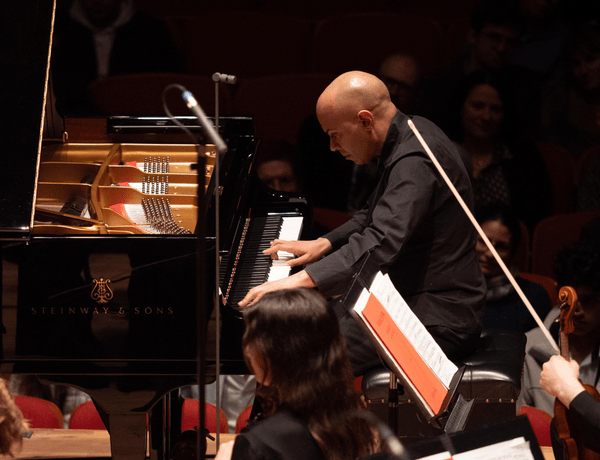
Stewart Goodyear (piano, above), City of Birmingham Symphony Orchestra / Kazuki Yamada
Simon Hellfighters’ Blues (2024)
Mazzoli Sinfonia (for Orbiting Spheres) (2014)
Gershwin Rhapsody in Blue (1924)
Ives ed. Sinclair Three Places in New England (1911-14)
Gershwin An American in Paris (1928)
Symphony Hall, Birmingham
Wednesday 21 January 2026
Reviewed by Richard Whitehouse
The heady interplay of jazz and blues idioms (with a little help from pioneer W. C. Handy) of Carlos Simon’s Hellfighter’s Blues launched in exhilarating fashion this City of Birmingham Symphony Orchestra concert, pertinent as the 250th anniversary of American Independence approaches.
Missy Mazzoli’sSinfonia (for Orbiting Spheres) could not have been further removed with its formal parallel to that of the solar system; an abstraction offset by the ‘sinfonia’ connotations of a Medieval hurdy-gurdy whose modal drone, recreated here with harmonicas played by the horns and woodwind, underlies the piece’s increasing velocity. That this suggested a tangible connection with the past and, at the same time, absorbed accrued influences into an idiom of today said much about the effectiveness of Mazzoli’s modus operandi these past two decades.
It could have been a conceptual leap too far from here to Gershwin’s galvanizing of the ‘jazz age’ aesthetic almost a century earlier yet Rhapsody in Blue has lost but little of its edge in the interim, especially as Stewart Goodyear rendered its solo part with almost reckless enjoyment. With almost every focal point either underlined or rendered in inverted commas, this was not the subtlest of performance, but Kazuki Yamada was at one with his pianist in conveying the breezy excitement of this music, with the final stages emerging as a high-octane apotheosis. Goodyear is evidently a pianist with whom to reckon – maybe his next appearance will find him tackling Gershwin’s Piano Concerto in F? For the present, he gave the slow movement of his own Piano Sonata (1996), poised midway between Copland and Piston, as plaintive encore.
Whatever his radical tendencies, Charles Ives embodies the ethos of an earlier age (Michael Tilson Thomas aptly described him as America’s greatest late-Romantic composer), such as felt uppermost with Yamada’s take on Three Places in New England. So the intensifying of feeling in The ‘St. Gaudens’ at Boston Common was secondary to a distanced recollection of time, while the elaborate march-fantasy that is Putnam’s Camp, Redding, Connecticut was genial rather than boisterous – albeit until its accumulation of activity for an ending of visceral abandon. The Housatonic at Stockbridge yet which left the deepest impression – its fervent evocation of place from the vantage of marital bliss duly inspiring a welling-up of emotion which not even Yamada’s slight over-hastiness could rob of its sheer eloquence.
An American in Paris might have been an awkward piece with which to close, but succeeded well on its own terms. Something between tone poem and symphonic rhapsody. Gershwin’s evocation of a compatriot (himself?) a little lost in the French capital received an impulsive yet perceptive reading. There was a start-stop feel to its earlier stages, while Oscar Whight’s rather forced take on the indelible trumpet melody was to its detriment, but what ensued was rarely less than persuasive – not least those final bars with their tangible sense of resolution.
It certainly brought to a resounding close a concert which conveyed much of the sheer variety of American music across little more than a century. Hopefully Yamada will programme more of this repertoire – perhaps an Ives symphony or music by the late, great Christopher Rouse?
To read more about the CBSO’s 2025/26 season, visit the CBSO website. Click on the names for more on pianist Stewart Goodyear, CBSO chief conductor Kazuki Yamada and composers Missy Mazzoli and Carlos Simon
Published post no.2,777 – Saturday 24 January 2026



 Arcana.fm