In concert – Augustin Hadelich, BBC SO / Sakari Oramo @ BBC Proms: Stravinsky, Mendelssohn, Anthony Davis & Richard Strauss

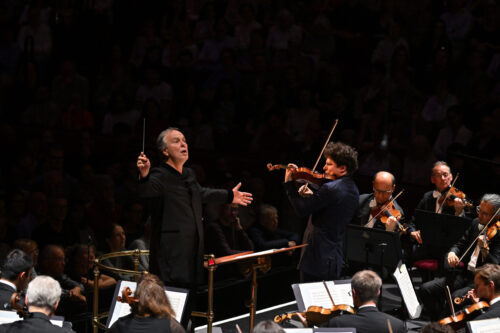
Augustin Hadelich (violin), BBC Symphony Orchestra / Sakari Oramo

Stravinsky Le chant du rossignol (1914/17)
Mendelssohn Violin Concerto in E minor, Op. 64 (1838-44)
Anthony Davis Tales (Tails) of the Signifying Monkey (1997) [European premiere]
Richard Strauss Till Eulenspiegels lustige Streiche, Op. 28 (1894-5)

Royal Albert Hall, London
Thursday 24 July 2025

Reviewed by Richard Whitehouse Photos (c) BBC / Mark Allan

Now in his second decade as chief conductor of the BBC Symphony Orchestra, Sakari Oramo can be relied on for innovative Proms programmes; tonight’s framing a staple of the concerto repertoire and an unfamiliar orchestral work with influential symphonic poems. In the case of The Song of the Nightingale, Stravinsky recycled sections from the latter two acts of his opera Le Rossignol into an illustrative sequence no less successful when heard in abstract terms. As exhilarating as are those earlier stages with their depiction of the bustling Chinese court, it is what follows – arrival of the mechanical nightingale, illness of the emperor then return of the real nightingale to restore his health – that proves most memorable. Above all, that plaintive song of the fisherman – heard on solo trumpet and rendered with due pathos by Niall Keatley.

Oramo has worked with Augustin Hadelich on numerous occasions and this evening’s account of Mendelssohn’s Violin Concerto confirmed their rapport right from the outset. Not its least attraction was the deftness of orchestral response in music as wears its Romanticism with the lightest of touches, with Hadelich’s handling of the first movement’s central cadenza no less assured than Oramo’s ushering in of its reprise. The slow movement had no lack of eloquence, nor the finale of that genial humour wholly typical of its era as it headed toward its engaging close. Hadelich responded to the (rightly) enthusiastic applause with his own arrangement of Por una Cabeza – originally a song penned by Carlos Gardel and Alfredo Le Pera, and which has latterly become a favourite addition to film-scores whenever a tango element is called for.

Although he is best known for his operas, notably X: The Life and Times of Malcolm X which has enjoyed several revivals since its Philadelphia premiere four decades ago, Anthony Davis has written numerous concertos and orchestral works with Tales of the Signifying Monkey the final part of a triptych that can be played together or separately. Inspired by an African fable about how the monkey uses its innate guile to keep lions and other predatory animals at bay, this proceeds as a stealthily cumulative entity in which elements of jazz and even swing, are prominent within the stylistic mix. An aura of anticipation, frequently with an ominous tinge, is always apparent and if the outcome is at all anti-climactic, it could well another take on the maxim of travelling in hope. Certainly, the BBCSO seemed to enjoy making its acquaintance.

Usually encountered at the beginning of a concert, Richard Strauss’s Till Eulenspiegel’s Merry Pranks is no less effective (and perhaps even more so) when heard at the close. So it proved tonight with a performance which, while eschewing the uproarious humour often instilled into these increasingly scatological events, was always adept in its conveying of the music’s capricious demeanour. Composed in the wake of his ill-received first opera Guntram, the present work was a ready incentive for that orchestral virtuosity which was Strauss’s metier – above all, its climactic confrontation between its protagonist and the judiciary that results in the former’s execution. The real Till likely survived to old age, only to expire during the Black Death, but his fictional self is doubtless more appealing when characterized so judiciously as it was here.

You can listen back to this Prom concert on BBC Sounds until Sunday 12 October.

Click on the artist names to read more about Augustin Hadelich, the BBC Symphony Orchestra and their chief conductor Sakari Oramo – as well as composer Anthony Davis. Click also for more on the BBC Proms

Published post no.2,609 – Monday 28 July 2025
In appreciation – Pierre Boulez

by Ben Hogwood

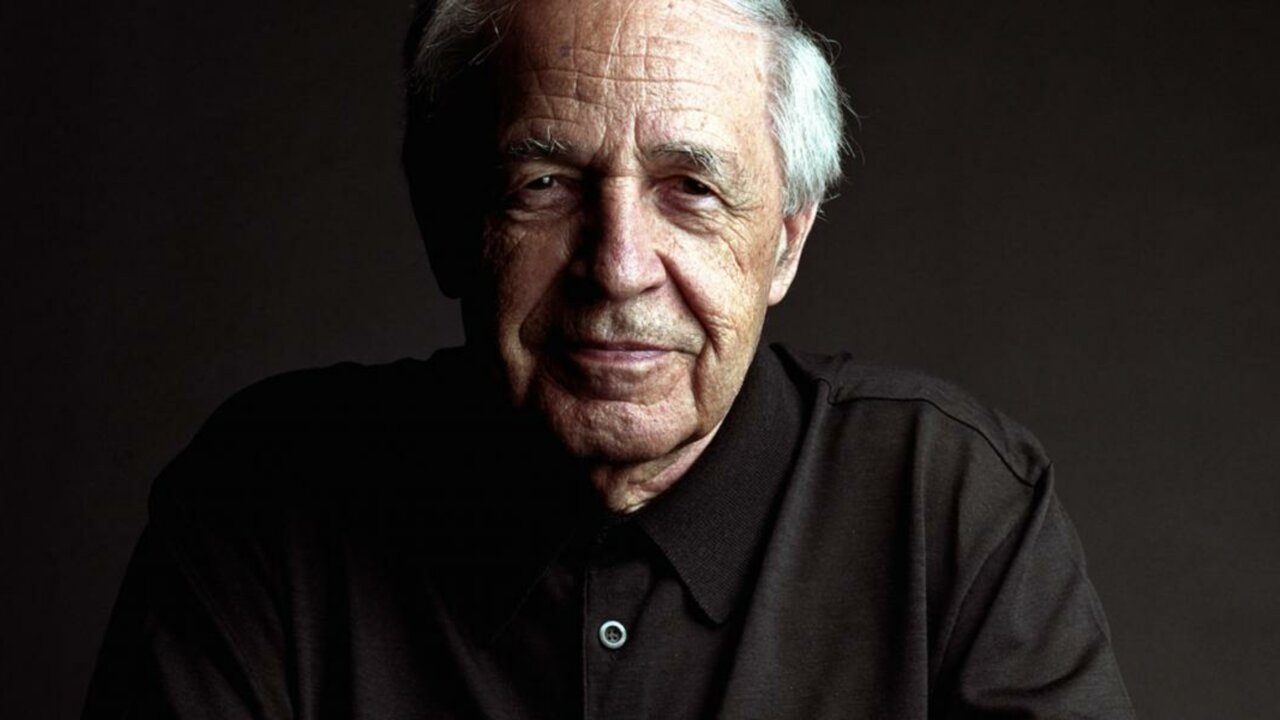
Today marks the centenary of the birth of composer and conductor Pierre Boulez, a towering figure in 20th century classical music.

There are so many recordings conducted by Boulez that I thought it best to share a playlist centred on memories of concerts I saw him conduct, largely from the 1990s and 2000s.

My first encounter with him was a rare appearance with the City of Birmingham Symphony Orchestra at the Royal Festival Hall. There he conducted Bartók’s Piano Concerto no.1 with customary clarity, soloist Krystian Zimerman delivering a memorable performance of percussive drive as he does here. On the second half of the concert was Stravinsky’s Petrushka, well-represented here by Boulez’s recording for DG in Cleveland.

Another South Bank visit in the 1990s brought an unusual appearance for Schoenberg’s monodrama Erwartung, sung memorably by soprano Jessye Norman. I remember vividly several visits to the Barbican to see Boulez conduct the London Symphony Orchestra in the 1990s, and one performance that particularly stands in the memory was that of Ravel’s Valses nobles et sentimentales, a colourful yet brisk performance that danced with a glint in its eye.

One other eyeopener, which I will never forget, was Boulez conducting Prokofiev’s Scythian Suite at the Barbican – a work he never recorded. Simultaneously on the bill was Szymanowski’s Violin Concerto no.1. Here was a composer Boulez seemingly re-evaluated later in his life, recording the concerto with violinist Christian Tetzlaff for DG.

From the recorded side I have included Maurizio Pollini’s pioneering account of Boulez’s own Piano Sonata no.2, a challenging piece that I must admit I have not yet conquered – but whose importance is clear.

To finish, my favourite Boulez recording, which finds him back in Cleveland conducting Debussy’s Nocturnes, a recording notable for its ideal pacing, beautiful colouring and immaculate rhythmic direction.

You can listen to this selection on Tidal by clicking on the playlist link below:

https://tidal.com/browse/playlist/3632d2ec-3ba7-4c0f-9654-569aff5dfb1d

Published post no.2,485 – Wednesday 25 March 2025

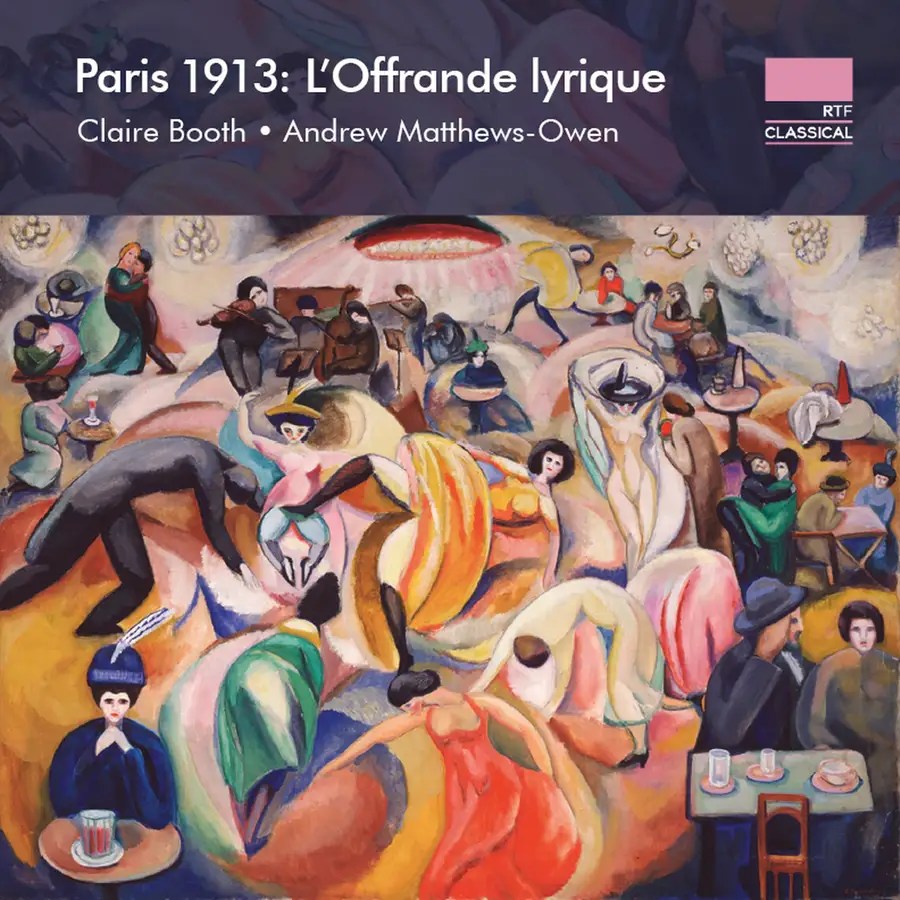
On Record – Claire Booth & Andrew Matthews-Owen: Paris 1913: L’offrande lyrique (Nimbus)

Caplet En regardant ces belles fleurs
Milhaud L’innocence Op. 10/3
Hahn À Chloris
Ravel arr. Stravinsky Trois poèmes de Stéphane Mallarmé M64
Auric Trois Interludes: Le pouf.
Ropartz La Route
Durey L’Offrande lyrique Op. 4
Saint-Saëns Petit main Op.146/9
Fauré Il m’est cher, Amour, le bandeau, Op. 106/7
Chaminade Je voudrais être une fleur
Debussy Trois poèmes de Stéphane Mallarmé L127
Satie ed. Dearden Trois Poèmes d’Amour
Lili Boulanger Clairières dans le Ciel: Vous m’avez regardé avec votre âme
Grovlez Guitares et mandolines

Claire Booth (soprano), Andrew Matthews-Owen (piano)

Nimbus RTF Classical NI6455 [66’23”] French texts included
Producer & Engineer Raphaël Mouterde

Recorded 11/12 March, 4-6 September 2023 at Wyastone Concert Hall, Monmouth

Reviewed by Richard Whitehouse

What’s the story?

Another enterprising song recital from Claire Booth and Andrew Matthews-Owen, this one focussing on songs that were either conceived, composed or premiered in Paris during 1913 and resulting in an absorbing collection best heard as a diverse while unpredictable totality.

What’s the music like?

Interleaving standalone songs and song-cycles, this recital opens with André Caplet’s take on Charles d’Orléans, its limpid modality highly appealing, then continues with an early song by Darius Milhaud as already demonstrates his distinctive and amusing approach to word-setting, while that by Reynaldo Hahn typifies the teasing charm familiar from his vocal music overall. Maurice Ravel’s triptych to texts by Mallarmé is performed in a version by Stravinsky with its accompanying nonet reduced to piano which, in preserving and maybe even accentuating the music’s questing introspection, represents no mean fete of transcription. Still relatively little known, this certainly deserves to be heard as at least an occasional alternative to the original.

Remembered best as a prolific writer of film scores, Georges Auric had shown a precocious talent for song as is evident in his sensuous setting of René Chalupt. A composer who often wrote on a symphonic scale, Guy Ropartz is heard in a setting of his own verse that amounts to a ‘scena’ in its wide expressive ambit. Interest understandably centres on the eponymous cycle by Louis Durey, a member of Les Six whose increasingly far-left conviction tended to marginalize his creativity yet, as these lucid and empathetic settings of Rabindranath Tagore (as translated by André Gide) confirm, had emerged as a protean talent by his mid-twenties. Hopefully these artists will be encouraged to investigate other of his songs from this period. By contrast, a late song by Camille Saint-Saëns exudes a touching poignancy, while that by Gabriel Fauré typifies the elusiveness of those in his last decade. As is evident here, Cécile Chaminade was a songwriter of style and elegance, then the Mallarmé triptych by Debussy (its first two texts identical to those of Ravel) finds this composer probing the inscrutability of these poems while drawing back from any more explicit intervention. The inscrutability conveyed by Erik Satie’s aphoristic settings (edited by Nathan James Dearden) of his own texts is altogether more playful – after which, the recital continues with a pensive offering by Lili Boulanger, with Gabriel Grovlez’s sultrily evocative setting of Saint-Saëns to finish.

Does it all work?

Yes, given the fascination of this collection taken as a whole and, moreover, the quality of these renditions. Booth is not a singer willing to take the easy option in her interpretations, and so it proves here with singing as fastidious as it is refined, while Matthews-Owen duly instils often deceptively spare accompaniments with understated insight. They contribute a succinctly informative note, but the booklet includes only the French texts with the English translations available at https://rtfn.eu/paris1913/: might it have best the other way round?

Is it recommended?

Very much so. There is much to fascinate even those who consider themselves afficionados of the ‘chanson’, and those who are unfamiliar with much of this repertoire could not have a better means of acquainting themselves with certain of its treasures – hidden or otherwise.

Listen & Buy

For purchase options, you can visit the Ulysees Arts website. For information on the performers, click on the names to read more about Claire Booth and Andrew Matthews-Owen

Published post no.2,466 – Friday 7 March 2025

In concert – Hyeyoon Park, CBSO / Alexander Shelley: Gershwin, Florence Price, Ravel & Stravinsky

Hyeyoon Park (violin, above), City of Birmingham Symphony Orchestra / Alexander Shelley (below)

Gershwin An American in Paris (1928)
Price Violin Concerto no.2 in D minor (1952)
Price arr. Farrington Adoration (1951)
Ravel Le Tombeau de Couperin (1914-17, orch. 1919)
Stravinsky The Firebird – suite (1910, arr. 1919)

Symphony Hall, Birmingham
Thursday 20 February 2025 (2:15pm)

Reviewed by Richard Whitehouse

Although he holds major posts in Canada and Naples and has a longstanding association with the Royal Philharmonic, Alexander Shelley seems not previously to have conducted the City of Birmingham Symphony Orchestra, and this afternoon’s concert made one hope he will return soon.

An American in Paris was a tricky piece with which to open proceedings, but here succeeded well on its own terms. Somewhere between tone poem and symphonic rhapsody, Gershwin’s evocation of a compatriot (maybe himself?) not a little lost in the French capital was treated to a bracingly impulsive and most often perceptive reading. A slightly start-stop feel in those earlier stages ceased well before Jason Lewis’s eloquent though not unduly inflected take on its indelible trumpet melody, with the closing stages afforded a tangible sense of resolution.

Much interest has centred over this past decade on the music of Florence Price – the Chicago-based composer and pianist, much of whose output was thought lost prior to the rediscovery of a substantial cache of manuscripts in 2009. One of which was her Second Violin Concerto, among her last works and whose 15-minute single movement evinces a focus and continuity often lacking in her earlier symphonic pieces (not least a Piano Concerto which Birmingham heard a couple of seasons ago). Its rich-textured orchestration (but why four percussionists?) is an ideal backdrop for the soloist to elaborate its series of episodes commanding, ruminative then impetuous, and Hyeyoon Park made the most of her time in the spotlight for an account that presented this always enjoyable while ultimately unmemorable work to best advantage.

The concerto being short measure, Park continued with an ideal encore. Written for solo organ, Price’s Adoration was given in Iain Farrington’s arrangement that brought out its elegance and warmth, if also an unlikely resemblance to Albert Fitz’s ballad The Honeysuckle and the Bee.

After the interval, music by composers from whom Gershwin had sought composition lessons when in Paris. Orchestral forces duly scaled down, Ravel’s Le Tombeau de Couperin was at its best in a deftly propelled Forlane, the alternation of verses with refrains never outstaying its welcome, then a Menuet whose winsome poise – and delectable oboe playing from Hyun Jung Song – emphasized the ominous tone of its central section. The Prélude was a little too skittish, while a capering Rigaudon was spoiled by an excessive ritenuto on its final phrase.

Interesting how the 1919 suite from Stravinsky’s The Firebird has regained a popularity it long enjoyed before renditions of the complete ballet became the norm. Drawing palpable mystery from its ‘Introduction’, Shelley (above) secured a dextrous response in Dance of the Firebird then an alluring response from the woodwind in Khovorod of the Princesses. Contrast again with the Infernal Dance of King Kashchei, even if its later stages lacked a measure of adrenalin, then the Berceuse had a soulful contribution by Nikolaj Henriques and fastidiously shaded strings. Hardly less involving was the crescendo into the Finale, started by Zoe Tweed’s poetic horn solo and culminating in a peroration with no lack of spectacle. It made an imposing end to this varied and cohesive concert, one that confirmed Shelley as a conductor with whom to reckon.

For details on the 2024-25 season A Season of Joy, head to the City of Birmingham Symphony Orchestra website. Click on the names to read more about violinist Hyeyoon Park, and conductor Alexander Shelley, or for more on composer Florence Price

Published post no.2,453 – Saturday 22 February 2025

Playlist – Sir Simon Rattle @ 70

by Ben Hogwood

Last week the British conductor Sir Simon Rattle celebrated his 70th birthday. Since the 1980s Rattle has played a hugely important part in classical music in the UK, with important conducting posts at the City of Birmingham Symphony Orchestra, Berliner Philharmoniker and London Symphony Orchestra. In 2023 he returned once more to Germany, as principal conductor for the Bavarian Radio Symphony Orchestra.

In that time, Rattle has made a huge range of recordings, from Haydn to Adès via Beethoven, Grainger and Schoenberg. Resisting temptation to compile a playlist of snippets, I have opted for a small number of heavyweight recordings, including AdèsAsyla, Schoenberg‘s Chamber Symphony no.1 and Stravinsky‘s Le Sacre du Printemps, his first recording on starting with the LSO in 2017. Topping the bill, however, is his CBSO recording of Mahler‘s Second Symphony, the Resurrection, the piece with which he opened Birmingham’s Symphony Hall in 1991. You can listen to the playlist on Tidal below:

Published post no.2,424 – Monday 27 January 2025