Live review – Jay Reise, Davood Ghadami, English Symphony Orchestra / Kenneth Woods: The Art of Storytelling – The Warrior Violinist

Jay Reise (music), Davood Ghadami (narrator), English Symphony Orchestra / Kenneth Woods

Wyastone Concert Hall, Monmouth
Friday 18 December 2020 (online)

Written by Richard Whitehouse

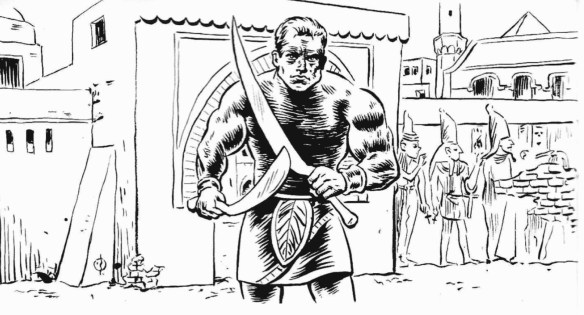
Following on from its uproarious version of Lubin from Chelm [*], the English Symphony Orchestra continues its series of pieces for virtual storytelling in the guise of an old Egyptian tale – here given a contemporary twist to result in the ‘morality’ fable The Warrior Violinist.

This is a parable about being careful what one wishes for. It centres on a youth who plays the violin to exclusion of all else, then finds an even greater other love – the Pharaoh’s daughter. Imagining himself inferior, he bids the Sphinx transform him into a great warrior – in which guise he vanquishes Egypt’s enemies. The princess can love only the man she heard playing the violin and when the warrior tries to reclaim his former prowess, he finds himself unable to play – the Sphinx’s warning that no-one can be changed back having proven only too true.

Davood Ghadami is a personable and thoughtful narrator; his understatement enabling one to focus on a musical score that, even more than the previous two in this series, packs a wealth of incident into a through-composed score which is effortlessly sustained over its 18 minutes. A tribute, indeed, to the initiative of Jay Reise in having elaborated a piece written almost a decade ago for this Art of Storytelling series. Not the least of its attractions is the extensive role allotted solo violin, played here by Zoë Beyers with no mean poise and resourcefulness.

The remaining ESO musicians play with skill and sensitivity, while Kenneth Woods ensures clarity of texture even in denser passages. The production should provoke children and adults alike – and, as usual with ESO, a range of sundry material enhances the overall experience.

You can watch the concert on the English Symphony Orchestra website here

For more information on the English Symphony Orchestra you can visit their website here

For information about Auricolae, visit Kenneth Woods’ website here

Live review – Henry Goodman, English Symphony Orchestra / Kenneth Woods: The Art of Storytelling – Lubin from Chelm

David Yang (above, music), Alisa Snyder (illustrations) Henry Goodman (narrator), English Symphony Orchestra / Kenneth Woods

Wyastone Concert Hall, Monmouth
Friday 4 December 2020 (online)

Written by Richard Whitehouse

Following on last week’s arresting version of The Ugly Ducking, the English Symphony Orchestra continues its series of pieces for virtual storytelling in the guise of an old English tale here given an inimitably Jewish twist to result in the ‘morality’ fable Lubin from Chelm.

While the tale of Lazy Jack might hardly have seemed other than an English story, it works well when relocated within Ukrainian Jewish environs then decked out with Yiddish turns of phrase and Klezmer stylings. The anti-hero Lubin – put to work only at the prompting of his aging mother, who is incapable of holding on to his wages, but who enchants the daughter of Chelm’s wealthiest family – could be interpreted in various ways; that of fortune smiling on those who least expect it, yet are by no means the least deserving, is the most straightforward.

Henry Goodman certainly makes the most of this barbed whimsy, relating the narrative with audible enjoyment as he assumes the role of Yiddish storyteller with aplomb. He is abetted by David Yang’s direct and characterful score, engagingly conducted by Kenneth Woods (who undertook the expert orchestrations) and illustrated by Alisa Snyder with a true appreciation of what line drawings are capable of conveying in this context. A few linguistic ‘curve-balls’ are thrown in, without detracting from the self-effacing directness of the unfolding narrative.

The ESO musicians (shots of whom alternate with the illustrations) play with their customary skill and sensitivity, and the whole production ought to amuse as well as provoke children and adults alike. As usual with ESO, a range of supporting material enhances the total experience.

You can watch the concert on the English Symphony Orchestra website here

For more information on the English Symphony Orchestra you can visit their website here

For information about Auricolae, visit Kenneth Woods’ website here

Live review – Hugh Bonneville, English Symphony Orchestra / Kenneth Woods: The Art of Storytelling – The Ugly Duckling

Hugh Bonneville (narrator), Wanda Sobieska (illustrations, above), English Symphony Orchestra / Kenneth Woods

Wyastone Concert Hall, Monmouth
Thursday 19 November 2020 (online)

Kenneth Woods The Ugly Duckling (after H.C. Andersen)

Written by Richard Whitehouse

The English Symphony Orchestra has demonstrated its versatility over these past few months with studio concerts of themed programmes. This latest offering takes up a line of pieces for storytelling that its conductor Kenneth Woods has pursued so ingeniously on past occasions.

Although The Ugly Duckling has retained its prominence as a children’s tale ever since Hans Christian Andersen first published it in 1843, its message has tended to be watered down with repetition. While it departs in numerous details, this retelling certainly restores those qualities of fear and anger, mixed with indignation, which remain central to the original’s conception. It helps when the bare bones of the story are conveyed so directly, with no attempt to soften or sentimentalize a narrative in which the notion of social acceptance should be paramount.

In this respect, there could hardly be a more sympathetic narrator than Hugh Bonneville, who relates the story with thoughtfulness and compassion. He is aided in this by illustrations from Wanda Sobieska as (rightly) suggest a setting far removed from comfortable domesticity; one emphasizing that harshness and struggle for survival pertinent to the natural world. Woods’s score ably sustains itself over the 18-minute whole, evoking Copland in innocent wonder but also Shostakovich in its sense of vastness and alienation – prior to a headily affirmative close.

The ESO musicians (shots of whom alternate with the illustrations) play with their customary verve and finesse, and this whole production should prove congenial for children and adults alike. As usual with ESO, a range of supporting material helps enhance the total experience.

You can watch the concert on the English Symphony Orchestra website here

For more information on the English Symphony Orchestra you can visit their website here

For information about Auricolae, visit Kenneth Woods’ website here

Live review – Raphael Wallfisch, English Symphony Orchestra / Kenneth Woods: Meditations for Armistice Day

Raphael Wallfisch (cello, above), English Symphony Orchestra / Kenneth Woods

Wyastone Concert Hall, Monmouth
Sunday 8 November 2020 (online)

Adrian Williams Russells’ Elegy (2009/11)
Elgar arr. Fraser Variations on an Original Theme, Op. 36 (1899) – Variation IX, ‘Nimrod’ (1899)

Written by Richard Whitehouse

Remembering the Armistice – and just what it represents in human terms – is a regular fixture on the English Symphony Orchestra’s schedule. This year featured two pieces for strings that complemented each other well, whether in terms of their overall mood or underlying aesthetic.

Adrian Williams is contributing several works as the ESO’s current John McCabe Composer-in-Association, with Russells’ Elegy apposite in its ‘remembrance’ context as well as being a commemoration of pianist-conductor John Russell and director Ken Russell (hence the plural of the title). Audibly in a long lineage of British works for strings, the 10-minute piece moves between passages for ensemble and those where solo strings dominate with no mean subtlety and finesse, culminating in a sustained tutti that fades thoughtfully yet inevitably into silence.

Those encountering Williams’s music for the first time will hopefully have been encouraged to investigate further, and they will doubtless have responded to Elgar’s Nimrod as arranged for cello and strings by Donald Fraser (who has previously orchestrated the composer’s Piano Quintet and Sea Pictures). The result is comparable to the version of Tchaikovsky’s Andante cantabile from his String Quartet no.1 in the cellist’s discreet elaboration of a melodic line without detriment to the existing instrumental texture, and it would certainly make for an ideal encore.

This arrangement was eloquently rendered by Raphael Wallfisch, whose advocacy of British music over the years cannot be gainsaid, and the performances given added resonance by the photographs of soldiers and images from the Great War as accompanied this touching tribute.

You can watch the concert on YouTube here:

For more information on the English Symphony Orchestra you can visit their website here

On record – Matthew Taylor: Symphonies nos.4 & 5 (BBC NOW / Woods) (Nimbus)

Matthew Taylor
Symphony no.4 Op.54 (2015-6)
Symphony no.5 Op.59 (2017-8)
Romanza for strings Op.36a (2006-7)

BBC National Orchestra of Wales (Symphonies), English Symphony Orchestra / Kenneth Woods

Nimbus Alliance NI6406 [63’56”]

Producer Simon Fox-Gál
Engineers Simon Smith, Mike Cox (Symphony no.4)

Recorded 8 June 2019 at St. Jude-on-the-Hill, London (Romanza); 14 January 2020 at Hoddinott Hall, Cardiff (Symphonies)

Written by Richard Whitehouse

What’s the story?

A new release of music by Matthew Taylor, including the Fourth and Fifth Symphonies, that means all of the composer’s works in this genre have now been commercially recorded (the First and Third on Dutton Epoch CDLX7178; the Second on Toccata Classics TOCC0175).

What’s the music like?

Symphonism goes back almost to the start of Taylor’s composing, his Sinfonia Brevis having been finished when he was 21, and symphonies have continued to appear at regular intervals across his output. Written respectively to mark the 50th anniversary of Kensington Symphony Orchestra, and as the third instalment within the English Symphony Orchestra’s 21st Century Symphony Project, these two pieces feel typical not least as regards their absolute contrasts of form and expression; while being equally unmistakable as the music of just one composer.

An in memoriam to composer John McCabe – dedicated to his widow Monica – the Fourth Symphony falls into three continuous movements. The first, marked Giubiloso, maintains its energy across distinct shifts of dynamics and activity (the evocative writing for woodwind and harp redolent of Tippett); subsiding from its impassioned climax into an Adagio where strings take the foreground in music of textural richness and emotional depth. Beginning at a decided remove from what has gone before, the Finale buffa exudes a nonchalant humour (reminiscent of Arnold), complemented by a deftly scored episode that cannily prepares for the denouement. This is purposefully controlled through to a climax that recalls the work’s opening theme before an ending as feels the more decisive for its literally coming to a halt.

Heard as an interlude between two imposing statements, the Romanza could hardly be better placed. An arrangement of the second movement of Taylor’s Sixth Quartet (Toccata Classics TOCC0144), it testifies to the suffused lyricism evident in this composer’s writing for strings.

The Fifth Symphony is only Taylor’s second such work in four movements, but its formal and expressive emphasis differs greatly. Indeed, the initial Allegro is unprecedented in his output for sheer volatility (not unlike that of Beethoven’s ‘Serioso’ Quartet), its driving impetus and explosive culmination creating a momentum which is pointedly left unfulfilled by the ensuing intermezzo-like Allegrettos. The first (a tribute to composer and teacher Cy Lloyd) is as terse and equivocal as the second (a tribute to Angela Simpson, wife of composer Robert Simpson) is poised and wistful. It thus remains for the final Adagio (a tribute to the composer’s mother Brigid) to secure that eloquent apotheosis towards which the whole work had been headed, as this moves with sustained power toward its plangent twin climaxes then on to a resigned coda.

Does it all work?

Indeed. In all three pieces, Kenneth Woods secures a dedicated response from the players so Taylor’s exacting yet practicable writing is heard to advantage, not least in acoustics whose immediacy emphasizes this music’s rapt inwardness as keenly as its untrammelled energy.

Is it recommended?

Yes, and not least for a booklet that features informative commentaries by both composer and conductor, and striking artwork by Andrea Kelland. An introductory portrait by James Francis Brown mentions Taylor as having written six symphonies: hopefully, no mere slip of the pen!

Listen & Buy

You can listen to clips from the recording and purchase, either in physical or digital form, at the Presto website

Read

You can discover more about Matthew Taylor by heading to his own website