Talking Heads – Helen Grime

by Ben Hogwood

Helen Grime

In the classical music calendar, summer effectively begins with the start of the Aldeburgh Festival. This year’s model – the 76th running of the Suffolk festival – comes prefaced by a line from Shelley:

And, hark! Their sweet sad voices! ‘t is despair
Mingled with love and then dissolved in sound.

At the heart of this year’s festival are four featured artists – tenor Allan Clayton, violinist Leila Josefowicz and composers Daniel Kidane and Helen Grime. Scottish composer Grime, currently living in London, joined Arcana for a chat to talk about the range of her compositions in the festival this year, and the close link she enjoys with its audience and organisers.

Her first experiences of the festival date back to 2005, when she was on the Britten Pears Advanced Composition course. “I was studying on that and Colin Matthews was there, and I went back in 2006 to hear the performance of the piece I wrote while I was there. I also played in the chamber orchestra for the War Requiem on a course, and I played in Britten’s Nocturne as well, which was amazing. Those were the first experiences, and I also went to an opera writing course as a composer, which would probably have been 2006. Then in 2009 I wrote a piece called A Cold Spring, for chamber ensemble. It was a joint commission with Aldeburgh Music, the Birmingham Contemporary Music Group and the Sue Knussen Trust. The piece was in the same program as an Elliott Carter premiere (On Conversing With Paradise). He was there, and it was an amazing time.”

Carter is a composer Grime has always admired, and she had met him the previous year. “I was a fellow in the Tanglewood Music Center, and it was his 100th birthday year. They have a festival of contemporary music every year, and that year it was completely devoted to Elliot Carter’s music. As composers we had the opportunity to go to all the rehearsals and concerts, and it was a chance to immerse yourself in a composer’s work – lots of his chamber music but also the orchestral works. This was the time that I really dived into his music and were able to meet him and ask him questions. It was an incredible point in history to think back to really, and he had so many amazing things to say. He was able to go back in time and talk about his time studying in Paris with Nadia Boulanger, and moments in jazz bars, little things that maybe you haven’t read in a book. Hearing that directly from the composer is a fantastic experience!”

Helen lived in Edinburgh initially but moved to London for studying, and has stayed. Her music still carries parallels to her Scottish roots – and these are evident in Folk, premiered by soprano Claire Booth with the BBC Scottish Symphony Orchestra under Ryan Wigglesworth in Glasgow. “Scotland still feels like home”, she says, “and I’m so fond of that orchestra. I’ve worked with them a fair bit over the years, and it was wonderful to be able to work with them on the premier of Folk, with Ryan Wigglesworth, and of course, Claire.”

The piece will receive a second performance at the Aldeburgh Festival, with the Knussen Chamber Orchestra conducted by Wigglesworth. “I’m excited now for Ryan to do it again with a different with a different group. The piece is rooted in lots of folklore traditions. Zoe Gilbert, who wrote the libretto, is particularly influenced by Manx folklore, but the stories are rooted in different storytelling traditions from different places. She based the libretto on the stories in her book, Folk, so when you read them, you feel the resonance with stories we already know and have known since childhood. She’s subverted lots of roles, but there’s definitely that kind of connection with Scotland and folklore, so I wanted to have that connection in the music as well.”
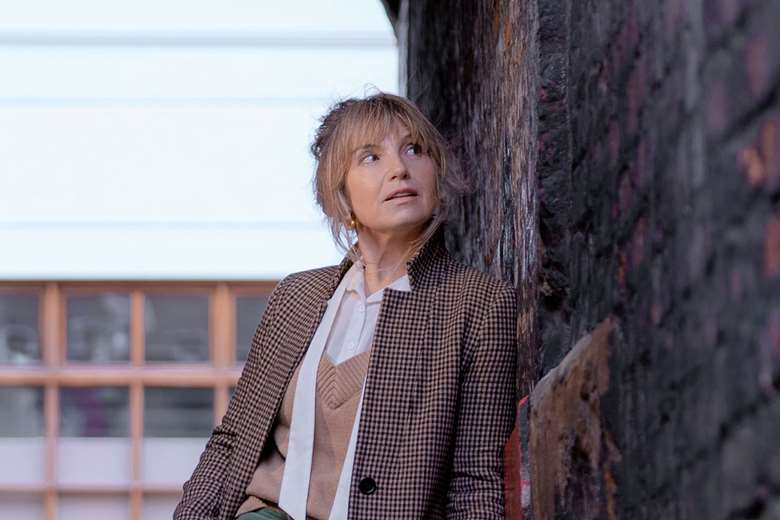
Arcana was fortunate to interview Claire Booth (above) just before the premiere of Folk, and Grime speaks warmly of her dedicatee. “She is a ball of energy! We’re very different in that way, but we get on very well. She is incredibly talented but also interested in many things. She found the book, and we both loved it, and so she approached Zoe. Obviously, I’ve known her work and singing for years. but we haven’t been working together until last year – although this project was brewing before Covid and then took a while to get it together. I don’t think it’s going to be the last time we work together, so I’m really excited about that. She’s an incredible talent but she brings such a personality to the piece, and she can just do anything. It’s very virtuosic, vocally. In Aldeburgh it will be with a small orchestra, so it will be interesting to hear that, in the Snape hall – but also with the surroundings, it’s made for that. When you’re there, and you’re amongst the reeds, it’s a magical place. You can see so far there, and whenever I’m there it always seems to be really clear skies. That time of dusk is particularly amazing.”

As a featured composer, Grime is presenting a varied body of work for the festival. “It is very satisfying. I’ve written a fair bit of music now, and I’m really happy with, for example, my Missa Brevis happening on the first Sunday. I’m really excited to hear that, as couldn’t go to the premiere in Edinburgh. To have these pieces happening in different locations around Aldeburgh is really special, with chamber music as well as bigger pieces. There is also another premiere, a piece I wrote during lockdown called Prayer which I wrote a while ago, which, again, I haven’t seen in a live performance. The Britten Pears Contemporary Ensemble are going to do that, a piece that I wrote during lockdown. It was recorded but not performed live, with the performers doing their bits separately, and Dame Sarah Connolly singing her bit. It’ll be great to be at an actual performance of that as well.”

Both of Grime’s string quartets will be performed in one recital, from the Heath and Fibonacci Quartets. They hold great personal significance for her. “It’s actually quite strange with the string quartets, because I wrote both of them partly while being pregnant. The first one was written in 2013, which was when I had my first son, so it’s weird that I then was writing another string quartet when I was pregnant with my second son! I was writing it at the beginning of lockdown, when we didn’t really know if things were going to be cancelled that summer. I was stressed out because I still had to meet the deadline, which was probably never going to actually happen – and it didn’t in the end, but I still needed to write the piece. For a lot of people that time they had lots of time to compose, but because everything was cancelled and you had a child who was then not at school, you suddenly didn’t have any time to work either, and there was no childcare of course. It was very intense, and I think the music is very intense, apart from the last movement, which is not intense in the same way and is much more of a release.”

Does it bring back vivid memories when she hears it? “Yeah, I can sort of remember how I felt, but it’s really difficult be in that moment. The Heath Quartet, who premiered and recorded that piece, I just love to hear them play, they made a brilliant recording of it and gave the most amazing premiere. So I can’t wait to hear them play it again, and to hear the other quartet with the Fibonacci Quartet, who I haven’t heard play before. It will be really exciting to hear the two pieces together and on the same program. They are sat between Beethoven and Britten, which I’m so happy about – hopefully they’ll somehow hold their own in amongst all of that! That concert is in Orford Church, so again a different venue which is so nice.”

It may seem an obvious question, but does Britten continue to be a constant presence at the festival? “Yes, and I think that’s the way it should be. I was in Aldeburgh last year, and Claire was there too, because she was coaching the young artists course. I paid my respects to Britten and Pears, at their graves. That line of history is so moving for me, and it’s something I hold close. I love Britten’s music, and it’s always going to be important to me, and that kind of continuation and line of British music is a beautiful thing. Having the opportunity to be a featured composer and to be surrounded by that is it’s a huge privilege.”
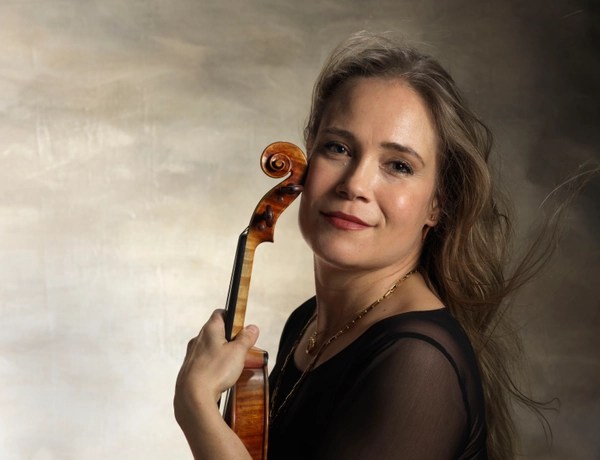
The featured artists and composers are chosen with typical care, placing Grime alongside violinist Leila Josefowicz (above), soloist in the composer’s Violin Concerto with the BBC Symphony Orchestra. “I’ve waited a long, long time for the UK premiere of concerto”, she says. “I wrote it for Malin Broman, an amazing Swedish violinist who used to be based in London and who premiered it in 2016, and then Leila took the piece on. She was supposed to be doing the UK premiere in 2020, but she’s played it a lot – in Amsterdam and in Finland. This does feel like the perfect moment, though, because Leila has that real connection with with Oliver Knussen. It’s kind of perfect that the premiere is happening in Aldeburgh. She’s an incredible artist, so the fact that we’re both featured artists is brilliant. I’m really, really excited about hearing Allan Clayton singing, and also Daniel Kidane’s pieces. We have quite a few shared concerts.”

Mention of Knussen leads us to talk about another highly influential composer, a clear influence on Grime both personally and professionally. “I have loved his music since the first time I heard it”, she says. “The first piece I heard was Ophelia Dances. My teacher at the time was Julian Anderson, and he introduced me to his music at the Royal College of Music. Every note is the right note, it’s just so beautifully crafted and exciting and powerful and enchanted.”

I was meant to meet him at the Britten Pears composer’s course, but when I was a fellow in Tanglewood he was out conducting, and he gave some masterclasses. He heard my music, and we got on well. Shortly after that, he conducted a short orchestral peace of mine called Virga, which I wrote as part of the London Symphony Orchestra scheme Sound Adventures, which is now known as the Panufnik Legacies. He was a real supporter of my music. I wrote Night Songs, which is also being done at Aldeburgh, for his 60th birthday celebrations in 2012. I really hold that dear, and I still listen to his music most weeks and days. A brilliant musician, composer, and supporter – and I think many musicians and composers feel the same way. My path would not have been the same at all without meeting Ollie.”

Looking ahead a little, Grime has an album of chamber works due for release on the Delphian label in August, a fascinating collection of works performed by The Hebrides Ensemble. “It’s coincidental to Aldeburgh, but great. The Hebrides Ensemble are one of those amazing groups who’ve been so supportive of me over the years, and they’ve given different performances. To have this portrait CD is fantastic, with a string sextet Into the Faded Air from 2007 right through to Braid Hills, a horn duo I wrote for St Mary’s Music School to celebrate their anniversary in 2022. I can’t wait for it to come out.”

Grime also acknowledges the passion and commitment of Delphian to composer albums such as this. “It’s really difficult to get these projects off the ground today, and very expensive, obviously. The commitment to new music in Delphian is absolutely brilliant, there was a wonderful CD the Hebrides Ensemble did a few years ago on Stuart MacRae, and there was a great collection of Judith Weir.”

With these projects coming to fruition, it is great to report Grime’s composition continues apace. “I’m coming to the end of my teaching turn at the moment, which means we get a bit of time for some holidays to compose. I’m writing a horn concerto at the moment, for Alec Frank-Gemmill and the Gothenburg Symphony Orchestra, so I’m completely immersed in all things horn at the moment! It’s a big piece, a big project, but I like that. I like to get my teeth into something. There are lots of various things on the horizon, too, but that’s the main thing. I’m more of a one piece at a time kind of person. Directly before this, I wrote a song cycle, Bright Travellers, which was premiered at the Leeds Lieder Festival earlier this year by Louise Alder and Joseph Middleton. I’ve been working with a lot of texts, and it’s been great in the last couple of years to work with living writers, that’s quite a new direction for me which is exciting!”

For more information on Helen Grime’s music at the Aldeburgh Festival, head to the Britten Pears Arts website

In concert – Leila Josefowicz, CBSO / Thomas Søndergård: Richard Strauss, Adès & Brahms

Leila Josefowicz (violin, above), City of Birmingham Symphony Orchestra / Thomas Søndergård (below)

Richard Strauss Don Juan Op.20 (1888)
Adès Violin Concerto, Op.24 ‘Concentric Paths’ (2004)
Brahms Symphony no.2 in D major Op.73 (1877)

Symphony Hall, Birmingham
Thursday 10 October 2024

Reviewed by Richard Whitehouse Pictures (c) Tom Zimberoff (Leila Josefowicz), Chris McDuffie (Thomas Søndergård)

He may be spending more time in the US than in the UK these days, but Thomas Søndergård tonight made a timely reappearance with the City of Birmingham Symphony Orchestra in a programme such as placed a highpoint among recent concertos between two established German classics.

Richard Strauss‘s Don Juan poses few technical issues for an orchestra these days – the only proviso about this performance being its almost too easy unfolding, the initial stages seeming suave rather than impetuous and emotional contrasts following on almost too seamlessly. Yet the central ‘love’ episode featured a melting contribution from oboist Lucie Sprague, with horns duly firing on all cylinders in a unison theme ultimately capped by a silence of tangible anticipation then a postlude of hushed resignation – heroic aspiration submerged in an aura of starkest fatalism.

If much of Thomas Adès’ music the past two decades has been of a conceptual brilliance that outweighs its intrinsic content, the Violin Concerto is destined to endure and rightly so given these Concentric Paths complement each other in a finely balanced totality. One, moreover, with which Leila Josefowicz identifies wholeheartedly: despatching its brief outer movements with an energy and a panache so that Rings conveyed a volatility channelled towards greater affirmation in Rounds; between them, the relatively expansive Paths proved a chaconne as methodical in evolution as it was affecting in its suffused intensity. Assured in her handling of the solo part, Josefowicz dovetailed it unerringly into orchestral writing as resourceful as any the composer has written. Those in the audience unfamiliar with it were most likely won over.

Many of those present were no doubt looking forward to BrahmsSecond Symphony after the interval, where Søndergård (above) and the CBSO did not disappoint. Outwardly its composer’s most equable such piece, this yields more than its share of ambiguities and equivocations that were rarely absent here. Not least in the opening movement, its unforced progress duly taking in an eventful development whose granitic culmination set its easeful themes at a notably uncertain remove, then with a coda whose restive horn solo was eloquently rendered by Elspeth Dutch. Søndergård was no less probing in the Adagio, flexibly paced so its autumnal main theme did not override the more whimsical and anxious elements which inform its longer-term progress. Certainly, the closing reflection on that theme cast a potent shadow on what had gone before.

The other two movements are usually thought to present few if any interpretative problems, so credit to Søndergård for finding no mean pathos in those reiterations of the Intermezzo’s main theme – not least when it returns as a winsome coda. Nor was the final Allegro lacking in incident, such as that spellbinding transition into the reprise whose epiphanic aspect was not lost on Mahler. Given its head without sounding at all rushed, the coda then emerged as the ebullient though never grandstanding peroration which Brahms himself surely intended.

A resounding close to an impressive performance, and there should be more music-making on this level next week when the CBSO is joined for the first time in many years by former chief guest conductor Mark Elder for an enticing programme of Brahms, Janáček and Shostakovich.

For details on the 2024-25 season A Season of Joy, head to the City of Birmingham Symphony Orchestra website. Click on the names to read more about violinist Leila Josefowicz, conductor Thomas Søndergård and composer Thomas Adès.

Published post no.2,331 – Monday 14 October 2024

In Concert – Leila Josefowicz & John Novacek @ Wigmore Hall: Debussy, Szymanowski, Bray & Stravinsky

Leila Josefowicz (violin, above), John Novacek (piano, below)

Debussy Violin Sonata in G minor L140 (1916-17)
Szymanowski 3 Myths Op.30 (1915)
Bray Mriya (2023) [Wigmore Hall commission: World premiere]
Stravinsky Divertimento from Le Baiser de la fée (1928, arr. 1934, rev. 1949)

Wigmore Hall, London
Saturday 21 September 2024

Reviewed by Richard Whitehouse

Long among the more adventurous violinists from her generation, this latest Wigmore recital found Leila Josefowicz focussing on music traversing the boundary between Impressionism and neo-Classicism, together with a recent piece such as conveyed a meaningful relevance.

It might not be such a good idea to launch a recital with Debussy’s Violin Sonata, as this last and conceptually most fluid of its composer’s late chamber works is essentially a culmination rather than starting-point. Having rather harried its opening Allegro, Josefowicz brought keen imagination to its Intermède which none the less lacked that fantasy and lightness intended. Most convincing was its finale, the headlong succession of ideas deftly propelled to a payoff not merely decisive but of all-round conclusiveness – whatever Debussy may have intended.

Whereas this piece was admired but initially found relatively few exponents, Szymanowski’s Myths was early recognized as a milestone in its medium and has latterly regained that initial eminence. Josefowicz duly recognized these innovative qualities with an impulsive yet never wayward take on La fontaine d’Arethuse, its capriciousness finding an ideal complement in the simmering emotion and alluring poise of Narcisse – self-aware rather self-regarding as to expression – or increasingly recalcitrant playfulness of Dryades et Pan with its teasingly delayed – even almost avoided – close. Just occasionally, Josefowicz’s snatching at a rhythmic gesture denied the music its high-flown eloquence but, overall, this proved a perceptive and involving account where her interaction with John Novacek’s attentive pianism was absolute.

Those who hear the Szymanowski as a ‘sonata malgré-lui’ might feel likewise about Mriya by Charlotte Bray, which tonight had its first hearing. Its Ukrainian title variously implying ‘dream, vision, ambition and vow’, this four-movement work charted a course of terror but also resolve. The first of these infused its disparate while distinctive ideas with a momentum as merged directly into the feline capering of its successor; after which, a slower movement offered a measure of sustained if hardly serene calm, before the finale once again marshalled its disjunct gestures towards a culmination which was pointedly withheld. A symbol, perhaps, of the Ukrainian people’s struggle as is far from reaching closure let alone victory? Whatever the case, this is absorbing and deeply felt music that received a suitably committed response.

From here to Stravinsky’s Divertimento from The Fairy’s Kiss was some conceptual leap. One of several such adaptations its composer made during its career as a duo-recitalist with Samuel Dushkin, this takes in most of the ballet’s initial two-thirds – the Sinfonia by turns pensive and restive, while the rumbustious Danses suisses was irresistibly despatched. The Scherzo exuded a capering charm and the Pas de Deux moved effortlessly from its soulful Adagio, via nimble Variation, to an initially dextrous then increasingly uproarious Coda.

This recital ended in a wholly different aesthetic world from which it began, but Josefowicz’s acuity could not be gainsaid. ‘Uproarious’ was also the watchword of the encore – Novacek’s Intoxication Rag, arranged by Itzhak Perlman no less and rendered with appropriate abandon.

For more on the Autumn season visit the Wigmore Hall website – and for more on the artists, click on the names Leila Josefowicz and John Novacek

Published post no.2,309 – Sunday 22 September 2024

BBC Proms 2023 – Leila Josefowicz, BBC Symphony Orchestra / Sakari Oramo – Berg & Mahler

Prom 35 – Leila Josefowicz (violin), BBC Symphony Orchestra / Sakari Oramo

Berg Violin Concerto (1935)
Mahler Symphony no.7 (1904-5)

Royal Albert Hall, London
Thursday 10 August 2023

by Richard Whitehouse photos by Chris Christodoulou / BBC

The late indisposition of Sir Andrew Davis saw Sakari Oramo at the helm for this programme of Berg and Mahler, an effective coupling even allowing for the replacement of the latter’s Tenth Symphony with his Seventh. Hopefully it will be ‘third time lucky’ for Davis and Mahler 10.

It might have received almost 20 hearings at these concerts, but Berg’s Violin Concerto is not easy to bring off in so resonant an acoustic as the Albert Hall’s. As elegantly as she delineated the initial Andante’s arch-like trajectory, Leila Josefowicz did struggle to make herself heard against a restrained though dense orchestral backdrop. Balance righted itself with the ensuing Allegretto – the soloist’s ingratiating response ideal for its alluring, even coy expression with a bittersweet folksong inflections then its ominous foreshadowing of the work’s second part.

It was in that latter half’s Allegro the performance really took flight, Josefowicz as attuned to its fractious opening pages as to the plangent searching of its cadenza-like central span. Both the seismic start of the movement’s culmination and its convulsive wind-down were assuredly handled – the emergence of Bach’s Es ist genug chorale setting the course for a final Adagio where pensive inwardness and heartfelt supplication were palpably conveyed through to the fervent climax, then a close bringing matters full circle with its mood of beatific resignation.

Unheard at the Proms until 1969, Mahler’s Seventh was also the last of his symphonies to win wider acceptance and is still a tough challenge to make cohere. Oramo (above) had its measure though not consistently in an opening movement, the effortfulness of whose introduction pervades its main Allegro yet without impeding its onward and increasingly cumulative course. For all the wonderment of its central interlude then emotional heft of the lead-in to the reprise, there was yet a sense of this music being coerced into shape rather than unfolding with due inevitability. Not so the ‘First Night Music’, its intertwining of the speculative and crepuscular rendered to bewitching effect – Oramo balancing those intricate yet translucent textures with a sure sense of where this movement was headed, namely a resolution not so much tentative as intangible.

Equally elusive, the central Scherzo can seem an exercise in flitting gestures as fail to add up to anything more substantial but here exuded darkly ironic humour as it wended its unsettling way. The ‘shadowy’ duly found its ideal complement in the ‘amorous’ manner of the ‘Second Night Music’ – its underlying affability all too easy to make bland or faceless, yet which here unfolded with a precise feel for its function within Mahler’s teasingly oblique formal scheme. As was almost equally true of the Rondo-Finale – its ordinario marking easy to misinterpret, but in which Oramo’s sure and steadfast if never turgid course made the most of its engaging progress. Hardly alone in not quite making the reappearance of first-movement material feel other than contrived, he nevertheless headed through those final pages with irresistible verve.

This performance would not have been as successful overall without its sterling contribution by the BBC Symphony Orchestra, both in soloistic passages or those tuttis as give the outer movements their impact. Ten years on, the rapport between orchestra and conductor remains undimmed.

For more on the 2023 BBC Proms, visit the festival’s website at the BBC. Meanwhile click on the names for more information on artists Leila Josefowicz, the BBC Symphony Orchestra and their chief conductor Sakari Oramo

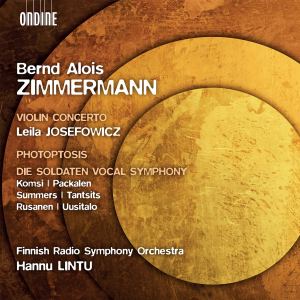
On record: Leila Josefowicz, Soloists, Finnish RSO / Hannu Lintu – Zimmermann: Violin Concerto & Die Soldaten (Ondine)


Leila Josefowicz (violin); Anu Komsi, Jeni Packalen (sopranos), Hilary Summers (contralto), Peter Tantsits (tenor), Ville Rusanen (baritone), Juha Uusitalo (bass), Finnish Radio Symphony Orchestra / Hannu Lintu

Zimmermann
Violin Concerto (1950)
Die Soldaten – Vocal Symphony (1963)
Photoptosis (1968)

Ondine ODE1325-2 [73’45”]

Producer Laura Heikinheimo
Engineers Enno Mäemets, Anna-Kaisa Kamppi (Photoptosis), Jari Rantakaulio (Violin Concerto), Antti Pohjola (Die Soldaten)

Recorded June 2016 (Photoptosis), May 2018 (Violin Concerto), live in September 2018 (Die Soldaten) at Helsinki Music Centre, Helsinki

What’s the story?

A belated though most welcome addition to those releases marking the centenary of the birth of Bernd Alois Zimmermann (1918-70), the Cologne-based composer whose singular music has gradually gained in recognition during the almost half-century since his untimely demise.

What’s the music like?

One of Zimmermann’s earliest successes, the Violin Concerto emerged out of a Violin Sonata from two years earlier. Most distinctive is the central Fantasia, whose rapt intensity (notably in its closing pages) is thrown into relief by the movements either side – a vehement opening Sonata with antecedents in Hindemith and Hartmann, then a final Rondo whose element of rumba duly adds to the heady abandon. Leila Josefowicz (who gave a memorable account of the Sonata at Wigmore Hall – reviewed by Arcana here) touches all the expressive bases for this impressive reading.

It was with his opera Die Soldaten that Zimmermann fully came into his own as a composer. Its gestation (1957-65) was a protracted one, during which the dramatic concept was radically overhauled without diluting the music’s emotive power. Intended to demonstrate the latter’s practicability (along the lines of Berg’s Lulu Symphony a quarter-century before), this Vocal Symphony comprises scenes from the first two of four acts in which the ultimately tragic fate of merchant’s daughter Marie at the hands of a brutal military class is set in motion.

Among the six soloists, Anu Komsi and Hilary Summers stand out for their security in the acrobatic vocal lines, while without eschewing more tangibly human expression. Yet it is in the purely orchestral episodes where Zimmermann’s increasing radicalism comes fully into focus – the Preludio with its melange of competing textures over the remorseless tread of drums; then the Intermezzo during Act Two – the simultaneity of action onstage mirrored by a layering of musical events with Zimmermann’s trait of timbral contrast rendered at its most visceral.

By the time of the ‘prelude for large orchestra’ that is Photoptosis, the composer’s idiom had found even greater power and concentration – evident in the textural stratification of its outer sections as they build from fugitive unease to assaultive violence. Between them, an interlude of half-remembered quotations and allusions ranges from the provocative to the inane – as if to confirm that remorseless ‘closing-in’ of the musical past on that of the present, and thereby denying any purpose for a creative future such as overcame Zimmermann in his final years.

Does it all work?

Yes, and not least when the performances are as perceptive as they are here. Both the Violin Concerto and Photoptosis have been recorded several times, not least by Thomas Zehetmair (ECM) and Karl-Heinz Steffens (Capriccio), though these new accounts would now be first choices. The Soldaten-Symphony has had no previous commercial recording (live readings by Hiroshi Wakasugi in 1978 and Peter Hirsch in 2014 can be heard on YouTube), making this an essential addition to the Zimmermann discography aside from its artistic excellence.

Is it recommended?

Indeed. Hannu Lintu draws a committed response from his Finnish Radio Symphony players, recorded with unstinting clarity and the programme afforded context by a thoughtful booklet note from Mark Berry. An impressive release with which to mark Zimmermann’s centenary.

Further listening

You can listen to this new release on Spotify:

Further reading

You can read more about this release on the Ondine website