On record – Orchestra New England / James Sinclair – Ives: Complete Sets for Chamber Orchestra (Naxos)

Orchestra New England / James Sinclair

Ives
Set no.1
Set no.2
Set no.3
Set no.4: Three Poets and Human Nature
Set no.5: The Other Side of Pioneering, or Side Lights on American Enterprise
Set no.6: From the Side Hill
Set no.7: Water Colors
Set no.8: Songs without Voices
Set no.9 of Three Pieces
Set no.10 of Three Pieces
Set for Theatre Orchestra

Naxos American Classics 8.559917 [68’17”]

Producer Kenneth Singleton
Engineers Benjamin Schwartz, Jonathan Galle

Recorded 8-9 March 2022 at Colony Hall and Choate Rosemary Hall, Wallingford CT

Written by Ben Hogwood

What’s the story?

James Sinclair here continues his long-term Naxos project devoted to Charles Ives with this first complete release of the sets for chamber orchestra that the composer put together across two decades and several of which are only now receiving their first recordings in this guise.

What’s the music like?

While his contribution to such major genres as the symphony, piano sonata and string quartet can hardly be gainsaid, Ives was no less committed to the miniature – whether in terms of his c130 songs, or nearly 40 evocative vignettes that are collated here. As Sinclair points out, the first three of these sets emerged during the First World War so pre-date the songs which were derived from them, whereas those other seven drew retrospectively on Ives’s songs as well as revising numerous of the composer’s shorter pieces – including his most famous single work.

Those relatively familiar with Ives’s output will be aware of many of the pieces through other media, not least the still excellent When the moon collection which Richard Bernas recorded with Music Projects in the 1990s (Decca) and which remains available for download. The 16 items which became songs are included thus in estimable readings by soprano Susan Narucki or baritone Sanford Sylvian with pianist Alan Feinberg, though the merit in having these sets as an integral series is self-evident as to make it surprising this had not earlier been attempted.

That the first three sets are relatively well-known does not lessen the arresting quality of such items as Ives’ quirky take on a Yale processional which is Calcium Light Night (Set 1/No 5), sardonic elision of (in)famous people in Gyp the Blood’ or Hearst!? Which is Worst?! (2/2), or his stark directive to embrace the future in Premonitions (3/3) with its subsequent setting of Robert Underwood Johnson. The ensuing five sets (Nos. 4 and 8 are recorded here for the first time) each has a descriptive title with which to characterise its content, while the last two sets (again in their first recordings) emerged nearly a decade after Ives had effectively ceased original composition – but inclusion of a (definitive?) version of The Unanswered Question (9/3) and reappearance of Like a Sick Eagle (1/4 & 10/1) thereby brings the series full circle.

Also featured here is the Set for Theatre Orchestra that Ives assembled around the same time as the First Set, and whose individual items between them encapsulate three distinct facets of his mature idiom – being respectively ominous, uproarious and nostalgic in their expression.

Does it all work?

It does indeed. Taken overall this collection might be felt to represent the essential Ives – its diversity of contents allied to its economy of means comparable to the orchestral miniatures which Webern composed some years earlier, not least by their exuding comparable intensity of expression. It helps to have so attuned an Ivesian as Sinclair at the helm, who directs with precision and insight these pieces – many of which he, Kenneth Singleton and David Porter realized for performance. Both sound and annotations are fully on a par with these readings.

Is it recommended?

Very much so. This is the fifth volume of Ives which Sinclair has now recorded for Naxos and, whether the series is slated to run to eight or nine volumes, it is building into the most inclusive and reliable edition of the composer’s orchestral output that has so far been made.

Stream

Buy

For more information on this release and purchasing options, visit Naxos Direct. For more information on the conductor’s Ives discography, visit the James Sinclair page on the Naxos website

In Appreciation – David Lloyd-Jones

by Ben Hogwood

This week we have learned the sad news of the death of conductor David Lloyd-Jones, at the age of 87. David was instrumental in founding Opera North in 1978, and there is a heartfelt tribute on their website in his honour.

While Lloyd-Jones was a highly respected opera conductor, I have chosen to focus on his many and pioneering recordings of English music by way of a tribute. These include extensive surveys of the orchestral music of Stanford (including a symphony cycle), Alwyn, Bliss, Rawsthorne and Arnold Bax, including another survey of his symphonies, and Holst – with an important disc of his orchestral music released in 1998. Here is just a hint of his discography for Naxos, with highlights from some very impressive recordings:

On record – Villa-Lobos: Choral Transcriptions (São Paulo Symphony Choir / Valentina Peleggi) (Naxos)

villa-lobos

Villa-Lobos transcriptions of:

Bach Prelude and Fugue no.8 in E flat minor / D sharp minor BWV853, Prelude no.14 in F sharp minor BWV883; Fugues – no.1 in C major, BWV846; no.5 in D major, BWV874; no.21 in B flat major, BWV866; no. 22 in B flat minor BWV867
Beethoven Adagio cantabile Op.13/2
Chopin Waltz no.7 in C sharp minor Op.64/2
Massenet Élégie Op.10/5
Mendelssohn Lieder ohne Worte in E major Op.30/3
Rachmaninov Prelude in C sharp minor Op.3/2
Schubert Ständchen D957/3
Schumann Träumerei Op.15/7
Villa-Lobos Bachianas Brasileiras no.9 W449

São Paulo Symphony Choir / Valentina Peleggi

Naxos 8.574286 [58’32”] English and Portuguese translations included

Producer Ulrich Schneider
Engineers Marcio Jesus Torres, Camilla Braga Marciano, Fabio Myiahara

Recorded: 5-10 August 2019 at Sala São Paulo, Brazil

Written by Richard Whitehouse

What’s the story?

Naxos’s coverage of the music of Heitor Villa-Lobos (part of this label’s series The Music of Brazil) continues with a selection of mainly transcriptions from the piano repertoire that the composer undertook during the mid-1930s as part of his extensive educational commitments.

What’s the music like?

Almost all these arrangements emerged in the period 1932-5, when Villa-Lobos took on the challenge of overhauling music education in the public school system of Rio de Janeiro. This involved the creation, virtually from scratch, of a choral pedagogy that he drew from across the spectrum of Baroque, Classical and Romantic music. It is a measure of his prowess that such transformation from mostly piano sources was accomplished with unfailing rigour and an idiomatic quality, so the fame of the originals is almost the only clue to their provenance.

From the soulful strains of among the most mellifluous from Mendelssohn’s Songs without Words, the programme then continues with the Eighth Prelude and Fugue from the first book of Bach’s The Well-Tempered Clavier – the former piece summoning a plangently rhetorical response which finds pertinent contrast with the latter piece’s methodical and intricate build-up to a culmination of sombre eloquence. The arrangement of Dreaming from Schumann’s Scenes from Childhood fully conveys its wistful pathos, as does that of the First Fugue from Bach’s WTC the original’s cool elegance. Similarly, the last of Schubert’s Serenade settings loses little of this song’s plaintiveness, and the Twenty-First Fugue from Bach’s WTC takes on unexpected jauntiness in what proves one of Villa-Lobos’s most inspiriting re-creations.

Chopin’s Waltzes might be considered unsuited to the vocal medium, yet the C sharp minor responds ably to such elaboration, as too the ruminative calm of the Twenty-Second Prelude from Bach’s WTC. Rachmaninov might have thought better of his Prelude in C sharp minor had he encountered this uninhibitedly dramatic realization, with basses providing the baleful anchorage, in contrast to the yearning aura drawn from the Fourteenth Prelude of the second book from Bach’s WTC. Massenet’s Elegy exceeds the original song for bittersweet poise, a foil to the serenity of the Fifth Fugue from Bach’s WTC. The indelible main melody from the Adagio of Beethoven’s Pathétique segues ideally into the Ninth Bachianas Brasileiras, with Villa-Lobos’s choral incarnation rather more atmospheric and evocative than that for strings.

Does it all work?

Almost entirely and due in no small part to the excellence of the São Paulo Symphonic Choir with its Italian conductor Valentina Peleggi. Lasting just under 60 minutes, the selection feels varied yet also cohesive enough to be enjoyed as a continuous programme, while enterprising choirs from both sides of the Atlantic ought to find much here to enrich their existing rosters. Inclusion of Villa-Lobos’s own music at the close is a reminder its technical demands should never be taken for granted, but here too the SPSC rises to the challenge with unstinting verve.

Is it recommended?

It is. The acoustic is just a little reverberant at times yet without detriment to the clarity of the choral writing, with informative annotations from Manoel Corrêa do Lago. Listeners should also investigate a recent Naxos release of Villa-Lobos’s first three violin sonatas (8.574310).

Listen

Buy

You can discover more about this release at the Naxos website, and you can also purchase the recording here. You can read more about conductor Valentina Peleggi here

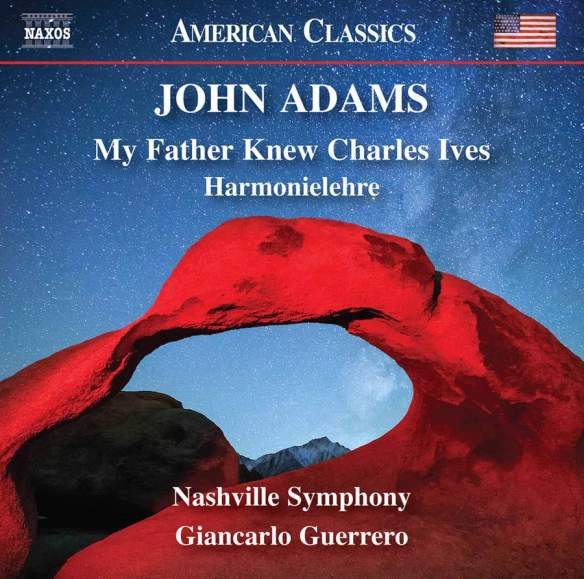
On record: Nashville Symphony / Giancarlo Guerrero – John Adams: My Father Knew Charles Ives, Harmonielehre (Naxos)

Nashville Symphony / Giancarlo Guerrero

John Adams
My Father Knew Charles Ives (2003)
Harmonielehre (1985)

Naxos American Classics 8.559854 [69’03”]
Producer Tim Handley
Engineer Trevor Wilkinson

Recorded 5-7 October 2018 (Harmonielehre), 25-27 October 2019 (My Father Knew Charles Ives), Laura Turner Concert Hall, Nashville

Reviewed by Richard Whitehouse

What’s the story?

Naxos adds to its coverage of John Adams with this release featuring two major orchestral works – the one among the most enticing of his latter-day output, the other among the most characteristic (and recorded) of the pieces that first accorded him international prominence.

What’s the music like?

Adams has long expressed a penchant for the music of America’s great visionary of the late-Romantic era, and My Father Knew Charles Ives is his oblique while affectionate homage to the composer who gave American classical music its aesthetic basis. Not that the title should be taken literally – rather, the work’s three movements add up to an inclusive portrait of Ives in a way not dissimilar to that of the composer’s orchestral sets. Thus, the opening Concord deftly identifies the cultural environment behind Ives’s thinking besides alluding to some of his most inimitable music, while The Lake builds upon this with evocative and atmospheric writing whose concertante role for piano also finds resonance in the senior composer’s music. The final and longest movement, The Mountain returns to those transcendental strivings as infused Ives’s creative maturity, though its finely sustained initial pages are not followed up by the falling back on well-rehearsed minimalist routines that ensue. Conversely, the closing pages inhabit an ethereal introspection as makes for an understated and affecting apotheosis.

Hard to believe it is now 36 years since Harmonielehre first blazed a trail over the Western musical landscape, or that what once provoked extreme reactions (causing a near riot at the 1987 Huddersfield Contemporary Music Festival) should have come to represent a musical lingua franca imitated many times in the interim. That this earliest of Adams’s ‘symphonic’ works remains among his most representative is fully reaffirmed here. Giancarlo Guerrero finds a viable balance between drama and lyricism in the lengthy opening movement, then builds the mingled Wagnerian and Mahlerian resonances of The Amfortas Wound toward a climax of potent anguish (if such is the music’s intent). The luminous opening of Meister Eckhardt and Quackie demonstrates the best in the Nashville Symphony – as with its superb release of Christopher Rouse (Naxos 8.559852) – and while even astute pacing cannot make the closing peroration sound other than manufactured, the approach yields a methodical and eventful sense of purpose as makes its ‘travelling in hope’ more compelling than any arrival.

Does it all work?

It does, from the perspective that Adams often makes his larger-scale works cohere through sheer force of impact more than formal ingenuity – his trademark post-minimalism proving renewable at almost every turn. Guerrero’s take on My Father Knew Charles Ives is certainly preferable to the composer’s rather calculated account with the BBC Symphony Orchestra (Nonesuch), while his Harmonielehre can rank high among the seven available recordings of this piece – among which, Kent Nagano with the Montréal Symphony Orchestra (Decca) currently leads the field.

Is it recommended?

Yes, not least when recording and annotations are first rate. Hopefully, future Naxos releases of Adams will explore further his extensive back catalogue and revive such as the impressive ‘symphony’ El Dorado, which still awaits its second recording after virtually three decades.

For further information on this release, and to purchase, visit the Naxos website. For more on John Adams, the composer’s website is a great resource. Meanwhile the Nashville Symphony website is here, and you can visit conductor Giancarlo Guerrero’s website here

On record – Dario Salvi conducts Humperdinck: Music for the Stage (Naxos)

a Andrea Chudak (soprano); b Ruxandra Voda van der Plas (contralto); c Harrie van der Plas (tenor); d Robert Bennesh (organ); Malmö Opera Chorus and Orchestra / Dario Salvi

Humperdinck
Die Heirat wider Willen (1905) – Prelude to Act Two
Der Kaufmann von Venedig (1905) – Incidental Music (abce)
Das Wunder (1912) – Suite (arr. Lotter) (d)
Die Wallfahrt nach Kevlaar (1878) (acd)
Lysistrata (1908) – Incidental Music (e)

Naxos 8.574177 [73’27”] German texts can be found here: http://www.naxos.com/libretti/574177.htm

Producer / Engineer Sean Lewis

Recorded 13-17 August 2019 at Bengt Hall-salen, Malmö, Sweden

Written by Richard Whitehouse

What’s the story?

Naxos continues its exploration into late-Romantic byways with this selection of theatre and choral works by Engelbert Humperdinck, presented so as to confirm a composer whose music more than makes up for what it might lack in overall individuality with expressive generosity.

What’s the music like?

The recent appearance of William Melton’s biography (Toccata Press) was of great value in conveying Humperdinck as a figure both selfless and humane; and a composer whose output reflects these qualities so that a personable and appealing musical idiom is always to the fore.

The selection gets underway with the Prelude to the second act of The Forced Marriage, after Alexandre Dumas, and the most likely among Humperdinck’s ‘forgotten’ operas to be worthy of revival. At least, the glowering intensity of this music set in the Bastille suggests as much.

Humperdinck contributed music to several productions by Max Reinhardt, with that for The Merchant of Venice running the gamut from very brief vocal or instrumental cues to such as a lilting Sarabande and a Procession of Masks which exude an engaging verve. The Casket Song draws a winsome response from female soloists and chorus, while the most extended item is an orchestral commentary on the text In such a night whose (not unduly) Wagnerian overtones and gently emergent rapture ought to secure more regular hearings in its own right.

Despite a lavish ‘multi-media’ premiere at Covent Garden, the sanctimonious scenario of the film The Miracle sealed its fate. Adolf Lotter’s suite deserves better – the evocative Prelude for organ leading into the lively Procession and Children’s Dance, then a festive ‘Banquet Scene’ finds contrast with the chaste Dance of the Nuns. A whimsical March of the Army is itself juxtaposed with the plangent Death Motif, before the Christmas Scene bestows a typically glowing atmosphere which the Finale to Act One builds to an eloquent apotheosis.

Much the earliest work, the cantata after Heine’s ballad The Pilgrimage to Kevlaar established Humperdinck’s reputation and is still occasionally revived – though not in the original version recorded here. If those swirling textures of the first section remind one that Humperdinck was soon to prove an invaluable amanuensis for Wagner, the central section renders the brunt of the narrative with considerable fervency, before the final section tempers the ostensibly tragic turn of events with a forceful reaffirmation of belief prior to its warmly consoling conclusion.

Finally, to incidental music for Aristophanes’ Lysistrata – comprising a perky Entr’acte for brass and woodwind, a vaunting Festal Procession that juxtaposes then combines male and female voices, then a Closing Song that elaborates its woodwind melodies to piquant effect.

Does it all work?

Yes, bearing in mind that Humperdinck never sought to impress his personality on the task at hand. Within its self-imposed limits, the theatre music is always suited to what is portrayed on stage, with the Heine setting among the most persuasive instances of a much-maligned genre.

Is it recommended?

Indeed. The various vocal and choral contributions have all the requisite limpidity and poise, while the Malmö Opera forces acquit themselves with verve and elegance under the capable guidance of Dario Salvi – whose efforts in raising the profile of this music compels respect.

Listen & Buy

You can get more information on the disc at the Capriccio website, or purchase from Naxos Direct. Meanwhile for more information on the recent Toccata Press book on Humperdinck, you can head to their website