Arcana at the opera: Fidelio @ Garsington Opera

Beethoven’s Fidelio, Garsington Opera at Wormsley, Stokenchurch, UK | Pictured: Robert Murray (Florestan); Sally Matthews (Leonore) | Image © Julian Guidera 2025

Fidelio (1804-5, rev. 1814)

Music by Ludwig van Beethoven
Libretto by Joseph Sonnleithner and Georg Friedrich Treitschke, after Jean-Nicolas Bouilly
Sung in German with English surtitles

Leonore, disguised as Fidelio – Sally Matthews (soprano), Florestan, her imprisoned husband – Robert Murray (tenor), Don Pizzarro, prison governor – Musa Ngqungwana (bass-baritone), Rocco, gaoler – Jonathan Lemalu (bass-baritone), Marzelline, his daughter – Isabelle Peters (soprano), Jacquino, prison warder – Oliver Johnston (tenor), Don Fernando, king’s minister – Richard Burkhard (baritone), First Prisoner – Alfred Mitchell (tenor), Second Prisoner – Wonsick Oh (bass)

John Cox (original director), Jamie Manton (revival director), Gary McCann (designer), Ben Pickersgill (lighting)

Garsington Opera Chorus, The English Concert / Douglas Boyd

Garsington Opera, Wormsley
Friday 27 June 2025

review by Richard Whitehouse Photos by (c) Julian Guidera

Few operas have been subject to matters of time and place as has Fidelio. Beethoven’s sole opera, by his own admission, caused him the greatest difficulty among all his works to ‘get right’ and, even today, it can all too easily emerge as a compromise between what had been intended and what (conceptually at least) was feasible. All credit, then, to Garsington Opera for this revival which not only avoided the likely pitfalls first time around but has improved with age – in short, a production that amply conveys the essence of this flawed masterpiece.
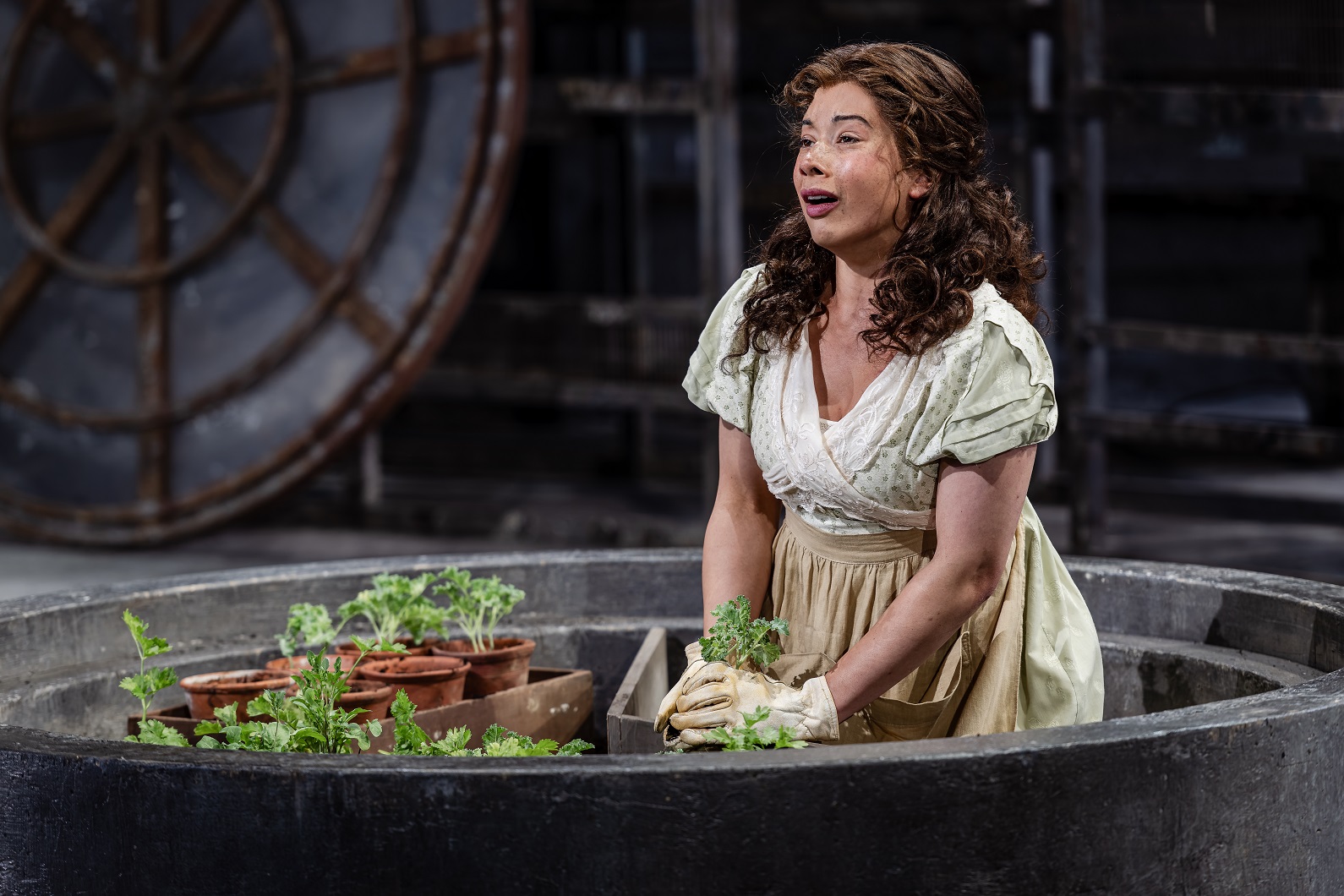
Beethoven’s Fidelio, Garsington Opera at Wormsley, Stokenchurch, UK | Pictured: Isabelle Peters (Marzelline) | Image © Julian Guidera 2025

That original staging had been directed by John Cox, whose productions are rarely less than durable and with such as his 1973 Capriccio or his 1975 The Rake’s Progress being close to definitive. For this second revival, Jamie Manton has streamlined the basic concept such that everything which takes place can be envisaged from the outset and hence ensures consistency across the production as a whole. He is abetted by Gary McCann’s designs, their monochrome stylings imparting a grim uniformity which could not be more fitting given that this drama is played out around and inside a prison. In particular, the hole front-of-stage from out of which the prisoners emerge and into which Florestan is to be committed is a device made elemental merely by its presence, while the final scene avoids the agitprop from an earlier era in favour of a straightforward tying-up of narrative loose-ends the more affecting for its understatement. Effective without being intrusive, Ben Pickersgill’s lighting enhances the changing moods of an opera which takes in domestic comedy and visceral drama prior to its heroic denouement.

Beethoven’s Fidelio, Garsington Opera at Wormsley, Stokenchurch, UK | Pictured: Garsington Opera Chorus | Image © Julian Guidera 2025

Vocally the opening night was a little uneven without there any real disappointments. If Sally Matthews initially sounded a little inhibited in the title-role, this most probably reflected its ambivalent nature rather than any lack of expressive focus; certainly, her commitment in the ‘Abscheulicher…Komm Hoffnung’ aria such as defines her emotional persona was absolute, as was her seizing hold of that climactic quartet to which the entire drama has been heading. Sounding as well as looking his part, Robert Murray avoided the rhetorical overkill that too often mars portrayals of Florestan – his mingled vulnerability and fatalism maintained right through to the duet ‘O namenlose Freude’ whose eliding of elation and doubt intensified its emotive force whatever its actual length, though without pre-empting what is still to come.

Beethoven’s Fidelio, Garsington Opera at Wormsley, Stokenchurch, UK | Pictured: Musa Ngqungwana (Don Pizarro); Richard Burkhard (Don Fernando) | Image © Julian Guidera 2025

As Don Pizarro, Musa Ngqungwana was imposing in presence and thoughtful in approach – his lack of histrionics preferable in a role which too often descends into caricature. That said, he was upstaged in their duet ‘Jetzt, Alter, jetzt hat es Eile!’ by Jonathan Lemalu who was in his element as Rocco; materialist aspiration outweighed by the humanity invested into a role where comedy rapidly gives way to pathos. Marzelline and Jaquino may have but little to do after the first scene, but Isabelle Peters was eloquence itself in her aria ‘O war ich schon mit dir vereint’ while Oliver Johnston veered engagingly between eagerness and consternation. Richard Burkhard made for an authoritative if never portentous Don Fernando, while Alfred Mitchell and Wonsick Oh afforded touching cameos during a memorable ‘Prisoners’ chorus’.
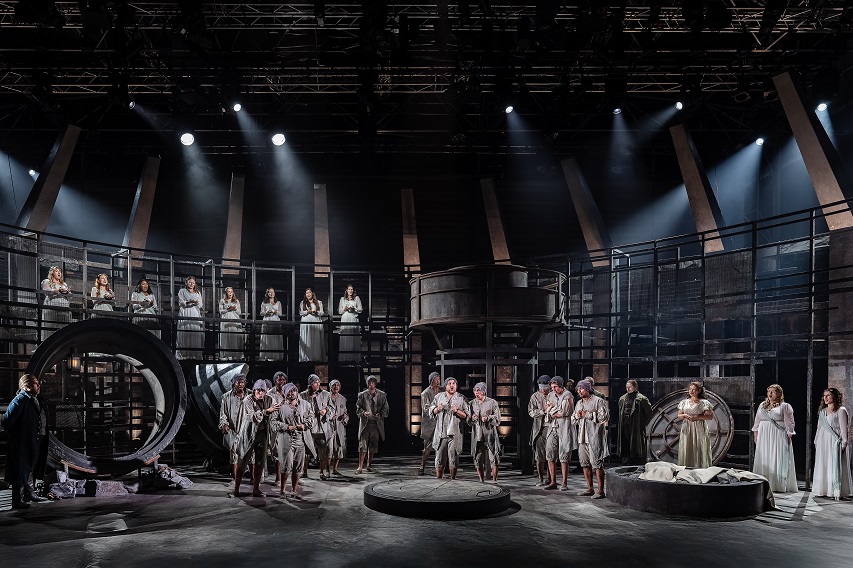
Beethoven’s Fidelio, Garsington Opera at Wormsley, Stokenchurch, UK | Pictured: Jonathan Lemalu (Rocco); Isabelle Peters (Marzelline); Garsington Opera Chorus | Image © Julian Guidera 2025

Nor was the Garsington Opera Chorus to be found wanting as a whole in its contribution to the finales of each act – the first as moving in its pallor, infused with radiance, as the second was in the unfettered joyousness which offset any risk of that final scene becoming merely a celebratory tableau. The English Concert sounded rarely less then characterful, even though humid conditions likely explained some occasionally approximate intonation – happily not in Rachel Chaplin’s scintillating oboe obligato which shadows Florestan’s aria ‘In des Lebens Frühlingstagen’ as if an extension of his character. Douglas Boyd directed with assurance an opera with which he has long been familiar, his tempos unexceptionally right and always at the service of the opera. The author Michael Oliver was surely correct in his observation that the Leonore original is superior in theatrical terms to the Fidelio revision, yet this latter was nothing if not cohesive through Boyd’s astute dovetailing of individual numbers, as between speech and music, so that any seeming discontinuities were made more apparent than real.

Some 211 years after the successful launch of its final version and Fidelio remains an opera acutely sensitive to political context and polemical intent. Beethoven himself was, of course, partly responsible for this but subsequent generations have sought, often recklessly, to foist their own preoccupations onto his music so as to distort or even negate its essence. There was no risk of that happening here thanks to the balanced objectivity of this production but also to its conviction that the composer’s guiding vision is, and always will be, its own justification.

Fidelio runs until 22 July 2025 – and for further information and performances, visit the Garsington Opera website

Published post no.2,581 – Monday 30 June 2025
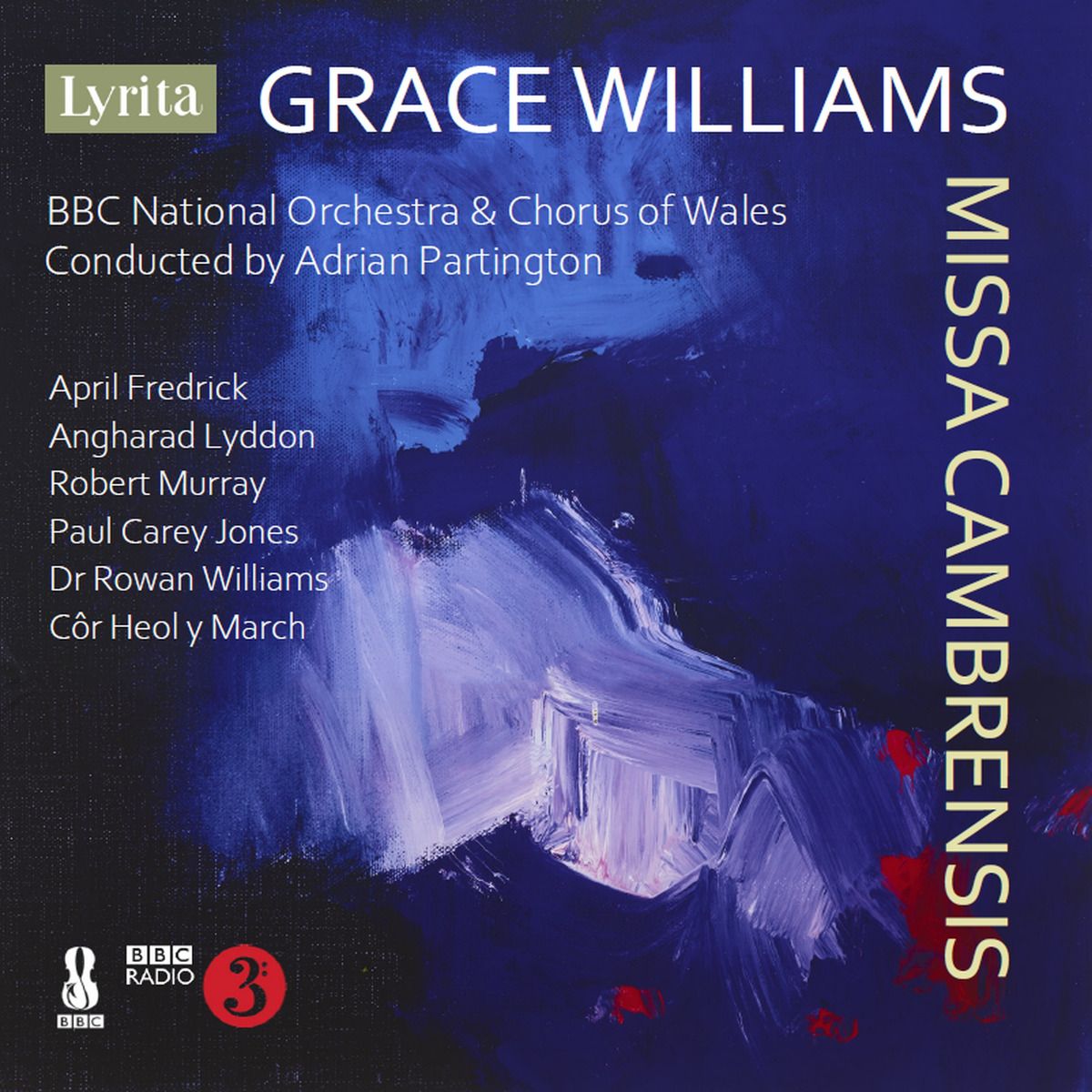
On Record – Soloists, BBC National Chorus and Orchestra of Wales / Adrian Partington – Grace Williams: Missa Cambrensis (Lyrita)

Grace Williams Missa Cambrensis (1968-71)

April Fredrick (soprano), Angharad Lyddon (mezzo-soprano), Robert Murray (tenor)
Paul Carey Jones (bass), Dr Rowan Williams (narrator); Côr Heol y March, BBC National Chorus and Orchestra of Wales / Adrian Partington

Lyrita SRCD442 [66’41’’] Latin / Welsh text and English translation included
Producer / Engineer Adrian Farmer, Engineer Simon Smith

Recorded 20-21 January 2024 at BBC Hoddinott Hall, Cardiff

Reviewed by Richard Whitehouse

What’s the story?

Lyrita continues its coverage of Grace Williams (1906-1977) with her largest concert work, Missa Cambrensis, in a recent studio recording which confirms it as the defining statement from a composer who, almost half a century since her death, is only now receiving her due.

What’s the music like?

As Paul Conway observes in his typically thorough booklet notes, Missa Cambrensis is one among a number of works by Williams that is Welsh only in a titular sense. Premiered at the Llandaff Festival in 1971, it was well received by fellow composers, critics and public alike but not heard again until 2016 in a performance one recalls as originally intended for release on Lyrita and which can be heard via the composer’s dedicated website. Not that the present account is other than successful in conveying the essence of this powerful yet elusive piece.

Many settings of the Mass since Haydn have unfolded a symphonic trajectory, but Williams goes further with the division into five clearly defined movements. The initial Kyrie Eleison not only introduces most of those salient motifs but also establishes that tone, mystical in its undulating equivocation, such as characterizes this work’s long-term expression: the contrast here between choral and soloistic textures duly accentuated by their hieratic and supplicatory quality. This duly sets up an emotional contrast intensified in the Gloria, outwardly the most straightforward part of the work but with a calmly ecstatic response at Laudamus te then an eloquent Dominus Deus that are nothing if not personal, together with an intensely wrought Cum Sancto Spiritu whose culminating Amen’s convey a distinctly ambivalent affirmation.

As most often, the Credo is the most substantial portion but Williams rings the changes by dividing this into halves, a pertinent division coming at Et homo factus est and Crucifíxus étiam pro nobis. In between are interpolated a setting of Saunders Lewis’s Carol Nadolig (A Christmas Carol) for children’s voices with viola, cello and harp of melting pathos, offset by a starkly narrative treatment of the ‘Beatitudes’ prior to a mostly ruminative resumption of the Credo. Pivoting between contemplation and elation, the Sanctus is rounded off by a joyful Hosánna in excélsis which is not to be heard again after the subdued eloquence of the Benedictus. An anguished response to the Agnus Dei feels the more acute, as also a searching Dona Nobis Pacem which brings the work full circle to its contemplative close.

Does it all work?

Yes, and with an understated while readily identifiable personality that surely makes this the most potent setting of the Mass from a Welsh composer. Subliminal influences might not be hard to discern, among them Britten’s War Requiem, but they never detract from Williams’s own idiom. The soloists cannot be faulted in terms of commitment, with Rowan Williams a notably incisive reciter, while Adrian Partington secures a lustrous response from his choral and orchestral forces. Overall, it is hard to imagine the work given with greater conviction.

Is it recommended?

It is indeed, not least in the hope that further live hearings of Missa Cambrensis may prove forthcoming. Good news, moreover, that Lyrita has now acquired the premiere performance of Williams’s only completed opera, The Parlour, which is scheduled for imminent release.

Listen & Buy

You can read more about this release at the Wyastone website

Published post no.2,516 – Monday 28 April 2025

BBC Proms #44 – Soloists, BBC Symphony Chorus & Orchestra / Sakari Oramo: Ethel Smyth ‘Mass’ & Debussy ‘Nocturnes’

Prom 44 – Nardus Williams (soprano), Bethan Langford (mezzo-soprano), Robert Murray (tenor), Božidar Smiljanić (bass), BBC Symphony Chorus, BBC Symphony Orchestra / Sakari Oramo

Debussy Nocturnes (1897-9)
Smyth Mass in D (1891, rev. 1924) [Proms premiere]

Royal Albert Hall, London

Saturday 20 August 2022

Reviewed by Richard Whitehouse Photos (c) Chris Christodoulou

His third Prom this season found Sakari Oramo conducting the BBC Symphony Orchestra in an unlikely yet, in the event, thought provoking double-bill of pieces composed at either end of the same decade and which duly played to the strengths of all those who were taking part.

The music of Ethel Smyth has been a prominent feature of this season and while her Mass in D comes too early in her career to be considered ‘mature’, it does evince many of those traits as defined the operas that followed. Written during a brief flush of adherence to Anglicanism, this is demonstrably a concert rather than liturgical setting (which makes its apparent status as the first Mass heard publicly in England for almost 300 years the more ironic) and, moreover, one of a ‘symphonic’ rather than ‘solemn’ conception despite the audible debt to Beethoven.

Smyth reinforces this aspect by placing the Gloria at the close – thereby making it the finale of a sequence in which the Kyrie, building gradually to a baleful climax before returning to its initial sombreness, becomes an extended introduction to the Credo whose numerous sub-sections facilitate a sonata-form design of no mean formal cohesion and expressive breadth. For their part, the Sanctus, Benedictus and Agnus Dei function as extended slow movement whose (for the most part) emotional restraint enables the soloists to come to the fore – after which, the Gloria takes its place as a finale not least in terms of drawing on previous themes and motifs through to the forceful though never merely bathetic culmination. That Smythe did not essay a symphony given her evident structural command seems the more surprising.

Tonight’s performance was no less assured than that which Oramo gave at the Barbican (and subsequently recorded, albeit with different soloists) three seasons ago. The soloists made the most of their contributions – Nardus Williams bringing a plaintiveness and elegance that was ideally complemented with Bethan Langford’s warmth and understated fervency, and though Robert Murray’s ardency showed signs of strain, he was no less ‘inside’ his part than Božidar Smiljanić, whose solo was more affecting for its burnished eloquence. The BBC Symphony Chorus responded as one to the full-on contrapuntal writing of those main movements, while Richard Pearce ensured the (too?) extensive organ part did not muddy the orchestral textures. Oramo directed with clear enjoyment a work that, for the most part, justified its 62 minutes.

In the first half, Oramo presided over a searching account of Debussy’s Nocturnes – its three movements still sometimes encountered separately but far more effective heard as a complete entity. Not its least impressive aspect was the ease with which these followed on from each other with a cumulative inevitability – the fugitive shading of Nuages (melting cor anglais playing by Helen Vigurs) leading to the half-lit activity of Fêtes, with its darting gestures and a central march-past of vivid understatement, then on to the sensuous allure of Sirènes.

As enticing as the women’s voices of the BBCSC sounded in this closing movement, it was the fervency with which Oramo infused its recalcitrant content such as made it the natural culmination of the sequence – the final bars dying away with a tangible sense of fulfillment.

Click on the artist names for more information on Nardus Williams, Bethan Langford, Robert Murray, Božidar Smiljanić and Sakari Oramo and for more information on the BBC Symphony Orchestra head to their website. For more on composer Dame Ethel Smyth, click here

Live review – Soloists, CBSO and Chorus / Kazuki Yamada – Mendelssohn’s Elijah

Keri Fuge (soprano), Karen Cargill (mezzo-soprano), Robert Murray (tenor), Matthew Brook (baritone), CBSO Chorus, City of Birmingham Symphony Orchestra / Kazuki Yamada (above)

Symphony Hall, Birmingham
Thursday 7 November 2019

Mendelssohn
Elijah Op.70 (1846)

Written by Richard Whitehouse

Although 173 years have passed since it first echoed around the Town Hall, Mendelssohn’s oratorio Elijah remains synonymous with Birmingham’s cultural tradition. Performances may be fewer than in its 19th-century heyday but there have been memorable ones – not least that in 1989 with Raphael Frühbeck de Burgos, for whom this piece was a speciality – and tonight saw a memorable account by the City of Birmingham Symphony Orchestra‘s principal guest conductor Kazuki Yamada, who duly banished any notions of this being a mid-Victorian period piece.

Whatever his failings on a broader aesthetic level, Mendelssohn was nothing if not creatively pragmatic when it came to a big occasion, and Elijah accordingly fulfilled its remit. Whereas the composer’s earlier oratorio St Paul had given notice of his abiding interest in the Passions of Bach, here he drew on the exemplar of those biblical epics through which Handel shaped English musical taste over the ensuing 150 years; enhanced by the rhythmic poise of Mozart and the harmonic subtleties of Beethoven to result in music wholly representative of its era.

Structured in two parts of almost equal duration, Elijah charts the trials of its eponymous hero as he draws the Israelites away from the pagan enticements of Baal and back to the true faith before himself ascending on a fiery chariot to Heaven. Julius Schubring‘s text (as sung in the idiomatic translation by William Bartholomew) fashions out of Kings and associated biblical sources a framework whose emotional rhetoric is balanced by a keen underlying momentum and unfailing sense of when to open-out the narrative to allow for more intimate expression.

The score implies eight soloists, but the four on hand (the brief role of ‘The Boy’ affectingly taken by chorus soprano Ella McNamee) proved more than able. As Elijah, Matthew Brook conveyed the anguish and the ecstasy of his part with unwavering assurance, while Robert Murray overcame initial strain to give commanding portrayals of his advocate Obadiah and detractor Ahab. Keri Fuge brought due pathos to the Widow, with Karen Cargill eloquent as the Angel – having stolen the show as the Queen who vents her wrath in unequivocal terms.

As with most of its forerunners, of course, Elijah is defined by a choral contribution in which the CBSO Chorus was not found wanting. Having recently sung the work with Yamada (and these soloists) in Monte Carlo, it conveyed the anger and supplication of the forsaken People with audible conviction, while being no less assured in those intricate choral items by which Mendelssohn frames and punctuates the drama. If choral numbers were appreciably less than the composer might have expected, then this was undoubtedly a case of less equalling more.

Neither should there have been any surprise as to the degree of Yamada’s identity with this music. Japan has produced notable exponents of Mendelssohn’s oratorios, with the present conductor evidently following in their wake. If those choruses ending each half summoned not quite the intensity evinced by Frühbeck all those years ago, the clarity and incisiveness he drew from both chorus and orchestra was hardly to be gainsaid – so setting the seal on a memorable reading of a work sure to wear its Birmingham credentials well into the future.

Listen

(Ben Hogwood writes…) Among the many available versions of Mendelssohn’s great oratorio, sadly none of these appear to yet include the City of Birmingham Symphony Orchestra – though one wonders if an extension to their Mendelssohn in Birmingham series will be forthcoming under Edward Gardner.

Spotify does however have a recent recording of Elijah from the Gabrieli Consort & Players under the direction of Paul McCreesh, with Robert Murray once again in the roles of Obadiah and Ahab. The organ itself was recorded in Birmingham Town Hall:

Live review – CBSO with Nicholas Collon: Savitri & The Planets

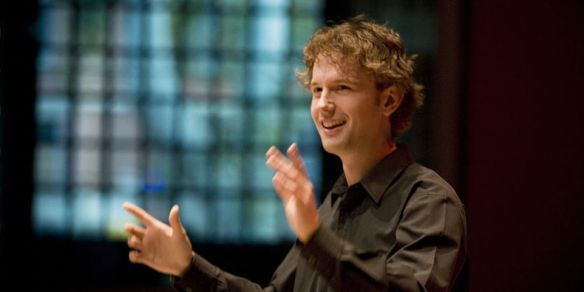
nicholas-collon

Yvonne Howard (mezzo-soprano, Sāvitri), Robert Murray (tenor, Satyavān), James Rutherford (baritone, Death), CBSO Youth Chorus, City of Birmingham Symphony Orchestra / Nicholas Collon (above)

Symphony Hall, Birmingham. Wednesday 8th February, 2017

Holst Sāvitri, H96 (1909); The Planets, H125 (1916)

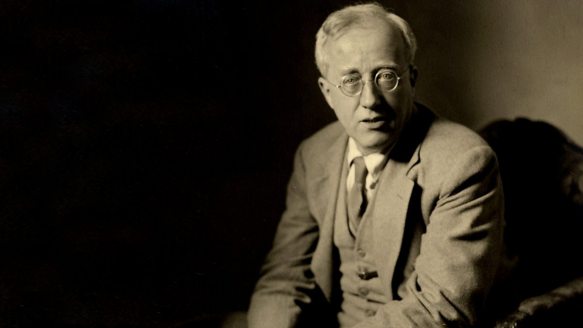
holst

Gustav Holst (1874-1934)

Written by Richard Whitehouse

Cheltenham-born Gustav Holst enjoyed a close relationship with the City of Birmingham Symphony right from its inception, so it was good to see a concert being devoted to his music as part of The Spirit of England series running through to the orchestra’s centenary in 2020.

The elapsing of 108 years has not dulled the innovative qualities of Sāvitri, Holst’s one-act opera with which he made a decisive move from the Wagnerian opulence of his earlier music (not least the three-act opera Sita, still awaiting complete performance), towards the lean and often introspective expression of his maturity. Just over half-an-hour in length, it explores the time-honoured operatic themes of love and redemption as a means of transcending death – all rendered from a curious amalgam of Vedic teaching and Socialist thinking wholly of its time yet no less influential for being so. In addition, the scoring for just three woodwinds and nine strings, along with (wordless) offstage female voices, blazed the trail for later generations of British opera. No Sāvitri = no Britten chamber-operas and no Maxwell Davies music-theatre.

First heard in Birmingham 63 years ago, Sāvitri was given by the CBSO in 2004 and 2008. Then, as now, James Rutherford took the role of Death – his forceful yet ultimately humane assumption complementing the title-role, in which Yvonne Howard (replacing an indisposed Sarah Connolly) responded with fearlessness but also compassion; Robert Murray likewise conveying the heroic vulnerability of Satyavān as he succumbs to then escapes death via the intercession of Sāvitri. Choral and instrumental forces responded ably to Nicholas Collon’s direction, using the spatial possibilities of Symphony Hall’s acoustic to telling effect, but it was a pity that dimmed house-lights made it impossible to follow the succinct yet detailed libretto which was otherwise not always audible. Maybe surtitles could have been provided?

It would be an unlikely all-Holst concert as did not feature The Planets, which duly followed the interval. Collon presided over a performance which, while it offered few revelations, still did justice to the power and originality of this music. Mars evinced a brooding implacability through to those seismic closing bars, then Venus brought eloquence without sentimentality and a solace that was never cloying. Mercury was nimble and quick-witted, not least in the hectic approach to its close, and the only partial disappointment (as so often in this work) was Jupiter, whose outer sections were a shade unsubtle rhythmically, the indelible melody at its centre haltingly paced.

Saturn went much better – Collon alive to the gaunt solemnity of its opening pages and the monumental climax, the final section effortlessly combining radiance and resignation. Nor was there any lack of impetuousity in the goings-on of Uranus, the martial episode reaching a heady culmination (its organ glissando finely integrated into the texture) and wrathful final climax not pre-empting the stillness around it.

Following-on without pause, Neptune rounded-off this reading with a fitting evocation of the ethereal – the CBSO Youth Chorus now placed high in the Symphony Hall auditorium so its role was wholly audible yet, in keeping with Holst’s conception, poised on the intangible.

For more information on future CBSO concerts head to their website