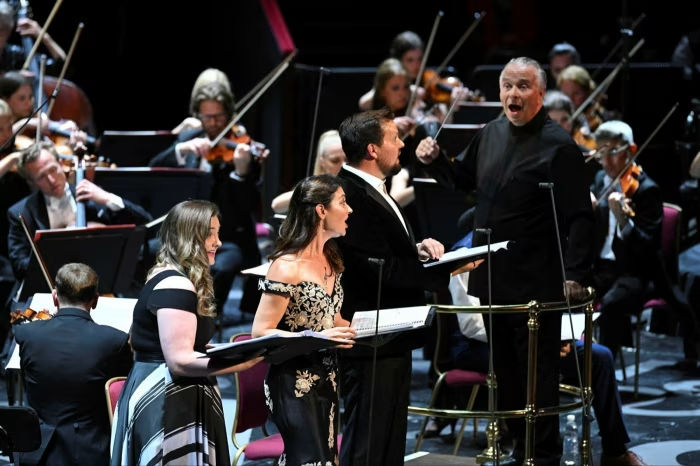
In concert – Soloists, London Philharmonic Choir, BBC Symphony Chorus & Orchestra / Sir Mark Elder @ BBC Proms: Delius: A Mass of Life

Jennifer Davis (soprano), Claudia Huckle (mezzo-soprano), David Butt Philip (tenor), Roderick Williams (baritone), BBC Symphony Chorus, London Philharmonic Choir, BBC Symphony Orchestra / Sir Mark Elder

Delius Eine Messe des Lebens (A Mass of Life) (1898; 1904-05)

Royal Albert Hall, London
Monday 18 August 2025

Reviewed by Richard Whitehouse Photos (c) BBC / Chris Christodoulou

There could be few venues better suited to Delius’s A Mass of Life, in its conceptual ambition and emotional opulence, than the Royal Albert Hall and this evening’s performance, only the third at these concerts and the first in 37 years, undoubtedly made the most of these qualities.

Despite the tragedy of his ultimate breakdown and ensuing incapacitation, Friedrich Nietzsche was considered a liberator in terms of a guiding philosophy with its emphasis on free will and rejection of conventional mores. Such appeal could hardly have been greater than on Frederick Delius, his largest concert work setting substantial extracts from Also sprach Zarathustra in a way that feels never judgemental and is only rarely overreaching. Much of the time its music has a detached and meditative aura whose inward intensity needs to be sustained accordingly.

That this account did so was owing to Sir Mark Elder, his advocacy already manifest in the finest modern recording (LAWO) as came across just as strongly and often more so here. Certainly, the longest sections were effortlessly paced – whether that beguiling interplay of longing and anticipation in In dein Auge which becomes the still (while never static) centre of Part One, or that extended sequence of Part Two taking in the scenic evocation as is Lasst vom Tanzen ab then the pantheist contemplation of Heisser Mittag schläft which is surely the expressive highpoint. Not that the dramatic openings of each part were under-characterized – the driving energy of O du mein Wille! setting the course for one as vividly as did the rousing Herauf! Nun herauf, with its orchestral prelude Auf den Bergen meltingly rendered, for the other.
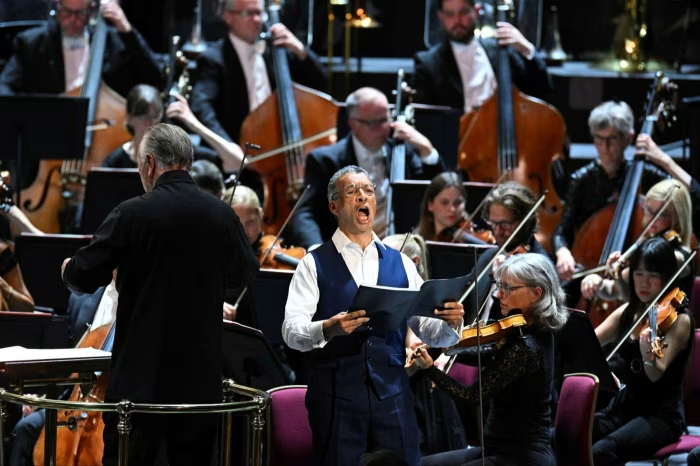
This may be regarded mainly as a choral work, but the importance of its vocal parts is never to be gainsaid. Above all, that of the baritone who assumes the role of Zarathustra in his gradual incline to enlightenment and in which Roderick Williams (above) was consistently at his best – hence the infectious Erhebt eure Herzen and assertive Wehe mir! then, subsequently, the alluring eloquence of Süsse Leier! and will to action of Gottes Weh ist tiefer. If this is the solo role as brings focus or unity to the whole, the others afford textural and expressive enhancements aplenty – Jennifer Davis as capricious and Claudia Huckle as confiding as David Butt Philip was assertive in their respective contributions. All three singers brought out the youthfulness or naivety which are crucial to this work’s underlying journey from innocence to experience.
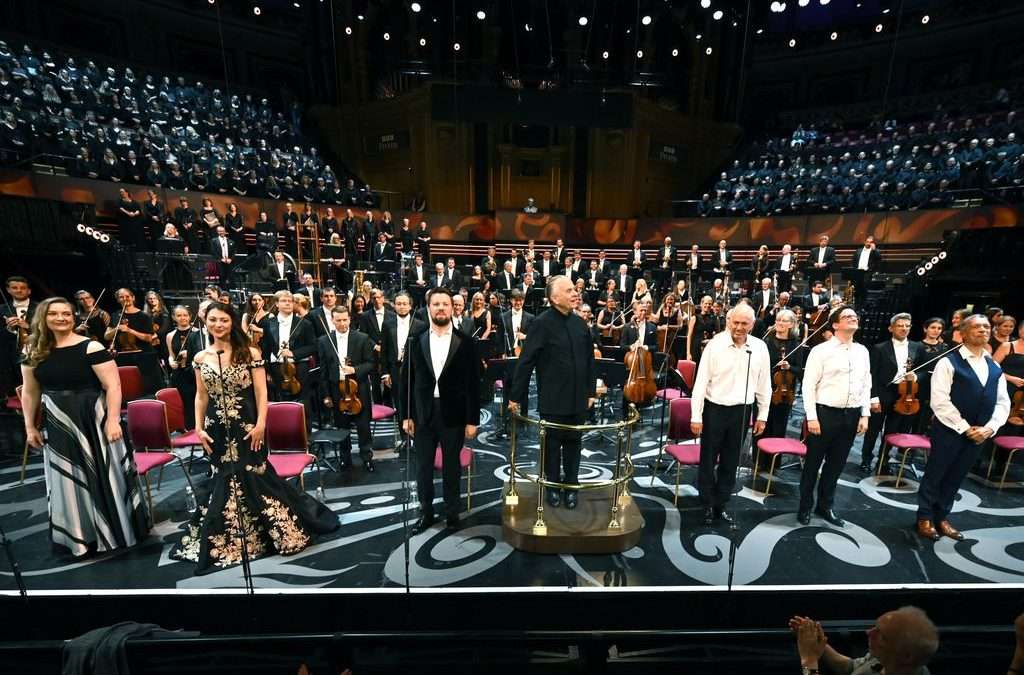
Any doubt a relative disparity in numbers of female and male singers would be detrimental to choral balance was groundless – Elder drawing a vividness but also delicacy of response from those combined BBC Symphony and London Philharmonic forces, while the BBC Symphony Orchestra was rarely less than galvanized whether in complex tuttis or the artless writing for solo woodwind that informs the latter stages. Delius’s orchestration rarely ‘plays itself’ but it conveys a lustre and translucency which could not be mistaken for that of another composer.

A near-capacity audience seemed as attentive to this as it was affected by the final Kommt! Lasst uns jetzt wandeln!, with its build-up to an ecstatic apotheosis then swift dispersal into silence: setting the seal on a memorable interpretation of this all-encompassing masterpiece.

You can listen back to this Prom concert on BBC Sounds until Sunday 12 October – or listen to the recent recording from Sir Mark Elder, with soloists, the Collegium Musicum Choir, Edvard Grieg Kor, Bergen Philharmonic Choir and Orchestra on Tidal below:

Click on the artist names to read more about soloists Jennifer Davis, Claude Huckle, David Butt Philip and Roderick Williams, the London Philharmonic Choir, BBC Symphony Chorus and BBC Symphony Orchestra, and conductor Sir Mark Elder. Click also for more on the Delius Society and the BBC Proms

Published post no.2,632 – Wednesday 20 August 2025

On Record – Gavin Higgins: The Fairie Bride, Horn Concerto (Lyrita)

Gavin Higgins
Horn Concerto (2023)
Fanfare, Air and Flourishes (2021)
The Fairie Bride (2021)

Marta Fontanals-Simmons (mezzo-soprano), Roderick Williams (baritone), Ben Goldscheider (horn), Three Choirs Festival Chorus; BBC National Orchestra of Wales / Jaime Martin (Horn Concerto), Martyn Brabbins (The Fairie Bride)

Lyrita SRCD440 [84’14”] English/Welsh libretto included
Producer Adrian Farmer Engineer Andrew Smilie

Recorded in Hoddinott Hall, 11 January 2024 (Horn Concerto), Concert Hall, Wyastone Leys, Monmouth, 4 April 2024 (Fanfare, Air and Flourishes), live performance from Gloucester Cathedral on 23 July 2023 (The Fairie Bride)

Reviewed by Richard Whitehouse

What’s the story?

Lyrita adds to the already growing discography of Gavin Higgins (b.1983) with this release featuring two recent major works, both of which are heard in their first performances and thereby confirm this composer’s place among the leading British voices of his generation.

What’s the music like?

Listeners may have come across Higgins’s music via the release Ekstasis (see the link below), a collection of chamber pieces which attests to a distinctive and searching personality. Such is equally true of those here, not least the Horn Concerto that takes its place in a notable lineage of such works ‘in E flat’, while taking in Schumann and Ligeti as part of its range of stylistic or conceptual allusions. Its three movements have as their inspiration the Waldhorn – the first, Understorey, duly outlining an emergence from the (Wagnerian) depths to the forest floor in mounting waves of activity. There follow Overstorey with its airily expressive evocation of the forest canopy as builds considerable fervency over its course, then Myelium Rondo with its overtones of the hunt and energetic fanfares which propel this work to an affirmative close.

No stranger to the horn (being his own instrument), Higgins had indirectly prepared for this concerto with Fanfare, Air and Flourishes, a brief but eventful solo triptych which tries out several gestures or motifs to be developed in the larger work as well as in his second opera.

Commissioned by the Three Choirs Festival, The Faerie Bride takes a legend from the Book of Hergest for its synopsis of the coming together but eventual (its being inevitable) disunion between water spirit and earthly man. This is played out over seven scenes divided into two parts – Francesca Simon’s succinct yet artfully constructed libretto moving from their initial encounters at the lake, via the gradual dissolution of their relationship through events during each of the four seasons, to a climactic juncture when the woman returns with her extended family into the depths. Musically the work encompasses the range of Higgins’s idiom up to this point, its richness and variety of texture complemented by an instrumental clarity which ensures vocal audibility throughout – certain discrepancies between the libretto as published and as sung being immediately evident. That this opera keeps its emotions close to its chest much of the time only makes the closing stages the more powerful, not least in the way the ending reaches back to the beginning for a tangible sense of resolution borne of experience.

Does it all work?

Yes, in that Higgins is able to integrate his influences into a coherent and personal language. It helps that these performers are audibly attuned to this music – not least Marta Fontanels-Simmons as an otherworldly Woman and Roderick Williams as the uncomprehending Man – with Ben Goldscheider a consummate exponent of works for horn. The Three Choirs Festival Chorus characterizes the Villagers with suitable aggression, while Jaime Martin and Martyn Brabbins secure idiomatic playing of real finesse from the BBC National Orchestra of Wales.

Is it recommended?

Very much so. Those yet to do so should certainly acquire the earlier release on Nimbus, but the works featured here round out the potency of Higgins’s music accordingly. Detailed and informative notes by Gillian Moore, though watch out for those discrepancies in the libretto.

Listen & Buy

For purchase options, you can visit the Ulysees Arts website. For information on the performers, click on the names to read more about Ben Goldscheider, Marta Fontanals-Simmons, Roderick Williams, Jaime Martin, Martyn Brabbins and the BBC National Orchestra of Wales. Click to read more about composer Gavin Higgins and about Ekstasis

Published post no.2,465 – Thursday 6 March 2025

On Record – Roderick Williams, Rupert Marshall-Luck, BBC Concert Orchestra / John Andrews – La Belle Dame (EM Records)

Roderick Williams (baritone) (Holst, O’Neil, Quilter & Scott), Rupert Marshall-Luck (violin, Brian), BBC Concert Orchestra / John Andrews

Brian orch. Marshall-Luck Legend B144 (c1919)
Delius Petite Suite d’Orchestre no.1 RTVI/6 (1889-90)
Holst Ornulf’s Drapa H34 (1898, rev. 1900)
Mackenzie Colomba Op.28 – Prelude (1883)
O’Neill La Belle Dame sans Merci Op.31 (1908)
Quilter orch. anonymous The Faithless Shepherdess Op.12/4 (1908)
Scott The Ballad of Fair Helen of Kirkconnel Op.8 (1900)

EM Records EMRCD085 [61’21’’] English texts included
Producer Neil Varley Engineers Andrew Rushton, Robbie Hayward
Recorded 5-7 January 2023 at Battersea Arts Centre, London

Reviewed by Richard Whitehouse

What’s the story?

EM Records continues its enterprising schedule with this collection of mainly vocal settings from the early twentieth century – heard alongside early orchestral pieces by Mackenzie and Delius, plus a recent orchestration of what is Havergal Brian’s only surviving chamber work.

What’s the music like?

This album’s title is also that of the 1819 poem by John Keats, its tale of ecstasy recollected in despair tangibly conveyed by Norman O’Neill in a setting which surely ranks among his finest concert works before music for theatre productions became his focus. Only marginally less compelling, Cyril Scott’s take on a typically over-elaborate ballad by Walter Scott has a keen sense of atmosphere – not least as rendered by Roderick Williams with an appropriate Lowland burr. Less involving emotionally, Holst’s setting of verse from an early Ibsen play is rather forced in its rhetoric – though the passages of emotional impulsiveness, allied to an acute feeling for orchestral textures, does presage those masterpieces of his maturity. Roger Quilter’s setting of a favourite Elizabethan lyric launches the collection with brusque charm.

Of the orchestral pieces, Delius’s early Première Petite Suite is here heard in full for the first time. Influences are easy to discern – Bizet in its whimsical Marche, Grieg in its winsome Berceuse, Massenet in its vivacious Scherzo then Fauré in its plaintive Duo – but never to the detriment of this music’s appeal, while the final variations on a sternly unison theme with ecclesiastical overtones will keep even seasoned Delians guessing as to its provenance. The likelihood of Alexander Mackenzie’s lyrical drama Colomba being revived is slim, but the Prelude to its first act has an evocative ardency which concludes this album in fine style.

John Andrews has the measure of these contrasting idioms and gets committed playing from the BBC Concert Orchestra. Roderick Williams is on fine form, as is Rupert Marshall-Luck in the Legend by Havergal Brian he himself has orchestrated. Ranging widely in expressive profile, while building considerable fervour during its relatively brief span prior to a calmly eloquent close, it is a stylish adaptation of the violin-and-piano original which has enjoyed increasing exposure this past decade. Marshall-Luck speculates whether Brian intended his own orchestral realization yet, given the composer had evidently written an orchestral piece with this title around 1915, it seems not impossible that the duo version is itself a reduction.

Does it all work?

Yes, in that the whole proves greater than the sum of its parts. Certainly, the works by Scott and O’Neill find these contemporaneous while otherwise very different figures at something near their best, while the Delius makes for an attractive sequence which deserves more than occasional revival. As, too, does the Brian given that comparable shorter concertante pieces by figures such as Saint-Saëns are being taken up by a younger generation of violinists. The spacious sound and extensive annotations are both up to EMR’s customary high standards.

Is it recommended?

Indeed. Hearing the Holst prompts the thought that, with the 150th and 90th anniversaries of his respective birth and death falling this year, now would be the ideal time for revival of his orchestral suite Phantastes – which has seemingly remained unheard since its 1912 premiere.

Listen & Buy

La Belle Dame is due for release on 19 April, but you can hear excerpts and look at purchase options on the EM Records website. For more information on the artists click on the names of conductor John Andrews, baritone Roderick Williams, violinist Rupert Marshall-Luck and the BBC Concert Orchestra

Published post no.2,126 – Saturday 23 March 2024

On Record – Robert Saxton: Portrait (Métier)

Saxton
A Hymn to the Thames (2020)
James Turnbull (oboe), St Paul’s Sinfonia / Andrew Morley
Fantasy Pieces (2020)
Fidelio Trio [Darragh Morgan (violin), Tim Gill (cello), Mary Dullea (piano)]
Time and the Seasons (2013)
Roderick Williams (baritone), Andrew West (piano)
Suite (2019)
Madeleine Mitchell (violin), Clare Hammond (piano)

Métier msv28624 [69’40’’]
Producers / Engineers Adaq Khan, Stewart Smith (Time and the Seasons)

Recorded 12 March 2014 at King’s Hall, Ilkley (Time and the Seasons); 27 January 2020 at St John the Evangelist, Oxford (Suite); 7 November 2021 at Conway Hall, London (Fantasy Pieces); 28 January 2022 at St John the Evangelist, London (A Hymn to the Thames)

Reviewed by Richard Whitehouse

What’s the story?

Having issued several of his works on miscellanies, Métier now issues a release devoted to Robert Saxton – this Portrait comprising four pieces which, written during the past decade, make for a revealing overview of the composer’s musical and wider aesthetic convictions.

What’s the music like?

Earliest among these works is Time and the Seasons – a song-cycle to Saxton’s own poems, in which memories of the composer’s long attraction to the south-eastern Norfolk coast are elided with a seasonal traversal from then back to winter; and itself underpinned by a tonal evolution drawing the six songs into a musical continuity. A piano solo Summer Seascape provides a formal and expressive pivot, the baritone solo Autumn an entrée into the The beach in winter as foregrounds human activity against a backdrop of temporal permanence.

Although they likewise have descriptive titles, the five pieces that comprise Suite for violin and piano seem inherently abstract in their content. Following the cumulative activity then limpid evocation of the first two, the others play without pause – the visceral immediacy of Jacob and the Angel, then the ethereal interplay in Bells of Memory, leading into Quest with (as in the song-cycle) a sense of this music having come full-circle yet simultaneously setting out fresh possibilities – tonal and emotional – to be pursued in future compositions.

The composer himself notes that Fantasy Pieces for piano trio, despite its title and scoring, is not related to Schumann’s eponymous work in any formal or thematic sense. Instead of the latter’s four character-pieces, moreover, Saxton opts for six continuous items whose fluidity of content and intuitive follow-through readily point up the various connotations of the title. That the closing piece seeks to provide a definite resolution while imparting a sense of open-endedness to the sequence overall is merely the most arresting facet of this engaging work.

Closure and un-restrictedness are no less crucial in A Hymn to the Thames, a concertante for oboe and ‘Classical’ forces whose four movements outline the river’s journey from its source in the Cotswolds to its estuary at the North Sea. Allusions to places encountered on route are deftly inferred (notably choral works by Taverner and Tallis), with the soloist a ‘first among equals’ as it leads the orchestra on through these contrasted musical landscapes towards a heightened arrival as the river meets the sea and, in turn, a comparable sense of renewal.

Does it all work?

It does. Saxton observed several years ago his music had become both more serial and tonal in its preoccupations, as is evident from the works recorded here. An incidental fascination is how each section or movement, appealing in itself, yet leaves a sense of open-endedness that is only resolved through the context in which they appear. This will doubtless be evident on a larger scale when Saxton’s Scenes from the Epic of Gilgamesh is premiered by the English Symphony Orchestra in Oxford as part of its 21st Century Symphony Project on March 10th.

Is it recommended?

Very much so. Excellence of performers and performances is matched by sound which gives little indication of any disparity in venues or dates, and the composer provides informative booklet notes. Hopefully further releases of Saxton will be forthcoming from this source.

For purchase information on this album, and to hear sound clips, visit the Divine Art Recordings Group website. For more on the composer, visit Robert Saxton’s dedicated website – and for more on the performers, click on Clare Hammond, Madeleine Mitchell, Andrew Morley, James Turnbull, Andrew West, Roderick Williams, Fidelio Trio and St. Paul’s Sinfonia

In concert – Roderick Williams, CBSO Chorus, CBSO / Michael Seal: Vaughan Williams at 150: 5 Mystical Songs, Symphony no.5

Vaughan Williams
The Wasps – Overture (1909); Towards the Unknown Region (1906-07); Five Mystical Songs (1906-11); Symphony no.5 in D major (1938-43)

Roderick Williams (baritone, above), CBSO Chorus, City of Birmingham Symphony Orchestra / Michael Seal

Symphony Hall, Birmingham
Thursday 10 November 2022

Reviewed by Richard Whitehouse

The City of Birmingham Symphony Orchestra’s mini-series devoted to Vaughan Williams continued this evening with the overture from his music to Aristophenes’ satire The Wasps, paced by Michael Seal (below) so its animated and soulful themes complemented each other perfectly.

Judicious was no less true of this first half with its overview of the composer’s music across the first decade of the last century. Its premiere at the Leeds Festival bringing a first taste of national acclaim, his ‘song for chorus and orchestra’ Toward the Unknown Region sets Walt Whitman with assurance and imagination in its evocative opening section, and if the ensuing peroration feels a little contrived – the journey proving more memorable than the destination – that was no fault of the CBSO Chorus whose contribution was sensitively attuned throughout.

As it was with those Five Mystical Songs in which the composer gave full vent to his love for the Metaphysical poets and George Herbert in particular. A curiously hybrid conception, the chorus is very much secondary to the baritone soloist throughout much of the first three songs – a congregational presence in the processional Easter and then underpinning the emotional intimacy of I Got Me Flowers or confiding profundity of Love Bade Me Welcome, before falling silent in The Call. Roderick Williams was eloquence itself in this latter setting and a forthright presence in the preceding, before sitting out the Antiphon with its pealing bells and mounting exultation. Williams has recently given the rarely heard version of these songs with piano but hearing them with such burnished splendour as here was its own justification.

Is the Fifth Symphony unduly exposed nowadays? The composer’s most characteristic and culturally significant such piece might risk palling with too much repetition, but there was no chance of that here. Seal (above) set a flowing if not too swift tempo for the Preludio, pointing up the radiant tonal contrast between its themes – the second of them capping the movement to thrilling effect towards its close. Its rhythmic pitfalls ably negotiated, the Scherzo had the requisite deftness and mystery while taking on a degree of malevolence over its later stages. The Romanza then emerged surely yet unforcedly through glowing chorales and plaintive soliloquy (CBSO woodwind at its most felicitous) to a heartfelt culmination before subsiding into a hardly less enveloping serenity – its inspiration in John Bunyan tacitly acknowledged.

Enough had wisely been kept in reserve for the final Passacaglia – its initial stages evincing an almost nonchalant gaiety as only clouded towards its centre with the recollection of earlier ideas. By making it the work’s emotional highpoint, moreover, Seal ensured that the epilogue capped not just this movement but the work overall – its transcendence (hopefully) speaking as directly to listeners today as those at the premiere almost 80 years ago. Certainly, it would be a real misfortune were this music ever to be viewed solely from the perspective of the past.

An absorbing performance, then, that reaffirmed the greatness of this music to an enthusiastic audience. Vaughan Williams at 50 concludes tomorrow evening with the CBSO providing a live soundtrack to the composer’s most ambitious cinematic project – Scott of the Antarctic.

You can read all about the 2022/23 season and book tickets at the CBSO website. For more information on Scott of the Antarctic, click here – and click on the artist names for more on Roderick Williams, the CBSO Chorus and Michael Seal