by Ben Hogwood, with text from the press release. Picture (c) Camilla Greenwell
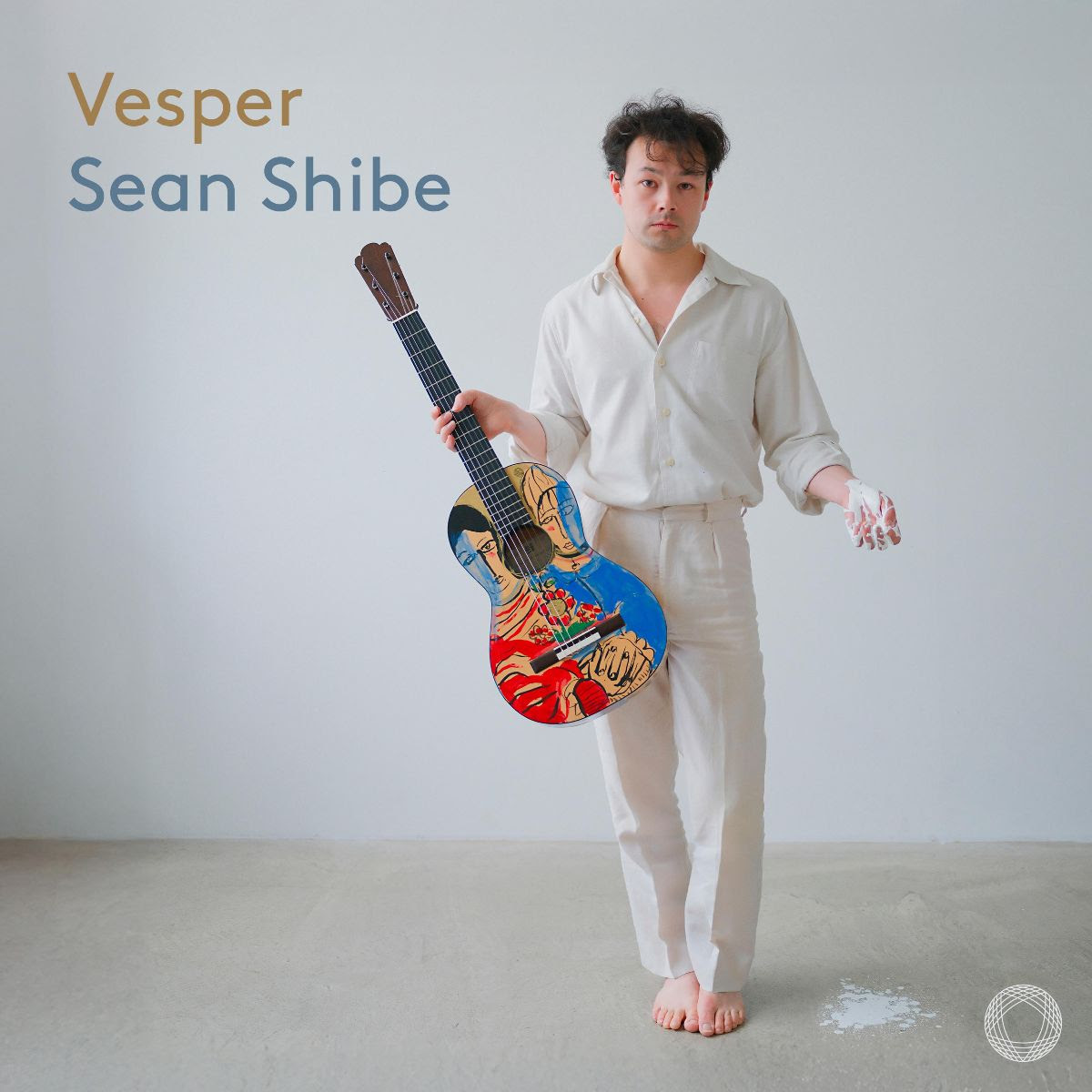
Sean Shibe’s fifth Pentatone album, Vesper, is due for release on 17 April 2026.
On it he presents a typically inventive collection of contemporary guitar works by the late Harrison Birtwistle, James Dillon, and Thomas Adès, “all composed by musicians who do not play the instrument themselves”, says the press release. “Recorded here for the first time, these recent miniatures explore the guitar’s expressive range in profoundly different ways: ritualistic and evocative in Birtwistle, elemental in Dillon, and allusive in Adès. Shibe’s interpretations reveal the instrument’s extraordinary colour, subtlety, and capacity for transformation, bringing each work to life with imagination and nuance.
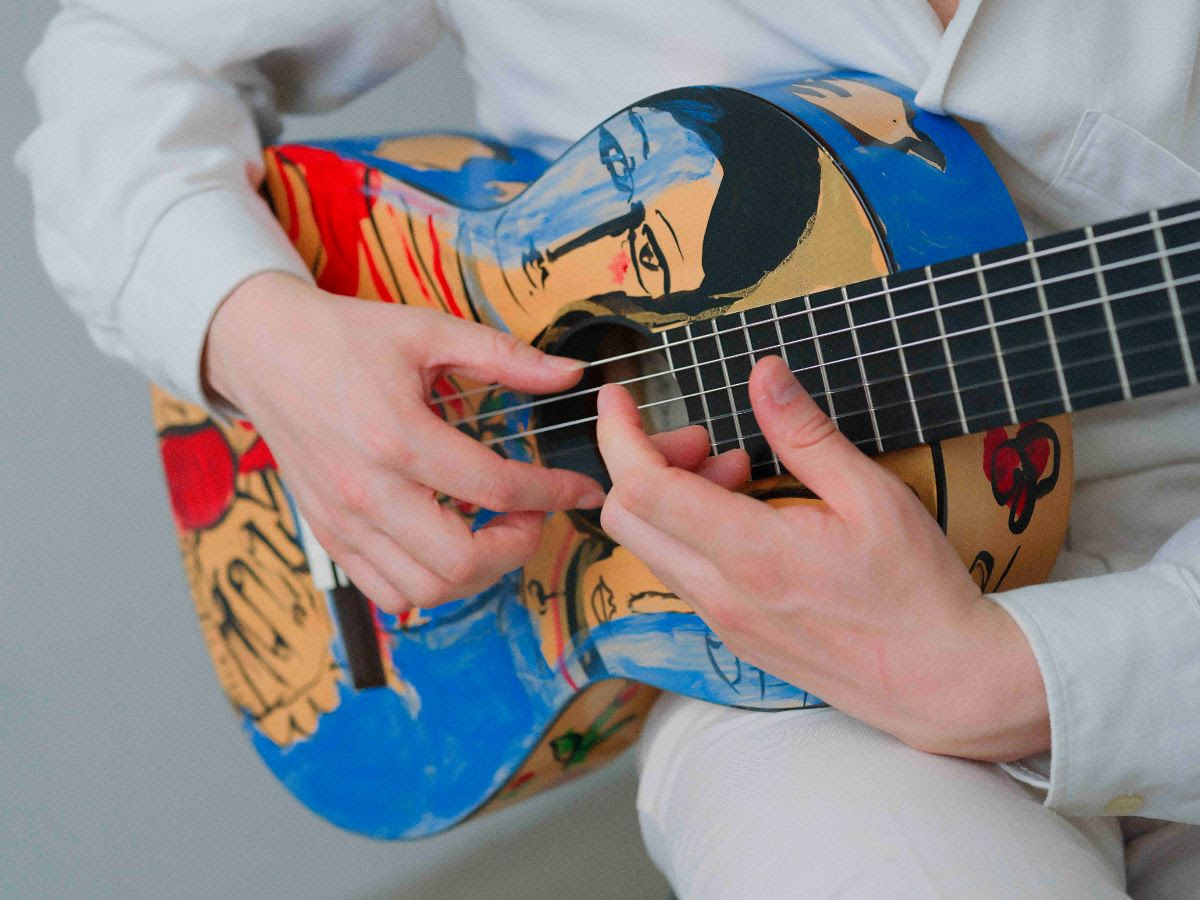
For some of Birtwistle’s pieces, Shibe performs on Sylvette (2021), a guitar made by luthier Simon Ambridge in collaboration with French-British artist Lydia Corbett. A muse to Pablo Picasso – who was himself an important influence for several of Birtwistle’s works on this album – Corbett also inspired Picasso’s celebrated Sylvette series. Modelled on the small, responsive instruments of the Andalusian luthier Antonio de Torres, the guitar features Corbett’s artwork on its body, adding a visual and symbolic layer to the performance.
You can watch the launch video for Vespers here:
The tracklisting for Vesper is:
Thomas Adès (b. 1971) Forgotten Dances* 1 I. Overture, Queen of the Spiders 2 II. Berceuse, The Paradise of Thebes 3 III. Courante – Here was a swift (for Max Ernst) 4 IV. Barcarolle – The Maiden Voyage 5 V. Carillon de Ville (for Hector Berlioz) 6 VI. Vesper (for Henry Purcell)
Harrison Birtwistle (1934–2022) 7 Beyond the White Hand: Construction with Guitar Player** 8 Guitar and White Hand**
Thomas Adès 9 Habanera* from ‘The Exterminating Angel’
10 Oockooing Bird (arr. for guitar by Forbes Henderson) 11 Sleep Song 12 Berceuse de Jeanne (arr. for guitar by Forbes Henderson) 13 Sad Song (arr. for guitar by Forbes Henderson) 14 Je sui aussi
James Dillon (b. 1950) 12 Caprices* 15-26 1.-12.
You can explore purchase options for Vesper at the Pentatone website
Sean Shibe (guitar), BBC Philharmonic Orchestra / Anja Bihlmaier
Richard Strauss Tod und Verklärung Op.24 (1888-89) Simpson ZEBRA (or, 2-3-74: The Divine Invasion of Philip K. Dick) (2025) [BBC commission: World premiere] Berlioz Symphonie fantastique Op.14 (1829-30)
Royal Albert Hall, London Tuesday 22nd July 2025
Reviewed by Richard Whitehouse Photos (c) BBC / Mark Allan
The current BBC Proms season features several high-profile premieres, not the least of them being tonight’s from Liverpool-born clarinettist and composer Mark Simpson, remembered at these concerts for his orchestral fanfare sparks launching 2012’s Last Night in no uncertain terms.
On one level, ZEBRA (or, 2-3-74: The Divine Invasion of Philip K. Dick) is a straightforward three-movement concerto following the customary formal trajectory. No work that draws its inspiration from one of Sci-Fi’s most distinctive authors could be deemed predictable and so it proved with this musical representation of an epiphany which, experienced in his mid-40s, pervaded his thinking until his untimely death. Whether or not possessing divine overtones, it duly provided an imaginative context for the present work as it unfolds from a combative and even assaultive opening movement, through a mostly ruminative yet sometimes restive elegy, into a finale whose rapidly accruing energy surges towards an apotheosis of theatrical overkill – the ‘Zebra’ of the title as demonstrative as it remained elusive a presence during Dick’s life.
Music whose virtuosity summoned an orchestral response to match – the BBC Philharmonic Orchestra responding with alacrity to Simpson’s often febrile textures and translucent sonorities under the assured guidance of Anja Bihlmaier. Ultimately, of course, this was Sean Shibe’s show – his magnetic presence and mastery of electric guitar making it a notable addition to a genre still lacking in worthwhile contributions. His encore of a dreamily disembodied soundscape might even have been paying oblique homage to the great, happily not so late Robert Fripp.
On another level, Simpson’s concerto chimed ideally with the likely concept of this concert. One that commenced with an unexceptionally fine account of Richard Strauss’s Tod und Verklärung, Bihlmaier characterizing its more inward episodes with affecting poignancy as compensated for a lack of implacability in its early stages or a slightly underwhelming affirmation toward its close. Rarely in doubt was the direction in which this composer’s metaphysical musings were headed, even if the outcome was a performance no more than the sum of its best parts.
Berlioz pursued a rather less elevated ‘death and transfiguration’ in his Symphonie fantastique, but an approach with which Bihlmaier seemed more fully in accord. The lengthy introduction of Rêveries – Passions was eloquently delineated, and if the main portion of this movement (without exposition repeat) was overly self-contained, it elided naturally into Un bal with its ingratiating waltz offset by passages of despondency and elation. The highlight was a Scène aux champs which unfolded seamlessly from its plangent cor anglais solo, through mounting agitation, near catastrophe then uneasy resignation, to its mesmeric ending made more so by undulating timpani chords. After this, Marche au supplice (with first-half repeat) built with ominous tread to a climax almost graphic in its depiction of the ‘hero’ condemned to death.
An outburst of applause suggested many had not anticipated the orgy to come, but Bihlmaier responded with a Songe d’une nuit du Sabbat that, if lacking the ultimate drama, set the seal on an engaging performance with the BBC Philharmonic at something like its collective best.
You can listen back to this Prom concert on BBC Sounds until Sunday 12 October.
J.S. Bach Prelude in C minor, BWV999 (c1727) Barrios Mangoré La Catedral (1921, rev. 1939) Villa-Lobos Prelude no. 3 in A minor (1940); Études (1929) – no.1 in E minor, no.5 in C major, no.8 in C sharp minor, no.10 in B minor Barrios Mangoré Barcarola in D major, ‘Julia Florida’ (1938) Mompou Suite compostelana (1962) – nos. 1, 2, 5 and 6 Martin Quatre pieces brèves (1933) Adès Forgotten Dances (2023)
Wigmore Hall, London Thursday 19 September 2023
Reviewed by Richard Whitehouse
Expecting the unexpected has become synonymous with Sean Shibe, who tonight began his season-long residency at Wigmore Hall with this recital which deftly blurred any perceived demarcation between improvised or notated music in a compulsively absorbing programme.
One of a surviving handful of pieces probably written for lute, Bach’s C minor Prelude began proceedings – its elegantly methodical unfolding here rendered with real liquidity by Shibe. It segued seamlessly into La Catedral as is among a relative few of Agustín Barrios Mangoré’s extended compositions: the subdued fervour of (belatedly added) Preludio saudade heading into the hieratic processional of Andante religioso, before the lively yet disquieting motion of Allegro solenne brought this vividly yet understatedly illustrative sequence to its close.
Here, as across this recital, Segovia was a pervasive presence – not least on the guitar output of Heitor Villa-Lobos. From his Five Preludes, Schiebe opted for the Third – a Homage to Bach whose echoing open strings summon an opulence, even majesty, out of all proportion to its length. Then came four of his 12 Études – the intensive arpeggio workout of the First, the stark contrasts between melody and accompaniment of the Fifth, the playful alternation of registers in the Eighth, then rounded off with the exacting rhythmic fluidity of the 10th.
The first half closed with more Barrios – his Júlia Florida a barcarolle of melting tenderness whose allure carried over a second half that commenced with four of the six movements from Federico Mompou’s Suite compostelana. One of the Catalan’s handful of works for other than piano, the distanced evocation of Preludio complemented the austere spirituality of Coral as surely as did the folk-tinged pathos of Canción the ingratiating allure of Muñeira – this latter bringing the Galician environs which had inspired this music into greatest prominence.
Shibe’s including music by Frank Martin was more than welcome in the 50th anniversary of the Swiss composer’s death as has passed largely unnoticed in the UK. His only work for solo guitar, Quatre pieces brèves has been championed by many guitarists in Segovia’s wake and Shibe duly left his mark with his quizzical take on its Prélude, the chaste witfulness of Air then the barely contained emotional impetus of Plainte, before Comme une gigue provided a pointedly ‘contemporary’ vantage on the Baroque dance by turns quixotic and invigorating.
That both Martin and Thomas Adès have written operas on Shakespeare’s The Tempest seems as good a link as any into Forgotten Dances, the latter composer’s first work for guitar. Its six vignettes traverse the restless Overture and Buñuel-influenced speculation of Berceuse, via the Ligetian propulsion of Courante and tenuous repose of Barcarolle, to the cumulatively effusive homage to Berlioz of Carillon de Ville then rather more equable homage to Purcell of Vesper – its allusions emerging, Dowland-like, over what becomes an affecting farewell.
An intriguingly varied recital duly afforded focus not least by the calmly assured presence of Shibe – his appearance this evening redolent of the long-gone, much-missed Billy Mackenzie. A limpid rendering of an as yet unidentified encore provided a brief if wholly appropriate envoi.
There is a famous, unattributed quote that ‘writing about music is like dancing about architecture’. How, then, to interpret a concert in celebration of a magazine? The conclusion, when that magazine is 100 years old, is that surely its writers are doing something right!
The magazine is the esteemed Gramophone, formed in 1923 and reaching its centenary without a break, not even an issue missed during the Second World War. Gramophone has reflected the growth of the classical record industry, proving something of a bible for classical music listeners and buyers, with its recommendations of recordings and interviews / thought pieces to put them in context. Music old and new is covered, and not all of it classical – indeed, as we found out during James Jolly’s revealing and entertaining narration, the magazine reviewed pop music in the 1960s.
Jolly is the magazine’s Editor in Chief, and has been with the magazine since starting as editorial assistant in 1985. He gave a debt of gratitude to the Gramophone founder Sir Compton Mackenzie and the Pollard family, where the large part of the night’s story lay. Modestly, the magazine did not dwell on their current state, which would have been easy – for Gramophone is one of those rare things, a publication where subscription is done without the bat of an eyelid, and each issue read cover to cover – either physically or online, where you can enjoy the entirety of its archive in digital form.
How to celebrate such a publication in a concert? Choosing the Wigmore Hall was a smart move, honing resources and ensuring the celebrations were done with quality as well as quantity. The move did of course eliminate larger scale forms – opera and orchestral – but it retained the magazine’s sense of musical exploration through five centuries of music.
Violinist Alina Ibragimova and pianist Cédric Tiberghien began with a concentrated performance of Debussy’s Violin Sonata, completed just six years before the magazine’s first edition. This was a thoughtful and virtuosic performance, Ibragimova fully inhabiting each phrase while Tiberghien successfully harnessed Debussy’s coloristic effects and sleights of harmony. The spectre of war was close at hand – as it was in Gramophone’s early years.
Next up was countertenor Iestyn Davies, a late replacement for soprano Fatma Said. It was a privilege to hear his Purcell, refracted through the eyes of modern composers, showing how access to the composer’s music has boomed since Gramophone started. Davies had a particularly arresting delivery for Britten’s Lord, what is man, before a deeply passionate vocal in the Thomas Adès setting By beauteous softness, Malcolm Martineau phrasing its postlude with exquisite shaping. Britten reappeared for a jubilant I’ll sail upon the Dog Star.
In Gramophone’s tenure the guitar has established itself as a central part of the classical repertoire. We heard two very different soloists – Milos in Mathias Duplessy’s bluesy Amor Fati, which though originating in France seemed to be looking over the Spanish border on occasion. Its full bodied chords were brilliantly declaimed. Sean Shibe, meanwhile, cast his eyes further east as partner for tenor Karim Sulayman in three songs of Arabic origins. Here was a striking alliance, Shibe’s exquisitely quiet playing a match for the tenor’s husky delivery. The two finished each other’s sentences, reflecting a musical chemistry of unusual quality found on their recent album Broken Branches.
We also heard three very different pianists, dazzling with virtuosity but also showing impeccable control. Nearest to the edge was Jean-Efflam Bavouzet, whose compelling excerpts from Ravel‘s suite Miroirs revealed rougher contours. These suited the storm of Une barque sur l’océan, while Alborada del gracioso was rustic and danced at quite a pace, the pianist relishing its whirling figurations.
Martin James Bartlett showed a painter’s touch to a pair of Liszt arrangements – the composer’s keyboard paraphrase of his son-in-law Wagner’s Liebestod especially fine. Bartlett’s phrasing was immaculate, each tune clear as a bell in spite of the myriad accompanying colours. The Schumann transcription Widmung also retained a songful air, powerful at its climactic passages.
Bisecting the keyboard soloists was soprano Carolyn Sampson and regular partner Joseph Middleton. Sampson will shortly reach her 100th album release, a remarkable achievement in a discography adorned with Gramophone accolades. We heard a well-chosen and varied selection taking us from Purcell and Britten to Saariaho via Poulenc and Régine Poldowski, the latter composer indicative of record companies’ efforts to include more female composers at last. Daughter of Polish composer Henryk Wieniawski, Poldowski made a very strong impression with L’heure exquise, while Sampson gave a ringing endorsement for Saariaho’s Parfum de l’instant, due in a future recording. Here she was aided by a fountain of cascading treble notes from Middleton.
Finally we heard Bernard Chamayou in a tour de force account of Liszt’s Venezia e Napoli, an apt choice in its inclusion of the city of Naples, looking out to a former home of Sir Compton Mackenzie on the island of Capri. Liszt added the Venezia e Napoli triptych as a footnote to the second book of his cycle Années de Pèlerinage, reflecting the impact of his travels around Europe as a virtuoso pianist. Its music is far from trivial and Chamayou, who recorded the complete cycle in 2010 brought unusually clear definition to the undulating figures of Gondoleria. The Rossini-themed Canzone was deeply intoned, majestically voiced with a sense of wonder projecting right to the back of the hall. Finally the Tarantella was a virtuoso affair, but Chamayou never lost sight of the thematic material in the tempestuous surroundings.
It was the ideal way to conclude a high-quality concert, though an encore saw the assembled artists sing ‘Happy birthday’ to the publication that has served them so well. Here’s to another 100 years, Gramophone!
Purcell, realised Britten Lord, what is man (1945); Purcell, realised Adès By beauteous softness (2017); Purcell, realised Britten I’ll sail upon the Dog Star (1943)
Ravel Miroirs: Une barque sur l’océan; Alborada del gracioso (1904-5)
Jean-Efflam Bavouzet (piano)
Trad arr. Sulayman & Shibe La prima vez; Arab-Andalusian Muwashsha arr. Shibe Lamma Bada Yatathanna; Sayed Darwish arr. Shibe & Sulayman after Ronnie Malley El helwa di
Karim Sulayman (tenor), Sean Shibe (guitar)
Wagner arr. Liszt Isoldens Liebestod (1867); Schumann arr. Liszt Widmung (1848)
Martin James Bartlett (piano)
Purcell realised Britten Sweeter than roses (c1945); Britten Fancie (1965); Poulenc Fancy (1959); Régine Poldowski L’heure exquise (1917); Saariaho Parfum de l’instant (from Quatre Instants) (2002)
Carolyn Sampson (soprano), Joseph Middleton (piano)
At 1pm on Monday June 1st, live music-making returned to the Wigmore Hall and BBC Radio 3.
While we have been incredibly fortunate to enjoy live streams of music from around the world since lockdown began, this felt like something extra special. A whole month of lunchtime concerts, served up by our finest chamber music venue in conjunction with BBC Radio 3, and streamed on the Wigmore Hall website. With a selection of top class artists, all of whom live close enough to journey in and play, all that was missing was the audience – but this added extra poignancy, offering us private moments with the musicians in our own home, a deluxe version of what BBC Radio 3 has been giving us for decades. A note should be made for presenter Andrew McGregor‘s broadcasting manner, expertly paced and perfectly weighted.
The musical riches in the first week have been many and varied. The first concert was ideally placed, Steven Hough giving us Busoni’s epic realisation of Bach’s Chaconne in D minor and Schumann’s lovelorn Fantasie in C major. In some performances of the Bach-Busoni the virtuoso elements of the piece take over at the expense of feeling, but not here. Hough shaped the phrases with great care, bringing out the gusto when it was needed but giving an incredibly well-balanced account of a familiar showpiece.
With Schumann’s Fantasie he gave a flowing performance of a notoriously difficult work, made all the more poignant because of its circumstances, written in isolation by a composer pining for his wife Clara. There was joy, too – the march theme of the second movement ringing out with bell-like clarity, while the resolution at the end, softly voiced, left a lasting smile.
Tuesday’s song recital from soprano Lucy Crowe and pianist Anna Tilbrook had the themes of Hope and Longing – appropriately in the awful context of world events, which saw the concert begin with a two-minute period of reflection on racial inequality and violence.
Crowe began on high, judging her vibrato beautifully for Thomas Arne’s aria O ravishing delight, before three Schumann songs found her vocal control matched by her communication with the audience, in spite of the empty hall. The sound world of Berg’s 7 frühe Lieder is very different, with challenges of tricky melodic intervals and words by seven different poets, but the soprano handled them effortlessly, helped by Tilbrook’s painterly application of light and shade for the corners of Berg’s nocturnal settings.
The pair moved on to a selection of poignant folk songs, none more so than the unaccompanied She moved through the fair, before English lyrics old and new from Thomas Dunhill, Ivor Gurney, Vaughan Williams and Madeline Dring. It was a touching recital with both soprano and pianist clearly on the same page.
Few guitarists would expect to receive compliments on the quality of their quiet playing…but that was what stood out immediately from Sean Shibe’s solo recital on the Wednesday. With a collection of attractive Scottish dances the listener was drawn in from the start and borne to the beauty of the Highlands, the tunes carrying on the air in performances of extraordinary intimacy.
The same could be said for Shibe’s performance of Bach’s Lute Suite in E minor, carefully studied but delighting in the expressive interplay between the parts, bringing Bach’s notes clean off the page. Steve Reich’s Electric Counterpoint was even better, Shibe moving to a Fender to play the 12th part of this multilayered composition. The waves of sound echoing around the Wigmore as the guitarist, now barefoot, completely lost himself in the music.
Oboist Nicholas Daniel and pianist Julius Drake, both Wigmore regulars and musical partners for 40+ years, crammed their Thursday lunchtime with music old and new, all of personal significance.
They included two short premieres, the wide open textures of Huw Watkins’ haunting Arietta and the uncertainties of Michael Berkeley’s A Dark Waltz, written in lockdown. There was a rarity,too, in the first broadcast performance of Liszt’s darkly coloured Élegie, originally written for cello and piano but here in a recently unearthed version with for cor anglais.
Howard Ferguson’s arrangement for oboe and piano of Finzi’s substantial Interlude was beautifully paced and deeply felt in that slightly elusive way in which the composer writes, Drake absorbing the extra parts with ease. Meanwhile Ferguson’s arrangements of three pieces for pedal piano by Schumann studies were also nicely done. Later we heard three attractive shorter pieces from Madeline Dring, and finally Nicholas Daniel showed off the oboe’s versatility in three rewarding arrangements of popular songs, including The Girl From Ipanema and capped by All The Things You Are. A note, too, for the pair’s deeply felt and beautifully observed Bach encore, Jesu, Joy of Man’s Desiring, prefaced by a sensitive introduction.
Last but not least, Pavel Kolesnikov and Samson Tsoy reminded us what an intimate form of communication the piano duet can be. As the pair live together they have experienced isolation in each other’s company, and that in itself brought an extra poignancy to their lovingly played selection of Brahms’ Liebeslieder Waltzes, a profound SchubertImpromptu in A flat from Tsoy and a bittersweet clutch of six Waltzes, Ländler & German Dances from Kolesnikov.
Together the pair enjoyed the humour and lightness of touch in Beethoven’s 8 Variations on a theme of Count Waldstein, but the best was saved for last and a wonderful performance of Schubert’s Fantasia in F minor. Recognised as one of the finest works in the piano duet repertoire, it received a performance led by Tsoy that moved from almost painful introspection to passionate outbursts five minutes later. The scherzo section had plenty of cut and thrust, while the whole piece, ideally paced, built to an almost overwhelming strength of feeling, capped by an intensely dramatic pause before the softly voiced opening theme returned.
What a musical week it has been – and looking at the roll call it looks like we are in for another three weeks of equally fine and moving insights. You can catch up with all the concerts on the links above and are strongly advised to do so, for there are some incredibly fine performances waiting to be heard. Live concerts may not be with us for a while yet, but in the meantime these intimate hours with some of our best classical music artists are an ideal substitute.
You can see the schedule for forthcoming Wigmore Hall livestreams here, the series resuming courtesy of cellist Steven Isserlis and pianist Mishka Rushdie Momen on Monday 8 June.



 Arcana.fm