In concert – Peter Moore, London Symphony Orchestra / Ryan Bancroft @ BBC Proms: Folk Songs & Dances

Peter Moore (trombone), London Symphony Orchestra / Ryan Bancroft

Vaughan Williams English Folk Song Suite (1923)
Schuller Eine kleine Posaunenmusik (1980) [Proms premiere]
Tippett Triumph (1992) [Proms premiere]
Arnold arr. Johnstone English Dances Set 1 Op.27 (1950, arr. 1965)
Grainger The Lads of Wamphray (1904), Country Gardens (1918, arr. 1953), Lincolnshire Posy (1937)

Royal Albert Hall, London
Saturday 30 August 2025 11am

Reviewed by Richard Whitehouse Photos (c) BBC / Chris Christodoulou

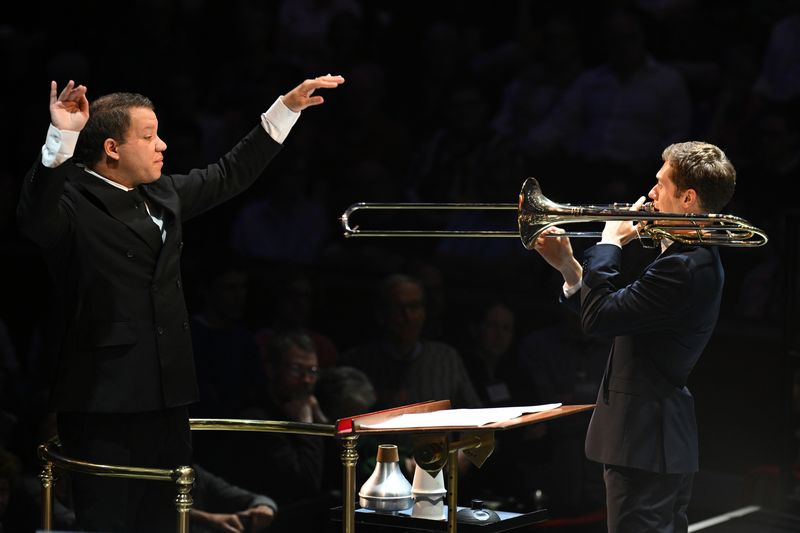
His pained countenance may have adorned its programme cover but Sir Simon Rattle’s ‘routine surgery’ meant this morning’s Prom was directed by Ryan Bancroft, though the works played by woodwind and brass (and basses) of the London Symphony Orchestra remained the same.

The concert duly breezed into life with Vaughan WilliamsEnglish Folksong Suite, heard in its original scoring for concert (i.e. – military) band such as imparts a forthright impetus to its outer marches – the former alternating brusqueness with insouciance, and the latter similarly balancing energy with geniality. In between these, the intermezzo provided welcome respite with its soulful medley. Expert as are the arrangements for orchestra by Gordon Jabob or for brass band by Frank Wright, this remains the ideal medium for an unassuming masterpiece.

It would have been remiss of the Proms not to include a piece by Gunther Schuller in the year of his centenary, with Eine Kleine Posaunenmusik being a fine choice in context. Fastidiously scored for trombone and ensemble, whose wind and brass melded into tuned percussion with notable solos from piano and harpsichord, its five succinct movements outline a succession of vignettes in which Peter Moore sounded as attuned expressively as technically. With music as distinctive as this, Schuller’s fourth appearance at these concerts will hopefully not be his last.

Surprising that Michael Tippett’s Triumph should have remained so obscure within his output. Seemingly made during work on The Rose Lake, this ‘Paraphrase on Music from The Mask of Time’ is for the greater part his arrangement of the oratorio’s sixth movement, though it could be heard as encapsulating his music over the decade from the mid-’70s. The main portion pits fractured lyricism against dissonant outbursts as befits its genesis in a setting of Shelley’s The Triumph of Life and, if the closing affirmation sounds added-on, its finality is hardly in doubt.
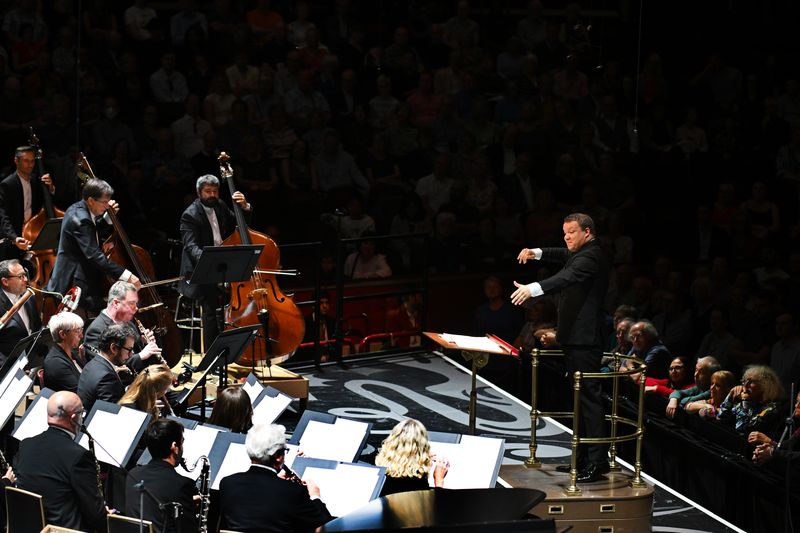
There could hardly have been a more pointed contrast than with Malcolm Arnold’s initial set of English Dances – its sequence of winsome, bracing, elegiac then energetic numbers ideally conveyed in Maurice Johnstone’s arrangement. Their concision was thrown into relief by the relative garrulousness of The Lads of Wamphray, an early example of Percy Grainger’s love for folksong which, in this instance, rather outstays its welcome. Rattle presumably enjoys it and Bancroft gave it its head, but its inclusion here was not warranted by its musical quality.

From the other end of Grainger’s career, his concert-band arrangement of Country Gardens exudes all the wit and irony of his later creativity. It made a canny upbeat into Lincolnshire Posy, one of a select handful of concert band masterpieces and where the LSO gave its all. Thus, the incisive Lisbon (Dublin Bay) was followed by the pathos-drenched Horkstow Grange then intricately imaginative Rufford Park Poachers; the jaunty The Brisk Young Sailor by the darkly rhetorical Lord Melbourne (very different from Britten’s elegiac take).

The surging impetus of The Lost Lady Found brought to a suitably rousing close this suite and what was a fine showcase for the LSO woodwind and brass, an unexpected if welcome appearance by Bancroft and, above all, a demonstration of the potential of the concert band.

Click on the artist names to read more about Peter Moore, the London Symphony Orchestra and conductor Ryan Bancroft. Click also for more on composer Gunter Schuller and the BBC Proms

Published post no.2,644 – Monday 1 September 2025
Arcana at the Proms – Prom 53: Remembering Sir Andrew Davis

Stravinsky Symphony in Three Movements (1942-5)
Reich Jacob’s Ladder (2023) [BBC co-commission: UK premiere]
Tippett The Midsummer Marriage – Ritual Dances (1946-52)
Elgar Variations on an Original Theme ‘Enigma’ Op.36 (1898-9)

Synergy Vocals [Tara Bungard (soprano), Micaela Haslam (soprano/director), Will Wright, Ben Alden (tenors)], BBC Symphony Orchestra / Martyn Brabbins

Royal Albert Hall, London
Friday 30 August 2024

reviewed by Richard Whitehouse Photos (c) Andy Paradise

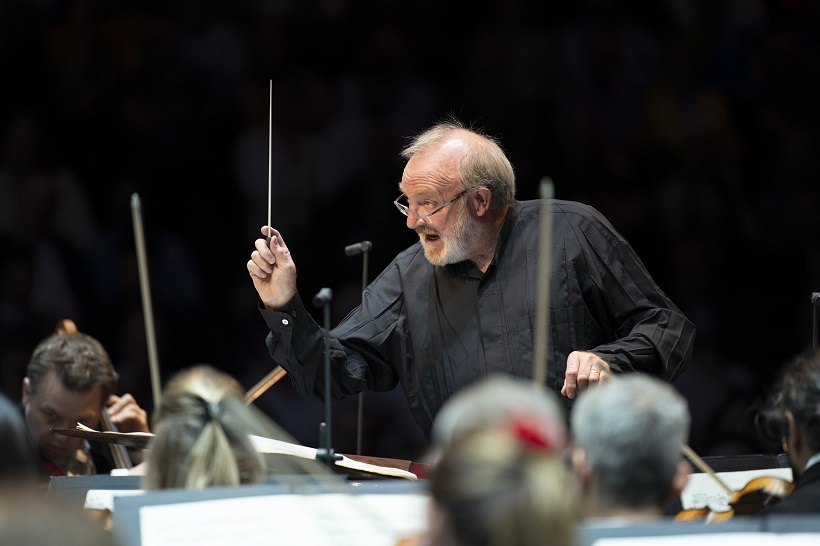
What should have been the 133rd concert that Sir Andrew Davis conducted at the Proms became a commemorative event after his untimely death in April but, with Martyn Brabbins presiding over a thoughtfully amended programme, the outcome could not have been more appropriate.

Proceeding unaltered, the first half began with Stravinsky’s Symphony in Three Movements in a performance redolent of Otto Klemperer in its deliberation if without that conductor’s heft – not least an opening movement whose rhythmic trenchancy felt a little dogged as it unfolded. Best was the Andante – its deadpan humour complemented by the beatific poise at its centre, then a transition of hushed expectancy to launch the finale. Here the closing build-up might have been more visceral, but the conclusiveness of that final chord could hardly be doubted.

Davis (above) was hardly known as proponent of Minimalism in general or Steve Reich in particular, thus his scheduling this first UK performance of the latter’s Jacob’s Ladder could be taken as significant. Playing just under 20 minutes, this is artfully structured as four short ‘expository’ sections followed by four longer ‘developmental’ ones. The former pitted its four vocalists – a telling number in this context of eight strings, six woodwind, two vibraphones and one piano – against an instrumental ensemble that took precedence in those latter sections; the final one brings them together in new-found accord. Dealing with scalic patterns in all their conceptual and metaphorical implications, the musical content typifies late Reich in ruminative elegance or subdued intensity which, if it offers no revelations, is yet satisfying in its stylistic deftness.

Schumann’s Second Symphony had been planned for a second half as now commenced with the Ritual Dances from Tippett’s The Midsummer Marriage – an opera, and composer, close to Davis’ heart. Unfailingly cohesive to the degree its series of elemental and seasonal dances interwove with their respective ‘transformations’ and ‘preparations’, this account was equally notable for its textural clarity even in those most contrapuntally intricate passages, along with a colouristic sense sustained up to the climactic return of its initial music for a magical envoi.

When Brabbins last conducted Elgar’s ‘Enigma’ Variations at the Proms, it was the final item in a 60th-birthday tribute that began with Pictured Within – a latter-day equivalent involving 14 different composers. Tonight’s account gave eloquent insight into what has become almost too familiar a work, evident from the outset in a ‘Theme’ of melting pathos. Highlights from those that followed included the soulfulness of ‘C.A.E.’, pensiveness of ‘R.P.A.’ or elegance of ‘Ysobel’ with its lilting viola from Sebastian Krunnies. ‘Nimrod’ started imperceptibly but built towards a nobly wrought apex, with the affectionate portrayed ‘Dorabella’ or searching evocation of ‘***(Romanza)’ no less affecting. The ‘E.D.U.’ finale moved confidently to an organ-clad peroration exuding what Elgar elsewhere termed a ‘‘massive hope for the future’’.

Just before this performance, Brabbins spoke for a capacity house in paying tribute to Davis with his dedication to music-making in the UK and beyond; something Sir Andrew brought to every one of his 132 appearances at the Proms, across 54 years of dedication to his cause.

You can get details about this year’s season at the BBC Proms website – and you can click on the names to read more about the BBC Symphony Orchestra, their conductor Martyn Brabbins, and an obituary of Sir Andrew Davis himself

Published post no.2,287 – Sunday 1 September 2024

Arcana at the opera: New Year @ Birmingham Opera Company

New Year (1985-88)

Opera in Three Acts

Music and libretto by Sir Michael Tippett
Sung in English with English surtitles

Jo Ann – Francesca Chiejina (soprano), Donny – Sakiwe Mkosana (baritone), Nan – Sarah Pring (mezzo-soprano), Merlin – Lucia Lucas (baritone), Pelegrin – Joshua Stewart (tenor), Regan – Samantha Crawford (soprano), Presenters – Grace Durham (mezzo-soprano), Oskar McCarthy (baritone)

Keith Warner (director), Michael Hunt (associate designer), Mariana Rosas (chorus director), Nicky Shaw (designer), Simone Sandrini (choreographer), John Bishop (lighting designer), Matt Powell (video designer)

Birmingham Opera Company Chorus, Actors and Dancers, City of Birmingham Symphony Orchestra / Alpesh Chauhan

The Dream Tent @ Smithfield, Birmingham
Sunday 7 July 2024

reviewed by Richard Whitehouse Photos (c) Adam Fradgley

Around a decade ago, Birmingham Opera Company mounted a production of Tippett’s opera The Ice Break which vindicated this opera as a dramatic entity, so making its composer’s fifth and final opera New Year a logical further step in the rehabilitation of a latterly neglected and frequently derided dramatist. What was seen and heard tonight was typical of BOC only in its playing fast and loose with a work that, far from representing a creative decline, finds Tippett pushing – unequivocally even if erratically – against the boundaries of what may be feasible.

Since its staging at Houston in 1989 then at Glyndebourne the following summer, New Year has barely surfaced in considering what was a productive and diverse era for opera in the UK – occasional revivals of its suite a reminder of those riches that more than outweigh any dross. Much of the problem lies in just what this work is – a masque whose ‘‘primary metaphor’’ is dance. What better than to locate it in a ‘Dream Tent’, which here functions as the scenic and sonic environment where ‘‘Somewhere and Today’’ collides with ‘‘Nowhere and Tomorrow’’?

Keith Warner’s direction makes resourceful use of the space therein. At its centre, a circular platform enables the presenters to comment on the action, as well as a means of bringing its climactic aspects into acute focus. At either end are a house where the humans are domiciled, then a white cube that opens-up to reveal a spaceship from where the time-travellers emerge. Along either side are gantries for chorus and orchestra – the former as volatile in its comings and goings as the latter is inevitably static, but their synchronization was hardly ever at fault.

Above all, such an array allows free rein to Simone Sandroni’s choreography – as animated or visceral as the scenario demands and abetting a sense of the opera playing out in real-time to onlookers either side of the dramatic divide, which duly blurs in consequence. Both Nicky Shaw’s designs and Matt Powell’s video make acknowledgement of that period from which New Year emerged, while John Bishop’s lighting comes decisively through the haze of ‘dry ice’ to illumine the production and denote the proximity of this opera to the heyday of MTV.

Vocally there was little to fault. As the reluctant heroine Jo Ann, Francesca Chiejina overcame initial uncertainty for a rendition affecting in its vulnerability; to which the Donny of Sakiwe Mkosana was a telling foil in its reckless self-confidence and excess of adrenalin. They were well complemented by the Merlin of Lucia Lucas, duly conveying hubris poised on the brink of disaster, and the Pelegrin of Joshua Stewart whose growing desire to bring together these separate but not thereby competing worlds bore eloquent fruit in his love-duet with Jo Ann.

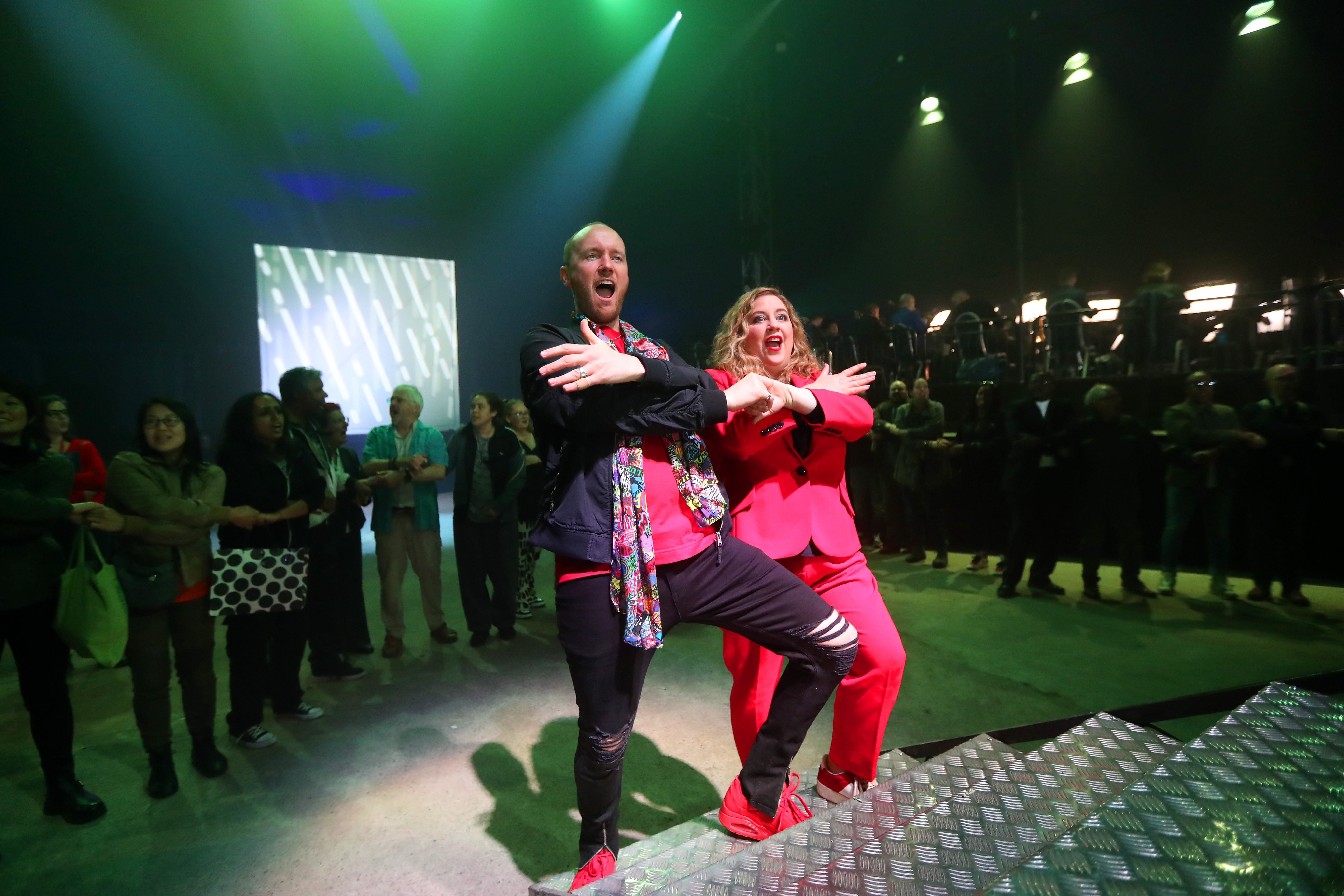
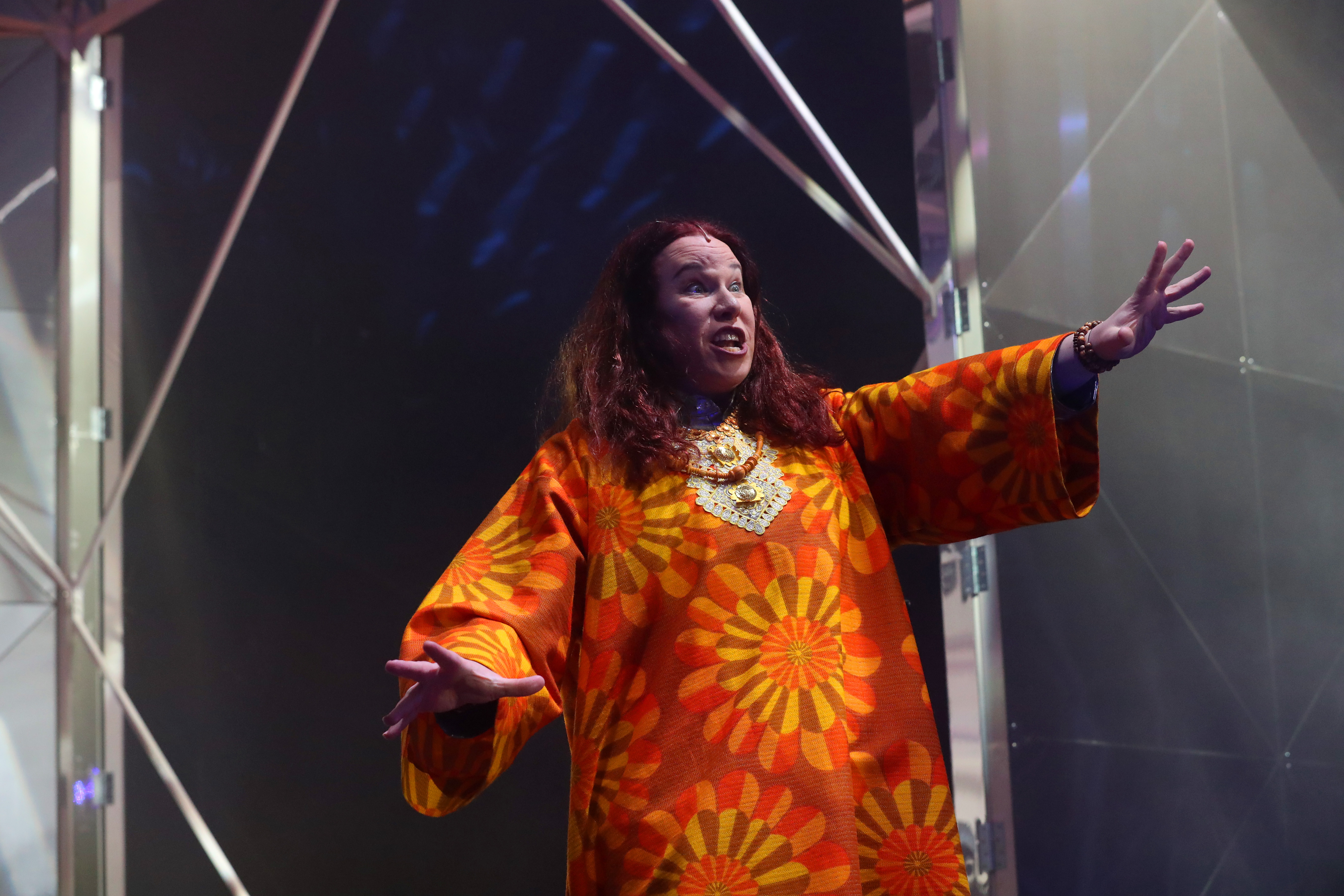
It was those other two main roles, however, that dominated proceedings. Sarah Pring gave a powerful while never inflexible portrayal of Nan, her innate fervency in contrast to the steely authority of Samantha Crawford (above) whose Regan approaches the human world with something between trepidation and disdain – not least in her confrontation with Donny, where Tippett’s would-be rap provoked some amusement. Splitting the role of Presenter worked effectively, Grace Durham and Oskar McCarthy (below) duly enhancing the stage-action with no little panache.

Not for the first time, BOC Chorus came into its own for what is among the most extensive and immediate of Tippett’s choral contributions to opera – the oft-favoured device of Greek Chorus afforded a visceral twist as it conveys the ominous and often violent attitudes of ‘the crowd’. That many of those involved have signed-up specifically for the occasion only adds to the rawness and physicality of its collective presence: something that the composer was at pains to capture, and which could not have been realized this directly in earlier productions.

Conducting the City of Birmingham Symphony Orchestra with typical discipline and energy, Alpesh Chauhan brought requisite vibrancy and clarity to Tippett’s writing. Less purposefully wrought than in his previous operas, there is no lack of subtlety or imagination – the frequent reliance on percussive sonorities to sustain the overall texture hardly an issue when so deftly realized as here. Is there a more moving passage in his output than the dance for Jo Ann and Pelegrin after their duet – Tippett’s musical past and present brought into disarming accord.

Playing for around 105 minutes, New Year is relatively expansive next to Tippett’s preceding two stage-works so that certain aspects of those outer acts do verge on diffuseness. That this hardly came to mind on the opening night was tribute to the conviction of those involved in seeking to reassess what this opera might be and, moreover, what it is there to do. Far from having run out of ideas, Tippett had a surfeit of these that he struggled to make cohere but in which he so nearly succeeded. Do see this engaging and enlightening production from BOC.

Further performances on 9, 10, 12 & 13 July – for more information head to the Birmingham Opera Company website

Published post no.2,233 – Monday 8 July 2024

In concert – Seong-Jin Cho, London Philharmonic Orchestra / Edward Gardner: Wagner, Beethoven & Tippett

Seong-Jin Cho (piano), London Philharmonic Orchestra / Edward Gardner

Wagner Parsifal – Prelude to Act One (1878)
Beethoven Piano Concerto no.4 in G major Op.58 (1805-6)
Tippett Symphony no. 2 (1956-7)

Symphony Hall, Birmingham
Wednesday 10 April 2024

Reviewed by Richard Whitehouse

Although the London Philharmonic Orchestra’s ongoing season might not have been among its most enterprising, this evening’s concert confirmed how Edward Gardner is influencing both this orchestra’s programmes and its approach to standard repertoire as well as modern classics.

Beginning with the Prelude from Wagner’s Parsifal is certainly playing for high stakes and, while it afforded no revelations, this performance seemed nothing if not aware of the piece’s searching grandeur where the placing of motifs and those silences between them is crucial to its overall cohesion. A pity, perhaps, that Gardner opted for the ‘concert ending’ in which the close of the first act is laminated onto what went before instead of merely allowing the music to remain in expectancy, but this detracted only slightly from the majesty of what was heard.

Beethoven’s Fourth Piano Concerto then provided a perfect foil, not least in a performance so attentive to the interplay between soloist and orchestra. It helped that Seong-Jin Cho, winner of the Chopin International Competition in 2015, had an innate feeling for that ‘give and take’ necessary in this most integrated of the cycle; his fastidious while never uninvolving pianism heard to advantage over an initial movement where gradual evolution was uppermost, though his take on Beethoven’s earlier and less capricious cadenza was not lacking virtuosity. He and Gardner were at one in conveying the elemental call-and-response of the Andante, a brief but profound entry into a final Rondo whose vivacity was judiciously balanced with a ruminative poise, where lower woodwinds and strings emerged at the fore prior to the exhilarating close.

Some 66 years following its problematic premiere (restarted after a collapse of ensemble just minutes in), Tippett’s Second Symphony now enjoys regular revival though it could hardly be said to play itself. A keen advocate of this composer (witness his acclaimed recording of The Midsummer Marriage), Gardner paced the opening Allegro unerringly – pointing up contrast between its vigorous and yielding themes, while securing the requisite impetus in its lengthy development then a surging energy in its coda. Punctuated by Paul Beniston’s superb trumpet playing, the Adagio was almost as fine even if a slower underlying tempo might have brought even more depth to some of Tippett’s most evocative and spellbinding music; not least during its central build-up in the strings to a climax whose stark curtailing feels more than prescient.

Reservations as such centred on the Presto – undeniably well articulated in terms of rhythmic precision, while lacking the swiftness or velocity for its obsessive interplay and its Dionysiac culmination really to hit home. By contrast, the final Allegro was far from the anti-climax it can seem. Gardner had its measure from the jazzy introduction, via an inventive sequence of variations then sensuously descending melody on strings against shimmering woodwinds, to those cumulative ‘gestures of farewell’ that ended this performance in ecstatic ambivalence.

If not definitive, this was certainly an absorbing and memorable account as will hopefully be made available on the LPO’s own label (the concert having been broadcast live on Radio 3): one that rounded off what proved to be a judiciously planned and finely executed programme.

Click on the link to read more on the current LPO concert season, and on the names for more on pianist Seong-Jin Cho, conductor Edward Gardner and a website devoted to composer Sir Michael Tippett. The LPO’s new recording of The Midsummer Marriage can be found here

Published post no.2,148 – Sunday 14 April 2024

In concert – Britten Sinfonia / Thomas Gould & Agata Zając @ Milton Court: Musical Everests – The Year 1953

Thomas Gould (violin/director), Miranda Dale (violin), Caroline Dearnley (cello), Britten Sinfonia / Agata Zając (Maconchy)

Corelli Concerto Grosso in F major Op.6/2 (publ. 1714)
Tippett Fantasia Concertante on a theme of Corelli (1953)
Maconchy Symphony for Double String Orchestra (1953)
Phibbs Flame and Shadow (2023)
Walton Finale from Variations on an Elizabethan Theme (1953)

Milton Court, London
Wednesday 24 May 2023

Reviewed by Ben Hogwood Pictures (c) Ben Hogwood

This typically imaginative concert devised by the Britten Sinfonia took as its starting point the events of 1953, where the United Kingdom shifted on its axis. It was of course the year in which Britain witnessed a Coronation, and in which Everest was scaled, but other than Walton’s jubilant finale to the collaborative composer project Variations on an Elizabethan Theme, no explicit musical links were made.

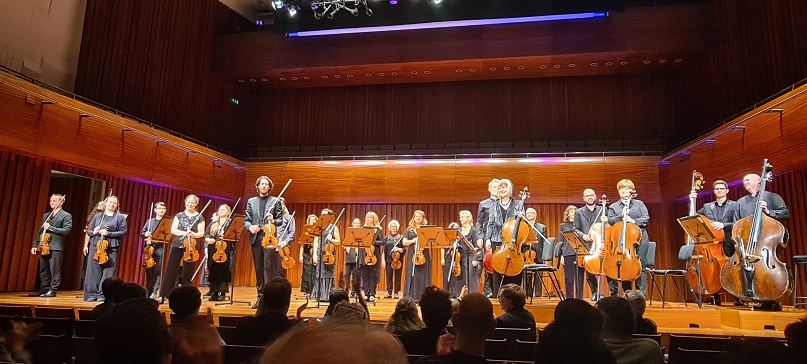
Instead, the Britten Sinfonia concentrated on two major works written for string orchestra in that year – one now well-known and one barely performed. The underdog, Elizabeth Maconchy’s Symphony for Double String Orchestra, made a very strong impression in this performance, brilliantly played by string players using a handwritten manuscript from 1953. The difficulty of this task necessitated a conductor, with Agata Zając joining at short notice. Hers was a dynamic presence, helping emphasise the rhythmic flair and dramatic impetus of the piece.

Maconchy’s music has often been critically coveted but is rarely heard in the concert hall – sadly an all-too familiar plight for a female composer innovating in the 20th century. Where many British composers wrote to include the countryside around them she wrote in a continental style, her music powered by fertile melodic imagination and rhythmic vitality. At times there are elements of Stravinsky and Bartók in her music but the closest parallel is Frank Bridge, with whom she shared an ability to explore the outer reaches of tonality without selling listeners short on melody.

The first movement of the Symphony grips the listener immediately, its powerful forward momentum complemented by soaring violin solos, which Thomas Gould played to perfection here. The febrile main motif bore close resemblance to Stravinsky’s Symphony in Three Movements, and Maconchy’s treatment of it was economical and engaging. Emotionally, however, the heart of the piece lay in the second movement Lento, where an eerie figure crept slowly upwards from cellos and basses, refusing to give way to the sweeter intimate melodies above. A rustic Scherzo, laden with syncopation, was followed by an equally captivating finale, initially pensive but with gathering intensity and drive. Just before the end the music broke out into a joyous country dance before returning to its more angular outlines.

The Britten Sinfonia were at the top of their game, subtly and superbly drilled by leader Gould. Each player was fully engaged, with smiles and nods of encouragement frequently passing between the team. When these qualities are natural, as they were here, a performance is elevated for the audience – and that was certainly the case for Corelli’s Concerto Grosso in F major, second in his set of twelve published as Op.6 in 1714. This opened the concert, dovetailing neatly into the work of Sir Michael Tippett, which it inspired.

Elegance and style were to the fore in the Corelli, with clean melodic lines given just a hint of vibrato for expression, and the interplay and balance between the three soloists and orchestra ideally judged. The work’s sunny countenance spilled over into the Tippett, though here the sun’s rays took on a more ecstatic quality.

The Fantasia Concertante on a theme of Corelli, also dating from 1953, is a compelling study in time travel. Tippett presents the original 18th century material unadorned, but adds his own unique musical language incrementally, so the piece becomes awash with bright colour and reaches a feverish intensity. Gould led a performance to savour, with fulsome support from fellow soloists Miranda Dale (violin) and Caroline Dearnley (cello). Together with the enhanced Sinfonia they rendered the golden textures beautifully, enhancing the elegance of the original material.

With the Tippett and Maconchy works a formidable pair either side of the interval, it says much for the London premiere of Joseph Phibbs’ new work that it was not in any way overshadowed. Though Flame and Shadow looked beyond events of 1953 for its stimulus it nonetheless bore a resemblance to the new coronation, its fresh take on music for strings revealing a busy contemporary approach.

Phibbs has an original and imaginative way with writing for strings, using audience-friendly melodic figurations but allowing them to roam harmonically, changing their perspective. The punchy rhythms of the Dance section here were a thrill, as were the combination of rapid fire and sustained open string pizzicato heard throughout the Interlude. Flame and Shadow, taking its title from a collection of verse by Sara Teasdale, was an edge of the seat piece, even to its closing Vocalise section, where a melody closely related to that found at the opening of Sibelius Symphony no.4 had a sobering effect. The contrasts of darkness and light were vivid and left a lasting impression – as indeed did the whole concert.

In twenty years of covering Britten Sinfonia concerts, and marvelling at their programming and technical prowess, this Milton Court evening confirmed their musical health to be stronger than ever. If only the same could be said for their long-term financial prospects, thrown into doubt by the withdrawal of funding in the latest Arts Council England cuts. Without the immediate publicity of similar actions levelled at English National Opera and the BBC Singers, the Britten Sinfonia have just launched their Play On fundraising campaign. The initial response has been encouraging, but it needs to raise more to secure the organisation’s future. Please do consider giving – I certainly will. This is the only way their imaginative concerts and a wealth of community-based outreach across East Anglia – where they are the only full time orchestra – can continue.

You can read all about future concerts from the ensemble at the Britten Sinfonia website. Click on the composer names to read more about Joseph Phibbs, Elizabeth Maconchy and Sir Michael Tippett – and for more details on concerts at the venue, visit the Milton Court website