
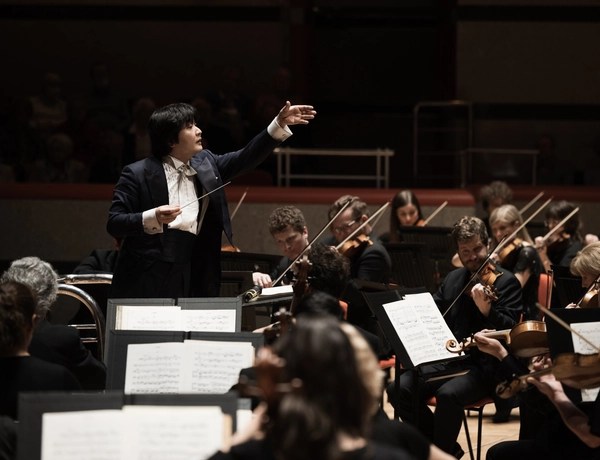
In concert – Marie-Christine Zupancic, Sebastian Heindl, CBSO / Kazuki Yamada: Saint-Saëns, Respighi, Takemitsu & Berlioz

Marie-Christine Zupancic (flute), Sebastian Heindl (organ), City of Birmingham Symphony Orchestra / Kazuki Yamada

Berlioz Le Corsaire Op.21 (1844)
Takemitsu I Hear the Water Dreaming (1987)
Respighi I Fontane di Roma P106 (1916)
Saint-Saëns Symphony no.3 in C minor Op.78 ‘Organ’ (1886)

Symphony Hall, Birmingham
Wednesday 4 June 2025

Reviewed by Richard Whitehouse Picture of Kazuki Yamada (c) Benjamin Ealovega

The dashing upsurge at the start of The Corsair launched this evening’s concert by the City of Birmingham Symphony Orchestra under its music director Kazuki Yamada in fine style. Nor was the pathos in this last of Berlioz’s concert overtures downplayed, and if the main portion lacked the pizzazz of illustrious predecessors, Yamada’s handling of the apotheosis proved an object-lesson in controlled spontaneity – setting the seal on a fine account of a piece that long -standing attendees will recall as a favourite of one-time principal conductor Louis Frémaux.

The music of Tōru Takemitsu was often heard in the era of Simon Rattle, but not I Hear the Water Dreaming. Taking its cue (along with other works of this period) from the ‘Dreamtime’ tradition of Aboriginal art, here a painting from the Papunya region of Western Australia, this short though eventful piece typifies its composer’s final creative phase – the formerly radical tendencies from previous years not so much disowned as finding an accommodation with the impressionist leanings of his earliest maturity. A sonic canvas, moreover, against which solo flute pursues its capricious course, with only a hint of something more confrontational either side of the cadenza-like passage towards its close. Certainly, this was music to which Marie-Christine Zupancic (taking time out as the CBSO’s first flute) sounded unerringly attuned.

CBSO regulars will recall Yamada presenting the whole of Respighi’s ‘Roman Triptych’ at a memorable concert four years ago. Tonight, Fountains of Rome rounded off the first half in a performance at its best in the effervescence of Triton at Morning or the dazzling majesty of Trevi at Midday, fading as if suspended in the Symphony Hall ambience. If Valle Giulia at Dawn felt a little passive in its allure, the enfolding serenity of Villa Medici at Sunset was fully sustained – the delicacy and suppleness of its entwining melodic lines accorded full rein.

The CBSO has been identified with Saint-Saëns’s Organ Symphony since Frémaux’s lauded recording of half-a-century ago, and it remains a work in which this orchestra excels. Yamada was (rightly) intent on stressing its symphonic cohesion, drawing ominous expectancy from the first part’s introduction and building no mean momentum in its ensuing Allegro. Sebastian Heindl’s hushed entry duly set the tone for a raptly eloquent slow movement, measured while never sluggish as it headed toward its heartfelt climax then on to a coda of bittersweet repose.

There was no lack of incisiveness or humour in the scherzo which opens the second part – its scintillating passagework for piano duet artfully integrated into the orchestral texture, with an ideally paced link into the finale with its indelible main melody and methodical build-up to a majestic peroration. Those thunderous initial chords aside, Heindl made less of an impact than might have been expected, but his always resourceful choice of registrations underlined the extent to which both he and Yamada continually had the ‘bigger picture’ uppermost in mind.

Overall, then, a concert which manifestly played to this orchestra’s collective strengths. The CBSO is back next week with its former music director Mirga Gražinytė-Tyla for what will be only a second UK performance, 63 years after the first, for Weinberg’s Fifth Symphony.

For details on the 2024-25 season A Season of Joy, head to the City of Birmingham Symphony Orchestra website. Click on the names to read more about soloists Marie-Christine Zupancic and Sebastian Heindl, and conductor Kazuki Yamada

Published post no.2,496 – Sunday 6 April 2025
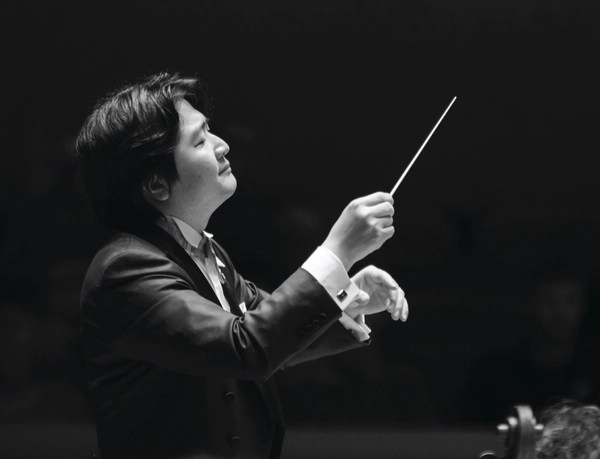
In concert – CBSO / Kazuki Yamada: Mahler Symphony no.9 & Takemitsu

City of Birmingham Symphony Orchestra / Kazuki Yamada (above)

Takemitsu Requiem (1957)
Mahler Symphony no.9 in D major (1908-09)

Symphony Hall, Birmingham
Thursday 10 April 2025

Reviewed by Richard Whitehouse Picture of Kazuki Yamada (c) Hannah Fathers

Ninth Symphonies have been a recurrent feature of this season from the City of Birmingham Symphony Orchestra and Kazuki Yamada. Tonight’s concert brought this to a culmination of sorts with that by Mahler and which naturally occupied almost the whole of the programme.

Whatever else, it was a performance whose scope matched the music’s ambition and not least in an opening Andante as lays claim to being its composer’s greatest achievement. Admittedly this took a few minutes to find focus, those initial bars not so much speculative as halting, but an overall sense of the movement unfolding seamlessly across its strategic peaks and troughs was undeniable, and Yamada was mindful to underline Mahler’s holding back of its expected culmination so the closing minutes mused eloquently if uncertainly on what might have been.

The middle movements can often emerge as incidental to the formal scheme, and Yamada’s take on the Ländler gave some pause for thought. Each of its constituents was vividly shaped and articulated, but a stop-start discontinuity arguably denied it that innocence to experience trajectory which, in turn, makes tangible the fatalistic humour at its end. The Rondo-Burleske was the undoubted highlight – its abrasiveness spilling over into violence towards the close, but not before Yamada had summoned the requisite anguish from its yearning trio section.

It might have been better to continue directly into the Adagio. As it was, a relatively lengthy pause left this finale sounding less a direct reaction to what had gone before than a delayed avoidance of the issues raised. Yamada’s overall handling of this movement was fine if not exceptionally so. Such as the twilit episode prior to the main climax was lucidity itself, but the conductor having already slowed to near-stasis then made it difficult to reduce the tempo further, so that the closing bars risked feeling emotionally gratuitous rather than inevitable.

What could hardly be gainsaid was the commitment of the CBSO’s response over what, for all its latter-day familiarity, remains a testing challenge whether individually or collectively. Wisely, Yamada has resisted any temptation to fashion a self-consciously virtuoso orchestra; emphasis seems to be instead on encouraging flexibility and sensitivity of response in terms of the music at hand – a more circumspect though productive approach which suggests he is happy to stay the course in terms of a partnership which is still in its relatively early stages.

Not a few performances of Mahler Nine opt for a scene-setting piece rather than first half as such. Yamada did so with Takemitsu’s Requiem – if not this composer’s first or even earliest acknowledged work, then certainly the one that established his wider reputation. The CBSO strings did justice to its subtle interplay of expressive threnody and more angular elements in a reading that fulfilled its purpose ideally. Hopefully the coming seasons will revive some of the more innovative pieces to have languished in the three decades since Takemitsu’s death.

This was the latest in what is becoming a tradition and rightly so – a page in the programme listing those ‘‘friends, members and colleagues’’ whom the CBSO Remembers with no little gratitude. From this perspective, tonight’s programme could hardly have been more fitting.

For details on the 2024-25 season A Season of Joy, head to the City of Birmingham Symphony Orchestra website. Click on the name to read more about conductor Kazuki Yamada

Published post no.2,502 – Monday 14 April 2025

In appreciation – Seiji Ozawa

by Ben Hogwood

Today we learned the sad news of the death of much-loved Japanese conductor Seiji Ozawa at the age of 88.

Among many other achievements Ozawa was the longest serving music director in the history of the Boston Symphony Orchestra, who he led from 1973 until 1992.

There is a comprehensive biography of Ozawa on the Decca Classics website, nearest to the label he called ‘home’ – which was Philips Classics from the Universal family. Ozawa made some very fine recordings in his career, and Arcana have picked a cross-section of personal favourites in the playlist below. Perhaps appropriately, the music selection begins with the Requiem for String Orchestra by Ozawa’s compatriot and contemporary, Toru Takemitsu, and includes an instalment from his pioneering Mahler cycle with the Boston Symphony Orchestra.

In concert – Sol Gabetta, NHK Symphony Orchestra Tokyo / Paavo Järvi: Takemitsu, Schumann & Rachmaninov

Sol Gabetta (cello), NHK Symphony Orchestra Tokyo / Paavo Järvi (above)

Royal Festival Hall, Southbank Centre, London
Monday 24 February 2020

Takemitsu How slow the wind (1991)
Schumann Cello Concerto in A minor Op.129 (1850)
Rachmaninov Symphony no.2 in E minor Op.27 (1906-07)

Reviewed by Ben Hogwood

This Royal Festival Hall concert offered the relatively rare chance to catch the NHK Symphony Orchestra, on a mini-tour from Tokyo in the company of their chief conductor, Paavo Järvi.

As he told Arcana in an interview the previous week, Järvi has been acquainting himself with the music of Toru Takemitsu in recent years, culminating in a recording of his orchestral works with the NHK. One of them, How slow the wind, was a descriptive and colourful way in which to open the concert, presenting a picture of relative calm.

One of Takemitsu’s best qualities is the descriptive power of his music, which is able to capture the elements in a subtle but meaningful way. Rain, earth and air are three you can expect to encounter with particularly vivid results, and the latter was to the fore in this intriguing symphonic poem. As the title suggests, it really was the slowed down movement of air, and was played with attention to detail and affection, painting a picture far away from the Southbank. The influence of Debussy, as outlined by Järvi, was clear, but so too were elements of Ravel and Messiaen, though the percussive colours in which Takemitsu dressed the piece were wholly his own.

Sol Gabetta then took charge of the Schumann Cello Concerto. Clearly this is a piece she loves, and it is gratifying in recent years to see the concerto come into the centre of the instrument’s repertoire. The first movement, dominated by a nagging theme that stays in your head for long after, was a dramatic affair, the cellist seizing the initiative but ensuring Järvi and the relatively small orchestral forces were with her every step of the way. Gabetta’s high register tone was probing, with unerring accuracy in her tuning.

When Schumann moves seamlessly into the slow movement it is like walking into a different, calmer room of the same house, but Gabetta ensured the links throughout were clearly signposted, and her duet with leader of the NHK cellos Ryoichi Fujimori was both sensitive and ideally balanced.

The finale found a bold approach from Gabetta capitalizing on Schumann’s innovative writing, with the written-out cadenza particularly strongly executed before a thoroughly affirmative end. Gabetta capped this with the inclusion of the first movement of VasksGramata cellam as an encore. Gabetta gave this at the first night of the BBC Proms in 2016 and it is no less startling heard once again with its vocalisation.

For the second half it was slow burning Rachmaninov, the NHK smoothly into their stride for the first movement of the Symphony no.2 in E minor. If the moody bass strings at the opening were slightly withdrawn, that gave Järvi plenty to work with as the music unfolded. With the faster tempo came an airy texture as though the sun was shining through outdoors. Once we had glimpsed the brightness it was hard not to let go of it, and the Scherzo, taken at a fastish tempo, glinted at the edges.

Järvi judged the famous Andante just right, indulging in the gorgeous textures but never overdoing it, so that Kei Ito’s clarinet was given the best possible platform to deliver a heartstopping solo. Yet it was in the excited whoops of the finale where this interpretation really delivered, the orchestra stepping up another gear as the music excitedly passed between the instrument groups, percussion adding a sheen to the wonderful wall of sound.

It being Estonian Independence Day, Järvi – while noting the amusement of celebrating the day in London with a Japanese orchestra – gave us a glimpse of summer through Heino Eller’s sunkissed Homeland Tune, from the 5 Pieces for Strings. It was a fitting end to a concert that helpfully reminded us of the approach of spring – and in the process told of classical music’s potential reach. A Japanese orchestra conducted by an Estonian with an Argentinian cellist. What’s not to like about that?!

Further listening

You can listen to a playlist of the programme performed by the NHK Symphony Orchestra and Paavo Järvi. It includes Gabetta’s recording of the Schumann, and leading recordings of the other repertoire (including encores):

For a very fine disc of Heino Eller’s music for string orchestra, this collection from the Tallinn Chamber Orchestra and Tonu Kaljuste on ECM is just the ticket:

Live review – CBSO Youth Orchestra / Kazuki Yamada: Elgar Symphony no.1, Takemitsu & Richard Strauss

CBSO Youth Orchestra / Kazuki Yamada (above)

Symphony Hall, Birmingham
Sunday 23 February 2020 (3pm)

Takemitsu Dreamtime (1981)
Richard Strauss Till Eulenspiegels lustige Streiche Op.28 (1894-5)
Elgar Symphony no.1 in A flat major Op.55 (1907-08)

Written by Richard Whitehouse

It is hardly an understatement to say that the concerts given each season by the CBSO Youth Orchestra are frequently among the most enterprising and engaging of all those to be heard in Symphony Hall, with this afternoon’s event under Kazuki Yamada proving no exception.

A contrasted pair of tone poems comprised the succinct first half, beginning with a welcome revival of Toru Takemitsu‘s Dreamtime. Conceived as a dance piece for Netherlands Dance Theatre, this is typical of the music from its composer’s maturity in its dissonant (but rarely abrasive) harmonies and its diaphanous textures. Both of these were fully in evidence, with Yamada also mindful to instill a sense of cumulative unfolding as ensures cohesion in music that can easily drift or lose focus. Suffice to add there was little sense of that happening here.

Takemitsu was not a composer given to the humour (ironic or otherwise) permeating Richard Strauss‘s Till Eulenspiegel, heard in an account that initially felt a little stolid in its depiction of that prankster from the Middle Ages; but which soon gained in conviction over the course of Till’s encounters monkish, amorous and social on the way to a vivid depiction of his trial and execution – with its irrepressible pay-off. Assured playing by woodwind and brass were the highlights of a reading to remind one of just how technically exacting this music remains.

112 years on from its premiere and Elgar‘s First Symphony exudes a very different if equally unequivocal virtuosity, such as happily held few fears for these musicians. Japan has a noted line of Elgar interpreters (not least the conductor Tadaaki Otaka), and Yamada demonstrated his credentials with a taut while never inflexible take on the lengthy opening movements – its indelible ‘motto’ theme eloquently and un-fussily rendered, then the main Allegro securing an almost ideal balance between anxiety and rumination across music which strives without ever regaining that calm assurance whose glimpses become the more affecting for their transience. No less impressive was Yamada’s handling of the coda as this winds down towards becalmed resignation, abetted by playing of exquisite finesse from the CBSOYO woodwind and strings.

There was little to fault in a scherzo that alternated the incisive and the wistful with unforced rightness, and how unerringly Yamada judged its transition into an Adagio that, less moulded than it often is, yet unfolding seamlessly towards its serene close. Not that there was anything bland or uninvolving about this music, or a finale that (rightly) followed with minimal pause; the barely suppressed expectancy of its introduction heading into an Allegro whose impetus hardly faltered. Strings never sounded fazed by the contrapuntal intricacy of its development, while brass came into their collective own during an apotheosis where the re-emergence of the motto theme evinced a triumph shorn of bombast or self-regard; the closing bars setting the seal on a performance of a maturity the more remarkable given the age of its exponents.

Elgar One has over the years come in for more than its fair share of objections to its supposed overtones of jingoism and self-gratification. That there was nothing of that here was tribute to Yamada in his drawing so ardent and insightful an interpretation from the CBSOYO players.