

Thibaut Garcia (guitar, above), Antoine Morinière (guitar)
Barrios La Catedral (1921) (1:38-8:39)
Tansman Inventions (Hommage à Bach) (1967) (9:47-20:23) , Pièce en forme de passacaille (1953) (20:57-26:14)
Bach arr. Garcia / Morinière Two-Part Inventions (c1720) (28:36-34:12) – nos. 7 (28:36), 8 (29:53),9 (31:10), & 10 (33:18)
Allemande from English Suite No.3 in G minor (before 1720) (34:49-38:02)
Bach. arr Garcia Chaconne from Partita No. 2 in D minor BWV1004 (1720) (40:06-53:36)
Wigmore Hall, London; Monday 29 October 2018
You can listen to the BBC Radio 3 broadcast by clicking here
Written by Ben Hogwood
One of the most endearing aspects of the music of Johann Sebastian Bach is its adaptability. It can be enjoyed on any instrument, a statement which rings true for only a few composers of his time. He did not write for the guitar directly, but in his lute writing and pieces for stringed instruments he often used melodies and figuration that transcribes effortlessly for the guitar. There is much to be found in this respect in the ‘easier’ keyboard pieces, several of which Thibaut Garcia and fellow guitarist Antoine Morinière played here.
This was a very well thought out program, picking up on composers for the guitar for whom J.S. Bach was a lasting influence. It began with Paraguayan composer Agustín Pío Barrios, a colourful composer whose music embraces the folk tunes of his country but is also in thrall to Bach. La Catedral, a three part homage, was beautifully played here (from 1:38 on the broadcast). In three sections, it set out a mood of affected nostalgia in the first, Preludio Saudade, before the Andante religioso (3:54) took on a processional mood. Finally Allegro Solemne (5:54) gained more momentum but was still carefully studied by Thibaut.
Polish composer Alexandre Tansman’s affectionate tribute of five brief Inventions began with a stately Passepied (9:47), moving on to an emotive Sarabande in the minor key (11:57), a Sicilienne with a nice lilt (14:17), a more lively Toccata (16:00), and then an introspective Aria (17:28). Capping this was a stand-alone Passacaille of impressive stature, given over an ever-present chord sequence.
The Bach inventions (28:36), transcribed into more ‘guitar friendly’ keys, worked well and became a very personal dialogue between two friends. It was as though one guitarist had taken the right hand part and the other the left hand, and were exchanging Bach’s ideas freely. It worked very nicely in the Wigmore acoustic, whether in the perky inventions (8 and 10) where the melodies passed seamlessly, or in the slower ones where the slightly different phrasing of each guitarist lent a nice personal touch.
The Allemande from the English Suite no.3 (34:49) was a graceful dance that became an intimate call and response, the parts originally written for both hands transferring nicely to the two guitars.
Arranging the Chaconne (40:06) for guitar is an impressive feat indeed – still more because Garcia managed to make it less about display (which many artists do) and more about emotional content. The single lines had a deep profundity, but when the virtuoso lines really did get going (from around 43:30) they were key to the overall impact as well as providing a dazzling technical display. Some of the weight of the piece is lost in transcription as far as sheer volume is concerned, but Garcia more than made up for this in a studied and brilliantly played account. There was a lovely transformation into the major key at 46:55, before returning to the sterner confines of the minor key again for the end.
Garcia’s brief encore (57:33-59:28) made excellent use of the harmonics. As you will hear on the broadcast in his amusing story, it is the Catalan folksong El testament de n’Amèlia (Amèlia’s Will), arranged by Miguel Llobet.
Further listening
You can track the repertoire used in this concert via the following Spotify playlist:
Meanwhile Thibaut Garcia’s new disc, Bach Inspirations, contains much of the music heard here, and is out now on Warner Classics:
Bach’s lute music transfers very well for guitar, as this album by the great guitarist Julian Bream demonstrates:


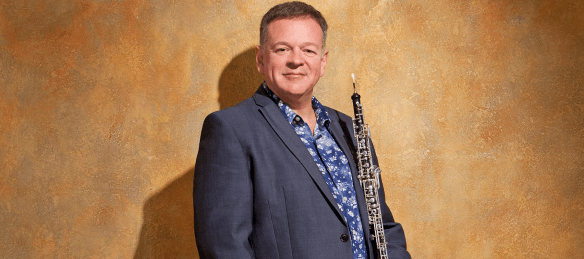
 For his comedic piece The Bearded Lady, commissioned by Daniel and based on a scene in Stravinsky’s Rake’s Progress, Julian Anderson used the extremities of the range of both instruments, the oboe jumping and swooping between high and low pitches, before we heard a tumbling figure down the piano. Then both instruments descended together, and while the piano hammered away at the low register Daniel left the stage. This was all part of the theatre, for soon we heard in the distance the mournful tones of the cor anglais (30:31), The Bearded Lady lamenting her fate at the end of an entertaining piece.
 In the right performance Mahler’s Rückert Lieder can present an unforgettable concert experience, which was exactly the case here. The flowing, outdoorsy Ich atmet einen linden Duft (I breathed a gentle fragrance) (32:59) had the ideal weight and pitch, delighting in its floral subject, while Blicke mir nicht in die Lieder! (35:24) found the subtle humour comparing the privacy of bees and songwriters! The ‘dying’ phrases of Liebst du um Schönheit (If you love for beauty) (36:43) were really well done, turning inwards, Morison’s voice again an instrument of beauty, while the famous Um Mitternacht (39:21) cast its spell through descriptive piano playing and expressive singing in Morison’s gorgeous lower register sound, the song’s pain vividly conveyed. Finally Ich bin der Welt abhanden gekommen (I am lost to the world) (45:35) reduced the audience to silence and reflection on how remarkable it was that two young interpreters of this song could bring so much insight.
 Arcana.fm